Nicholas Dwork

4.2K posts

Nicholas Dwork banner
Nicholas Dwork

Nicholas Dwork

@ndwork

Asst. Prof at CU Anschutz; PhD in EE; Republican. Work: Biomedical imaging. Hobby: macroecon based investing. All opinions are my own.

Katılım Şubat 2009
590 Takip Edilen636 Takipçiler
Nikita Lisitsa
Nikita Lisitsa@lisyarus·
So I asked students what language/platform they'd want to learn real-time graphics in, and the result was roughly 40% C++ 40% Rust 20% Zig Didn't know Zig was so popular! Also interesting that they don't seem to care about Web at all.
English
65
6
601
34.9K
Aria Churchill
Aria Churchill@Aria_Churchill·
@BignaultJon @sourceryy @friedberg I don't see how distinguishing between the state and the people that live in the state does anything for any side of the argument here. In fact, I'm not sure what is the argument you are trying to make.
San Francisco, CA 🇺🇸 English
2
0
0
122
sourcery
sourcery@sourceryy·
.@friedberg says "California is functionally bankrupt": "People don't realize how screwed California is. I worry that if California falls, so does the union." "We're $250 billion to $1 trillion short." "If it was the federal government, they would just print more money. California doesn't have the ability to print money, so California has to pay this out, and you can't restructure retirement benefits." "There's a Supreme Court case in California that said once an employee has been offered retirement benefits, even if they're currently an employee, you can never restructure their retirement benefits. It has to stay forever." "And the state cannot declare bankruptcy. There's no way for the state to functionally declare bankruptcy. There's no law to allow it." "No state has ever declared bankruptcy, and the the retirement benefits sit senior to the bonds in California. So you have to pay out the retirement benefits before you pay out all the bond holders that have loaned California the money that they use to run all their programs and services." " This isn't about taxes and Billionaire Tax Act. I don't think you can tax your way out of this problem. People will just leave the state." "California's functional bankruptcy is a major risk to the country and we need to figure out what we can change to fix it." At the @HillValleyForum 2026
English
197
557
2.6K
277.9K
Aria Churchill
Aria Churchill@Aria_Churchill·
The part I don’t understand is why red states would have grounds to complain. Red states don’t dominate net contributions to the federal budget. If anything, much of the money used to “bail out California” would come from Californians themselves and other blue states The idea that red states would be bailing out California doesn’t seem to match the data
Aria Churchill tweet media
English
21
1
16
2.2K
Nicholas Dwork
Nicholas Dwork@ndwork·
@adcock_brett Robots dancing and walking are useless. We're all awaiting the videos of robots doing something useful. Until then, it's all hype.
English
0
0
0
130
Brett Adcock
Brett Adcock@adcock_brett·
F.03 can now walk up/down stairs purely using it's onboard camera perception Our robots now walk from manufacturing when built to HQ This is trained end-to-end with reinforcement learning in simulation
English
83
127
1.9K
164.5K
Swapna Kumar Panda
Swapna Kumar Panda@swapnakpanda·
You will be a WORLD-CLASS SOFTWARE ENGINEER once you read these 20 books:
English
28
218
1.5K
172.4K
Nicholas Dwork
Nicholas Dwork@ndwork·
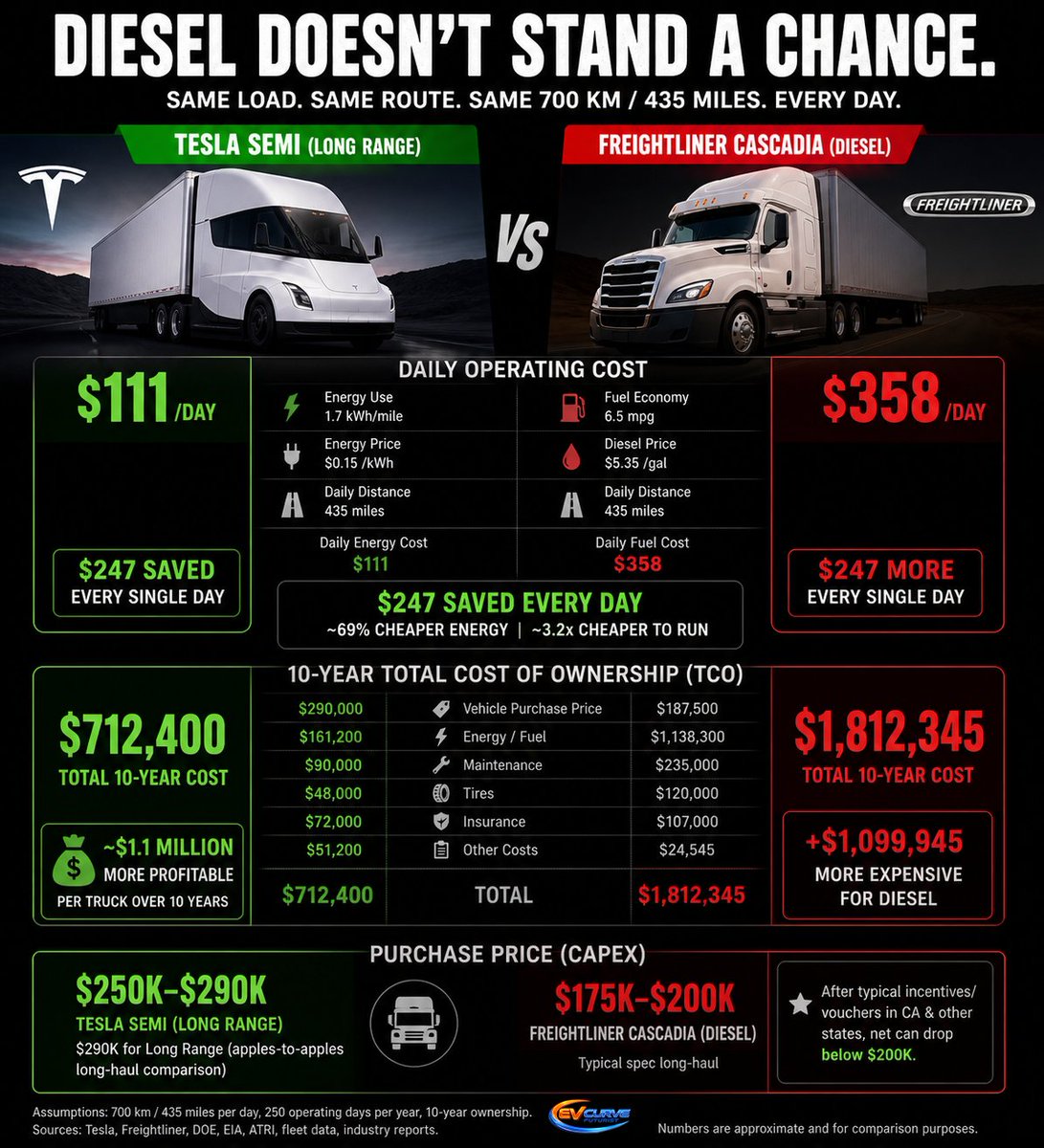
@EVCurveFuturist Tires may (or may not) be exhausted faster with the electric truck. (They certainly are on a car.) Brakes will not need to be replaced nearly as often since the truck will use regenerative breaking on downhill. Making downhill an asset is a huge advantage for the Tesla truck.
English
0
0
0
27
Chris Meder
Chris Meder@EVCurveFuturist·
DIESEL DOESN’T STAND A CHANCE. Tesla Semi high-volume production started April 29, 2026. Same load. Same route. Same 700 km / 435 miles. Every day. Tesla Semi → $111/day Freightliner Cascadia → $358/day → $247 saved. Every single day. → ~69% cheaper energy → ~3.2x cheaper to run 10-year TCO: Tesla Semi → $712,400 Diesel → $1,812,345 → ~$1.1M more profitable per truck The math is bulletproof. Every day you wait costs you $247. Fleet owners… your move. #TeslaSemi #ElectricTruck #Bettrification #EV
Chris Meder tweet media
English
108
418
1.5K
85.4K
aka
aka@akafaceUS·
I actually smiled while watching this. This was satisfying.
English
12
39
1.4K
186.8K
Nicholas Dwork
Nicholas Dwork@ndwork·
@BasedMikeLee Red states and the republican controlled Federal government are comparable in the amount they take. Why does the government take at least 40% no matter where I live?
English
0
0
0
4
Aakash Gupta
Aakash Gupta@aakashgupta·
68 college students played video games an hour a day for 30 weeks. They got measurably smarter. EEG brain scans confirmed it. The setup was simple. Half the group played League of Legends, an action game. The other half played Legends of the Three Kingdoms, a strategy card game. Same hours, same schedule, no gaming experience for anyone going in. Both groups improved on attention, working memory, and executive function. The League group's gains were significantly larger in spatial attention and spatial working memory. The benefits were still measurable 10 weeks after the gaming stopped. None of this is new. Daphne Bavelier's lab at the University of Geneva has been replicating this finding since the early 2000s. Her 2018 meta-analysis in Psychological Bulletin pulled data from 8,970 participants across 15 years and found the same thing. Action games train attentional control, a brain skill that transfers to other tasks. Strategy games train deliberation, which mostly stays inside the strategy game. The mechanism is the counterintuitive part. Action games train your brain by giving you no time to think. The brain can't deliberate. League of Legends throws 9 champions, hundreds of minions, dozens of abilities, mana, cooldowns, and map state at you, all updating in milliseconds. The brain learns to perceive faster instead. That perceptual speed transfers to anything else that demands the same skill. Including surgery. The 2007 Rosser study in Archives of Surgery found that laparoscopic surgeons who played video games more than 3 hours a week made 37% fewer errors, completed procedures 27% faster, and scored 42% higher on overall performance. The top third of gamers made 47% fewer errors. Laparoscopic surgery is a 2D screen with distorted depth perception, remote-controlled instruments, and multiple data streams updating in real time. The cognitive profile is almost identical to an action video game. The 10-week persistence is the part that should change how this gets discussed. If the gains were just from practicing the game, they would have disappeared the moment the students stopped playing. They didn't. The 30 weeks rewired the perceptual system, and the rewiring stayed.
Aakash Gupta tweet media
English
177
644
4.9K
1.4M
Shay Boloor
Shay Boloor@StockSavvyShay·
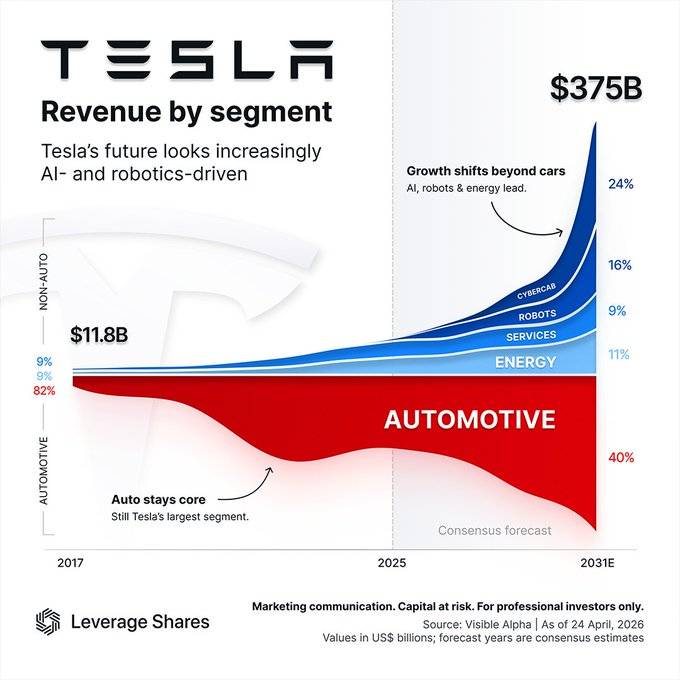
$TSLA is positioning to be the largest physical AI deployment platform by the end of this decade. By 2031, Tesla could become a $375B revenue story where AI, robots, services, energy & Cybercab together become larger than automotive: • Automotive 40% • Cybercab 24% • Robots 16% • Energy 11% • Services 9%
Shay Boloor tweet media
English
162
411
2.2K
155.7K
Nicholas Dwork
Nicholas Dwork@ndwork·
The more relevant metric is murders + attempted murders. Due to improvements in healthcare technologies, many victims of attempted murders who would have died in the past now survive.
Austin Justice@AustinJustice

"Blue cities are radical hellscapes that can't fix crime." Counterpoint: Baltimore. Baltimore had 334 murders in 2022. Last year it had 133, the lowest since 1977. The turning point was that voters defenestrated a Soros-backed prosecutor Marilyn Mosby who averaged 333 homicides a year across eight years and declined to use mandatory minimum sentences. (She was later convicted of mortgage fraud, so there's that too.) Her replacement, Ivan Bates, ran on the Democratic ticket with a simple message: repeat violent offenders belong in prison. Maryland law already allowed five years with no parole for convicted felons caught carrying a gun, but Mosby never used it. Bates used it a lot. In just two years, his office sent more than 2K repeat violent offenders to prison, double his predecessor's TOTAL. The city paired that with a precision intervention program that identified the small number of people driving most of the violence, which led to 631 arrests (94% haven't reoffended). Police also seized 2,480 firearms last year alone, including hundreds of ghost guns, while maintaining a 64% homicide clearance rate. When shooters know they'll get caught and actually prosecuted, behavior changes. Sandtown-Winchester, once the most violent neighborhoods in the city, just went a year without a killing! Carjackings (-51%) and robberies (-24%) are also down. Baltimore didn't change demographics, or its culture, its rules, or much of anything else in those years. It simply voted in a new Democratic prosecutor, who decided the city needed to finally put violent criminals in prison.

English
0
0
1
32
Thierry from arvy 🇨🇭
Thierry from arvy 🇨🇭@ThierryBorgeat·
10 numbers every investor should know by heart: 6.9% Real annualised return of stocks over 200 years. After inflation. 72 Divide by your return rate = years to double your money. At 8%: 9 years. At 12%: 6 years. 40% Of your total long-term stock return comes from reinvested dividends. Spend them instead and you burn 40% of your compounding engine. 2% Average annual inflation. Over 30 years it cuts your cash’s purchasing power in half. Over 50 years it destroys 73% of it. 10 The number of best trading days per year. Miss them over 20 years and you lose half your returns. Most fell during bear markets. 0.98 Correlation between S&P 500 and earnings growth over 30 years. In the short term, sentiment rules. In the long term, fundamentals always win. 4% Safe withdrawal rate in retirement. Historically lasts 30+ years without running out. −14% Average intra-year drawdown of the S&P 500. Every year. Normal. Expected. Ignore it. +36.4% Average S&P 500 return in the 12 months after a midterm election year bottom. The most reliable seasonal pattern in markets. 100% Percentage of 20-year rolling periods that delivered positive real returns. Every single one. In 150 years of data. Save these. They are worth more than most financial advice you will ever pay for.
English
18
134
928
108.2K
Nicholas Dwork
Nicholas Dwork@ndwork·
It’s interesting that Andrew Wiles and Yitan Zhang, two of the most successful pure mathematicians, acted contrary to Hamming suggestions. Both worked in isolation.
Ihtesham Ali@ihtesham2005

A mathematician who shared an office with Claude Shannon at Bell Labs gave one lecture in 1986 that explains why some people win Nobel Prizes and other equally smart people spend their whole lives doing forgettable work. His name was Richard Hamming. He won the Turing Award. He invented error-correcting codes that made modern computing possible. And he spent 30 years at Bell Labs sitting in a cafeteria at lunch watching which scientists became legendary and which ones faded into nothing. In March 1986, he walked into a Bellcore auditorium in front of 200 researchers and told them exactly what he had seen. Here's the framework that has been quoted by every serious scientist for the last 40 years. His opening line landed like a punch. He said most scientists he worked with at Bell Labs were just as smart as the Nobel Prize winners. Just as hardworking. Just as credentialed. And yet at the end of a 40-year career, one group had changed entire fields and the other group was forgotten by the time they retired. He wanted to know what the difference actually was. And he said it wasn't luck. It wasn't IQ. It was a specific set of habits that almost nobody is willing to follow. The first habit was the one that hurts the most to hear. He said most scientists deliberately avoid the most important problem in their field because the odds of failure are too high. They pick a safe adjacent problem, solve it cleanly, publish it, and move on. And because they never swing at the hard problem, they never hit it. He said if you do not work on an important problem, it is unlikely you will do important work. That is not a motivational line. That is a logical one. The second habit was about doors. Literal doors. He noticed that the scientists at Bell Labs who kept their office doors closed got more done in the short term because they had no interruptions. But the scientists who kept their doors open got more done over a career. The open-door scientists were interrupted constantly. They also absorbed every new idea passing through the hallway. Ten years in, they were working on problems the closed-door scientists did not even know existed. The third habit was inversion. When Bell Labs refused to give him the team of programmers he wanted, Hamming sat with the rejection for weeks. Then he flipped the question. Instead of asking for programmers to write the programs, he asked why machines could not write the programs themselves. That single inversion pushed him into the frontier of computer science. He said the pattern repeats everywhere. What looks like a defect, if you flip it correctly, becomes the exact thing that pushes you ahead of everyone else. The fourth habit was the one that hit me the hardest. He said knowledge and productivity compound like interest. Someone who works 10 percent harder than you does not produce 10 percent more over a career. They produce twice as much. The gap doesn't add. It multiplies. And it compounds silently for years before anyone notices. He finished the lecture with a line I have never been able to shake. He said Pasteur's famous quote is right. Luck favors the prepared mind. But he meant it literally. You don't hope for luck. You engineer the conditions where luck can land on you. Open doors. Important problems. Inverted questions. Compounded hours. Those are not traits. Those are choices you make every single day. The transcript has been sitting on the University of Virginia's computer science website for almost 30 years. The video is free on YouTube. Stripe Press reprinted the full lectures as a book in 2020 and Bret Victor wrote the foreword. Hamming died in 1998. He gave his final lecture a few weeks before. He was 82. The lecture that explains why some careers become legendary and others disappear is still free. Most people who could benefit from it will never open it.

English
0
0
3
62
Massimo
Massimo@Rainmaker1973·
Soft inflatable silicone earplugs
English
60
179
2.4K
833.9K
Nicholas Dwork retweetledi
G-PA
G-PA@IndianaGPA·
There's something oddly beautiful about how men who have never met will silently unite when a problem appears. No introductions, no small talk-just a shared understanding that something needs fixing. 😃
English
463
1.9K
21.3K
530.5K
Nicholas Dwork
Nicholas Dwork@ndwork·
@MTSlive Is their product getting better? Or does Apple Silicon still significantly outperform an Intel processor?
English
0
0
0
95
MTS
MTS@MTSlive·
SITUATION DETECTED: Intel Corp ($INTC) is up 16% after hours after reporting far higher than expected earnings. After 26 years, Intel has exceeded its all time high of $74.88 a share.
MTS tweet media
English
4
10
239
25.2K