Sumit (taxpayer)
7.1K posts

Sabitlenmiş Tweet
Sumit (taxpayer) retweetledi

Absolutely!! The Gymkhana club should pay market rent. And it is also time that ministers and high officials occupying huge bungalows in the neighbourhood also pay market rents. Why should taxpayers pay for them?
Avinash Shishoo@laidback1954
Leave the 'national security threat' to the experts . Why should a private club be subsidised ? Will the club exist if it is charged rent at market rates ? Let the club buy land at market rates anywhere and continue to function .
English
Sumit (taxpayer) retweetledi

Jumaben Marwadi's husband Kalaji had a life insurance policy with HDFC Life.
HDFC Life — the flagship insurance arm of India's largest private bank. A company that runs full-page ads about protecting your family.
When Kalaji died, Jumaben filed the claim.
HDFC Life's answer: rejected.
Their reason: he had visited a doctor once, years before the policy. They called it suppression of material facts.
The sum assured: ₹25 lakh.
This is how claim repudiation works in India.
The company collects premiums for years without questioning anything.
The moment a claim comes — after a death, after a trauma, after a family is already broken — they send investigators. They pull hospital records. They look for any prescription, any visit, any entry in a register.
And then they find one. And they say: you lied.
The "evidence" HDFC Life produced was a single prescription dated January 17, 2012, from one Dr. Ramesh M. Vakharia.
One prescription. Years old. No diagnosis of a serious, life-altering disease. No pattern. No treatment history.
On the basis of this, they told a widow: your husband concealed facts. We owe you nothing.
Jumaben took them to the NCDRC.
The Commission looked at what HDFC Life actually had. One prescription. That's it.
The NCDRC ruled that the insurer had failed to prove any suppression of material facts by the deceased policyholder Kalaji Bhikhaji Marwadi, and that the repudiation of Jumaben Kalaji Marwadi's claim amounted to deficiency in service.
The Commission cited the Supreme Court's own ruling in LIC vs. GM Channabasamma (1991):
"Suppression of material facts with respect to pre-existing ailments entitles the insurance company to repudiate the claim, but the onus to prove suppression of such material facts lies on the Insurance Company."
HDFC Life had not met that burden. A single, old prescription is not proof. It is a fishing expedition.
HDFC Life was directed to pay ₹25 lakh — the full sum assured — along with compensation and litigation costs.
This is a company that managed ₹2.5+ lakh crore in assets at the time of this case.
They had every resource to verify his health at the time of policy issuance. They chose to collect premiums instead. And investigate only after the death.
One policy. One prescription. One widow who made them prove it in court.
Save this —
If a life insurer rejects your family's death claim citing "non-disclosure," demand: what exactly did they suppress? Show the medical evidence.
The burden of proof is on the insurance company — not on your grieving family. Indian courts have said this, repeatedly, at the highest level.
Source: Jumaben Kalaji Marwadi vs. HDFC Standard Life Insurance Company, NCDRC — reported by Moneylife
English
Sumit (taxpayer) retweetledi

Anil Kumar Patel was from Kheda, Gujarat.
He had nine life insurance policies with LIC — India's largest insurer, a company owned by the Government of India, backed by a sovereign guarantee and decades of public trust. Total claim denied: ₹47.90 lakh.
He died of a heart attack, roughly two years after taking the policies.
His family filed claims on all nine.
LIC rejected every single one.
LIC's argument: Anil Kumar Patel had not disclosed material facts at the time of policy issuance.
The Life Insurance Corporation of India had provided nine life insurance policies to Anil Kumar Patel, a native of Kheda, Gujarat. After Mr. Patel passed away, his heirs properly submitted claims for each of the policies. LIC denied all claims on the ground that material facts had been suppressed.
Nine policies. Nine rejections. One family.
The family went to the District Consumer Forum in Kheda.
The District Forum partially ruled in their favour.
LIC wasn't satisfied. They appealed to the Gujarat State Consumer Disputes Redressal Commission.
The State Commission upheld the original ruling.
LIC still wasn't satisfied. They went to the NCDRC — the apex consumer court.
At the NCDRC, LIC made a technical argument: the family should have produced an affidavit from the treating physician to prove there was no suppression.
The Commission dismissed this.
The NCDRC stated that an affidavit from the physician is not required when the insured party has given the insurance company permission to obtain medical records from hospitals.
LIC had the authorisation. They had the means. They chose not to verify at the time of issuance.
The NCDRC bench comprising Inder Jit Singh (Presiding Member) dismissed LIC's appeal and ordered it to pay ₹47.90 lakh to the nominees of the complainant.
Three levels of consumer courts. Three rulings against LIC.
The country's largest insurer — with over 1 lakh employees and crores in annual advertising budget — fought a family from Kheda, Gujarat all the way to the apex consumer court.
And lost. At every stage.
There is a pattern worth naming here.
LIC collects premiums. Issues policies. Takes authorisations to access medical records. And then — only after a death — decides to investigate whether facts were suppressed.
The courts have a word for this: deficiency in service.
One family from Kheda. Nine policies. Three courts. Zero justice from LIC — until a judge said enough.
Save this —
If LIC or any insurer rejects a death claim citing "non-disclosure," check: did they actually investigate before issuing the policy?
If they had authorisation to pull medical records and chose not to — courts have ruled they cannot use that same gap against your family years later. The right to investigate belongs to them at issuance, not at death.
Source: Life Insurance Corporation of India vs. Dr. Nilam Hetalkumar Patel & 4 Ors., NCDRC, October 2023 — reported by LiveLaw
English
Sumit (taxpayer) retweetledi

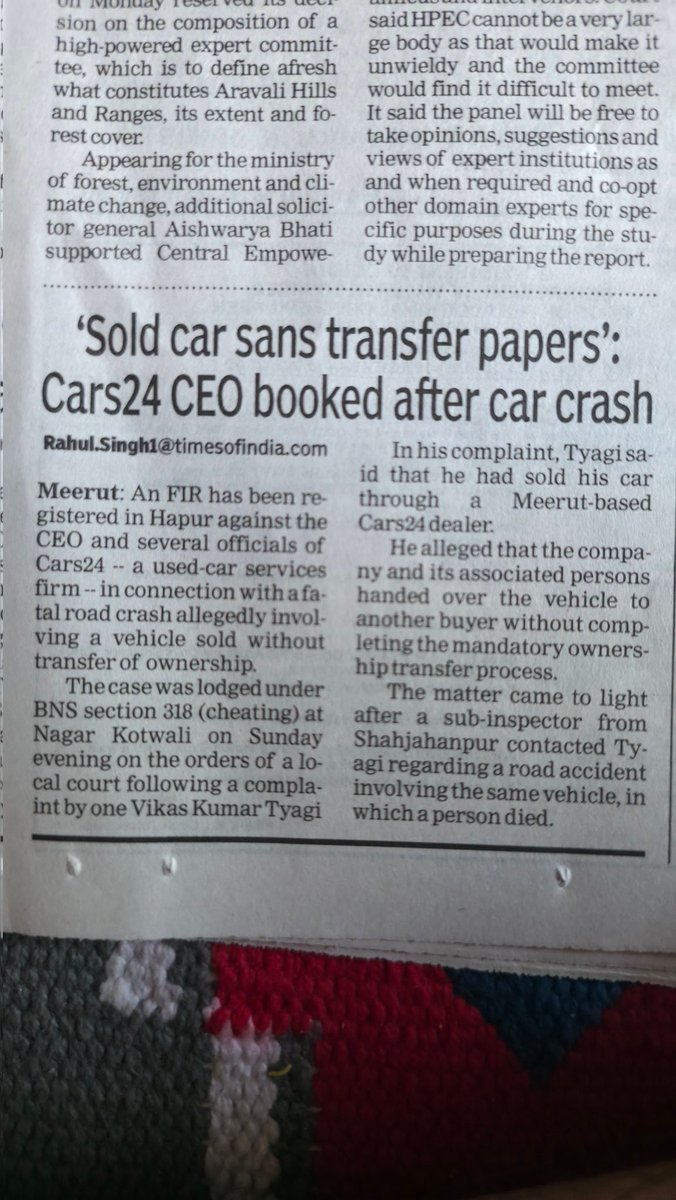
Wah wah @cars24india.
It seemed you transferred the car to new owner under your 1 year return scheme..🤣🤣.
#cars24

English
Sumit (taxpayer) retweetledi

Big Breaking in
VAT on Petrol in Telangana 35%
VAT on Petrol in Karnataka 29%
Rahul Gandhi decided that 35% and 29% Extra VAT abolished in Karnataka and Telangana
Old price in Telangana 116
New price 75.5
Old price in Karnataka 108
New price 76
To avail this offer
Public must go to petrol pump and say Rahul Gandhi chutiya hai!! 😹🤣🤣
English
Sumit (taxpayer) retweetledi

This is wild. India has 200 billionaires. India also has 350 million people going to bed hungry. The billionaires didn't earn their wealth in spite of that poverty. They earned it because of it — cheap labor, captured regulators, rigged contracts. Still calling it a free market? #IndiaInequality
English

@TusshKapoor The days without smart mobiles and social media..just wow!!!
English

“Mujhe Kuch Kehna Hai…” ❤️
25 years ago, on 25th May, my journey began with a film that gave me not just a debut, but a lifetime of memories.
Honestly, today, when I look back at how time has flown by it feels unreal. So much has changed over the years, but the love I’ve received from all of you has remained constant through every phase.
I’m truly grateful to everyone who has been a part of this journey, my directors, co-actors, teams, friends, family, and, especially, the audience who accepted me and gave me so much love over these past 25 years.
Thank you for growing with me. 🤍🎬 #25yearsofMujheKucchKehnaHai


English
Sumit (taxpayer) retweetledi

This is wild. 75% of under-trials in Indian jails haven't been convicted of anything. They're just poor and couldn't afford bail. Rich people get anticipatory bail. Poor people rot for years waiting for a trial date. This is not a legal system. It's a wealth-sorting mechanism. #IndianJustice
English
Sumit (taxpayer) retweetledi

90% of the startups you see around you daily : Zomato, Swiggy, Zepto, Blinkit, Urban Company — are built on cheap labor in an overpopulated country where millions of people are struggling to survive and feed their families.
These companies understood one thing early: if a person has a bike and desperation, they can be turned into a delivery machine.
Yes, these apps make life convenient for the middle class and upper class, which is why many people defend them by saying, “At least they are giving jobs.”
But what kind of job is this?
₹25 for a ride, including fuel and bike maintenance, while riding for 30 minutes in 45-degree heat.
Most workers get trapped in an endless cycle of completing order targets just to unlock ₹300–400 incentives. The system keeps them so busy surviving day to day that many don’t even get the time or energy to think about getting out of it.
English

Actually true..go to any mall or restaurants and you find more Indians (mostly down South) in Bay area..doesn't feel like US of 20 years ago.
Vineeth K@DealsDhamaka
My neighbour who moved to SF said that he sees more Indians in the bay area than in India 🤣🤣🤣

English
Sumit (taxpayer) retweetledi

I remember in childhood, dinner outings meant happiness without planning.
No table bookings.
No 90 minute waiting.
No 500 mocktails.
No pressure to click pictures.
Families actually talked to each other while eating.
Now half the restaurant is busy filming food, the other half is rushing for the next booking slot.
We upgraded restaurants, but somehow lost the feeling.
English

@Panks_Arora Anyone buying under construction property is commiting suicide on that money..
English

A relative invested 25 lakh in a “pre-launch” real estate project in 2021.
Builder promised possession in 3 years, rental income & huge appreciation.
Today, it’s still an empty plot with a broken boundary wall.
No construction. No returns. No updates.
Meanwhile, the same money in mutual funds or REITs would’ve quietly grown without stress.
Indian real estate sells dreams with brochures and sample flats, then traps people for years with zero liquidity and endless excuses.
English

If you are around 30 35 years of age, Male, and Professional then :
1. Housing is unaffordable with prices in crores
2. Land is unaffordable with Prices in Crores
3. Buying a Vehicle is risky with No Clarity on their Maintainence
4. 10 gm Gold = Rs 1.5 Lacs
5. Cylinder has 40 days Waiting
6. Fuel is >>Rs 100 per litre
7. Shrinking Job Oppurtunities
8. Most Govt jobs are now Contractual
How to fulfill Responsibilities while also fulfilling self Ambition?
Thats the question #india #economy
English

We need to get an idea or context of what we are trying to do.
Lot of people put enormous efforts on content creation in Youtube and Instagram.
But in our country, only around 75,000 content creators make a monthly revenue of Rs.1 lakh or more.
Money doesn't come easy. The earners in every sphere is less. It's a brutal world.
English

Builders and banks sell you a dream. What you get is a dysfynctional version of urban utopia.
Pankaj Arora 🇮🇳@Panks_Arora
Bought a flat for 1.5 Cr. Still paying 8,000 monthly maintenance. Extra charges for parking, clubhouse, generator, move-in pass & even pets. Builder promised luxury living. Reality: leaking walls, traffic noise & power cuts. Society gate looks like a 5 star hotel. Inside, residents still fight daily for water tankers. This isn’t premium housing. It’s EMI slavery with fancy brochures.
English
Sumit (taxpayer) retweetledi

Bought a flat for 1.5 Cr.
Still paying 8,000 monthly maintenance.
Extra charges for parking, clubhouse, generator, move-in pass & even pets.
Builder promised luxury living.
Reality: leaking walls, traffic noise & power cuts.
Society gate looks like a 5 star hotel.
Inside, residents still fight daily for water tankers.
This isn’t premium housing.
It’s EMI slavery with fancy brochures.

English

@dmuthuk The important aspect is even being in top 1% implies you are amongst top 1.45 crore people in India.
1.45 crore is approx. half the population is Aus & NZ.
If one were to do a percentile ranking for those in cities, top 1%tile could be like in top 10%tile in respective cities.
English

Lot of people reject the income and wealth data I give. That's absolutely fine.
But all they tell is the data I provide is wrong. They say India has lots and lots of wealthy people.
Please provide some data and facts to justify that. Atleast do some backworking.
Feeling alone cannot be a substitute for data.
Luxury cars are owned by only around 3 lakhs households, which is 0.1% of the country.
Mid to high level segment cars are owned only by 1% of the households.
If you include all kinds of cars including hatchbacks, only 6% of Indian households own cars.
5% of population own credit cards. Only 1% of the population owns premium credit cards.
Private Banking customers are just 0.1% of total bank customers in India.
If you include all kinds of foreign travel, still the percentage doesn't cross 2% of our population.
Food delivery apps are predominantly used only by 4% of Indian households.
The total number of unique individual air travellers does not exceed 4% of country's population.
5 star hotels in India are being frequented by only 0.5% of population.
Only 1.5% of country's population have more than Rs.10 lakhs in demat accounts and mutual fund folios combined.
Fine dining where an average bill is more than Rs.4000 is limited to 2% of households.
The addressable market for anything premium is 15 million households, top 5% of the country.
I can keep on giving you data and facts.
Show me where are lots and lots of wealthy people and what they are doing with their money.
English

If there’s one cricketer known for living a luxury lifestyle, it has to be Hardik Pandya 😄
One car is never enough for him… One day it’s a Lamborghini, the next day a Rolls Royce, and then another supercar
But when he steps onto the field, he turns into a complete match-winner
Today, Hardik Pandya crushed the IPL dreams of both Punjab and Kolkata with his brilliant performance...
When this Mumbai Indians star gets into form, he can change the entire game on his own.


English
Sumit (taxpayer) retweetledi

Brené Brown, researcher and author, on the contradiction she keeps hearing in rooms full of tech billionaires:
Her work puts her in rooms where the founders and CEOs of major tech platforms talk openly about how they think.
What @BreneBrown hears there unsettles her:
"So I hear someone say, 'Hey, you know, tech billionaire, what should my kids study? I'm worried for my kids… they should study coding, physics,' and then five minutes later, as if that answer didn't happen, someone will say, 'What do you attribute your success to?' I mean deeply when you think about it, and the same person will say, 'My deep reading of philosophy and the stoics.'"
The contradiction is what stops her: the same people crediting philosophy and the liberal arts for their own success are telling other parents their kids should focus on coding and physics.
That gap leads her to a bigger, more uncomfortable question:
"I start to extrapolate from there and wonder if there is a thinking class that's emerging where they're like, 'We're going to read philosophy and we're going to read the liberal arts and we're going to study history, and the rest of you just keep scrolling. Don't worry about the big words. We'll handle all the big words for you.'"
She points to Steve Jobs as an early signal of the same pattern:
"It's like when they asked Steve Jobs, 'Boy, your kids must love the iPad.' Steve Jobs said, 'My kids don't have an iPad.' And then his biographer who spent time with his family said he wasn't kidding. There's no technology. At dinner, they're talking about art and history."
The takeaway is simple but uncomfortable.
The people building these platforms are protecting their own kids from them, and giving them books, ideas, and real conversation instead.
So why are the rest of us being sold something different?
English