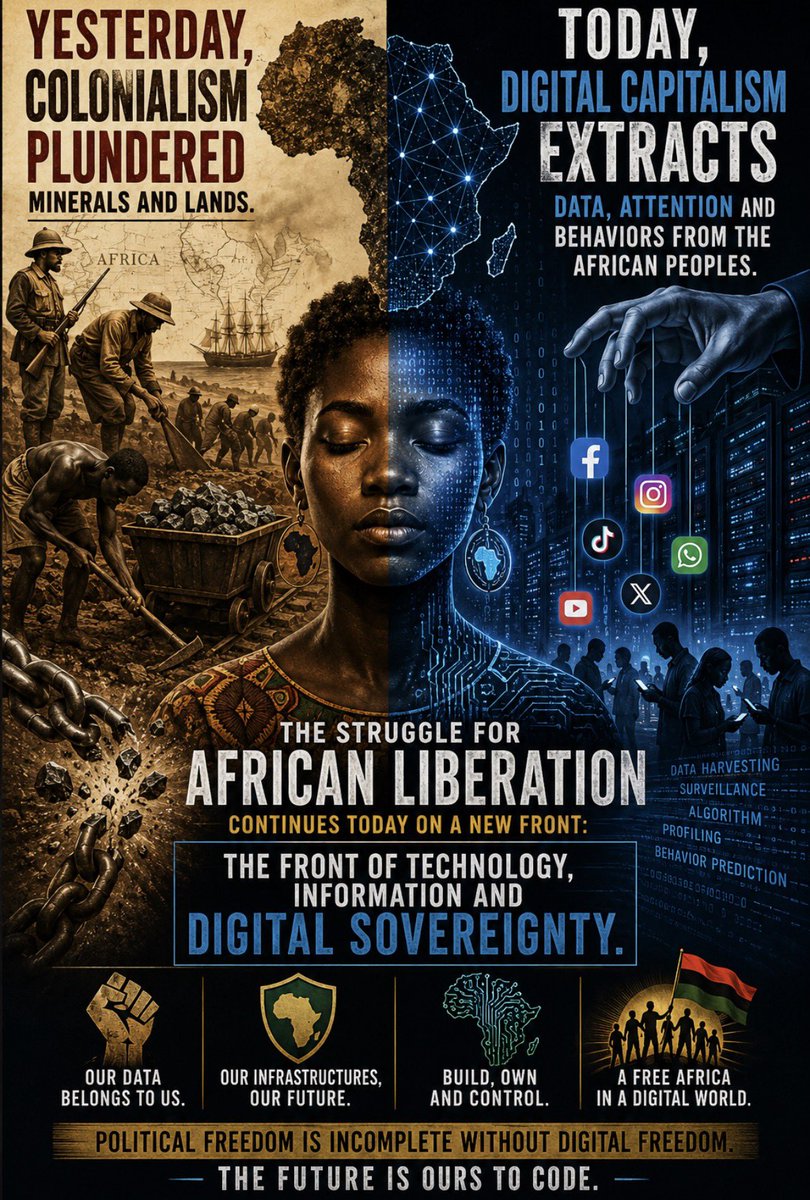
OBED MAYA

1.6K posts

OBED MAYA banner
OBED MAYA

OBED MAYA

@ngama_obed

Coordinator of the Black People magazine, human rights activist, internationalist Pan-Africanist, climate advocate, @magazinepeuplenoir @GrilaKinshasa

Dubai, United Arab Emirates Katılım Eylül 2017
1.9K Takip Edilen806 Takipçiler
Sabitlenmiş Tweet
OBED MAYA
OBED MAYA@ngama_obed·
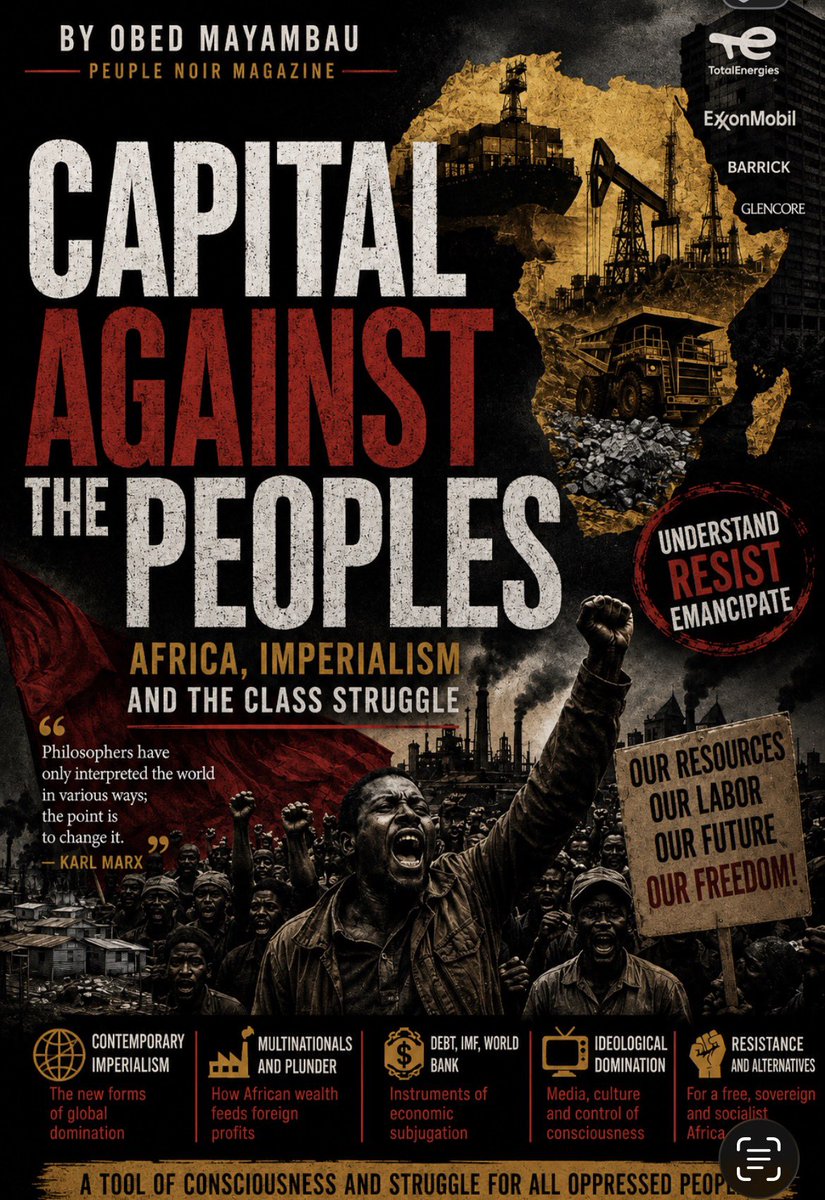
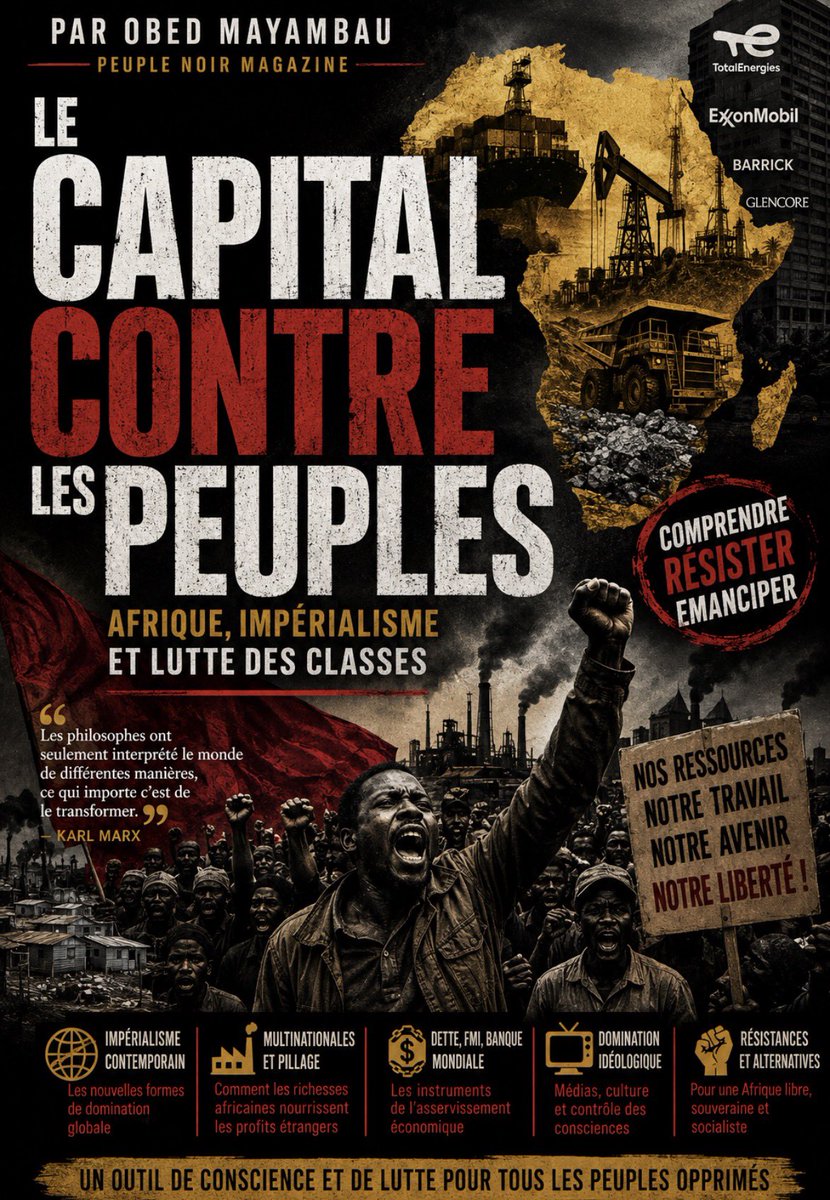
🔥 ESSAY 🔥 CAPITAL AGAINST THE PEOPLE Global capitalism is not a neutral system. Behind the rhetoric of democracy, development, and globalization lies a brutal reality: the plundering of African resources, the exploitation of workers, cultural domination, and the destruction of popular sovereignty. in this Marxist and pan-African political essay, I analyze the modern mechanisms of imperialism through a materialist and historical framework inspired in particular by the works of Karl Marx, Samir Amin, Frantz Fanon, Kwame Nkrumah, and Aziz Fall. Key themes: ▪️ the domination of multinational corporations; ▪️ the role of the IMF and the World Bank; ▪️ economic neocolonialism; ▪️ the exploitation of African labor; ▪️ media and ideological manipulation; ▪️ the question of African sovereignty; ▪️ class struggle in the African context; ▪️ popular and Pan-African resistance movements. This essay is also a reflection on: ✊🏾 revolutionary consciousness, ✊🏾 the emancipation of peoples, ✊🏾 African intellectual reconstruction, ✊🏾 and the need for a sovereign political project in the face of global capital. Combining geopolitical analysis, Marxist critique, and Pan-African commitment, *Capital Against the Peoples* aims to be a tool for consciousness-raising, political education, and struggle. Read the full French version: drive.google.com/file/d/12aCl_Z… Read the full English version: drive.google.com/file/d/1tLg1G0… #CapitalAgainstThePeople #PeupleNoirMagazine @congofriends @PascalMuteba @asmbaraza @africa_csc @AfricansRising @azizfall9 @ProudSocialist @sheilakamuzinzi @MutemiWaKiama @theblacklist @TiborPNagyJr @SommetLome @CedoMadubedube @SocialistGhana @partisocialiste @CommunistsKe @papasalif
OBED MAYA tweet mediaOBED MAYA tweet media
English
4
22
37
3.2K
OBED MAYA retweetledi
Africans Rising
Africans Rising@AfricansRising·
Happy Africa Day 2026! Today we celebrate more than borders on a map; we celebrate the people, the cultures, the languages, the hustle, the innovation, the music, the food, the memes, and the unstoppable spirit that makes Africa, AFRICA. From the days of the OAU to the bold dreams of today, Africa has been on a 63-year marathon of resilience, rhythm, resistance, and reinvention. And somehow… we still dance through it all. From Nakuru to Ouagadougou, Zanzibar to Lubumbashi, Juba to Maputo, the dream remains alive. ✨ A united Africa ✨ A borderless Africa ✨ An Africa that works for Africans Yes, we’ve faced challenges. But we’ve also built movements, raised voices, created solutions, and shown the world that Africa is not the future… Africa is NOW. So today, wave your flag, play your favorite African anthem, eat something deliciously African, and celebrate this beautiful continent we call home. Here’s to more unity, more collaboration, more growth, and more wins for the motherland. Happy Africa Day! ✊🏾 #AfricaDay2026 #BorderlessAfrica #TheAfricaWeWant #AfricansRising
Africans Rising tweet media
English
1
7
10
182
OBED MAYA
OBED MAYA@ngama_obed·
130 years after Adwa, 50 years after Soweto, Africa remains at a crossroads. In the face of imperialist resurgence, divisions, and the disarray among the youth, our duty is clear: to organize, reflect, and fight. June 16 will not be a mere commemoration, but a call to rebuild militant and conscious pan-African forces. Africa lacks neither courage nor memory. It needs a vision for the future. ✊🏾 @azizfall9 @asmbaraza @AfricansRising @congofriends @lenschain @ProudSocialist @TrustAfrica
OBED MAYA tweet media
English
0
5
9
470
OBED MAYA retweetledi
Power to the People ☭🕊
Power to the People ☭🕊@ProudSocialist·
Today is the birthday of the great Malcolm X. His message is still relevant today because we still live under the same capitalist system that has to change for things to get better. “You’re living at a time of revolution. A time where there’s got to be a change. People in power have misused it. And now there has to be a change and a better world has to be built. I will join with anyone, I don’t care what color you are, as long as you want to change this miserable condition that exists on this earth.”
English
61
883
2.5K
31K
OBED MAYA
OBED MAYA@ngama_obed·
MARXISM IS NOT A GHOST OF THE PAST. IT IS A METHOD OF STRUGGLE, A FRAMEWORK FOR ANALYSIS, AND AN INTELLECTUAL WEAPON FOR PEOPLE WHO REFUSE DOMINATION. In a world marked by exploitation, the confiscation of wealth, and cultural alienation, Marxism remains a living ideology. It challenges the structures of power, exposes the mechanisms of oppression, and reminds us of a fundamental truth: no genuine liberation can arise without the conscious organization of the masses. For Africa and for Black peoples, this reflection takes on a historical dimension. In the face of economic plunder, political dependencies, and new forms of imperialism, the question is no longer merely one of resistance, but of building a collective project capable of restoring to the people control over their own destiny. This issue of Peuple Noir does not celebrate a dogma. It opens a space for reflection, debate, and political awakening. For to think about Marxism today is to think about social justice, sovereignty, human dignity, and the radical transformation of relations of domination. Understand in order to transform. Organize to win. Africans RisingSon of Africa. @azizfall9 @MutemiWaKiama @AfricansRising @congofriends
OBED MAYA tweet media
English
0
5
12
308
OBED MAYA retweetledi
Nath Yamb
Nath Yamb@Nath_Yamb2·
Comment l’hebdomadaire sud-africain The Continent résume la virée de Macron au Kenya… Contente de voir que personne n’est dupe 😂
Nath Yamb tweet media
Français
11
106
327
10.1K
OBED MAYA retweetledi
Pambazuka News
Pambazuka News@Pambazuka_News·
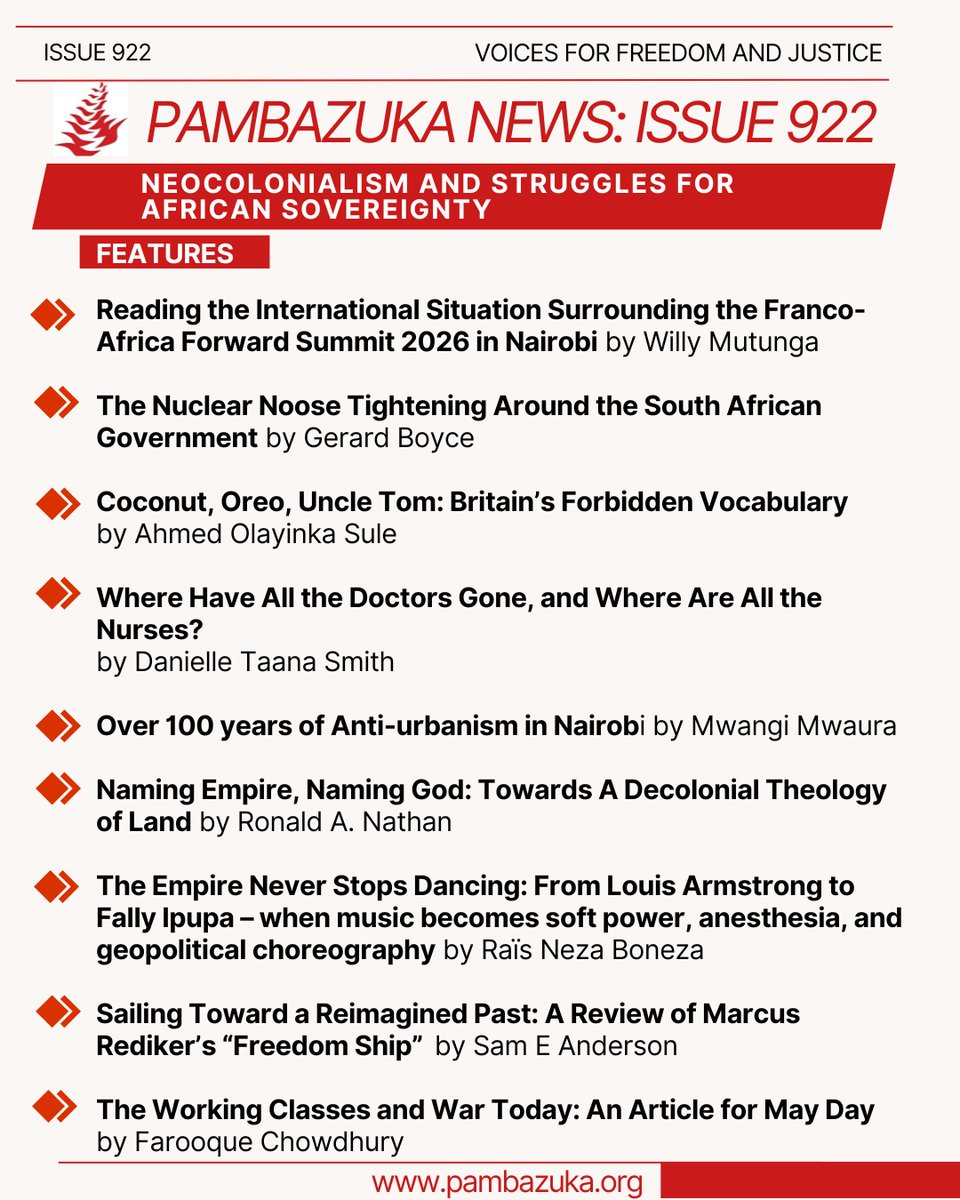
🔥Issue 922 offers incisive analyses of the 2026 Franco-Africa Summit, nuclear energy, intra-Global African critiques, belonging, naming, music, freedom ships, and workers' issues. 📖Read it at: pambazuka.org #Africa #France #Kenya #Music #SouthAfrica
Pambazuka News tweet media
English
0
8
12
1.5K
OBED MAYA retweetledi
1804 Books
1804 Books@1804Books·
📖AVAILABLE NOW! 📖Readers are calling the new edition of PAN-AFRICANISM AND COMMUNISM “imperative reading,” a “crucial tool,” a “blueprint,” and more . . . now with an updated preface from author Hakim Adi! This book fills in a gap, uncovering the long-overlooked revolutionary alliance between African and Caribbean leaders and organizations and the Communist International. 🌍 PAN-AFRICANISM AND COMMUNISM charts the development of the Comintern’s approach to the question of African liberation and how their struggles were intertwined. As they gathered leaders in historic congresses and published newspapers to uplift the struggle of African people on the continent and the diaspora, they demonstrated a refusal to separate the fight against white supremacy from the fight against colonialism and capitalism. This book shows a history of what it was like to build solidarity, an urgent lesson that we can still draw much from today. ⏳ AVAILABLE NOW! Get yours (and Hakim’s other excellent book PAN-AFRICANISM: A HISTORY) at 1804books.com today!
1804 Books tweet media
English
3
73
210
7.9K
Tommy. T
Tommy. T@tallmetommy·
This is exactly the frontier of the 21st century debate. The old question was: Who owns the factory? The new question is: Who owns the substrate reality now runs on? Energy. Compute. Data. Identity. Payments. AI models. Supply chains. Satellites. Algorithms. These are no longer just industries. They are the operating system of civilization. So I agree with you here: Access without sovereignty becomes dependency. Innovation without distribution becomes empire. Ownership without invention becomes stagnation. The path forward has to be something deeper than capitalism defending extraction or socialism defending control. We need civilizational infrastructure where communities, nations, builders, and individuals can participate in value creation instead of being reduced to consumers, workers, data sources, or mineral suppliers. That is the real test. Does technology concentrate power upward? Or does it compound agency outward? That may be the defining question of our time.
English
2
0
8
29
Forbes
Forbes@Forbes·
Elon Musk is the planet’s richest person by far, worth $839 billion as of Forbes’ annual World’s Billionaires list. He also ranks among the least philanthropic billionaires. Sure, Musk has transferred $8.5 billion of Tesla stock to his charitable foundations (1% of his net worth)—but nearly all of it is still sitting there idle. Only an estimated $500 million, or 0.06% of Musk’s vast fortune, has ever been disbursed to those in need. His lack of giving raises a question: What would our billionaires ranking look like if the world’s most generous people had never donated a dollar to charity? forbes.com/sites/mattduro…
Forbes tweet media
English
200
171
554
88.3K
OBED MAYA retweetledi
Friends of the Congo
Friends of the Congo@congofriends·
A federal judge on Wednesday ordered the Trump administration to return to the US a Colombian woman who was deported to the Democratic Republic of Congo edition.cnn.com/2026/05/14/us/…
English
0
9
17
516
OBED MAYA
OBED MAYA@ngama_obed·
Or can we build a civilization in which the productive forces finally serve collective emancipation rather than oligarchic concentration of power? That may well be the ultimate contradiction of our time — and perhaps the great historical debate of the 21st century. Thank you again for this remarkably profound exchange.
English
1
0
3
27
OBED MAYA
OBED MAYA@ngama_obed·
Your reflection becomes especially important because it touches the central contradiction of our era: the contradiction between the technological expansion of human capacities and the historical concentration of structures of power. And this is precisely where dialectical analysis becomes indispensable once again. No technology exists outside the material relations that produce it. The “rails” you describe — energy, computation, data, identity, payments, algorithms — are not merely technical infrastructures; they are the new forms of strategic property around which the global struggle for power is now organized. Marx had already argued that every historical phase generates its own mechanisms of domination through control over the productive forces. Yesterday, these were land, factories, trade routes, and industrial machinery. Today, they are cloud infrastructures, energy grids, semiconductors, digital platforms, algorithmic financial systems, and data architectures. The form changes. The logic of concentration remains. That is why I agree with your point that the old mechanical opposition between “capitalism” and “socialism” becomes insufficient if it is not reexamined through the deeper question of the actual architecture of power. But this architecture itself cannot be understood without analyzing the class relations and accumulation mechanisms embedded within technological systems. Capitalism possesses a remarkable ability: it absorbs even the very tools that were initially imagined as alternatives to it. The Internet was supposed to decentralize information; it produced digital empires. Social media promised the democratization of expression; it industrialized human attention. Globalization was meant to connect peoples; it often globalized dependency. Artificial intelligence promises the expansion of human capability; it may also centralize knowledge, computation, and decision-making at a scale unprecedented in history. This is the real dialectic of progress under capital: every advancement that expands human capacity can simultaneously deepen mechanisms of domination if the infrastructures themselves remain concentrated. That is why your question is decisive: Can peoples truly own the infrastructures upon which they depend? In my view, this is where the century will be decided. Because a people that does not control its energy systems, data infrastructures, financial networks, computational capacities, or digital architectures remains dependent — even when it possesses the illusion of connectivity or access. Africa represents perhaps the clearest contradiction within the global system: a continent indispensable to the technological supply chains of the 21st century because of its strategic minerals, yet still largely marginalized from ownership over patents, platforms, computational centers, digital currencies, and global value-capture mechanisms. In other words, the Global South still too often supplies the raw material while the Global North captures the technological surplus value. Marx called this accumulation; today it has become global, digital, and algorithmic. You are also correct on another fundamental point: ownership without innovation produces stagnation. But innovation without sovereignty produces dependent modernity. The real dialectical transcendence may therefore lie in constructing a civilization where: - technological innovation does not serve only private accumulation; - strategic infrastructures become partially socialized or democratically governed; - nations participate in the production of value instead of being reduced to markets; - and progress ceases to be extractive and becomes genuinely civilizational. At its core, the defining question of our century is not merely economic. It is anthropological and historical: Will humanity become technologically augmented yet politically dispossessed?
English
1
1
3
28
OBED MAYA
OBED MAYA@ngama_obed·
Your reflection significantly enriches this debate, and it is precisely through exchanges of this kind that we move beyond slogans and begin interrogating the real structures of contemporary power. This is, in many ways, what Marx had already anticipated when he argued that the fundamental issue is not merely the production of wealth, but the ownership of the means of production and the control of the infrastructures that organize society itself. History shows that capitalism does not reject access when access itself can generate profit. It may even democratize certain tools. Yet while usage becomes widespread, ownership often becomes increasingly concentrated. That is the central contradiction. Yes, the Internet expanded access to information. Yes, financial technologies simplified transactions. Yes, digital platforms created new opportunities for millions of people to work, communicate, and participate in economic life. But we must examine the actual architecture of power: Who owns the servers? Who controls the submarine cables? Who defines the algorithmic rules? Who captures the data? Who transforms global human activity into financial capital? Today, a handful of multinational corporations possess economic power that, in some cases, exceeds that of entire states. This is not merely a technological revolution; it is also a historic concentration of economic power. Marx described this dynamic as the concentration of capital: a system in which competition paradoxically produces monopolies or oligopolies capable of dominating markets, states, and even social behavior itself. That is why your question about the “rails” is so fundamental. Because those who own the economic rails often determine the direction of historical movement itself. Take Africa as an example. The continent supplies cobalt, lithium, coltan, and other strategic resources indispensable to the global digital economy. Yet most of the added value is captured elsewhere — within financial centers, industrial processing hubs, and technological platforms located in the Global North. African peoples provide raw materials and, in many cases, cheap labor, while remaining excluded from ownership over global value chains, patents, digital infrastructures, and financial mechanisms. This is what a modern extractive structure looks like. That is why the decisive question is not simply: “Is technology accessible?” The deeper question is: “Who controls the production of value, and who determines the direction of progress?” Real progress begins when peoples are no longer treated merely as consumers, data sources, labor reservoirs, or suppliers of raw materials, but become co-owners of infrastructures, financial institutions, technologies, and strategic decision-making processes. Otherwise, distributed access can become little more than an illusion of freedom within a system whose centers of power remain fundamentally unchanged. And that is precisely the difference between a multipolar world grounded in popular sovereignty and a globalized economic empire administered by transnational oligarchies. Thank you again for enriching this discussion. It is precisely through serious intellectual confrontations such as this that we can begin imagining futures beyond simplistic narratives.
English
1
0
2
43
Tommy. T
Tommy. T@tallmetommy·
You’re right. The question is control. A technology is not liberating just because it is powerful. It becomes liberating when access widens, costs fall, and the user gains agency instead of dependency. So maybe the real impact filter is: Who owns the rails? Who sets the terms? Who captures the upside? Who gets reduced to input data, labor, or raw material? That’s why I separate extraction from frontier building. Progress is not just invention. Progress is invention plus distributed access. 🦾
English
1
0
7
26
OBED MAYA
OBED MAYA@ngama_obed·
The price will first be paid by the peoples themselves: the precarization of labor, the erosion of national sovereignty, economic dependency, the extraction of strategic resources, and the weakening of social states. The primary beneficiaries will be major financial powers, multinational corporations, and oligarchic structures capable of transforming crises into instruments of accumulation and profit. The losers will be workers, countries of the Global South, popular classes, and all nations reduced to the role of consumer markets or reservoirs of raw materials. Capital does not fundamentally seek human equilibrium; it seeks perpetual expansion. And when a system can only sustain itself through the sacrifice of entire populations, the issue ceases to be merely economic — it becomes civilizational. The essential question, therefore, is that of the alternative. Should humanity accept a world in which a handful of financial centers determine the destiny of nations, or should we strive to construct a model grounded in popular sovereignty, collective control over strategic resources, social justice, and cooperation among free nations? Technological and economic progress only acquires legitimacy when it empowers peoples rather than deepening their dependence. The economy must once again become an instrument serving human development, rather than humanity serving the imperatives of capital accumulation. The challenge of our era is not simply to criticize extractive capitalism, but to rebuild political and economic structures capable of protecting populations, securing sovereignty over national wealth, and restoring human dignity to the center of development. Without such a transformation, globalization risks becoming nothing more than a faceless empire.
English
1
1
1
7
Mad Scientist
Mad Scientist@ravcchaudhary·
@tallmetommy @Forbes #PowerCorrupts At what price and who’ll be the winners vs losers? x.com/ngama_obed/sta…
OBED MAYA@ngama_obed

🔥 ESSAY 🔥 CAPITAL AGAINST THE PEOPLE Global capitalism is not a neutral system. Behind the rhetoric of democracy, development, and globalization lies a brutal reality: the plundering of African resources, the exploitation of workers, cultural domination, and the destruction of popular sovereignty. in this Marxist and pan-African political essay, I analyze the modern mechanisms of imperialism through a materialist and historical framework inspired in particular by the works of Karl Marx, Samir Amin, Frantz Fanon, Kwame Nkrumah, and Aziz Fall. Key themes: ▪️ the domination of multinational corporations; ▪️ the role of the IMF and the World Bank; ▪️ economic neocolonialism; ▪️ the exploitation of African labor; ▪️ media and ideological manipulation; ▪️ the question of African sovereignty; ▪️ class struggle in the African context; ▪️ popular and Pan-African resistance movements. This essay is also a reflection on: ✊🏾 revolutionary consciousness, ✊🏾 the emancipation of peoples, ✊🏾 African intellectual reconstruction, ✊🏾 and the need for a sovereign political project in the face of global capital. Combining geopolitical analysis, Marxist critique, and Pan-African commitment, *Capital Against the Peoples* aims to be a tool for consciousness-raising, political education, and struggle. Read the full French version: drive.google.com/file/d/12aCl_Z… Read the full English version: drive.google.com/file/d/1tLg1G0… #CapitalAgainstThePeople #PeupleNoirMagazine @congofriends @PascalMuteba @asmbaraza @africa_csc @AfricansRising @azizfall9 @ProudSocialist @sheilakamuzinzi @MutemiWaKiama @theblacklist @TiborPNagyJr @SommetLome @CedoMadubedube @SocialistGhana @partisocialiste @CommunistsKe @papasalif

English
2
0
2
68
OBED MAYA
OBED MAYA@ngama_obed·
Your point is valid, but it highlights the central contradiction of contemporary capitalism. Capital can indeed produce tools, infrastructure, and technological advances capable of expanding certain human capabilities. The problem is not the tool itself, but the power structure that controls it. When a technology emerges within a system dominated by the logic of accumulation, it often ends up primarily reinforcing those who already possess capital, data, networks, and the means of production. Yes, access to energy, information, or markets may seem to democratize opportunities. But if the rules of the game remain defined by a few centers of economic power, then this “openness” can also become a new form of dependency. The real issue, therefore, is not just innovation, but collective control over its benefits. In other words: who controls the infrastructure, who sets the rules, who captures the value produced, and who remains merely a consumer or supplier of raw materials? This is where, as you say, the line between progress and empire is drawn.
English
1
0
2
38
Tommy. T
Tommy. T@tallmetommy·
Fair question. Power absolutely corrupts when it becomes extractive. That’s why the filter matters. Does capital remove agency from people, or increase it? Does it trap nations in dependency, or give them cheaper access to energy, information, transportation, markets, and tools? The winners should not just be shareholders. The real test is whether the technology expands human leverage for people who were previously locked out. That’s the line between empire and progress.
English
1
0
4
32
OBED MAYA retweetledi
Mzalendo Mūtemi wa Kīama
Mzalendo Mūtemi wa Kīama@MutemiWaKiama·
Ruto is no longer preparing to win 2027. He is preparing for what happens AFTER Kenyans reject the results. Look carefully at the pattern. Njoki Ndung’u being pushed to the ICC. Philomena Mwilu exiting soon. Warsame already singing “respect the appointing authority.” A carefully cultivated Supreme Court bench slowly taking shape around one man’s political survival. This is not random. This is architecture. A 7 judge shield designed to sanitize disputed elections, neutralize constitutional resistance and protect power at all costs. Kenyans must stop thinking rigging only happens at polling stations. Modern state capture happens in the courts, in appointments, in institutions and in silent elite deals made years before an election. Why is State House so invested in judicial positioning? Why are loyalists being rewarded strategically? Why is every independent institution slowly becoming politically obedient? Because Ruto understands one thing: The real battle after 2027 may not be in the streets. It may be in the Supreme Court of Kenya. Observe the SCOK carefully. Observe the appointments. Observe the silence. Observe the programming. This regime is not planning for democracy. It is planning for legal protection after democracy is violated. History has taught us one painful truth: When the judiciary is captured, the citizen becomes powerless. 2027 will not just be about votes. It will be about whether Kenya still has institutions strong enough to defend those votes. #Borrowed
English
189
3.7K
8.1K
196.8K
OBED MAYA
OBED MAYA@ngama_obed·
🔥 ESSAY 🔥 CAPITAL AGAINST THE PEOPLE Global capitalism is not a neutral system. Behind the rhetoric of democracy, development, and globalization lies a brutal reality: the plundering of African resources, the exploitation of workers, cultural domination, and the destruction of popular sovereignty. in this Marxist and pan-African political essay, I analyze the modern mechanisms of imperialism through a materialist and historical framework inspired in particular by the works of Karl Marx, Samir Amin, Frantz Fanon, Kwame Nkrumah, and Aziz Fall. Key themes: ▪️ the domination of multinational corporations; ▪️ the role of the IMF and the World Bank; ▪️ economic neocolonialism; ▪️ the exploitation of African labor; ▪️ media and ideological manipulation; ▪️ the question of African sovereignty; ▪️ class struggle in the African context; ▪️ popular and Pan-African resistance movements. This essay is also a reflection on: ✊🏾 revolutionary consciousness, ✊🏾 the emancipation of peoples, ✊🏾 African intellectual reconstruction, ✊🏾 and the need for a sovereign political project in the face of global capital. Combining geopolitical analysis, Marxist critique, and Pan-African commitment, *Capital Against the Peoples* aims to be a tool for consciousness-raising, political education, and struggle. Read the full French version: drive.google.com/file/d/12aCl_Z… Read the full English version: drive.google.com/file/d/1tLg1G0… #CapitalAgainstThePeople #PeupleNoirMagazine @congofriends @PascalMuteba @asmbaraza @africa_csc @AfricansRising @azizfall9 @ProudSocialist @sheilakamuzinzi @MutemiWaKiama @theblacklist @TiborPNagyJr @SommetLome @CedoMadubedube @SocialistGhana @partisocialiste @CommunistsKe @papasalif
OBED MAYA tweet mediaOBED MAYA tweet media
English
4
22
37
3.2K
OBED MAYA
OBED MAYA@ngama_obed·
Karl Marx wrote in *Contribution to the Critique of Hegel’s Philosophy of Right* in 1844 that ‘religion is the opium of the people.’ When pastors become the mouthpieces of those in power and endorse constitutional changes that run counter to the interests of the people, they no longer serve God, but rather the preservation of an oppressive order. A nation dies when its altars become the spiritual offices of the regime. @AfricansRising @congofriends @sheilakamuzinzi @Judicaelle_ @KatangaCynthia @ProudSocialist @TrustAfrica @PatrickMbeko
OBED MAYA tweet media
English
0
7
8
385