

Nicholas James
8 posts


This week, we released Google AI Edge Eloquent, offering AI-enhanced dictation powered by #Gemma. The reception has been incredible, the app shot to top 20 on the iOS App Store productivity chart at its peak without any marketing.
English
@sdhilip I’v been using Google Eloquent. It’s completely local too and will have a mobile app soon
English

I've dictated almost everything for 6 months with Wispr Flow. 44,414 words, 161 wpm, top 0.1% of users.
Last week I tried FluidVoice. Open source, runs local on my Mac, corrects as I speak with no API key, and handles slang better than I expected.
Cancelled my paid plan. If you're on a Mac, this one's for you: altic.dev/fluid
@ALTIC_DEV
English
It will be an uncommon choice not to have LLMs write for you, but it won't be a merely idiosyncratic one. It will be what all the people who care about thinking well do.
paulgraham.com/writes.html
Joe Weisenthal@TheStalwart
Unfortunately, I think that in the near future, not using LLMs to write for you will be like someone refusing to use Google Maps for directions in a new city. A bizarre idiosyncratic choice that's just completely incomprehensible to the vast majority of people.
English

I was wrong about the Midjourney ultra-sound scanner.
Well, maybe not wrong, but at a minimum I missed something obvious because I was thinking like a doctor who's been practicing for 25 years.
And I didn't explain my point well.
First, where I was wrong:
All historical precendent that showed that widespread screening imaging is net neutral or harmful was imaging that was expensive, inconvenient, gated by physicians and couldn't practically be repeated frequently short term.
If the Midjourney ultrasound is high resolution, harmless, inexpensive and convenient, people can get an initial scan, then if there are abnormalities concerning for cancer, they can get weekly follow up scans to see if it's growing/changing, and if it's not, they can leave it alone.
In retrospect, that is obvious but it never occurred to me.
Now, you'd assume that that approach would have to lead to it being useful and saving lives, and it probably will. But we won't really know it does until we have a couple years of data. Lots of things that seem obvious in medicine end up being wrong once we collect data.
Second, what I didn't explain well:
It's not that I think non-doctors are 'too dumb' to use the results effectively.
Its that historically it was literally impossible to use the results effectively, and that is super, super counterintuitive. It seems obvious that finding stuff early is beneficial, but experience has shown that it isn't.
Here's why:
The vast majority of abnormalities (i.e. possible cancer) isn't cancer - like over 90% of them, ends up being harmless - something thay your body could have handled on it's own.
But the only way to find out was to have invasive, risky procedures to biopsy or remove what was found.
And overall, the side effects from all the risky, invasive procedures to track down the over 90% of stuff that was harmless equal or outweigh the benefit from removing the less than 10% of stuff that wasn't harmless.
If the MIdjourney device can be repeated frequently, like weekly, at a low cost and is harmless, it could negate the need for the risky, invasive procedures.
Not saying it will, but it seems like it could and I confidently posted yesterday that it was a bad idea.
I was wrong to confidently post that.
Matthew Zirwas, MD@MattZirwas
I usually agree with Dr. Locasale. But not on this. A $100 full-body ultrasound on asymptomatic people, sold as a wellness service, will open a massive can of financial worms for individuals. You’ll pay around $100 for the scan, there’s a 90% chance they find something you’ll worry about, your insurance won’t cover the expensive follow-up they recommend, so you’ll be deciding whether to spend thousands to relieve anxiety about something with a 98% chance of being nothing. How’d I get there? Enough screening full body MRIs have been done to give us a good idea of the size of the can and what’ll be in it. Roughly 90% of asymptomatic people who get a screening full body MRI have an abnormality. We have decades of diagnostic imaging with millions and millions of followed-up findings that allow 2/3 of those to be classified as incidental findings that definitely don’t need further work up. Of the roughly 1/3 they can’t be sure about, after work up, 10% of them (4% of people who got a scan) end up with something important, and about 1.5% of people have a cancer detected. And the existing evidence says finding those lesions doesn’t improve overall mortality. I know that’s hard to believe, but it’s true. Look up Korean thyroid ultrasounds or German melanoma screening. Now extend it to a modality we have no baseline data on follow-up of lesions. Midjourney has been explicit that the early scans train the model and diagnostic accuracy comes later. For the first year or two, it’s reasonable to say 90% of people who get a scan will have an abnormality they can’t rule out as concerning, and it’ll be up to the individual to pay to train Midjourney’s model. Insurance probably won’t cover the follow-up scan or biopsy with an established modality, because there’s no evidence saying it needs follow-up. So 90% of people who get scanned will be worried and facing the decision of whether to pay out of pocket for the expensive follow-up. A small percentage of those will have side effects and complications from the follow-up testing. And remember, 98% of the findings are nothing. You can argue affluent people could get one, chase down all the abnormals, then repeat a scam (sorry, meant scan) every 3 months to look for changes. But that just leads to over-diagnosis with no mortality benefit. So, rich people get scanned every 3 months with subsequent overtesting and overdiagnosis, normal people get anxious over things that are 98% likely to be fine, nobody has a survival benefit and Midjourney gets their model trained for free. I wonder who’s coming out ahead here?
English
@doodlestein Yeah sorry, I meant seperate from research.
So what brenner bot is for research there could be Elon bot for engineering and Paul Graham bot for executive?
English

@Nicjwhittle Yes, but those are much less powerful for scientific truth discovery!
English
The more I think about how digital twin models are dramatically more useful and applicable in a world of pervasive and brilliant AI agents, the more it reinforces the conclusion to me that what makes them so useful is the ability to apply the scientific method to them.
When you have a rich enough model that reflects the ground truth well and is kept in constant sync with the real data, you can do real experiments: come up with a hypothesis, a causal link grounded in evidence, propose an intervention, and register it all in a clear, detailed way where you articulate what you believe will happen and why.
Then a human operator can actually DO the intervention/action (or, for lower-stakes settings, the agents themselves could do them), and then you can gather the results and actually test if the theory/model was right.
If it worked, then you have more evidence, although as Karl Popper would observe, you haven’t actually proven anything. But if it didn’t, then you’ve falsified the hypothesis and revealed problems in your model or in your understanding of it.
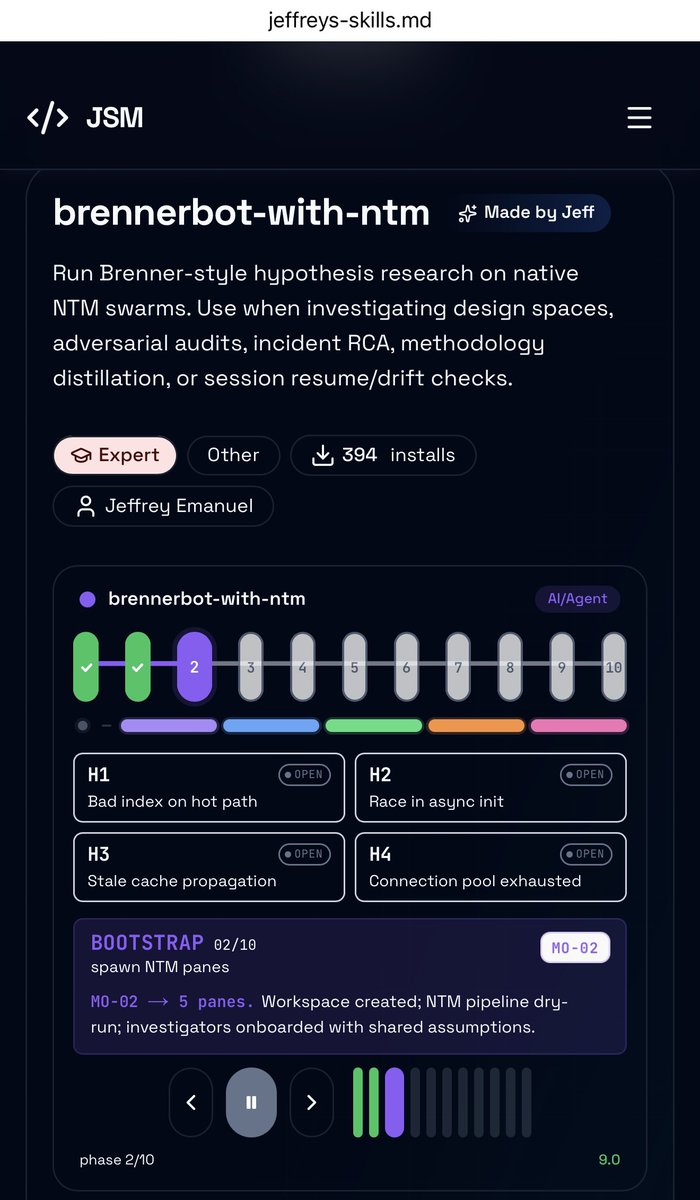
But how do you actually conduct this science in an organized, structured, effective way using AI agents? That’s where all this dovetails so nicely with a project of mine that I’ve posted about several times, brennerbot.org.
BrennerBot gives exactly the right kind of approach to getting the most out of these models, and I highly recommend reading about the system and how it works, particularly the distillations and the operators on the website.
The system is based on the scientific method and approach espoused by Sydney Brenner, one of the most far-seeing and important biologists in history. The ideas are distilled from 20+ hours of video interview transcripts that I transformed into a rigorous methodology.
The original version of my BrennerBot project had a separate software tool for running the process and orchestrating the agents, but it sort of sat outside of the rest of my tooling and workflows, so I didn’t use it as much.
Nowadays, for actually applying the BrennerBot methodology in practice, I prefer the skill-based version of it that is built on top of my ntm orchestration tool. You can get the skill version here:
jeffreys-skills.md/skills/brenner…
I believe that this combination of digital twins and automated application of the scientific method, and particularly Brenner’s Bayesian-supercharged, extra-discriminative version of it, has huge promise across a wide range of real-world applications.
I’m already using it in business contexts, but think it could also help manage schools, hospitals, and other institutions.
Jeffrey Emanuel@doodlestein
This book from 1993 was really way ahead of its time, explaining the concept of what we'd now call a "digital twin," a computer model of a real-world system that is kept in constant sync with the underlying real data. This approach is more relevant than ever now that agents can study documents, plans, and data and use them to automatically design the models. And then other agents can automatically keep the models in sync with reality by querying APIs, parsing documents, checking cameras, monitoring transactions, etc. This lets you understand what's happening in real time, make predictions (and ground them in logic and causality), detect anomalies and explain them, perform hypothetical what-if simulations, and generally apply the scientific method in a rigorous way to test your understanding of the underlying reality. While digital twins used to be so much work to build and update that they only made sense for big, high-stakes projects like NASA space missions, now you can model all sorts of everyday systems in this way, like a business or school. We know that the scientific method is fabulously, "unreasonably" effective in explaining the rich complexity of the natural world. It makes you wonder what becomes possible when we start applying that same lens and approach, guided by super-smart AI agent practitioners, to realms that until now have mostly been governed by simple heuristics and institutional inertia.
English
@doodlestein The idea is having better workflows and decision making when planning for example
English
@doodlestein No worries. I still haven’t fully understood how to use this effectively yet. I’ll keep trying!
A side note: Could the principles of brenner not be used similarly for a Paul Graham blog or even Elon Musk philosophy. Then having them in a swarm as a council?
English