Nick Caputo

12 posts

Nick Caputo

Nick Caputo

@nickacaputo

AI, governance, law, etc. @aigioxford

Katılım Ağustos 2016
635 Takip Edilen87 Takipçiler
Dean W. Ball
Dean W. Ball@deanwball·
Who are the best thinkers on AI rights? I do not mean “who is the most prominent person who has expressed broad support for AI rights?,” but rather “who has done the best work elaborating on the details of what ‘AI rights’ should or could entail?”
English
60
9
206
22K
Nick Caputo
Nick Caputo@nickacaputo·
@karpathy I call the inverse of legibility "scrutability" and wrote a paper on how to use AI to improve it. We need both more capable and accountable government, and this is the place to start (it's a law review article so too long, check out Intro and Part III.A) papers.ssrn.com/sol3/papers.cf…
English
0
5
14
1.9K
Andrej Karpathy
Andrej Karpathy@karpathy·
Something I've been thinking about - I am bullish on people (empowered by AI) increasing the visibility, legibility and accountability of their governments. Historically, it is the governments that act to make society legible (e.g. "Seeing like a state" is the common reference), but with AI, society can dramatically improve its ability to do this in reverse. Government accountability has not been constrained by access (the various branches of government publish an enormous amount of data), it has been constrained by intelligence - the ability to process a lot of raw data, combine it with domain expertise and derive insights. As an example, the 4000-page omnibus bill is "transparent" in principle and in a legal sense, but certainly not in a practical sense for most people. There's a lot more like it: laws, spending bills, federal budgets, freedom of information act responses, lobbying disclosures... Only a few highly trained professionals (investigative journalists) could historically process this information. This bottleneck might dissolve - not only are the professionals further empowered, but a lot more people can participate. Some examples to be precise: Detailed accounting of spending and budgets, diff tracking of legislation, individual voting trends w.r.t. stated positions or speeches, lobbying and influence (e.g. graph of lobbyist -> firm -> client -> legislator -> committee -> vote -> regulation), procurement and contracting, regulatory capture warning lights, judicial and legal patterns, campaign finance... Local governments might be even more interesting because the governed population is smaller so there is less national coverage: city council meetings, decisions around zoning, policing, schools, utilities... Certainly, the same tools can easily cut the other way and it's worth being very mindful of that, but I lean optimistic overall that added participation, transparency and accountability will improve democratic, free societies. (the quoted tweet is half-ish related, but inspired me to post some recent thoughts)
Harry Rushworth@Hrushworth

The British Government is a complicated beast. Dozens of departments, hundreds of public bodies, more corporations than one can count... Such is its complexity that there isn't an org chart for it. Well, there wasn't... Introducing ⚙️Machinery of Government⚙️

English
407
726
5.9K
937.4K
Nick Caputo
Nick Caputo@nickacaputo·
@essemmeppi @agenticstate_ I think this stuff is a great start and that there's more that could be done--have you read Henry Farrell's work on AI as a fourth type of government?
English
0
0
0
9
Simone Maria Parazzoli
Simone Maria Parazzoli@essemmeppi·
@nickacaputo @agenticstate_ Last week a govt team asked us: what do we do with the rest of the org that has been automated? How will orgs actually look like? A lot to do on the pars construens (and had to catch a flight and forgot to finish my reply)
English
1
0
0
18
Nick Caputo
Nick Caputo@nickacaputo·
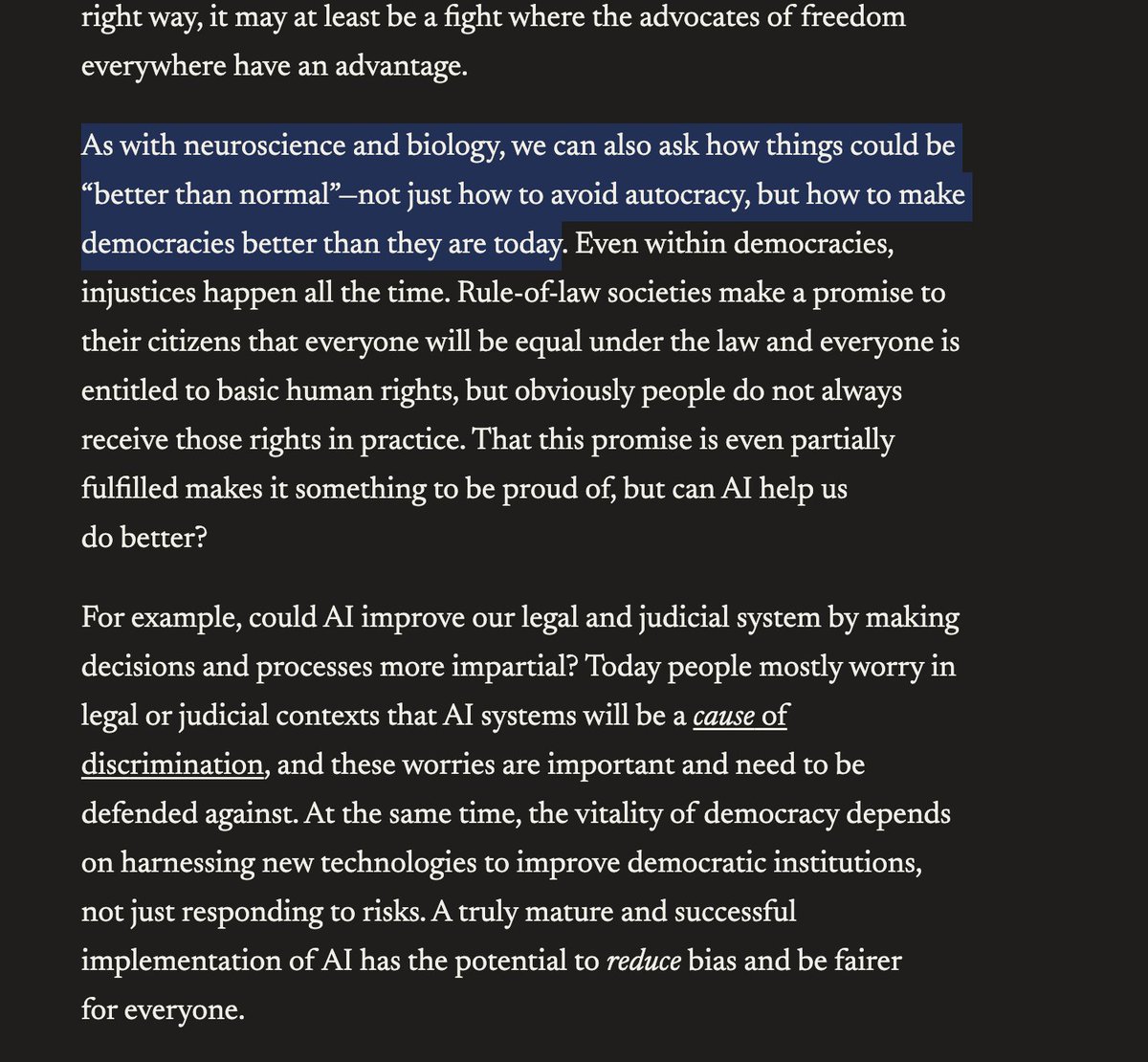
Most people (the labs especially) articulate positive visions that are "subtractive", about how AI removes barriers to things people already want. Removing illness, economic scarcity, limits to education. This makes sense, because they don't want to seem to be telling us what to do. And it's also how most new tech visions work: lots of early talk about electrification focused on reducing chores to free up time for recreation. But we need "additive" visions too. What new forms of life does AI allow? Electricity enabled the internet and people today would focus on stuff like that, not chores. It's hard to dream these things up and they'll mostly emerge over time, but worth considering what positive and additive visions of AI could look like.
Ethan Mollick@emollick

The AI labs have actually done a bad job explaining what the future they are building towards will actually look like for most of us. Even “Machines of Loving Grace” has very few well-articulated visions of what Anthropic hopes life will be like if they succeed at their goals.


English
2
1
8
466
Nick Caputo
Nick Caputo@nickacaputo·
@girishsastry MLG is among the best additive articulations. But note the passage is still about removing obstacles to what we already want: impartiality through removing bias, getting rid of barriers to human rights. Does AI give us better courts and agencies or something new in government?
English
0
0
0
18
Nick Caputo retweetledi
Ethan Mollick
Ethan Mollick@emollick·
The AI labs have actually done a bad job explaining what the future they are building towards will actually look like for most of us. Even “Machines of Loving Grace” has very few well-articulated visions of what Anthropic hopes life will be like if they succeed at their goals.

English
133
64
919
248.8K
Nick Caputo
Nick Caputo@nickacaputo·
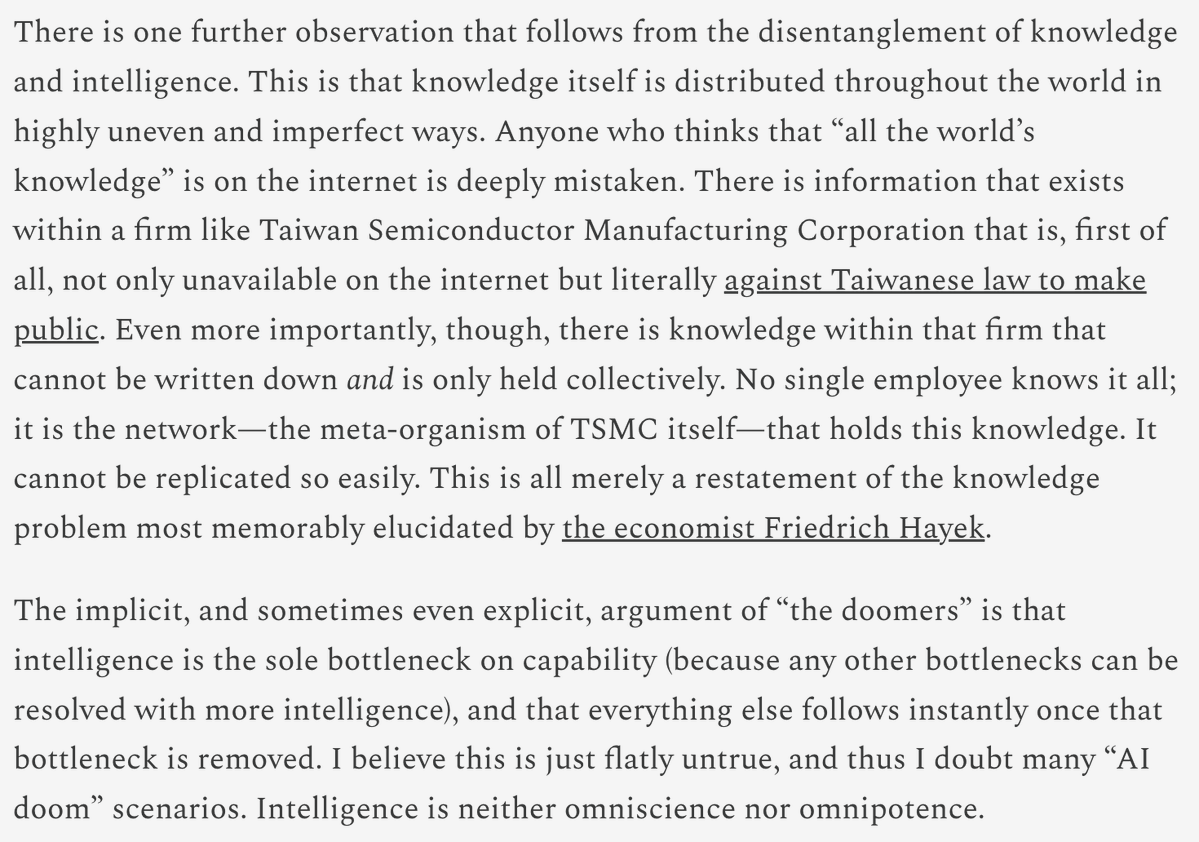
@binarybits @deanwball I found Brynjolfsson & Hitzig's recent paper on why Hayekian informational conditions might not persist given advancing AI to be persuasive. Not that this makes doom inevitable, but increasing intelligence has long centralized knowledge nber.org/system/files/c…
English
0
1
5
137
Timothy B. Lee
Timothy B. Lee@binarybits·
This is the correct view of existential risk from AI, and I'm glad @deanwball sees the same connection to Hayek's thinking that I do.
Timothy B. Lee tweet media
English
26
37
291
22.2K
Nick Caputo retweetledi
Peter Henderson
Peter Henderson@PeterHndrsn·
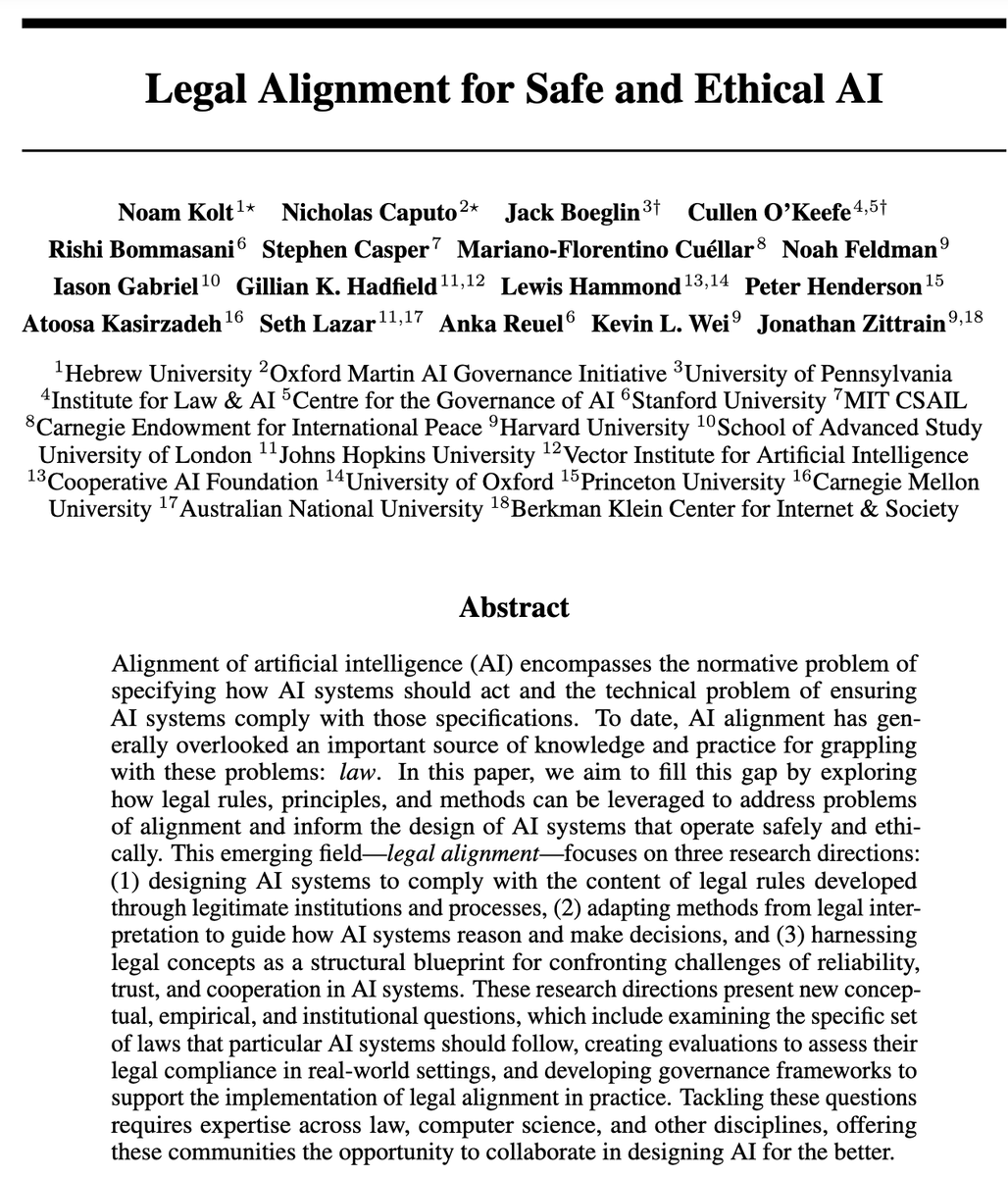
I’m really excited about our new paper! I think we will ultimately need to draw on expertise from both law and AI to get alignment right, and this paper lays out that vision in more detail. As an aside, my PhD thesis was titled ‘Aligning law, policy, and machine learning for responsible real-world deployments’ for a reason. I think this is a very important area, and I’m excited to see so many excellent researchers working together to move it forward.
Peter Henderson tweet media
English
5
15
124
11.9K
Nick Caputo retweetledi
Miro
Miro@Miropluckebaum·
AI companies coming together at the India Summit @sama @DarioAmodei
Miro tweet media
English
3
4
70
20K
Cas (Stephen Casper)
Cas (Stephen Casper)@StephenLCasper·
🚨 New paper from an awesome group led by Noam Kolt and @nickacaputo. We hear a lot about what important concepts and methods from AI research that lawyers need to understand. But it's really a two-way street... 🧵🧵🧵
Cas (Stephen Casper) tweet media
English
3
12
68
5K
Nick Caputo
Nick Caputo@nickacaputo·
@natfriedman True though there’s some debate about this based on some cases extending 230 to other algorithmically generated content like google’s search snippets (see techdirt.com/2023/03/17/yes…). Will be interesting to see the arguments made
English
1
0
3
702
Nat Friedman
Nat Friedman@natfriedman·
The much more interesting legal point -- which I don't think anyone has disputed -- is that section 230 does not shield chatbots from liability in the way it shields platforms from issues with user-generated content.
Semafor@semafor

🟡 NEW: IAC, The New York Times, News Corp., and Axel Springer are close to formalizing a coalition that could lead a lawsuit against AI companies that have trained models on their data, @semaforben reports. semafor.com/article/07/23/…
English
5
16
139
116K