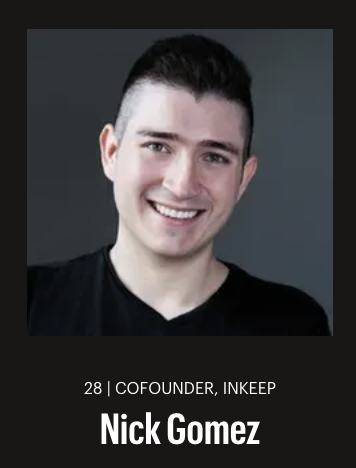
Nick Gomez

294 posts

Nick Gomez banner
Nick Gomez

Nick Gomez

@nickgomez

founder @inkeep - open source agent builder + developer sdk with 2-way sync. previously @MIT @Microsoft

San Francisco Katılım Şubat 2022
470 Takip Edilen731 Takipçiler
Sabitlenmiş Tweet
Nick Gomez
Nick Gomez@nickgomez·
Announcing our $13M seed to put AI Agents in the hands of every team (code or no-code). So far, we've worked with top companies like Anthropic, Midjourney, Clay, PostHog and tons more to power their customer-facing AI assistants. Today, we’re launching Inkeep Agents: a platform where both business and engineering teams can build AI agents together. Our story 👇🧵
English
26
31
284
115.8K
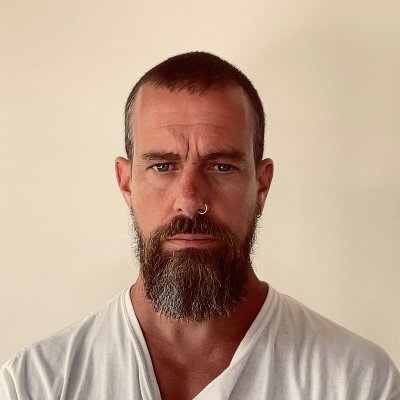
jack
jack@jack·
we're making @blocks smaller today. here's my note to the company. #### today we're making one of the hardest decisions in the history of our company: we're reducing our organization by nearly half, from over 10,000 people to just under 6,000. that means over 4,000 of you are being asked to leave or entering into consultation. i'll be straight about what's happening, why, and what it means for everyone. first off, if you're one of the people affected, you'll receive your salary for 20 weeks + 1 week per year of tenure, equity vested through the end of may, 6 months of health care, your corporate devices, and $5,000 to put toward whatever you need to help you in this transition (if you’re outside the U.S. you’ll receive similar support but exact details are going to vary based on local requirements). i want you to know that before anything else. everyone will be notified today, whether you're being asked to leave, entering consultation, or asked to stay. we're not making this decision because we're in trouble. our business is strong. gross profit continues to grow, we continue to serve more and more customers, and profitability is improving. but something has changed. we're already seeing that the intelligence tools we’re creating and using, paired with smaller and flatter teams, are enabling a new way of working which fundamentally changes what it means to build and run a company. and that's accelerating rapidly. i had two options: cut gradually over months or years as this shift plays out, or be honest about where we are and act on it now. i chose the latter. repeated rounds of cuts are destructive to morale, to focus, and to the trust that customers and shareholders place in our ability to lead. i'd rather take a hard, clear action now and build from a position we believe in than manage a slow reduction of people toward the same outcome. a smaller company also gives us the space to grow our business the right way, on our own terms, instead of constantly reacting to market pressures. a decision at this scale carries risk. but so does standing still. we've done a full review to determine the roles and people we require to reliably grow the business from here, and we've pressure-tested those decisions from multiple angles. i accept that we may have gotten some of them wrong, and we've built in flexibility to account for that, and do the right thing for our customers. we're not going to just disappear people from slack and email and pretend they were never here. communication channels will stay open through thursday evening (pacific) so everyone can say goodbye properly, and share whatever you wish. i'll also be hosting a live video session to thank everyone at 3:35pm pacific. i know doing it this way might feel awkward. i'd rather it feel awkward and human than efficient and cold. to those of you leaving…i’m grateful for you, and i’m sorry to put you through this. you built what this company is today. that's a fact that i'll honor forever. this decision is not a reflection of what you contributed. you will be a great contributor to any organization going forward. to those staying…i made this decision, and i'll own it. what i'm asking of you is to build with me. we're going to build this company with intelligence at the core of everything we do. how we work, how we create, how we serve our customers. our customers will feel this shift too, and we're going to help them navigate it: towards a future where they can build their own features directly, composed of our capabilities and served through our interfaces. that's what i'm focused on now. expect a note from me tomorrow. jack
English
8.8K
6.7K
51.2K
64.1M
Auth0
Auth0@auth0·
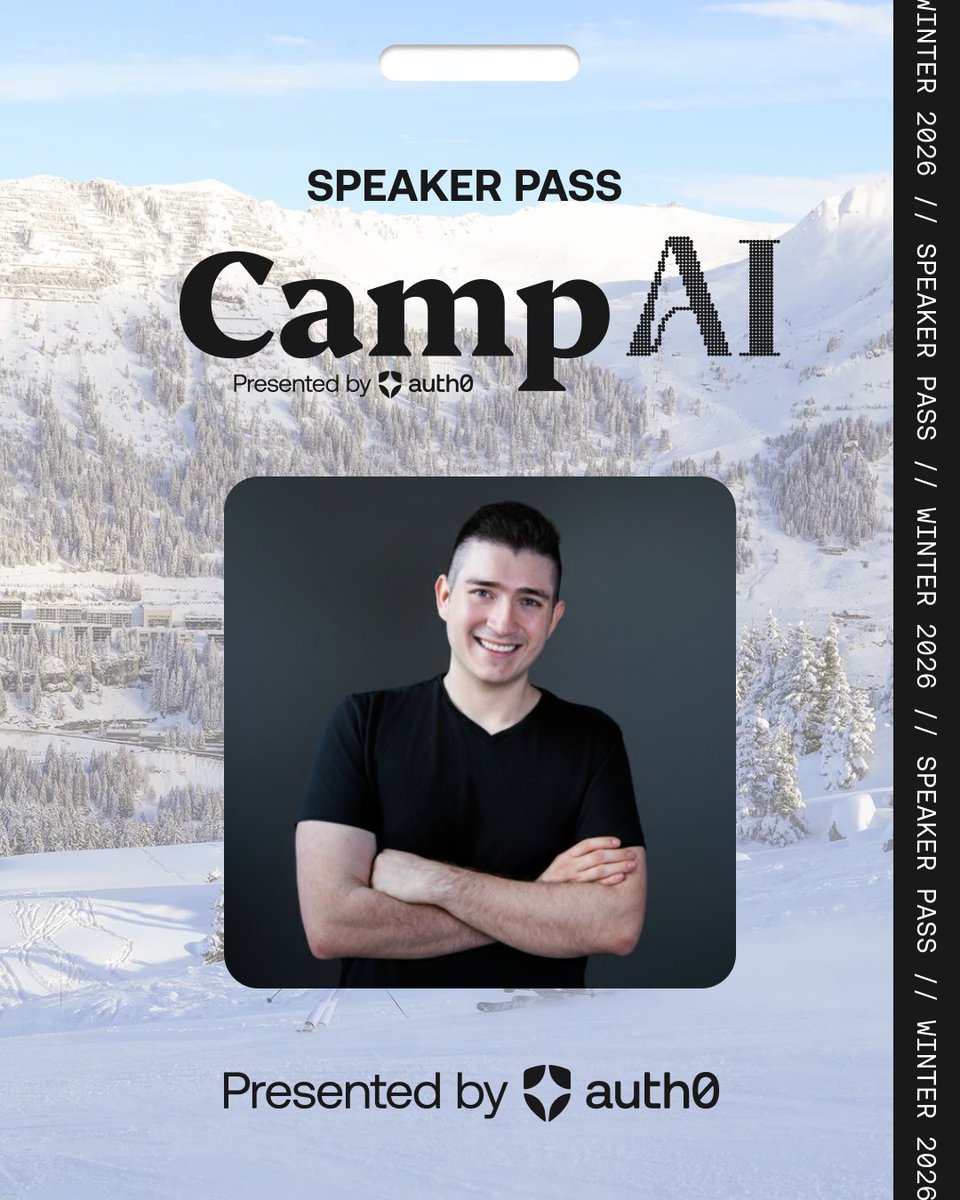
Hearing from @nickgomez, Founder and CEO at @inkeep, on agents for CX and Ops 🤖 Big focus on how AI agents can streamline support, reduce friction, and actually drive real operational impact. Practical, actionable, and forward looking 🚀
Auth0 tweet media
English
1
0
2
290
Nick Gomez
Nick Gomez@nickgomez·
Excited to be presenting tomorrow at @auth0's CampAI night! I'll be sharing a live demo and keynote on how teams can build Agents that use MCP tools on the Inkeep platform. Link to sign up in the comments 👇️ 👇️ 👇️
Nick Gomez tweet media
English
3
0
5
287
Nick Gomez
Nick Gomez@nickgomez·
Last week was one of the densest week in GenAI since ChatGPT launched. The Opus 4.6 vs. GPT-5.3-Codex same-day release, OpenClaw's security chaos, and Apple going all-in on agentic coding signal that 2026 is the year agents go from demos to production. One thing clear to me is that enterprises are about to demand reliability, controls, and predictable builds. And while prompting is the dominant interface today, I think visual, no-code agent studios will become the translation layer between builders, operators, and governance, and perhaps AI agents within inside enterprises. At Inkeep, we’re betting on both. Great prompting for speed and accesibility, and visual studios for visual clarity, collaboration, and control as agentic work goes mainstream. We're excited by what's to come this year.
English
1
0
1
239
Nick Gomez
Nick Gomez@nickgomez·
@rauchg I agree — and this also extends to non-engineering teams. For example, our GTM team is extending their capacity through Skills in Claude Code & Cursor to get more done. It’s an even bigger unlock once they learn how cron jobs work (and we obviously make them use @vercel 😉).
English
0
0
0
389
Guillermo Rauch
Guillermo Rauch@rauchg·
The new engineering is building the agents that "take your job", but now do it at 100x the scale. Agents give developers horizontal scalability. The simple version of this is Ghostty splits and tabs, 𝚝𝚖𝚞𝚡 sessions and the like, running CLI agents in parallel. Skills and MCPs help you direct the behavior of these agents. Sandboxes give the ultimate leverage: ~infinite parallelism, run while you sleep, on PRs, when an incident is filed, a customer reports an issue… Automating the full product development loop is now your job, and your edge.
Guillermo Rauch tweet media
Naval@naval

Vibe coding is the new product management. Training and tuning models is the new coding.

English
106
108
1.9K
174.3K
Nick Gomez
Nick Gomez@nickgomez·
Enterprise AI pattern we see a lot: an AI Chatbot is deployed. Deflection up, quick win for teams. Then, everyone asks for more. So another vendor, and another tool. Now you’ve got a patchwork. Context is siloed across those tools. And humans do the real work manually. Scaling then stalls. In the Agentic era, enterprise teams need AI that connect different tools, reason across tasks, and act to get real work done. That’s what we’re building @inkeep. DMs open to see how it works.
English
0
0
4
276
Nick Gomez
Nick Gomez@nickgomez·
Bundled AI is the new "free" feature that costs you more than you realize in Enterprise AI. But here's the real issue: the upfront savings disappear when you count what happens downstream. We're seeing this play out in real conversations. Prospects tell us they're evaluating doc platforms that bundle AI at lower cost. The math looks obvious—why pay for a dedicated platform when you get AI "included"? Then we dig into what "included" actually means. What's missing in most bundled AI: 1. Agentic workflows that can actually resolve issues, not just surface links 2. MCP primitives to connect the app to those agentic workflows 3. RAG for guardrails that prevent confident wrong answers at scale That last one matters more than people think. At Inkeep, guardrails are foundational to how we approach enterprise reliability. Because one hallucinated answer to a technical question can erode trust faster than a hundred correct ones. We just had a prospect running a structured evaluation across three vendors. One competitor was winning on quality, and the bundled option was winning on cost. But when they mapped out support escalations, ticket volume, and engineering time spent correcting AI mistakes, the "cheaper" option stopped looking cheap. Enterprise buyers who model total cost of ownership see this clearly. Weak AI creates downstream support costs that exceed platform savings within months. The bundling trend mirrors broader SaaS consolidation. But sophisticated buyers aren't racing to the bottom, they're asking better questions about what quality actually costs.
English
0
0
3
130
Nick Gomez
Nick Gomez@nickgomez·
Hot take: DevRel should own sales pipeline attribution. Why? Because technical buying decisions are now happening through answers, not sales conversations. Increasingly, those answers are being evaluated by coding agents inside a developer’s terminal (e.g. Claude Code) or IDE (e.g. Cursor) long before a demo is booked. I've noticed this more with forward looking companies on our last ~15 sales calls at Inkeep. Enterprise buyers weren't just asking about features. They were telling us they'd already tested our AI against competitors, inside our documentation. One prospect ran 50 questions through our docs before ever booking a demo. Their verdict: "Your response quality was significantly better than our current vendor." That's a buying decision happening before sales even knows the prospect exists. Documentation is where technical buyers & coding agents stress-test AI quality. They evaluate answer accuracy, citations, and whether the knowledge base is complete enough to trust in real workflows. Yet most companies still treat docs as a cost center buried under support or engineering. The shift requires a mindset change, not a technology overhaul. DevRel and DevEx teams already understand what technical buyers need and know how to write good docs (or should at least). So they're closer to the evaluation experience by coding agents or technical buyers than marketing or sales will ever be. Give them conversion metrics. Let them instrument docs as a funnel surface. Track which answers generate pipeline, not just which pages get traffic. So in summary: Developer experience (good APIs, easy authentication, webhooks, test environments, programmatic equivalents for all features) will become the most important differentiators for SaaS products as agents become systems of record and companies adopt agent workflows.
English
0
1
8
397
Chris Tate
Chris Tate@ctatedev·
Introducing json-render AI-generated UI. Deterministic output. 1. Define your component catalog 2. AI steams JSON 3. Render interactive UI Let users prompt dashboards, widgets and apps - safely constrained to components and actions you define
English
252
467
6K
676.5K
Nick Gomez
Nick Gomez@nickgomez·
Spoke with a technical CX leader at a 500-person, $100M+ ARR company evaluating Inkeep. It was quiet revealing about the state of technical CX. The key takeaway: CX teams don’t need another way to search faster. What CX leaders need is visibility into what’s changing before customers feel it. The failure mode is always the same. Engineering ships a change. Nobody flags doc impact. Support sees tickets from confused users. The doc team finds out weeks later through escalations. Customer trust drops with every stale page. At scale, that’s not a docs problem. It’s a coordination system problem. Here's the mechanism most vendors miss: 1. Engineering ships a feature change 2. No one flags the doc impact 3. Support gets tickets about outdated content 4. The doc team finds out weeks later through escalation 5. Trust erodes with every stale page Inkeep helps teams close the loop by ingesting customer questions and knowledge sources, analyzing gaps, then acting where work lives. That’s why we built knowledge gap reports and feature gap tracking. And with Inkeep Agents, teams can go a step further by drafting updates, opening the right tickets, and routing work to the right owner. So the takeaway for anyone running CX at scale: Optimize for building systems for maintain information across teams who don't naturally talk to each other.
Nick Gomez tweet media
English
1
1
7
416
Nick Gomez
Nick Gomez@nickgomez·
Yesterday, Anthropic shipped Claude Cowork, bringing the power of agentic workflows to non-developers. In practice, this means non-developers can now have an agent that 1) autonomously manipulates files on their local machine, 2) executes tasks on their computers, and 3) democratizes capabilities through a beautiful UI. This theme is a signal I’ve been watching for in 2026, as we’re entering the year AI agents go mainstream; where agents move from “chatting about work” to “doing work” inside the files and tools people already use. But trust remains a bottleneck. That’s because for agents to go mainstream, they need to earn the user’s trust, and personalization is the driving lever. So in essence, differentiation is now the personalization layer. In practice, this means agents that know your sources-of-truth content, use knowledge that’s yours (not generic web fluff), and produce outputs that match your brand and policies. At Inkeep, we’re seeing this pattern play out across dozens of deployments. The teams winning aren’t the ones with the most sophisticated base models (that’s table stakes). They’re the ones building deeply personalized agents, grounded in their knowledge base, brand, and business tools. The UX gap between a generic agent and a personalized one is going to grow exponentially. This is true for both enterprise and consumer. The most personalized agent wins adoption. If you’re making big bets on Agents this year, then reach out. Happy to share what we’re learning.
English
1
0
3
203
Nick Gomez
Nick Gomez@nickgomez·
Forcing your team to take 2 weeks off sounds like a terrible startup strategy. But it's one of the best operational decisions we've made at Inkeep. For the first 18 months of building, nobody took real time off. When you're a small team, every person is load-bearing. PTO feels impossible when there's no coverage. So we made a counterintuitive call last month: every December, we completely shut down the company for 2 weeks. The world naturally slows down in the last 2 weeks of the year, so a forced rest prevents the slow burnout that kills velocity in Q1. We expect a lot from our team. So the standards only holds if we design for sustainability. We're lucky to work an amazing team, and this is a small way we can say thank you for all their hard work during the year. Looking forward to what 2026 has to bring. [Photo from our offsite in Hawaii]
Nick Gomez tweet media
English
1
1
7
312
Nick Gomez
Nick Gomez@nickgomez·
A pattern I keep seeing in Support teams: Support teams get an AI tool that searches docs. They use it for basic queries, but for technical questions they open Cursor or Slack senior engineers directly. That's not a workflow problem, but rather a signal of underlying issues in the documentation process. Why? Because documentation gets outdated, very fast especially now with tools like Claude Code and Cursor. So this docs are just drifting very quickly. And Support engineer knows this. So when a tricky ticket lands, they skip the AI that searches 3,000 pages of docs and go straight to the source of truth: the code. This is where RAG breaks down. Not because retrieval is bad or generation is weak, because the knowledge base itself is a lossy abstraction of reality. The companies solving support at scale aren't dumping more docs into the system. They're giving AI access to what their best support engineers already use: code, configs, changelogs, production context. Curation beats accumulation. If your support team is bypassing your AI tools, don't blame the team. Ask what signal they're responding to that your AI can't see.
English
0
0
3
127
Nick Gomez retweetledi
Inkeep
Inkeep@inkeep·
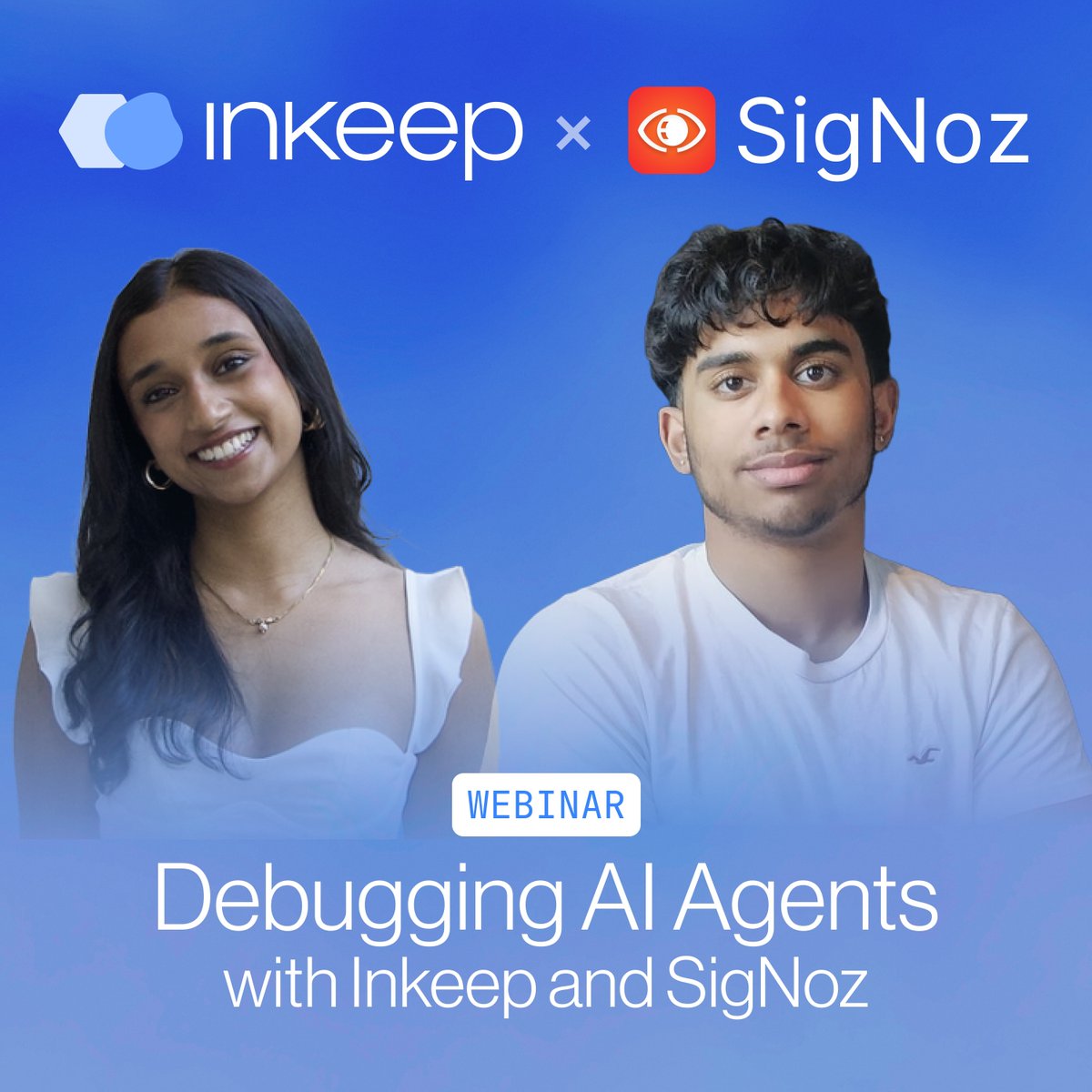
Debugging AI agents in production is broken ⚠️ Non-determinism, LLM latency, and token costs make traditional observability fall short. Join @inkeep × @signozhq for a live webinar on Debugging AI Agents: Observability Best Practices and see how teams trace agent execution, tool calls, latency, and token usage in real time. 🎤 Speakers and Moderators: - Shagun Singh (Speaker) — Software Engineer @ Inkeep - Goutham Karthi (Speaker) — Software Engineer @ SigNoz - Anushka Karmakar (Moderator) — PMM @ SigNoz - @gauravnvarma (Moderator) — DX Engineer @ Inkeep 📅 Jan 28 | ⏰ 11:30–12:10 PM PT | 📍 Zoom 💬 Event link in the comments below
Inkeep tweet media
English
2
3
4
338
Nick Gomez retweetledi
Inkeep
Inkeep@inkeep·
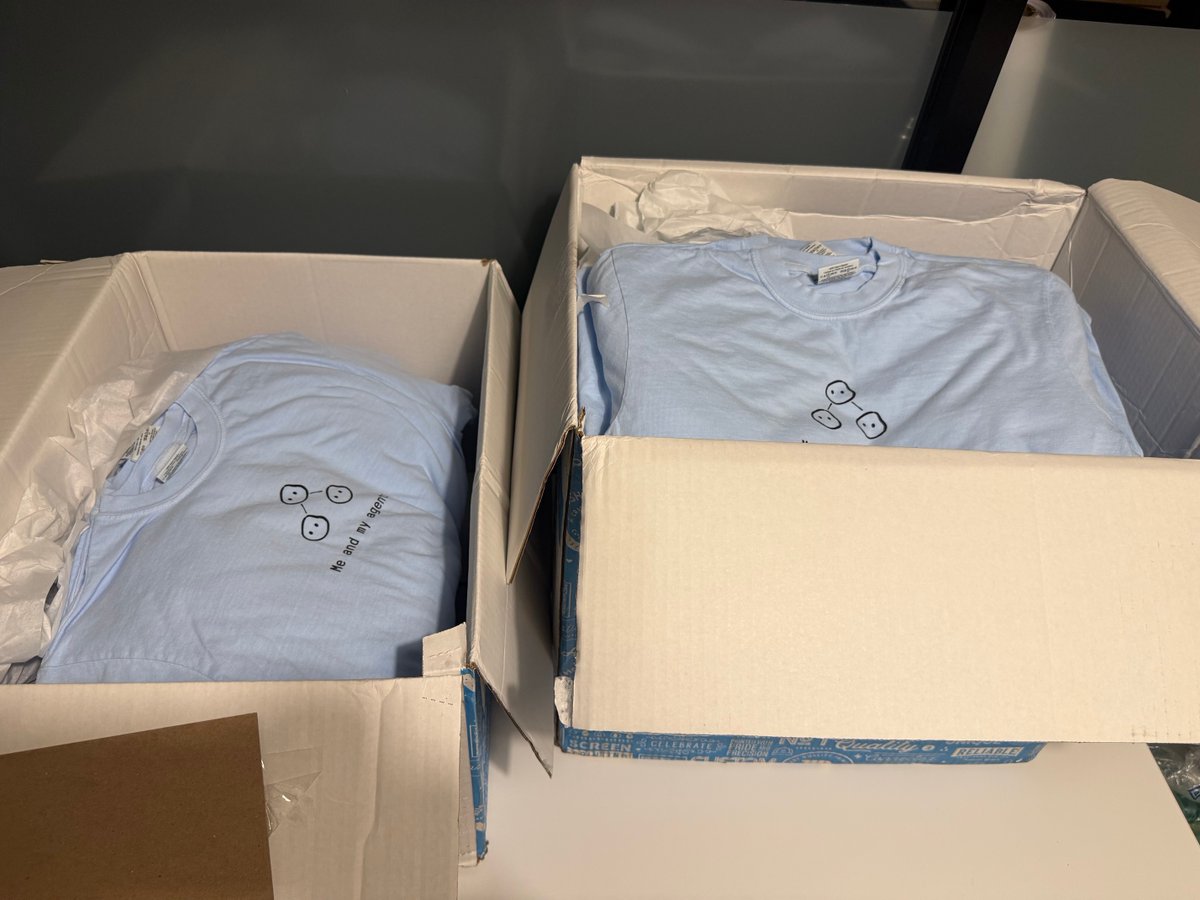
📦 Two full boxes of 𝘔𝘦 𝘢𝘯𝘥 𝘔𝘺 𝘈𝘨𝘦𝘯𝘵𝘴 shirts just dropped- they sell out at hackathons every time. Build an agent with @inkeep (include an MCP server), tag us, and we’ll send you one free 👕 Quickstart 👇
Inkeep tweet mediaInkeep tweet media
English
1
1
3
290
Nick Gomez
Nick Gomez@nickgomez·
9 -> 21 employees. RAG -> Agents. Some lessons on how we scaled an AI-first team. 2025 milestones were great: - Closed first set of S&P500 and large enterprise deals - Raised 13M seed and were highlighted in @ForbesUnder30 - Open-sourced our Agent Platform and expanded @inkeep to cover RAG, Agents, and AI Workflows for CX & Ops teams. But the real challenge of 2025 was moving from "founder-led everything" to "founder-led systems". In the first stages of Inkeep, my cofounder @robert_inkeep and I had our hands in everything: sales, support, success, and engineering. We rode @ycombinator's advice of "do things that don't scale" to the max by personally driving every customer interaction pre- and post-sales. We wanted to both "wow" customers and to keep a close pulse so we didn't miss any learning. In early 2025, we hit a ceiling on that approach (even as assisted by AI). We realized we were doing work for areas that now had solid playbooks. We weren't adding anything novel + we were getting spread thin. So, we raised around and spent the latter half of the year recruiting and learning to build a team that enabled Robert and me to focus on the most gnarly or high-opportunity parts of the business. Here were 4 counterintuitive lessons: 1. Hire when a problem starts looking the same and you've found a playbook that's "80%+ there" (not earlier). This lets you know what to look for in a hire. 2. Early on, prefer operators who can do the work and set a template for how a role should be done. Ex-founders or high-caliber mid-career folks can work well. 3. Don't be shy about expectations or feel the need to hide messiness. The more you share, the more you mutually know if someone is a good fit. 4. Set an environment where assumptions are encouraged to be questioned, but don't be afraid to be opinionated. Founders can bring immense clarity. And a few for an AI-first world: 1. Systems-level thinking, attention to detail, and clarity of thought are the most valuable skills. 2. The role of an employee will be to define operating processes ("playbooks") and be looped in to resolve novel edge cases. Hire for this. 3. Come up with hiring criteria and use AI to ideate on questions that tease out those skills. Surprisingly useful. 4. The "Jobs to be done" framework used in product management can work well for defining the work that needs to be done internally (by employees or AI). We've found these guidelines to help us hit the right mix of velocity and nimbleness. You can now do so much more.
English
2
0
11
533
nizzy
nizzy@nizzyabi·
if vcs fund companies, who funds vcs?
English
88
1
151
33.1K
Nick Gomez
Nick Gomez@nickgomez·
Interesting pattern emerging in how technical teams think about AI search: Most start by asking "what features does it have?" But the teams that get the most value flip this question to "what problems does it solve that we can't solve ourselves?" One prospect recently asked about Jira integration specifics before we'd even discussed their core use case. Nothing wrong with due diligence, but I've noticed the highest-performing implementations happen when teams first map their support workflow, then evaluate tools. Features follow function, not the other way around.
English
0
0
2
249
Nick Gomez
Nick Gomez@nickgomez·
Thank you to all our customers and investors for believing in us. We're just getting started.
English
0
0
2
121
Nick Gomez
Nick Gomez@nickgomez·
That focus evolved into something bigger. Today, we're an enterprise platform that lets customer operations teams create conversational and workflow agents that transform their CX, regardless of technical background.
English
1
0
2
126
Nick Gomez
Nick Gomez@nickgomez·
Grateful to be named Forbes 30 Under 30 in the AI category. When we founded Inkeep in 2023, we wanted to solve one problem: developers spending hours hunting for answers instead of building.
Nick Gomez tweet mediaNick Gomez tweet media
English
2
0
7
542