nick

99 posts

nick

nick

@nicklb_

rust + cryptography · building multiparty computation @Arcium prev. physics @ ETH Zurich 🇬🇷🇨🇭🏳️‍🌈

Katılım Ocak 2014
359 Takip Edilen310 Takipçiler
nick
nick@nicklb_·
@LefterisJP You might want to try any other consulate in Germany or any other country for that matter. The procedure you mentioned before is done by phone and email and really only requires you to be a Greek citizen, not necessarily a resident of whatever country you're calling.
English
0
0
0
232
Lefteris Karapetsas
Lefteris Karapetsas@LefterisJP·
🇬🇷 Do I know anyone working for the Greek government? I have been trying to get in contact with the consulate here in Berlin and phones don't work and emails are sending me from 1 department to another for weeks now. A warm intro would help ...
Lefteris Karapetsas tweet media
English
13
2
19
13.8K
nick
nick@nicklb_·
@LefterisJP Πάρε το προξενείο στο Βερολίνο. Είχα ακριβώς το ίδιο πρόβλημα και με βοήθησαν να γραφτώ με ξένο νούμερο.
Ελληνικά
0
0
2
22
Lefteris Karapetsas
Lefteris Karapetsas@LefterisJP·
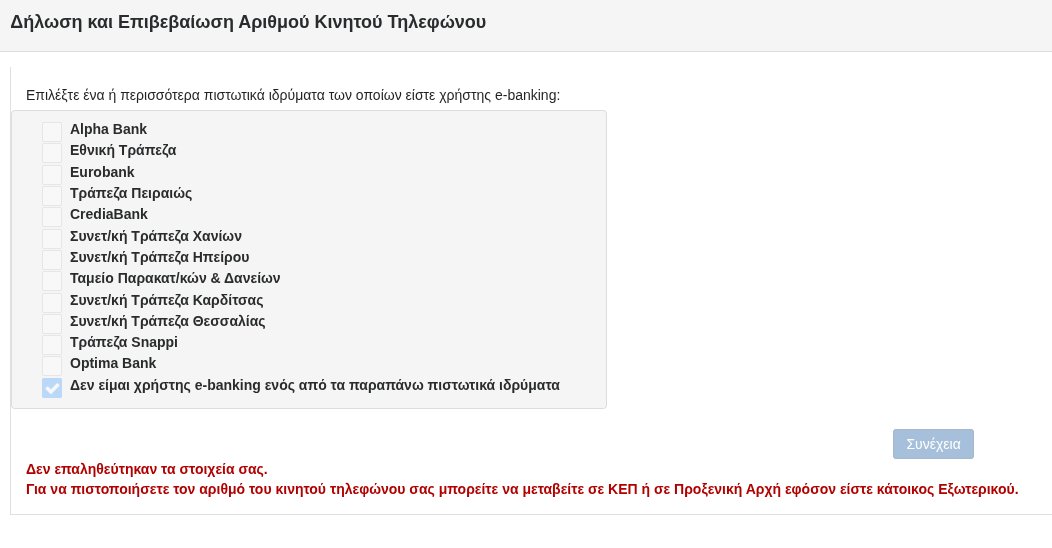
🤡🇬🇷 Greek bureaucratic insanity. - Login gov.gr to request a certificate - Login success but to do anything now you need to register a mobile number. - Thank you for registering mobile nr. Which Greek bank do you use? - None - Oh well gl. You are on your own👿
Lefteris Karapetsas tweet media
English
14
2
34
3.6K
nick retweetledi
milian
milian@milianstx·
TL;DR - Privacy on public blockchains has historically been fragmented and episodic. Umbra introduces persistent, expressive privacy by default. - Umbra is a private financial layer on Solana, enabling private transfers, swaps, balances, and yield within a continuous shielded environment. - Umbra combines client-side zero-knowledge proofs for anonymity with MPC for confidentiality - MPC enables confidential balances via Encrypted Token Accounts (ETAs), hiding balances and transfer amounts - Privacy strength depends not only on cryptography, but on anonymity set size and user behavior. - Umbra treats anonymity sets as a first-class metric and designs the product to minimize behavioral privacy failures. - A multi-purpose shielded pool allows funds to remain private across transfers, swaps, and yield, compounding privacy over time. - The Umbra SDK allows wallets and applications to integrate private transfers, swaps, and balances, feeding activity into a shared shielded pool. - Swaps execute via public liquidity venues while identity, balances, and intent remain unlinkable. - Users can earn yield on shielded assets, incentivizing longer time in the private environment. - Umbra mitigates exit-related privacy risks through product design, including anonymity indicators, configurable unshielding delays, and confidential balances. - UTXO-based shielded systems suffer from performance decay as balances fragment into many notes over time, increasing scan and aggregation costs. - Umbra eliminates this bottleneck by consolidating balances into Encrypted Token Accounts (ETAs), using UTXOs only at the anonymity boundary. The result is encrypted balances with stable, high-performance transfers even as activity scales. - Compliance is addressed through proactive screening against risk databases and opt-in selective disclosure via read-only viewing keys. - Umbra was launched via MetaDAO as an ownership coin, with governance and economic policy determined by token holders through futarchy. - Umbra is not a mixer or a single feature, but a sovereign privacy domain with its own private state and internal economy. - Umbra is Hopecore for Privacy. Thank you all for reading!
milian@milianstx

x.com/i/article/2014…

English
24
24
188
13.6K
nick retweetledi
Gwart
Gwart@GwartyGwart·
when some nerd says “ZK solves this” and you know it doesn’t but you also don’t know how ZK works
Gwart tweet media
English
130
95
2.1K
88.9K
nick
nick@nicklb_·
Great writeup! One specific note I'd have on the PET comparison is that MPC-based solutions offer the exact same composability benefits as FHE, and are not restricted to just the MPC participants. In fact the FHE + threshold decryption setup can be seen as a special case of MPC. This means the privacy model is also exactly the same, as it depends on the threshold decryption (i.e. MPC) protocol used. The main difference between the two in the private shared state setting is public verifiability (anyone can re-run the FHE state transition themselves and check against the published ciphertext), though this is also achievable in MPC. Additionally, scaling to more parties is easier in the FHE case because the cost of computing the state transition is independent of the number of keyshare holders (the cost of decryption is usually not, however).
English
0
0
1
106
Daniel Shapiro
Daniel Shapiro@_dshap·
1/ We just published our deep dive on fully homomorphic encryption (FHE), the cryptographic primitive enabling computation directly on encrypted data. With @Zama launching on mainnet, we believe it is time to pay attention to the space.
Daniel Shapiro tweet media
English
19
7
91
48.4K
nick
nick@nicklb_·
@badcryptobitch Depending on the liveness guarantees, IA can be pretty important. You don't want a single node to be able to censor transactions without being identified (for dishonest majority). And there are cheap enough IA-DM protocols today that the tradeoff is very tolerable.
English
0
0
2
34
Mikerah
Mikerah@badcryptobitch·
i can't be the only one that thinks that for the most part, identifiable abort in MPC protocols is overrated in practice
English
4
0
4
1K
nick
nick@nicklb_·
@TACEO_IO OK, makes sense, wasn't aware that semi-honest ABY3 still maintains privacy in the active setting. Does that apply to the OMap protocol as a whole as well?
English
0
0
0
18
TACEO
TACEO@TACEO_IO·
@nicklb_ Two parties need to collude to break privacy. What attackers can do in semi-honest ABY3 is just adding additive offsets to multiplications, which is why malicious security mainly focuses on guaranteeing correctness of multiplications
English
1
0
1
25
nick
nick@nicklb_·
@TACEO_IO Nice! I think the main point with semi-honest protocols is the privacy, as just one malicious actor may be able to recover secrets on their own. I know ABY3 has a malicious flavor so I'm wondering what the hardest part would be to port the protocol to the active setting
English
1
0
1
38
TACEO
TACEO@TACEO_IO·
@nicklb_ Hey Nick! 1. Long term probably yes, but that will take a while 2. The DuORAM is indeed semi-honest, but we produce a CoSNARK in the end, so integrity of the system is always given by the ZK proof
English
1
0
1
40
nick
nick@nicklb_·
@lambda0xE @badcryptobitch @KSimback In another thread you mentioned this PoC repo was only meant to test a hypothesis, can you elaborate? Without a clear spec and security proof it's impossible to take this seriously, there should have been at least a preprint months ago.
English
1
0
2
110
λ
λ@lambda0xE·
@badcryptobitch @KSimback we’ve opened up the poc and we’re continuing to update it towards a pre-prod version, if you’re interested i can walk you through the principles and explain (without insane claims)
English
2
0
5
301
Kevin Simback 🍷
Kevin Simback 🍷@KSimback·
Perfect example of what I posted yesterday Octra, a privacy chain no one has heard of, is planning a public raise at $200m val A little over a year ago they raised a $4m pre-seed, at which I presume was at a $40m val at most But yeah let’s go for the 5x+ up round and then TGE a few months later for more Xs into absolutely zero demand
Kevin Simback 🍷 tweet media
Kevin Simback 🍷@KSimback

Reality check - crypto fundraise valuations are too high In the last few years you may have been able to get away with a "2 on 20" pre-seed with not much more than a pitch deck and wireframes, then follow that up 6-12 months later with a "5 on 50" seed round well before any true measure of pmf I believe those days are over (for now) The result of raising at these high vals is that teams are incentivized to TGE too soon at even higher vals which removes much of the liquid demand thus leaving very little upside post-TGE The market has a way of finding the correct price over time and for many tokens that number is unfortunately closer to 0 than it is to the opening TGE price You can see from the data below that until 2021, median crypto fundraises were about the same, or slightly lower, than all VC fundraises Then from 2021 onwards, crypto fundraises maintained a healthy valuation premium compared to all VC fundraises Why? If as an investor I can get a quick 2-5x by unloading on secondaries and/or quickly selling unlocks, I can show great IRR and DPI numbers to my LPs to raise bigger funds, so I'm less valuation sensitive as long as I can get in the deal Note: I'm not saying that all funds explicitly operate this way, just that the incentives are present that can drive this type of behavior These high fundraise and TGE valuations also encourage teams to offload as quickly as possible as well - who knows if the price will sustain or if the product/chain will be relevant in 3-4 years after all the unlocks so better to offload whatever you can as early as possible But this year we're seeing those 2-5x quick returns are hard to come by - token prices just aren't cooperating and the secondary demand isn't as robust So the investors still deploying are more valuation sensitive It's much better for everyone involved if all these valuations got a big haircut - from the pre-seed all the way through the opening TGE val Then maybe we'd see more organic liquid demand if more upside remained after TGE, thus encouraging teams to hold longer and stay motivated to building better products that accrued more value, leading to more organic liquid demand Of course there are always exceptions where some teams are so strong that they'll raise at eye-popping levels with everyone trying to get in - this will always happen, I'm referring to the other 99% of deals

English
33
9
67
53.4K
nick
nick@nicklb_·
@luhelminger @pratiks_crypto @gm_usi What does "offering services in the EU" look like when you're building on a permissionless network? Geoblocking your frontend and calling it a day? Or do EU courts claim jurisdiction over everything by default?
English
1
0
1
34
Lukas Helminger
Lukas Helminger@luhelminger·
@nicklb_ @pratiks_crypto @gm_usi I guess you mean t=N-1 ad jurisdiction: this is non-trivial as for example you can fall under the GDPR by only offering service in the EU (without having the server in the EU)
English
1
0
1
33
Lukas Helminger
Lukas Helminger@luhelminger·
Why do tech and TradFi companies deal with data-protection rules, and blockchain infra or DeFi mostly do not? People keep saying it is decentralization. It is not.
English
3
0
6
540
nick
nick@nicklb_·
@pratiks_crypto @luhelminger @gm_usi Also curious. I'd assume if t = N then it's similar to having your data stored in plaintext on N different servers. For t < N, any one operator could blame another subset for the leak, so if they're in different countries I'm not sure which one would have jurisdiction.
English
1
0
1
27
Pratik Sarkar
Pratik Sarkar@pratiks_crypto·
@luhelminger @gm_usi In MPC-based solutions, if the trust assumption is broken then the MPC operators see the data. In such a case, will data protection laws apply to it? Asking from a legal standpoint, not a cryptographer's POV.
English
2
0
1
42
nick
nick@nicklb_·
@kyle_corsola Don't you still have to trust that t-out-of-n ceremony participants didn't collude to learn the secret payload? You can never be sure at the end of the day, so I don't think that assumption ever goes away
English
1
0
1
27
Taproot 🇮🇱
Taproot 🇮🇱@kyle_corsola·
@nicklb_ I think actually since its just the Initial ceremony, it becomes n-out-of-n. And yes imo a main bottleneck rn is verifiable fhe.. I heard theres a specialized fheVM for tfhe or something but I need to read more.
English
1
0
0
30
Taproot 🇮🇱
Taproot 🇮🇱@kyle_corsola·
It seems obv to me that for privacy to take the next jump, shared private state is a must. But having an t of n decryption assumption is a non-starter. No committees.. kinda seems like iO is inevitable.
English
3
0
8
487
nick
nick@nicklb_·
@kyle_corsola In the end the advantages seem to be no-communication private compute and decryption, and guaranteed liveness (as long as the underlying chain is live). For privacy you still get the trust assumptions of the MPC ceremony
English
1
0
1
22
Taproot 🇮🇱
Taproot 🇮🇱@kyle_corsola·
@nicklb_ Yeah so I think u need mpc for the initial ceremony, but after that I dont think you do. And yes I think zk for external players for verification seems reasonable, the machina team talks about both these things u bring up in their recent draft.
English
2
0
0
41
Pratik Sarkar
Pratik Sarkar@pratiks_crypto·
@luhelminger Can you share which FHE schemes ? I hope the assumptions are battle tested.
English
1
0
3
141
Lukas Helminger
Lukas Helminger@luhelminger·
FHE will help in the long-term decentralising the private shared state infrastructure but signals get stronger that it won’t be based on TFHE I’m excited to see people working on new FHE schemes similar development as in ZK with proof systems
English
8
0
25
1.2K
nick retweetledi
noyb
noyb@NOYBeu·
🇪🇺 "I am surprised and concerned that the GDPR is being reopened and weakened at its core […]" 💬 Read the full article, including comments from Max Schrems and Markéta Gregorová, who is a European Parliament negotiator on the issue 👉 brusselstimes.com/1835654/secret…
English
9
41
72
4.2K