Nikolay Bakaltchev

4.5K posts

Nikolay Bakaltchev banner
Nikolay Bakaltchev

Nikolay Bakaltchev

@nikolaygb

From Physics to Creative AI... 🌎🌍🌏

Zurich, Switzerland Katılım Nisan 2009
7.5K Takip Edilen2.1K Takipçiler
LilHumansBigImpact
LilHumansBigImpact@BigImpactHumans·
Scientists have found “hidden shortcuts” in the orbital paths of asteroids that could slash the round-trip travel time to Mars to as little as 153 days. This is great news for the Starship program.
LilHumansBigImpact tweet media
English
26
27
224
8.3K
Nikolay Bakaltchev
Nikolay Bakaltchev@nikolaygb·
🔮💪🚀
Jaynit@jaynitx

In 2007, Elon Musk predicted: SpaceX will replace the space shuttle by 2011. Tesla will make a $30,000 car. Solar power will be “a really big deal.” SpaceX had never reached orbit. Tesla had never delivered a car. He spent 20 minutes explaining everything he saw coming: The interviewer pushed back. What about Richard Branson? "What Branson is doing is a much smaller technological challenge. His craft is suborbital. It goes to Mach 3. Our craft is orbital. Mach 25." "But that doesn't describe the whole scale of difficulty. The energy required scales to the square of velocity." "To do what Branson is doing, you need 9 units of energy. To do what we're doing, you need 625." "What Branson is building can cross the English Channel. What we're building can circumnavigate the globe." "I still think what he's doing is great. I bought a ticket on his effort. But it's not in the same league technologically." So what does worry him? "The things that can really hurt SpaceX are our own foolishness. Our own errors. But none of the competition that I'm aware of." This was 2007. SpaceX had never reached orbit. He had already mapped the future. "When the shuttle retires in 2010, starting in 2011, SpaceX's rocket will replace the space shuttle in servicing the space station." It happened. "The Model 2 of Tesla is a $49,000 four-door five-passenger sedan. The Model 3 is intended to be around a $30,000 price point. That's affordable by almost everyone who can buy a new car." It happened. The interviewer asked about his trajectory. From physics at Stanford to Zip2 to PayPal to rockets. "When I graduated from college, there were three areas I thought would be most impactful to the future of humanity." "The internet. Space exploration. And changing the economy from a hydrocarbon-based economy to one which is solar electric." He built companies in all three. The interviewer asked about NASA. "There's a confusion in the public mind that SpaceX is competing with NASA. NASA is a customer of ours." He asked about the space program. "In 1969 we were able to go to the moon. Here we are over three decades later and we can barely get to low Earth orbit. By any measure, that is a step backwards." "If you look at news articles in the late 60s, the expectation was that by the 21st century we would have a moon base and probably a Mars base." "If you'd asked anyone at that point whether we would be unable to go to the moon and not have been to Mars, they would think you're crazy." The interviewer asked about the moon. "I don't think we should be going back to the moon. We should be focused on Mars." "The moon is kind of like the Arctic. Very barren. Very little resources. Not a place we could establish another human civilization." "We saw that movie in the 60s. The remake's never as good." Then came the lifestyle question. You've made a fortune. Ever thought about sitting on a beach drinking beer? "I find that really pretty boring. That would be torture if I had to do that every day." "I really need to be preoccupied with something. If I'm just sitting there relaxing, I can only do that for a very short period of time and then it becomes unbearable." A friend of his has a phrase for startups. "A startup is like eating glass and staring into the abyss." So why do it? "For me it's always about: does what I'm doing matter if we are successful? Does it matter to the world?" "There are easier ways to make money than starting a rocket company or a car company." "The interest in Tesla is not that the world needs another car company. It's that we have a very important environmental problem. Global climate change is going to be one of the most significant issues of the 21st century." "The only way to get around that is with an electric vehicle paired with zero-emission power generation. Solar power is going to be a really big deal." The interviewer asked about selling Tesla to a big car company. "Right now the big car companies believe that a viable electric vehicle is not possible, and even if it was, people wouldn't buy it." "We need to show that neither of those are true. That the technology works. That people want to buy it." "If we sold to one of the big car companies, it would really slow things down." On his daily routine: "I'm not an early morning person. I tend to get up around 7:30 or 8 and be in the office around 9:30. But I stay until about 8pm." On his office: "I just have a cubicle at SpaceX. Surrounded by my colleagues." On legacy: "What I'd like to do is help solve some important problems." "With respect to space, I hope to help make humanity a multiplanetary species." This 20 minute interview will teach you more about vision, ambition, and betting on yourself than every biography combined. Bookmark & give it 20 minutes today, no matter what.

ART
0
0
0
7
Manu Sisti
Manu Sisti@Manu_Sisti·
Claude is literally a money-making machine. I used it to create a 90-page nonfiction eBook... now it generates me $4K–$5K/month. Usually, I charge $199 for this killer guide, but today I'm giving it away 100% FREE. Inside: • The exact prompts I use • My step-by-step workflow • How to turn one book into monthly income Like + comment 'Claude' & I'll send you my step-by-step guide for FREE. Must follow me to get DM. FREE for 48 hrs.
Manu Sisti tweet media
English
1.2K
158
1.7K
171.8K
Nikolay Bakaltchev retweetledi
Physics & Astronomy Zone
Physics & Astronomy Zone@zone_astronomy·
The highest quality video of the moon was just released… this is so beautiful.
English
5.2K
65.3K
333.1K
11.2M
Nikolay Bakaltchev
Nikolay Bakaltchev@nikolaygb·
💡
Andrej Karpathy@karpathy

Wow, this tweet went very viral! I wanted share a possibly slightly improved version of the tweet in an "idea file". The idea of the idea file is that in this era of LLM agents, there is less of a point/need of sharing the specific code/app, you just share the idea, then the other person's agent customizes & builds it for your specific needs. So here's the idea in a gist format: gist.github.com/karpathy/442a6… You can give this to your agent and it can build you your own LLM wiki and guide you on how to use it etc. It's intentionally kept a little bit abstract/vague because there are so many directions to take this in. And ofc, people can adjust the idea or contribute their own in the Discussion which is cool.
ART
0
0
1
28
Nikolay Bakaltchev retweetledi
Massimo
Massimo@Rainmaker1973·
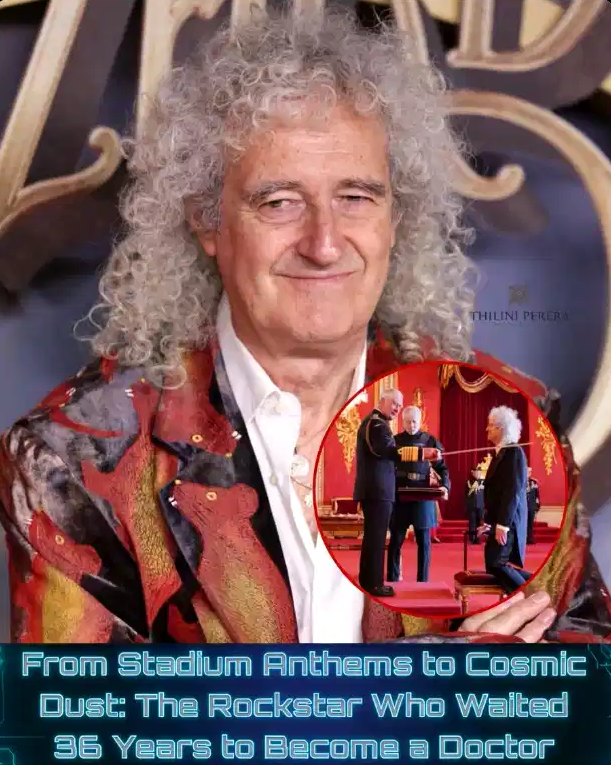
In 1970, a 23-year-old physics student at Imperial College London found himself at a life-altering crossroads. Brian May was deep into his doctoral research on cosmic dust—specifically the zodiacal dust cloud, the tiny particles that drift through the solar system and scatter sunlight. His PhD was well underway, and a promising academic career in astrophysics lay ahead. But there was another path calling him. May was also the lead guitarist of a newly signed rock band named Queen. With a record deal secured and tours on the horizon, the band’s momentum was building fast. Faced with an impossible choice between the guitar and the telescope, May made his decision: he paused his studies and bet everything on music. Queen’s ascent was meteoric. By the mid-1970s, they had become a global phenomenon. Timeless anthems like “Bohemian Rhapsody” and “We Will Rock You” exploded onto the charts, while May’s iconic homemade guitar, the Red Special, helped define the band’s legendary sound. Stadiums sold out worldwide, and millions of albums flew off the shelves. Yet throughout his rock stardom, May never fully let go of his scientific passion. Even at the height of Queen’s fame, he stayed connected to astrophysics—reading journals, attending lectures when possible, and maintaining contact with his former supervisor, Professor Michael Rowan-Robinson, who had once told him: “You can always come back and finish.” Thirty-six years after stepping away, in 2006, May decided the time had finally come. He reached out to Rowan-Robinson, and together they revived the long-dormant project. Though the field had moved forward and his original data needed updating, his early observations still held real scientific value. Balancing his ongoing music career with late-night research sessions, May updated his work, incorporated new findings, and refined his analysis. In 2007, at the age of 60, Imperial College London officially awarded him a PhD in astrophysics—not an honorary title, but one earned through rigorous research and peer review. Dr. Brian May had finally completed what he started more than three decades earlier. His journey is a powerful reminder that passion has no expiration date. Whether on stage under stadium lights or studying the dust between the planets, Brian May proved it’s never too late to finish what you began.
Massimo tweet media
English
45
530
3K
119.5K
Kshitij Mishra | AI & Tech
Kshitij Mishra | AI & Tech@DAIEvolutionHub·
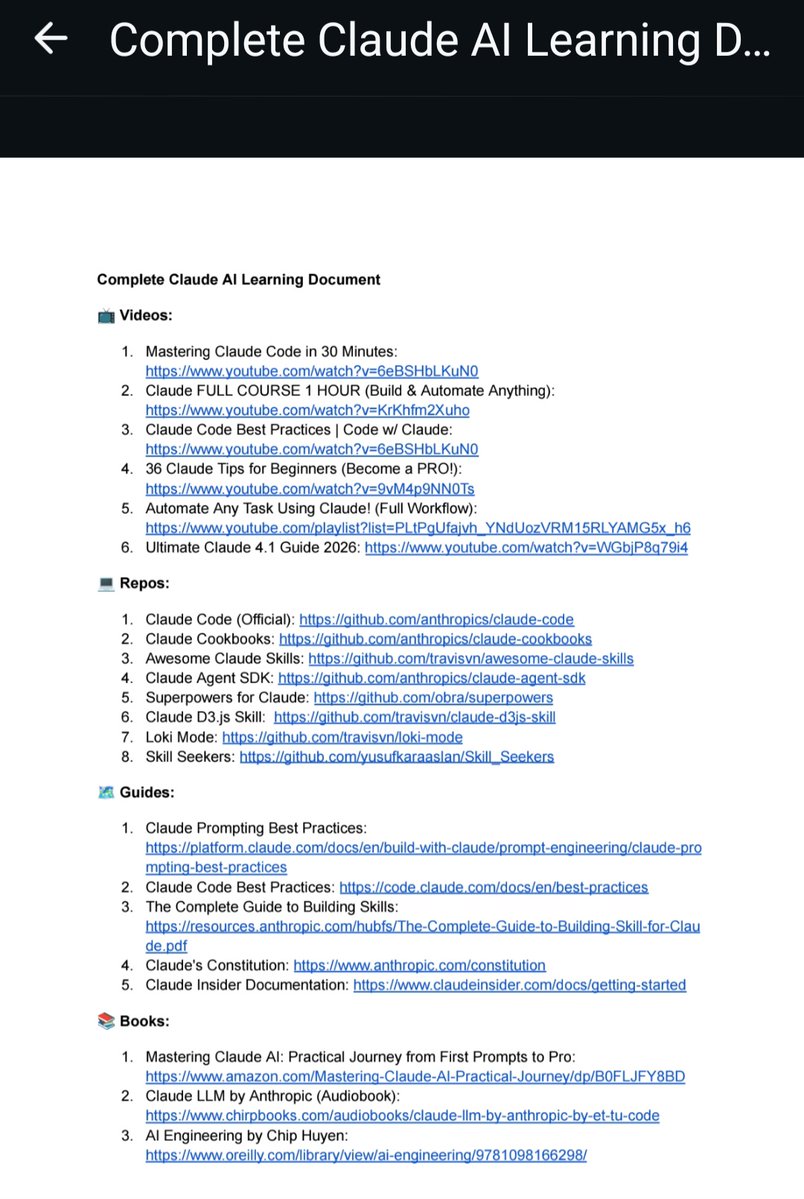
SHOCKING: 99% people using Claude are barely scratching the surface. Right now, the entire internet is screaming “Claude, Claude, Claude”... But here’s the truth: just chatting with it won’t change your life. To unlock its real power, you need to master: • agentic workflows • Claude Code • skills, automation & system-level usage I spent 100+ hours researching and compiled the best Claude resources from across the entire internet — videos, repos, guides, books, and papers. I’ll give it to only 4,500 people. To get it: 1. Follow me MUST (so i can dm) 2. Comment “Claude” 3. I’ll DM you the document 📩 If you don’t follow or comment, you won’t receive it
Kshitij Mishra | AI & Tech tweet media
English
107
26
116
13.8K