
Nirmit Joshi

25 posts

Nirmit Joshi banner
Nirmit Joshi

Nirmit Joshi

@nirmitj_

Guessing • Erring • Better Guessing

Chicago, IL Katılım Ekim 2021
197 Takip Edilen95 Takipçiler
Nirmit Joshi retweetledi

Julia Kempe
Julia Kempe@KempeLab·
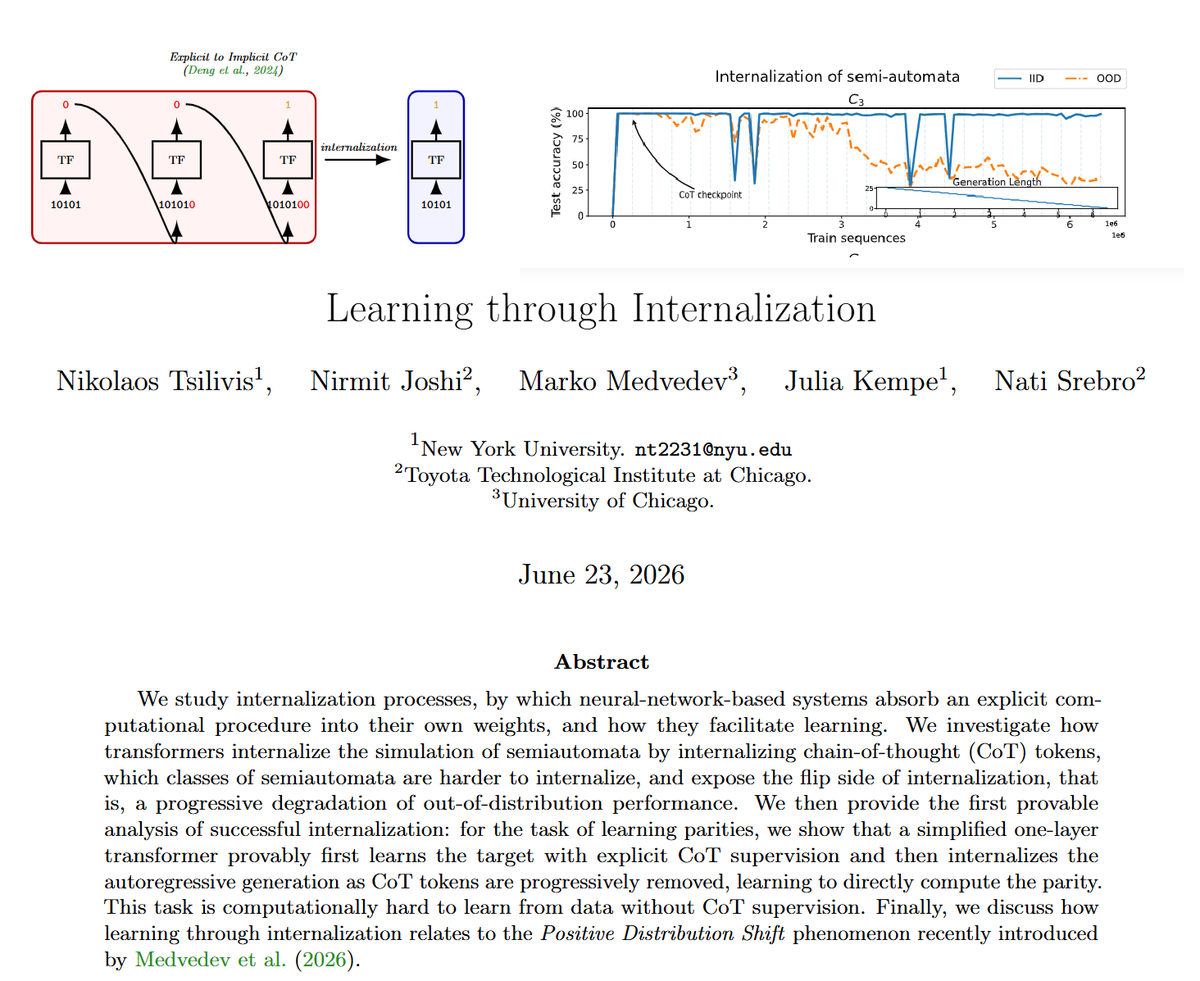
Check out our new paper on internalization: the process of gradually "absorbing" chain of thought computations during training. Our results show that internalization can work for problems that are computationally hard to learn directly. We carefully study method and task specific factors that determine internalization success. To learn more, see arxiv.org/abs/2606.20937. With @nikostsilivis @nirmitj_ @_rkomma Nati Srebro. @NYUDataScience @TTIC_Connect
Julia Kempe tweet media
English
1
38
327
29.2K
Nirmit Joshi
Nirmit Joshi@nirmitj_·
@kfountou We also have an algorithm without any such initial assumption, but that ACTIVELY collects CoTs from different thinkers and then aggregates. This only ensures E2E correctness though and we leave the study of “entire CoT correctness” like Diligent Learner paper to future work.
English
0
0
0
38
Kimon Fountoulakis
Kimon Fountoulakis@kfountou·
What do you think about the assumption that your thinkers don't make mistakes? I saw a similar assumption in the Diligent Learner paper. In there the generator model is correct with probability gamma, and there is also a verify which is always correct and can tell you where to backtrack. I guess your goal here is to teach one model what other thinkers already know? So in this case, assuming this is fine?
English
3
0
0
249
Nirmit Joshi
Nirmit Joshi@nirmitj_·
Imagine learning from multiple thinkers with different thought processes. We find that passive data from just two thinkers can be cryptographically hard to learn from. But active collection allows arbitrarily high accuracy, with per-thinker CoT independent of target accuracy.
Nirmit Joshi tweet media
English
3
3
31
2.1K
Nirmit Joshi
Nirmit Joshi@nirmitj_·
@kfountou Their learner assumes initial generator and verifier access as you said, and the goal is to produce entire CoT correct. So they make stronger oracle assumptions. Given our negative results, in passive collection, it’s worth investigating setting with stronger assumptions.
English
0
0
0
37
Nirmit Joshi
Nirmit Joshi@nirmitj_·
@kfountou Let’s chat more over email. The short answer is that, in our setup all thinkers are correct (they lead to the same final answer). The goal is to only learn final E2E mapping. Unfortunately, learning is computationally hard even though it was easy from a single thinker CoT.
English
0
0
0
69
Nirmit Joshi
Nirmit Joshi@nirmitj_·
Learning theory folks: the algorithm uses a boosting connection: a predictor trained on any one thinking style acts as a weak learner, and aggregation gives a strong learner. Overall, a landscape from hard to easy regimes based on data collection, with several open questions.
English
0
1
2
194
Nirmit Joshi
Nirmit Joshi@nirmitj_·
Are the models actually getting better at doing math, or at producing math that is harder to catch mistakes in? Still impressive and incredibly useful.
English
0
0
0
116
Nirmit Joshi
Nirmit Joshi@nirmitj_·
@CsabaSzepesvari I think this needs more than a table caption. At least at a proposition level, so that it is explicitly on the table. Will update in the next version.
English
0
0
1
106
Csaba Szepesvari
Csaba Szepesvari@CsabaSzepesvari·
@nirmitj_ Although if you state a theorem (or proposition) that will give you a chance to have a more nuanced/precise argument (because you actually need one, which explains in more details the steps of the reduction -- it all works out though nicely!)
English
1
0
0
326
Nirmit Joshi
Nirmit Joshi@nirmitj_·
Very satisfied with some neat results on imitation learning. When distribution matching isn’t possible, what’s even the role of demonstrations? Cloning/log-loss minimization? We propose directly encoding reward structure—motivating new algorithmic ideas. arxiv.org/abs/2510.15464
English
4
6
69
11.3K
Nirmit Joshi
Nirmit Joshi@nirmitj_·
@CsabaSzepesvari Thanks. In Section 2, we argue that how small S is strictly weaker assumption than small Pi—-one can form the reward class S_Pi associated with any Pi, and run the algorithm. You didn’t miss anything. We debated whether this is worth formalizing, but now I think we should have.
English
1
0
0
277
Csaba Szepesvari
Csaba Szepesvari@CsabaSzepesvari·
@nirmitj_ Cool. A clarification question: Which result in the paper backs up the result in the lower left cell in Table 2 copied here? Did I miss that result? That result is kinda important as it shows that the new learner can do as well as MLE in the situation that favours MLE.
Csaba Szepesvari tweet media
English
1
0
4
750
Nirmit Joshi
Nirmit Joshi@nirmitj_·
@alirezamh_ @HugoKoubbi Gaussian is a very special case where lower bound on samples is matched with algorithms which are also runtime optimal because one must at least take time to read the samples. But in general, algorithms that achieve both optimal runtime and sample complexity may not exist.
English
0
0
0
50
Alireza Mousavi
Alireza Mousavi@alirezamh_·
@nirmitj_ @HugoKoubbi Cool work! I had a quick look and it was interesting to see the SQ lower bound in Thm 1 depends on q, since the one I’m used to see more for Gaussians has log q, which I thought was fundamentally due to rotation invariance. How do you manage to get q instead of log q?
English
3
0
0
260
Nirmit Joshi
Nirmit Joshi@nirmitj_·
Happy to share our work (with amazing @HugoKoubbi , Theodor Misiakiewicz, Nati Srebro) We argue that spherical harmonics—rather than Hermite polynomials—provides a natural basis for this problem to obtain a more transparent picture. arxiv.org/abs/2506.09887
English
1
6
24
3.6K
Nirmit Joshi
Nirmit Joshi@nirmitj_·
@alirezamh_ @HugoKoubbi We find this analogy between SQ and samples a little murky. So for samples we are just relying on low degree polynomial framework and for only runtime we show lower bounds in SQ framework.
English
0
0
0
49
Nirmit Joshi
Nirmit Joshi@nirmitj_·
@alirezamh_ @HugoKoubbi The one you are talking about with log q is a lower bound on samples which is actually a stronger statement: it says as long as q was poly d, what is the precision tau one needs and 1/tau^2 is then taken as lower bound on the samples.
English
0
0
0
58
Nirmit Joshi
Nirmit Joshi@nirmitj_·
@alirezamh_ @HugoKoubbi Clarifications that can perhaps help: * we are showing lower bound on q/tau^2 which should be seen as lower bound on runtime (not on samples). In Gaussian also we get the lower bound on q/tau^2 for runtime.
English
1
0
0
95