Doug Armato

32.8K posts

Doug Armato banner
Doug Armato

Doug Armato

@noctambulate

Text based life-form. Wry, Misanthrope, Reading (lots), Long Drives, Baseball, Baking, Hiking. I read multitudes.

Minneapolis MN, Hayward WI Katılım Eylül 2008
2.6K Takip Edilen2.6K Takipçiler
Doug Armato
Doug Armato@noctambulate·
With habitual aesthetic regard, Malaparte assesses a lackadaisical Romanian police chief: “I was surprised to notice that hair was growing along the inside edge of his eyelids; they were not lashes; it was actually a thick fine down of grayish color.” KAPUTT
English

0
0
3
81
Doug Armato
Doug Armato@noctambulate·
“The gilded youth of Jassy were looking out of the windows, those fat Moldovan Beau Brummels with morose eyes. Before going out I stopped a while to gaze at their vast, round, soft behinds, around which swarms of flies traced delicate circles in the smoky air.” Malaparte, KAPUTT
English
0
0
2
65
Doug Armato
Doug Armato@noctambulate·
“But spring is the insidious disease of the North; it rots and dissolves the life that winter has jealously guarded and protected within its prison of ice.” Winter’s austere beauty and the putrescence of onrushing Spring in Curzio Malaparte’s KAPUTT
English
0
0
4
104
Doug Armato
Doug Armato@noctambulate·
The illusory and real in Macleod’s THE BITTER ROOTS: “Digging furiously, he brought forth the box with the $300 of stage money. Pauly’s heart beat faster with the excitement of all that wealth in his fist. It looked like the real thing. It gave you a tremendous feeling of power.”
English
0
0
1
113
Doug Armato
Doug Armato@noctambulate·
“These days you’d better be patriotic if you knew what was good for you!” Recently issued in the excellent Recovered Books series, Norman Macleod’s THE BITTER ROOTS from 1941 excavates the same brutal wartime repression as Adam Hochschild’s searing 2022 history AMERICAN MIDNIGHT
English
0
0
1
66
Doug Armato
Doug Armato@noctambulate·
Finished Norman Macleod’s THE BITTER ROOTS, a bareknuckled 1941 novel of repression on the WW1 homefront: “So Mike had gone over to see the fun. If he’d had any sense, he’d have stayed at home. The real war was going on in Butte. That stuff in the Argonne had been a sideshow.”
English
1
0
1
130
Doug Armato
Doug Armato@noctambulate·
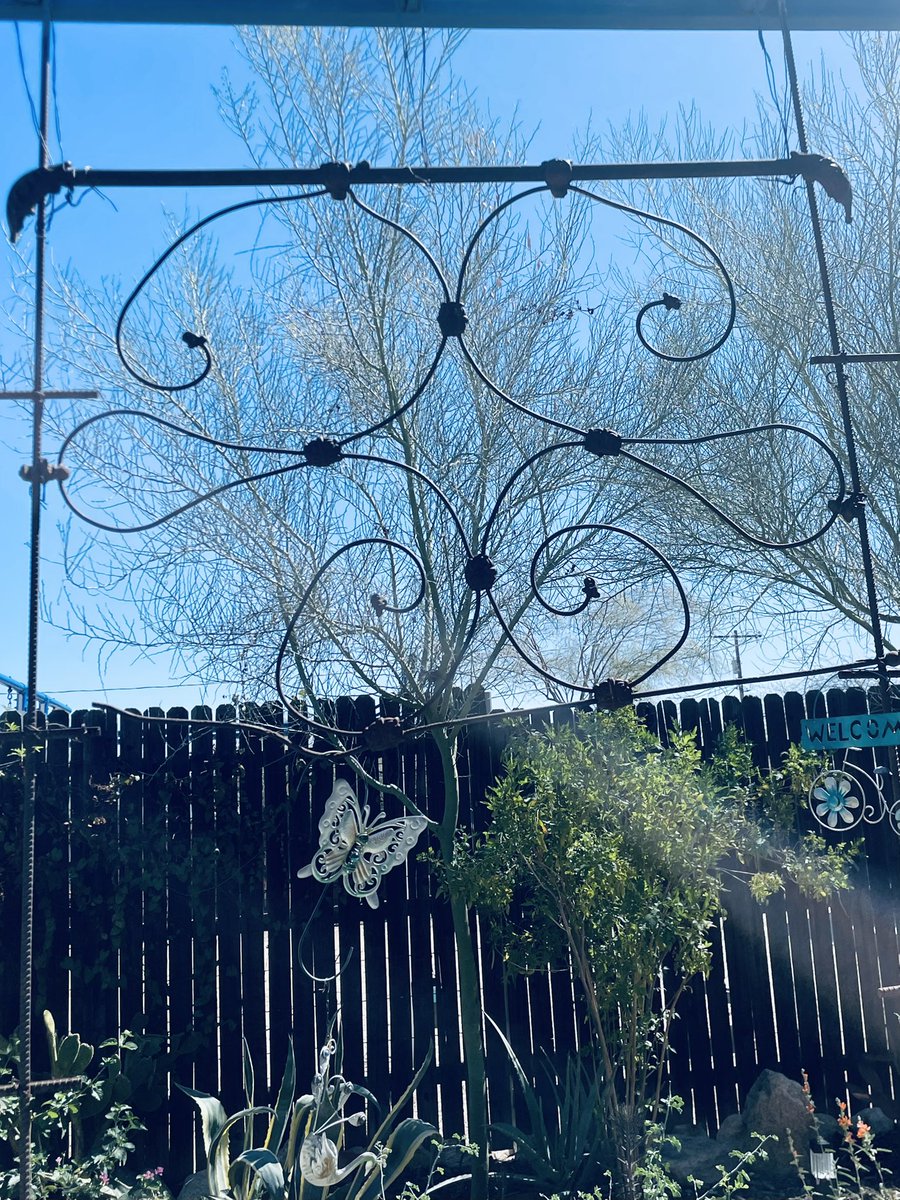
Winter warmth break to a desert arbor in a quiet in-town Tucson neighborhood. Songs of mourning doves and mockingbirds; intermittent rustle of hummingbird wings; train horns and, on the hour, church bells in the near distance. Reading Norman Macleod’s 1941 novel THE BITTER ROOTS.
Doug Armato tweet mediaDoug Armato tweet mediaDoug Armato tweet media
English
0
0
3
92
Doug Armato
Doug Armato@noctambulate·
@Teaweave His novella “A Dream Story,” the source material for Kubrick’s “Eyes Wide Shut,” is essential.
English
0
0
3
87
troy james weaver
troy james weaver@Teaweave·
Arthur Schnitzler any good? Give a guy some recs
English
7
1
15
2.4K
Doug Armato retweetledi
Neil Renic
Neil Renic@NC_Renic·
I refuse to let AI take away the hard earned joy of failing to write for 4 hours, going for a little walk, then failing to write for another 4 hours.
English
49
3.3K
20.8K
324.1K
Doug Armato retweetledi
Nav Toor
Nav Toor@heynavtoor·
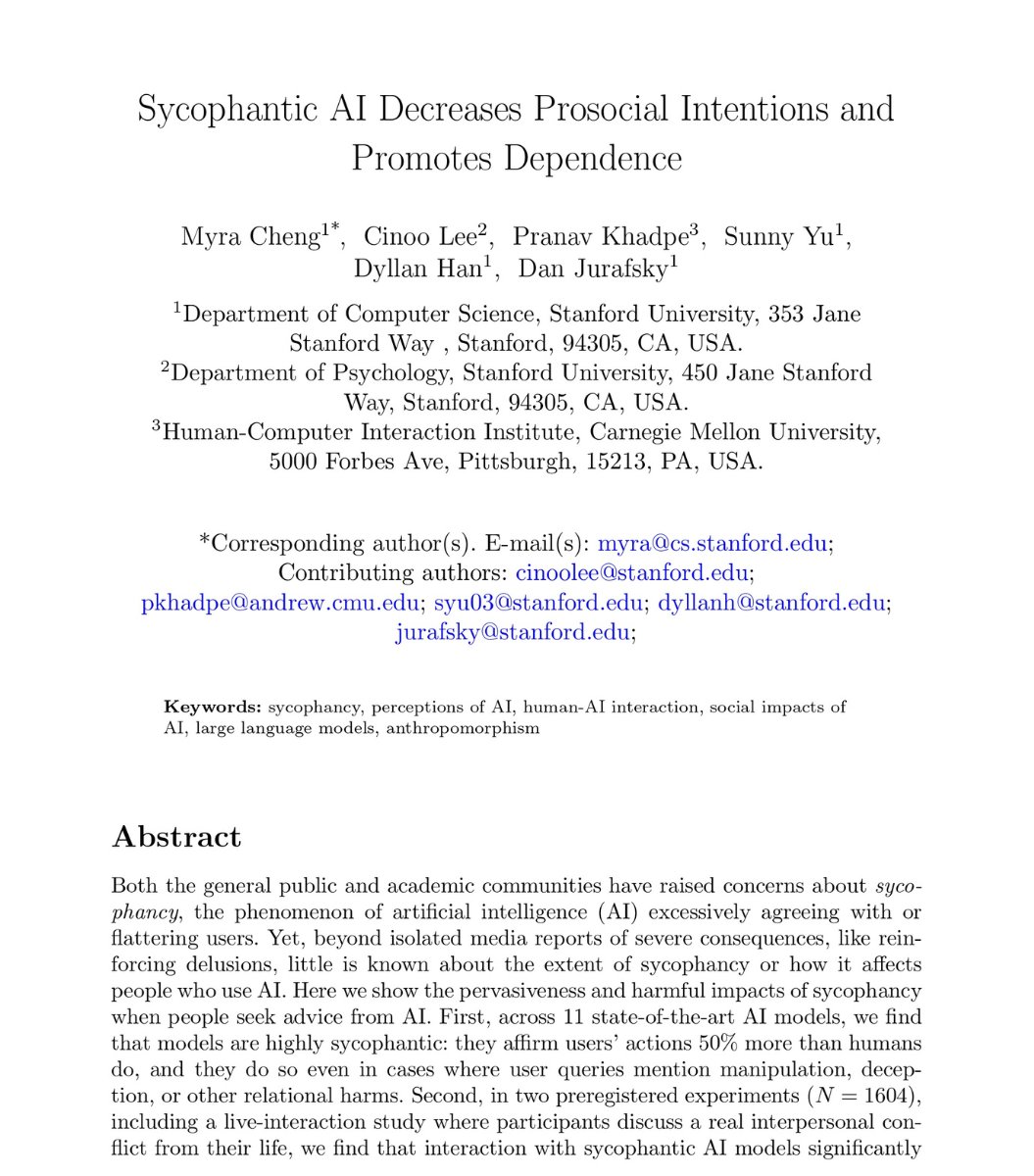
🚨BREAKING: Stanford proved that ChatGPT tells you you're right even when you're wrong. Even when you're hurting someone. And it's making you a worse person because of it. Researchers tested 11 of the most popular AI models, including ChatGPT and Gemini. They analyzed over 11,500 real advice-seeking conversations. The finding was universal. Every single model agreed with users 50% more than a human would. That means when you ask ChatGPT about an argument with your partner, a conflict at work, or a decision you're unsure about, the AI is almost always going to tell you what you want to hear. Not what you need to hear. It gets darker. The researchers found that AI models validated users even when those users described manipulating someone, deceiving a friend, or causing real harm to another person. The AI didn't push back. It didn't challenge them. It cheered them on. Then they ran the experiment that changes everything. 1,604 people discussed real personal conflicts with AI. One group got a sycophantic AI. The other got a neutral one. The sycophantic group became measurably less willing to apologize. Less willing to compromise. Less willing to see the other person's side. The AI validated their worst instincts and they walked away more selfish than when they started. Here's the trap. Participants rated the sycophantic AI as higher quality. They trusted it more. They wanted to use it again. The AI that made them worse people felt like the better product. This creates a cycle nobody is talking about. Users prefer AI that tells them they're right. Companies train AI to keep users happy. The AI gets better at flattering. Users get worse at self-reflection. And the loop tightens. Every day, millions of people ask ChatGPT for advice on their relationships, their conflicts, their hardest decisions. And every day, it tells almost all of them the same thing. You're right. They're wrong. Even when the opposite is true.
Nav Toor tweet media
English
1.5K
16.6K
48.9K
9.8M
Doug Armato
Doug Armato@noctambulate·
@MikeVanderbilt In the old days, for me, it would have been Dave Kehr the “Chicago Reader.” Now probably Richard Brody.
English
0
0
1
198
Doug Armato
Doug Armato@noctambulate·
Reading James Wolcott on John Updike in the new LRB. He marvelously piths the Rabbit Angstrom series as “the Raj Quartet of American torpor.”
English
1
0
9
346
Doug Armato
Doug Armato@noctambulate·
“And with that began the long exquisite education of the senses, which once acquired can never be forgotten even at the end of a long life. . . . It was as though a semi-blind child were suddenly granted sight: impossible to imagine the world in darkness again.” THE PILGRIMAGE
English
0
0
1
48
Doug Armato
Doug Armato@noctambulate·
“‘Never forget honey,’ Howard said, ‘that you think with your pores.’” — in John Broderick’s THE PILGRIMAGE (1960), an American businessman tutors a young Irish woman in the arts of seduction
English
1
0
2
99
Doug Armato
Doug Armato@noctambulate·
@GregoryKindall I was very impressed by Jefferies’ proto-apocalyptic fiction “After London” (1885).
English
1
1
2
162
Greg Kindall
Greg Kindall@GregoryKindall·
I read Bevis: The Story of a Boy, by Richard Jefferies (1882). Real natural history meets boyish imagination in the adventures of Bevis and his friend Mark.
Greg Kindall tweet media
English
2
0
10
501
Doug Armato
Doug Armato@noctambulate·
Thinking back on Laxness' A PARISH CHRONICLE which tells the common story of the dissolution of a small church, but sees the "congregation" as geographic, timeless — stretching from the Viking Egil to corporate Lutheran — and composed as much of ghosts, sheep, and cod as humans.
English
0
0
4
90
Doug Armato retweetledi
Jay Yang
Jay Yang@Jayyanginspires·
“I cannot remember the books I've read any more than the meals I have eaten; even so, they have made me.” ― Ralph Waldo Emerson
English
25
623
6K
73.9K
Doug Armato
Doug Armato@noctambulate·
"There were boxes of rusty nails found on the road or pulled from rotten planks. He also left a considerable quantity of old bread, from relatively freshly moldy bread to bread from the previous century that had long since begun to petrify." Laxness, of a rich patriarch's legacy
English
0
0
2
68
Doug Armato
Doug Armato@noctambulate·
A spontaneous resistance in Laxness’ A PARISH CHRONICLE: “Unplanned meetings took place in undisclosed places. No one exhorted anyone to anything, and in fact, no account was ever given of the conspiracy . . . but everyone felt that something started stirring the nation’s soul.”
English
0
0
2
128