

Norrferr 🦦
14.5K posts

Norrferr 🦦
@norrferr
Aspirante a ser la incómoda feminista de todos mis círculos 🇲🇽 Supporting women from the non-profit sector #PGH
Quintana Roo, México Katılım Ağustos 2010
350 Takip Edilen206 Takipçiler
Norrferr 🦦 retweetledi

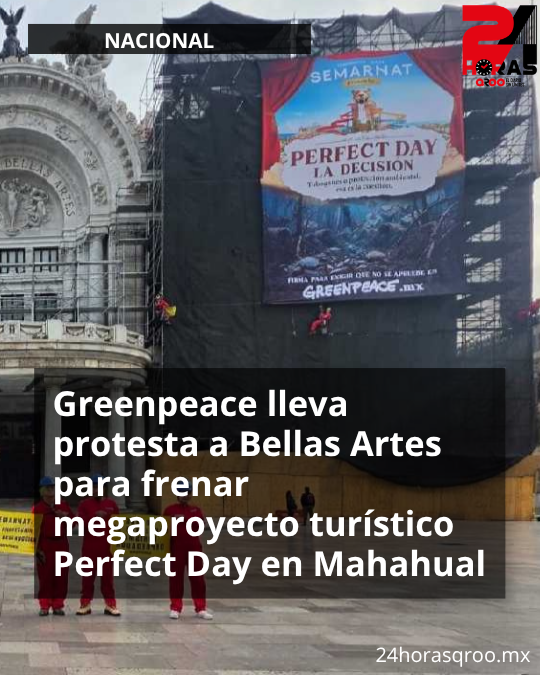
🔴NACIONAL | 🌿🚨 Greenpeace protestó en Bellas Artes contra el proyecto “Perfect Day Mexico” en Mahahual, Quintana Roo, y pidió a Semarnat proteger la Selva Maya. 👇 🐆🌎 #Greenpeace #Mahahual #QuintanaRoo
24horasqroo.mx/2026/05/12/gre…
Español
Norrferr 🦦 retweetledi

Activistas de Greenpeace colocaron una manta sobre la fachada del Palacio de Bellas Artes, en la CDMX, como parte de una manifestación pacífica dirigida contra la Secretaría de Medio Ambiente y Recursos Naturales (SEMARNAT). La acción buscó visibilizar su rechazo a proyectos turísticos en la Riviera Maya, en Quintana Roo.
Durante la protesta en la explanada del recinto cultural, alrededor de 10 activistas exigieron detener iniciativas que, señalan, afectan ecosistemas de la región. En la manta se leía un llamado a no aprobar el proyecto “Perfect Day” y se invitaba a firmar una petición en línea. #Metrópoli
🔗 lasillarota.com/metropoli/2026…

Español
Norrferr 🦦 retweetledi

Me encanta este mapa del Instituto Brasileño de Geografía y Estadística
Muestra la riqueza de especies a nivel global resaltando la dominancia de América tropical en riqueza biológica
Además, nos recuerda que poner el norte arriba es solo una convención histórica

Español
Norrferr 🦦 retweetledi

We, the Lebanese and Palestinian, are the only people in history watching our genocide live, and we could get arrested or suspended for saying stop kill us, because it might hurt the feelings of the killers.
English
Norrferr 🦦 retweetledi

La causa de las personas desaparecidas es algo que jamás voy a soltar, encontré este video en Tik Tok y cruda realidad de lo que se vive en CDMX.
Español
Norrferr 🦦 retweetledi

a lot of yall dont get that the reason the death penalty is bad is not because the people dont deserve death
English
Norrferr 🦦 retweetledi

sí, amor, yo sé que no hay consumo ético bajo el capitalismo, pero igual y no deberías hacer tu noveno pedido del mes en Shein y maybe no se acaba el mundo si dejas de comprar todas las colecciones de termos del Starbucks.
Español
Norrferr 🦦 retweetledi

Police DO NOT REDUCE CRIME.
Housing, employment, food, REDUCE CRIME.
English
Norrferr 🦦 retweetledi

Norrferr 🦦 retweetledi

Norrferr 🦦 retweetledi

My "Roman Empire is the realization that my life is a lottery win. Somewhere in Sudan, Pålestine, iran, Afghanistan, Iraq or Congo, there is a boy smarter than me. He is more disciplined, more resilient, and holds more potential in his single finger than I do in my entire career.
The only difference? I am siting in a train and he is sting in the rubble of his dreams.
My "bad days" are his wildest dreams.
My "burnout" is a luxury he can't afford because his only job is staying alive.
It's geographical luck and it's a haunting injustice that we all refuse to acknowledge and look away
໊smolaraa@kesikesiluv
Hit me with the harshest reality truth.
English
Norrferr 🦦 retweetledi

🇮🇱 #Israel bombardeó varias zonas densamente pobladas en el centro de 🇱🇧 #Beirut este miércoles sin previo aviso, horas después de que se anunciara un alto al fuego en la guerra entre 🇺🇸 #EU e Israel con 🇮🇷 #Irán. El ejército israelí lo calificó como el mayor ataque coordinado en la guerra actual, al golpear más de 100 objetivos de Hezbollah en 10 minutos en Beirut, el sur de #Líbano. El Ministerio de Salud libanés informó que decenas de personas murieron y cientos resultaron heridas en una estimación preliminar. Israel había dicho que el acuerdo no se extiende a su guerra con el grupo Hezbollah en Líbano, aunque el mediador 🇵🇰 #Pakistán sostuvo que sí.
Más información 👉 jornada.com.mx/noticia/2026/0…
#VideosLaJornada
Español
Norrferr 🦦 retweetledi

It’s kind of insane that we’re all lucky enough to live on this insignificant blue ball floating in an endless void that can somehow keep us alive indefinitely and yet a huge chunk of people want to ruin it forever in the name of an economic concept that we made up ourselves
Scott Gustin@ScottGustin
Like a grand and miraculous spaceship, our planet has sailed through the universe of time. Earth as seen from Artemis II.
English
Norrferr 🦦 retweetledi

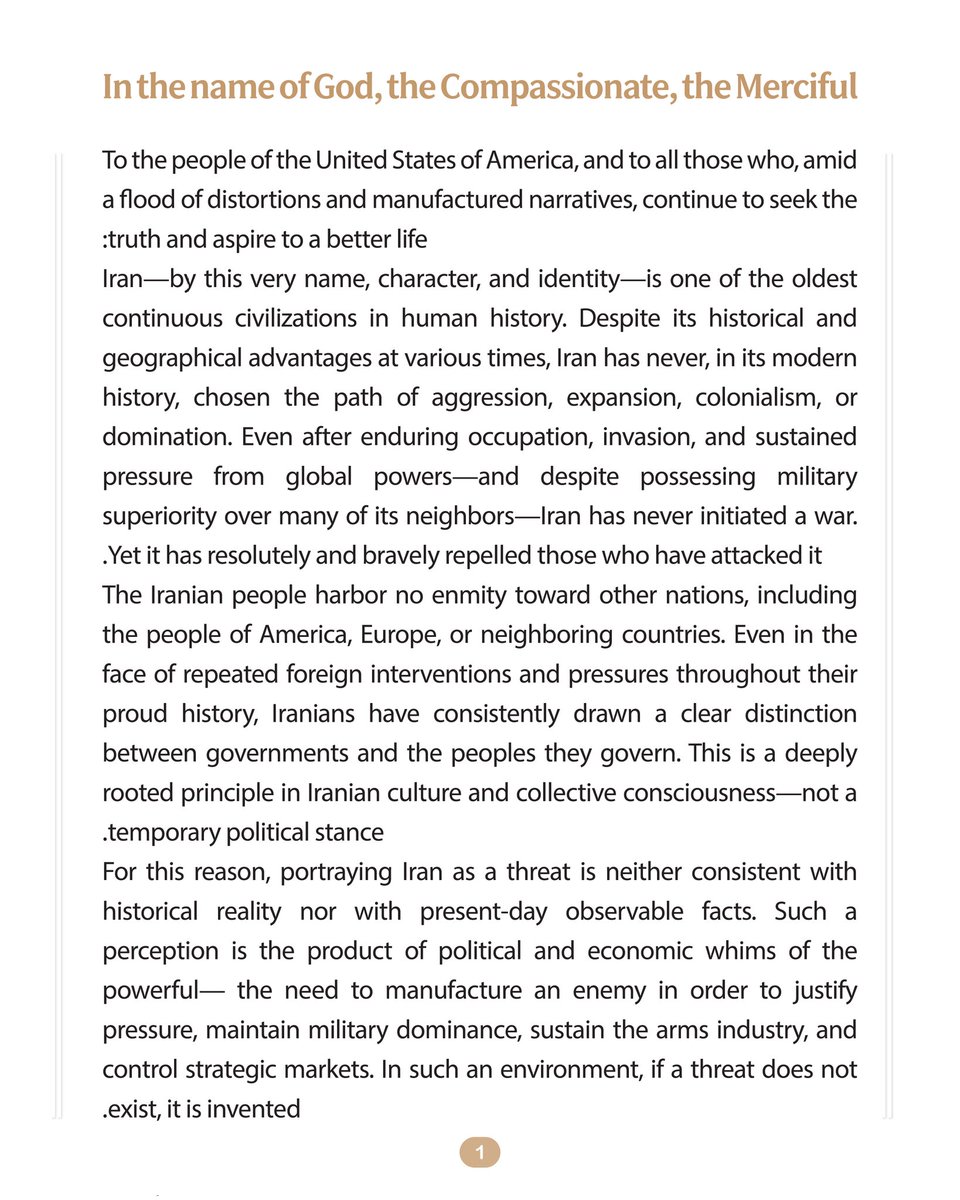
To the people of the United States of America


English
Norrferr 🦦 retweetledi

Norrferr 🦦 retweetledi

Norrferr 🦦 retweetledi
If you want to understand why the US and Israel are attacking and attempting to subjugate Iran, you must read this historic speech by Iranian foreign minister Abbas Araghchi, delivered earlier this month at the 16th Al Jazeera Forum held in Doha:
“Excellencies,
Distinguished colleagues,
Ladies and gentlemen,
السلام علیکم
It is a privilege to address you at this distinguished forum and discuss the profound question of our region: Palestine.
Let me begin with a fact that the region has learned through decades of painful experience, and that the world is learning again at a terrible human cost: ‘Palestine is not one issue among many’.
Palestine is the defining question of justice in West Asia and beyond. It is the strategic and moral compass of our region. It is a test of whether international law has meaning, whether human rights have universal value, and whether global institutions exist to protect the weak — or merely to rationalise the power of the strong.
For generations, the Palestinian crisis was understood primarily as the consequence of an illegal occupation and the denial of an inalienable right: the right of a people to self-determination. But today, we must recognise that the crisis has moved far beyond the parameters of occupation alone. What we are witnessing in Gaza is not merely war. It is not a ‘conflict’ between equal parties. It is not an unfortunate byproduct of security measures. It is the deliberate destruction of civilian life on a massive scale. It is genocide.
The human cost of Israel’s atrocities in Gaza has wounded the conscience of humanity. It has torn open the heart of the Muslim world — and it has also shaken millions beyond it: Christians, Jews, and people of all faiths, who still believe that the life of a child is not a bargaining chip, that starvation is not a weapon, that hospitals are not battlefields, and that the killing of families is not self-defense.
Palestine today is not simply a tragedy; it is a mirror held up to the world. It reflects not only the suffering of Palestinians, but also the moral failure of those who had the power to stop this catastrophe — and chose instead to justify it, enable it, or normalise it.
But Palestine and Gaza is not only a humanitarian crisis. It has become the platform for something larger and more dangerous: an expansionist project pursued under the banner of ‘security’.
This project has three consequences — each of them profound, each of them alarming:
The first consequence is global. The Israeli regime’s conduct in Palestine, and the impunity granted to it, have deeply damaged the international legal order. We must say this clearly: the world is moving toward a condition where international law no longer is respected and governs international relations.
What is perhaps most dangerous is the precedent being established: that if a state has sufficient political cover and protection, it may bomb civilians, besiege populations, target infrastructure, assassinate individuals across borders, and still demand to be regarded as lawful.
This is not merely a Palestinian problem. It is a global problem.
We are witnessing not only the tragedy of Palestine, but the transformation of the world into a place where the law is replaced by force.
The second consequence is regional. Israel’s expansionist project has had a direct and destabilising impact on the security of all countries in the region.
The Israeli regime now openly violates borders. It breaches sovereignties. It assassinates official dignitaries. It conducts terrorist operations. It expands its reach in multiple theatres. And it does so, not discreetly, but with a sense of entitlement — because it has learned that international accountability will not come.
Let us be candid: if the Gaza issue is ‘settled’ through destruction and forced displacement — if that becomes the model — then the West Bank will be next. Annexation will become policy.
This is the essence of what has long been called the ‘Greater Israel’ project.
The question therefore is not whether Israel’s actions threaten Palestinians alone. The question is whether the region will accept a future in which borders are temporary, sovereignty is conditional, and security is determined not by law or diplomacy, but by the ambitions of a militarised occupier.
The third consequence is structural — and perhaps the most dangerous.
Israel’s expansionist project requires that neighboring countries be weakened — militarily, technologically, economically, and socially — so that the Israeli regime permanently enjoys the upper hand.
Under this project, Israel is free to expand its military arsenal without limits, including weapons of mass destruction that remain outside any inspection regime. Yet other countries are demanded to disarm. Others are pressured to reduce defensive capacity. Others are punished for scientific progress. Others are sanctioned for building resilience.
Nobody should be confused: this is not arms control, it is not non-proliferation, it is not security.
It is the enforcement of permanent inequality: Israel must have a ‘military, intelligence and strategic edge’, and others must remain vulnerable. This is a doctrine of domination.
Ladies and gentlemen,
This is why the Palestinian question is not only a humanitarian issue. It is a strategic issue. It is not only about Gaza and the West Bank. It is about the future of our region and the rules of the world.
So what must be done?
It is not enough to express concern. It is not enough to issue statements. It is not enough to mourn. We need a coordinated strategy of action — legal, diplomatic, economic, and security-based — rooted in the principles of international law and collective responsibility.
First, the international community must support legal mechanisms without hesitation.
Second, there must be consequences for violations.
We call for comprehensive and targeted sanctions against Israel, including: an immediate arms embargo,
the suspension of military and intelligence cooperation,
restrictions on officials, and banning trade.
Third, we need a credible political horizon grounded in law. The international community must affirm: the end of occupation, the right of return and compensation in accordance with international law, and the establishment of a unified and independent Palestinian state with Al-Quds Al-Sharif as its capital.
Fourth, the humanitarian crisis must be treated as a matter of urgent international responsibility. Collective punishment must never be normalised.
Fifth, regional states must coordinate to protect sovereignty and deter aggression. The principle must be clear: security cannot be built on the insecurity of others.
And finally, the Islamic world, the Arab world, and the nations of the Global South must build a united diplomatic front.
The Organization of Islamic Cooperation, the Arab League, and regional organisations must move beyond symbolism toward coordinated action: legal support, diplomatic initiatives, economic measures, and strategic messaging.
This is not about confrontation. It is about preventing the region from being reshaped by force.
Dear colleagues,
Let no one miscalculate: a region cannot be kept stable by allowing one actor to act above the law. The doctrine of impunity will not produce peace; it will produce wider conflict.
The path to stability is clear: justice for Palestine, accountability for crimes, an end to occupation and apartheid, and a regional order built on sovereignty, equality, and cooperation.
If the world wants peace, it must stop rewarding aggression.
If the world wants stability, it must stop enabling expansionism.
If the world believes in international law, it must enforce it — consistently and without double standards.
And if the nations of this region seek a future free from perpetual war, they must recognise this fundamental truth: Palestine is not merely a cause for solidarity; it is the indispensable cornerstone of regional security.
Thank you”.

English
Norrferr 🦦 retweetledi

Bombing Iran in the middle of negotiations, while starving Cuba, while genociding Palestinians, while threatening to invade Greenland… the US and Israel are the single greatest threat to humanity and it’s not even close. We are all forced to live in the nightmare they create.
English