nathan

1.4K posts

nathan banner
nathan

nathan

@nrdcid

Boulder, CO Katılım Ocak 2014
418 Takip Edilen397 Takipçiler
nathan
nathan@nrdcid·
@mattshumer_ That’s pretty wild that it called a full blown forced removal of whole user. In 2026. We honestly need to scale interpretability tools at the same rate as these models
English
0
0
0
152
Pedro Domingos
Pedro Domingos@pmddomingos·
Data centers are ecosystems, and transformers are an invasive species.
English
11
3
67
7.2K
nathan
nathan@nrdcid·
@ArjChi I don’t think a singularity is fundamentally possible. That polarizing feeling is just the bubble getting ready to burst
English
1
0
3
236
arjun
arjun@ArjChi·
SF continuously feels polarized in terms of mission-driven people vs money-driven people pretty much everything outside of deeptech feels like a grift now maybe this is the singularity they were talking about
English
10
0
43
13.1K
nathan retweetledi
Elliot Arledge
Elliot Arledge@elliotarledge·
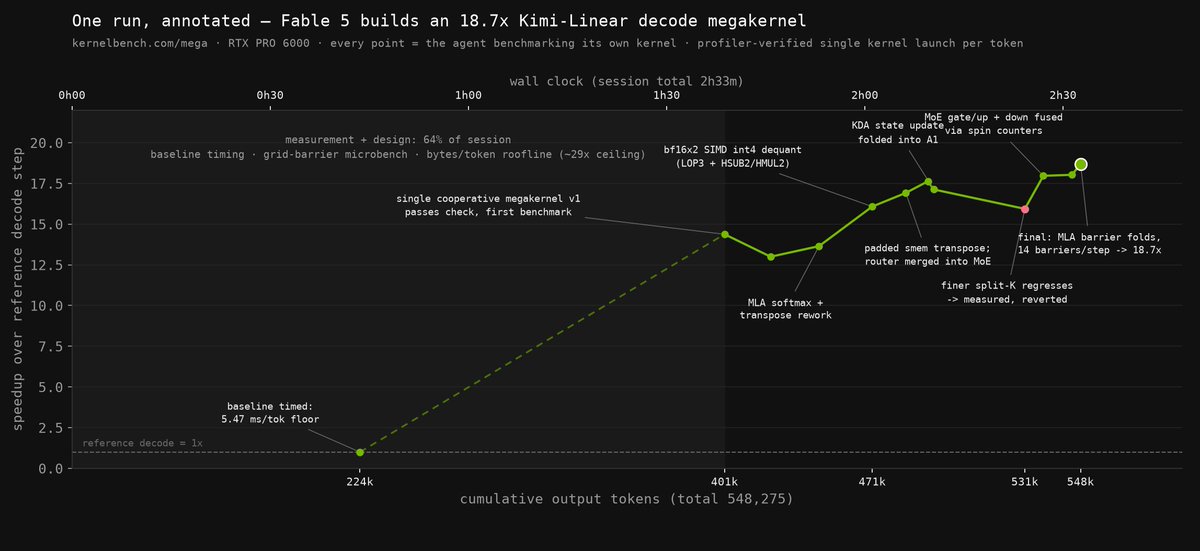
Claude Fable 5 [max] wrote the first genuine (and fastest) megakernel ever submitted to KernelBench-Mega. It was tested on: Kimi-Linear W4A16 batch-1 decode for RTX PRO 6000 Blackwell. Every prior model "won" it with a multi-kernel Triton pipeline that fails our single-fused-kernel authenticity gate > Opus 4.8 at 14.4x > GLM-5.2 11.1x > GPT-5.5 4.3x > Sonnet 5 4.0x. Fable shipped 18.7x over reference, and torch.profiler shows exactly ONE cooperative kernel launch per decoded token. Int4 dequant (nibbles unpacked in-register, never materialized), conv+SiLU, KDA gated-delta state, MLA absorbed-latent attention with online softmax, MoE router + top-8 experts, RMSNorms, even the KV cache append all inside one launch, staged by 14 grid barriers. We overwrote its input buffers mid-audit to prove it recomputes on live data. It does. The advantage grows with context. 17.8x at 2k, 18.9x at 8k, 19.5x at 16k. Longer context means a bigger KV cache and more attention work per token which is usually where a decode kernel bleeds. Keeping everything in one launch amortizes the fixed barrier overhead and the int4 GEMV stays bandwidth-bound, so the gap over the reference widens instead of closing. It spent 64% of the session in silence timing the baseline, microbenchmarking grid barriers, deriving a ~29x bytes/token roofline, then wrote the whole kernel once, hit 14.4x on the first benchmark, and spent the last hour deleting barriers and making int4 dequant free (one LOP3 + HSUB2/HMUL2). The one regression it tried (finer split-K) it measured and reverted instead of rationalizing. kernelbench.com/mega
Elliot Arledge tweet media
English
52
101
1.2K
501.9K
nathan
nathan@nrdcid·
@sun_hanchi 1 is not controversial it’s actually just facts because the bottleneck is compute which mainly requires EE/physicists
English
0
0
1
45
Hanchi Sun
Hanchi Sun@sun_hanchi·
Very Very Controversial Opinion: 1. The most needed intellectuals for AI are physicists 2. Many of the great physicists chose their job because back then it was the best way to advance humanity intellectually, not because they inherently have to do physics They all later turned their interests to computer science, communications, and early forms of (symbolic) AI, as that was the best way to advance humanity in the later half of the 20th century If they were still alive or born 80 years later, they would not study physics at all or have correctly given it up at the latest at the 2nd year of phd. instead, they’d be studying AI 3. However, those who study physics today following the great physicists, though appearingly doing the same thing , are among a totally different group of people. They chase the leftover fame of physics which was an aftermath for being the most influential intellectual work from 18th century up to 1950s. Yet, as Chenning Yang said, “the party is over”, and the failure to recognize that after 1970s indicates a second tier taste Example: almost all string theorists except the very first few are not great physicists, because a great one would realize the study of a subject without a chance to test experimentally is inherently theology. 4. If a truly great physicists study AI, (say a Richard Feynman but born in 2000), he shall bring some special touch to our approach, raising one or two layers of abstractions (but not three) beyond empirical results and discovers some dynamic laws that has statistical physics flavor. Scaling law is a perfect example of one layer naive induction. However, the current physicists you hire to do AI (with very few exceptions) will likely work on incremental stuff, like creating a new variant of attention or studying agentic compacting. You would not see the leap forward Fourier or Laplace did, who somehow looked at the data and deduced the physics behind. The reason is those who chose to study physics today are followers of an outdated research paradigm and would thus follow current AI paradigms too instead of creating new ones
Zhengyang Geng@ZhengyangGeng

My serendipitous encounter at IAS @Princeton today. I was just wandering around looking for a restroom when I ran into the incredibly kind Prof. Peter Sarnak, who guided me inside. The very first thing to welcome me was this iconic photo. Prof. Sarnak: "Are you in math?" Me: "I'm a PhD student in AI." Him (chuckling): "Everywhere is AI." Me: "lol We're trying to make better tools for mathematicians." Left Simonyi Hall wondering: maybe in a parallel universe, I'm studying number theory right now.


English
14
14
125
56.8K
nathan
nathan@nrdcid·
@angelizado2009 @TIDAL It's not a stupid question because the post clearly states that "100% AI-generated songs will receive a badge", so I'm wondering if that would still be the case for slightly < 100% and how they plan to measure that criteria :)
English
2
0
23
424
angel
angel@angelizado2009·
@nathandelcid @TIDAL why would you ask something stupid like this, knowing adding vocal audio to an AI-generated song doesn't make it less AI generated?
English
6
0
17
463
Tidal
Tidal@TIDAL·
We're a music platform that puts artists and listeners first. To protect artists and keep listeners informed, here's how we're handling AI-generated music on Tidal beginning on July 15: - 100% AI-generated tracks will receive a badge that says “AI” and will not receive royalties. - Content designed to impersonate other artists gets removed. - Listeners will be able to filter all 100% AI-generated content out. - These standards also apply to Tidal Uploads. Read in full: tidal.com/ai-policy
Tidal tweet media
English
116
433
1.9K
191.5K
angel
angel@angelizado2009·
@nathandelcid @TIDAL why would you even make AI-generated music are you retarded?
English
1
0
38
855
Josh Pigford
Josh Pigford@Shpigford·
the deeper i get into using chat, CLIs and MCPs for everything, the more i find myself desperately just wanting a nice proper UI. tired of everything just being walls of text.
English
48
4
209
19.1K
nathan
nathan@nrdcid·
@dwarkesh_sp It’d be better off to just integrate LLMs at the kernel level than to have it run on the application layer i.e. we need OS renovations
English
0
0
0
840
Dwarkesh Patel
Dwarkesh Patel@dwarkesh_sp·
Here's a question I find confusing and interesting and which actually tells us a lot about the nature of current AI progress: Why has progress on computer use been so slow? Computer use is so clearly verifiable. I think the answer is that it is not enough for a domain to be verifiable. It also has to be very grindable—in the sense that you can run lots of parallel rollouts against a deterministic and replayable simulator. If you’re trying to make a model better at coding, you can create an environment that has a software repo with some missing feature that you’ve tasked the AIs with creating, and then you have a thousand parallel agents just go at the problem, each with their identical copy of the container. But this doesn’t work with computer use—at least not trivially. You can’t have a thousand agents go try the same checkout flow on Amazon. Because Andy Jassy will find and detect your bots and shut your ass down. How would we train an AI to build a business? How would you make an AI that’s really good at winning court cases? Or having a profitable day trading in the markets? Or helping a candidate win an election? What is the RL environment to make an AI as good at politics as Lyndon Johnson, or as good at building a space launch business as Elon Musk? The rollout requires interacting with the world and cannot be recreated simply within the datacenter. And the outer loop verification may take months or years of real world actions to elicit, and cannot be re-observed by perturbing the model’s actions thousands of times in parallel so that you can isolate what exactly the model did that actually worked.
Dwarkesh Patel@dwarkesh_sp

What does the next training paradigm look like? 0:00:00 – The big research bet the labs are making 0:02:12 – Grindability is just as important as verifiability 0:06:10 – Will RLVR alone generalize? 0:08:41 – Getting the learning back to the weights 0:15:22 – Dreaming 0:17:23 – What 2027 looks like Also on YouTube, pod feed, and Substack.

English
139
67
984
529.5K
nathan
nathan@nrdcid·
@jxnlco Does Computer Use utilize Microsoft’s Omniparser?
English
0
0
0
67
jason
jason@jxnlco·
I’m top 5 Computer Use users at OpenAI Ask me anything.
English
424
32
1.9K
317.7K
nathan
nathan@nrdcid·
@elonmusk @CoreyTheX @XMoney I can truly and with 100% certainty say that I have never, EVER, in my life seen anyone abbreviate “thanks” like that until now
English
0
0
0
892
Corey
Corey@CoreyTheX·
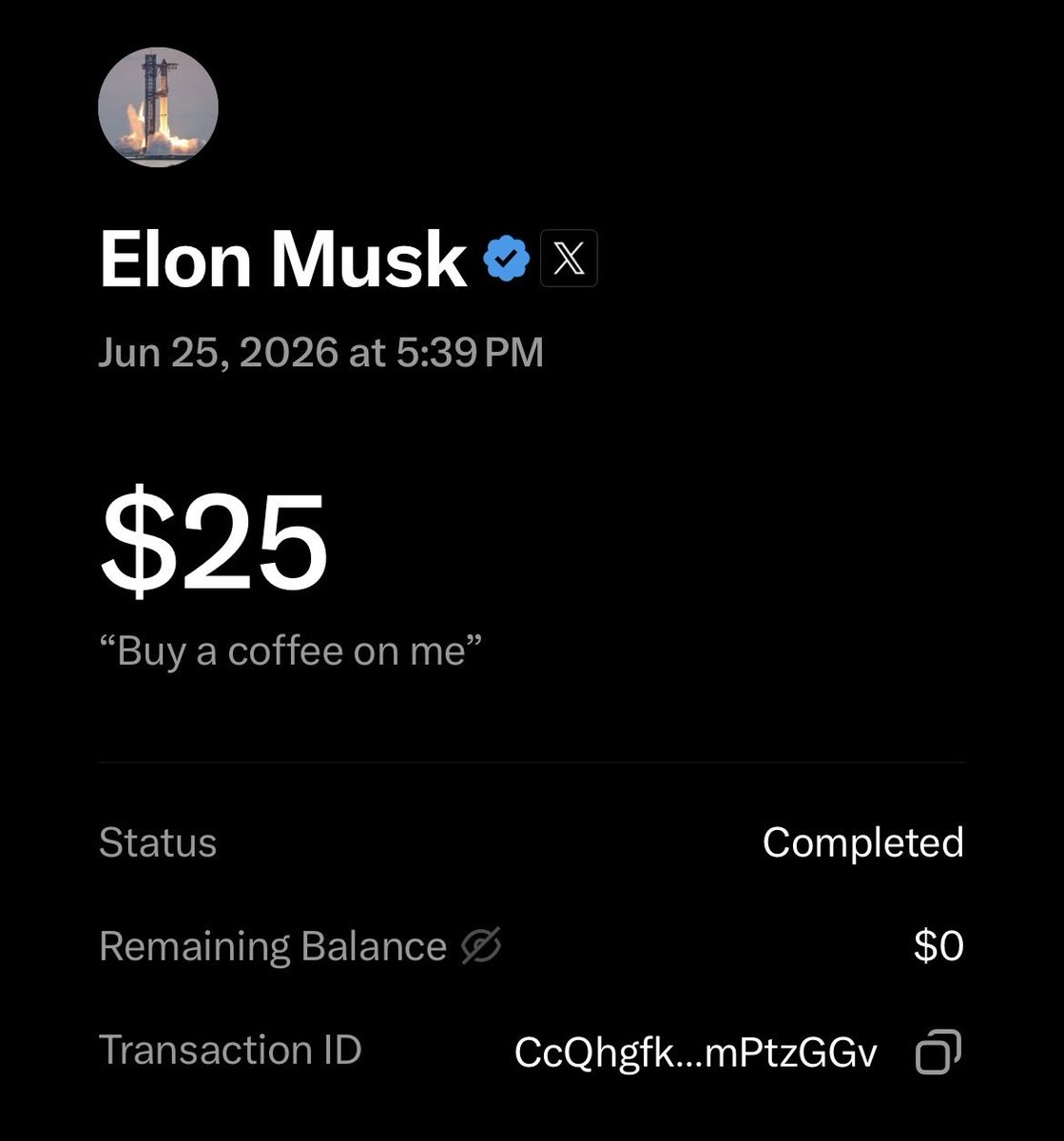
Call me an idiot, but I just sent $25 directly to Elon Musk, the richest man in the world using @XMoney for no other reason than I just can. lol
Corey tweet media
English
7.6K
1.5K
45.3K
19.6M
nathan
nathan@nrdcid·
@trikcode Open up any AI textbook from the 90s and you’ll see why. “Agents” are a fundamental concept in artificial intelligence, and LLMs are more or less “new” but surprisingly effective (we literally don’t know why), so we’re trying to fit them into the definition of an agent.
English
1
0
2
70
Wise
Wise@trikcode·
Why are we even calling them "agents" instead of "scripts that use LLMs"? Because most "agents" I've seen are just: 1. Prompt 2. Call API 3. Parse response 4. Loop That's... a script.
English
370
131
3.1K
202.7K
nathan
nathan@nrdcid·
@gabriel1 This is what the government is scared of
English
0
0
0
53
gabriel
gabriel@gabriel1·
chatgpts worst word it can come up with is "lukewarm moist clump" it has that real "found behind a radiator" energy
gabriel tweet media
English
32
1
349
98.1K
nathan retweetledi
François Chollet
François Chollet@fchollet·
The true measure of a software engineer isn't their ability to write clever code. It's their ability to ruthlessly protect the codebase from unnecessary cleverness.
English
88
191
2.2K
84.6K
nathan
nathan@nrdcid·
@paulg I'm of the opinion that the compiler is just now starting to recognize this. There is a certain fatigue a-brewing
English
0
0
1
361
Paul Graham
Paul Graham@paulg·
College students use AI to do most of their writing. An increasing number of professors secretly use it for grading. In the limit case, AIs do all the work, and all the humans do is transmit what they create. A good compiler would recognize this as dead code and remove it.
English
384
349
6.3K
393K
nathan retweetledi
Aleph
Aleph@alephneuro·
We recently obtained the highest-resolution 3D images of the human brain ever taken from outside the skull. This is the first look. Introducing Aleph, a research lab building brain interfaces for the telepathic future. (1/n)
English
223
998
6.7K
1.6M
Pedro Domingos
Pedro Domingos@pmddomingos·
Live in the present with the future in mind.
English
7
2
64
5.1K