Nathan Belcher, Ed.D.

11.4K posts

Nathan Belcher, Ed.D. banner
Nathan Belcher, Ed.D.

Nathan Belcher, Ed.D.

@ntbelcher

Helping people learn and grow. Lover of beautiful conversations, books, sports, education, #modphys, family, and Jesus. @williamandmary '08 & '10 @UofSC ‘17

Katılım Ağustos 2014
4.5K Takip Edilen2.1K Takipçiler
Sabitlenmiş Tweet
Nathan Belcher, Ed.D.
Nathan Belcher, Ed.D.@ntbelcher·
NEW ARTICLE! "The Fundamentals of Practice — Maximizing Learning with High-Impact Types of Practice" Link: @ntbelcher/the-fundamentals-of-practice-maximizing-learning-with-high-impact-types-of-practice-fcf8ca6f8b69" target="_blank" rel="nofollow noopener">medium.com/@ntbelcher/the… Thread below:
English

2
4
11
8.8K
Nathan Belcher, Ed.D. retweetledi
David Perell
David Perell@david_perell·
Here's a three-part Bible Study method that's been working well for me: Step 1: Observation (85% of your time) A good detective starts by collecting data without making too many assumptions about what happened, and that’s how you can read the Bible too. Start by attempting to understand the text. Ground yourself in its context. Ask questions like: Where does the story take place? Who is speaking? How does this story relate to the rest of Scripture? Be as objective as you can. Most of the work of Bible Study is simply to understand what’s happening, what's being said, and why each word is worth the ink on the page. Step 2: Interpretation (10% of your time) This is the stage in a detective’s search where they start connecting the dots to see what kind of image is emerging. They know it’s best to wait until they have a keen understanding of the events that took place, and it can be wise to do the same with your Bible study. Look at the big picture. Step away from the details and try to figure out what the author is trying to say, based on the observations you’ve made. Step 3: Application (5% of your time) This is the practical part of Bible Study when you can start thinking about what the text means for your life. Most people see this final step as the essence of Bible Study, even though it may be better to spend the least of your time on it. The problem with leaping to this final step is that you’re bound to miss the point by interpreting scripture through the lens of your life instead of interpreting your life through the lens of scripture. (For a deeper understanding of this method, which I've picked up from multiple mentors, look up Howard Hendricks' videos on YouTube.).
English
3
4
56
14.8K
Nathan Belcher, Ed.D. retweetledi
David Perell
David Perell@david_perell·
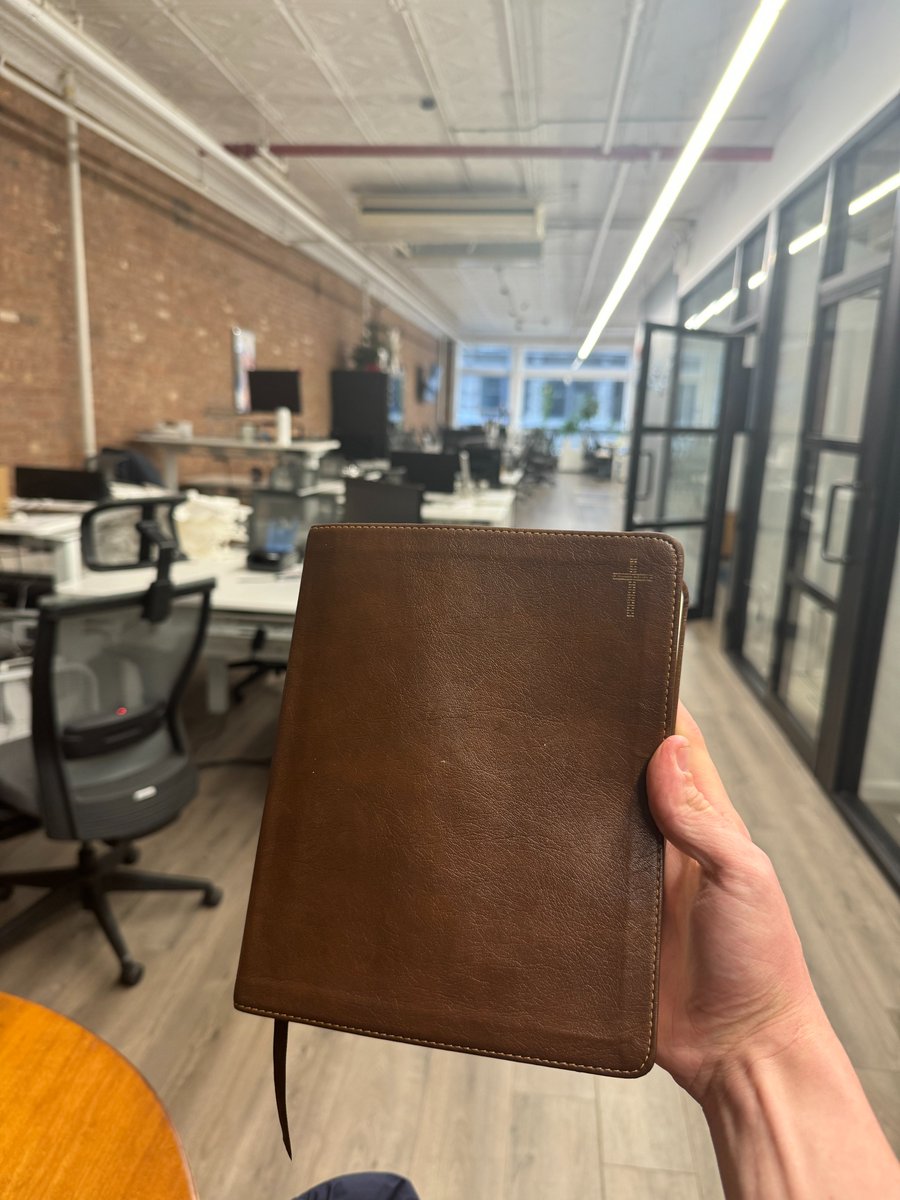
I went from thinking the Bible was the most boring book ever to seeing the magic in it. Years ago, I realized that the Bible is the foundational book of Western civilization. If I was going to be an educated person, I needed to know what it said. Though I was motivated to learn about it, I didn't have the patience to read it or the knowledge to understand it. Generally, I try to follow my 4th-grade English teacher's advice to read things first-hand. But the Bible seemed too hard, too boring, and too confusing to read on my own. It was a snooze fest. The stories felt outdated in a world of smartphones and fast Internet. Living in the modern world, shouldn’t I be rooting my life in modern books, modern studies, and modern authors? At the time, I was living in New York when a friend introduced me to the work of Tim Keller. I reluctantly found time to put down the self-help and picked up two of his books instead: The Reason for God and Making Sense of God. It was around that time when I discovered Keller's Questioning Christianity lecture series. Instead of focusing on the Bible directly, Keller focused on Christianity's relationship with culture and the modern world. He spoke to career-driven Gordon Gekkos who were driven by the glories of the material world, but sensed the emptiness at the heart of such a single-minded pursuit. Instead of referencing scripture directly, he spoke about big-picture themes like identity and purpose, morality and meaning. This was back when I thought all Christians had the intelligence of sidewalk pigeons. I would scoff at church-goers because I didn’t understand why anyone would worship a sky fairy or follow rules from thousands of years ago. Keller was the guide I needed. For the first few years, I looked at faith through a cultural lens instead of reading the Bible directly. I literally knew nothing about Jesus or Christianity — and I came to realize how little I knew about my own atheism too. In school, while studying the Declaration of Independence, I’d learned that it’s “self-evident” that “all men are created equal.” Turns out, this defining American ideal is only self-evident if you assume that every person has inherent worth because they’re made in the image of God. I was stumped. Where did my moral compass come from? Do people have inherent value? And if so, is it because every human is a child of God? In addition to advocating for the life of Jesus and the truth of his message, Keller revealed the many assumptions underlying my own atheistic worldview. He taught me that every worldview requires a leap of faith. Sure, Christianity couldn’t perfectly explain everything in the universe, but then again, neither can any worldview. Astrophysicists say that much of the universe is made up of “dark matter,” which is a scientific-sounding way to talk about a leap of faith Though I did some Bible studies, I never enjoyed them. They felt more like reading tedious academic papers than drinking directly from the fountain of God’s wisdom. Instead of reading Scripture directly, I joined a small Christian reading group where I was the only non-believer. By showing me coherent ways to interpret reality besides my science-based materialism, books like The Story of Reality and I Don't Have Enough Faith to Be an Atheist loosened the screws on my atheism. My palate was beginning to change. Like a fine wine, the same flavors that were once repulsive to me started to appeal to my intellectual taste buds. I surrounded myself with wise Christians who were orthodox about scripture and eager to answer my hardest questions about faith. I asked them to dinner and invited myself to Church with them. This marked a new era. Once again, I found some guides: books, Internet sources, and an in-person leader to show me the way. On the Internet, I'd turn to The Bible Project to answer my big-picture thematic questions. I picked up the ESV Study Bible, which I still read every day on the white boucle couch in my living room (if you like reading on the computer, I recommend The Bible Study App by Olive Tree). For years, I’d stiff-armed the Bible. Now, I was skipping to a 7am Bible Study led by a devout believer who'd been reading God's word every day for almost a quarter-century, and wasn’t afraid to rebuke my theology. What surprised me most was how carefully we read. I admired the integrity of our study. We live in a culture of binge-reading where people boast about how many books they can complete in a given year. We did the opposite. We never read more than ~20 verses in a single session and dissected every word, every verse, and every story. (I once spent two hours studying John 1:1-4 — just four verses at a strip mall Schlotzsky's in the Texas Hill Country.) Never in my life had I read so deliberately. I spent months in the books of Ephesians, Romans, John, and 2 Corinthians, and there's no way I would've known how to read the Bible so diligently on my own. I learned to look beyond English translations, and I use the BibleHub to look up the original Greek and Hebrew whenever possible. For a translation, I recommend the English Standard Version (ESV) (no, you don’t need to read the King James Version). And If you're going to pick two books, I recommend the Gospel of John and the Book of Romans. Either find a guide to read them carefully with you or follow along with The Bible Project and The ESV Study Bible. Whatever you do, read slowly. I used to be a serial consumer who’d brag about how many books I read every year. I’d pick up anything and everything. The more, the merry. But the more I study the Bible, the more careful I’ve become about who I read and listen to. Gone are my days as a serial consumer. Frauds, charlatans, and false teachers abound, so be skeptical and vet your sources. In all this time, I’ve had no more than ten serious teachers. Fortunately, that’s all you need. I became a believer on March 20th of this year, four years after attending my first Tim Keller lecture, and the Bible is alive for me now like no book I've ever read. These days, I read the Bible and basically nothing else. Opening it up is the best part of my daily routine. The words twinkle. The stories are supernatural. It's a living, breathing document, and I wholeheartedly believe it's the Word of God, which makes every other book feel dim by comparison.
David Perell tweet media
English
440
655
5K
1.3M
Nathan Belcher, Ed.D.
Nathan Belcher, Ed.D.@ntbelcher·
How do you use high-impact types of practice? If you want to get better at any task in your personal or professional life, you need to practice. Use this guide to understand and apply high-impact types of practice! @ntbelcher/the-fundamentals-of-practice-maximizing-learning-with-high-impact-types-of-practice-fcf8ca6f8b69" target="_blank" rel="nofollow noopener">medium.com/@ntbelcher/the…
English
0
2
4
361
Nathan Belcher, Ed.D.
Nathan Belcher, Ed.D.@ntbelcher·
*NEW ARTICLE* "Tracking Student Progress and Intensity of Classes — Connecting These Ideas to Student Learning" I've recently had discussion about how often we should track student progress; this article has some thoughts on this issue. ntbelcher.medium.com/tracking-stude…
English
0
2
5
471
Nathan Belcher, Ed.D.
Nathan Belcher, Ed.D.@ntbelcher·
You are an expert in your field — however, you still need to learn and grow. This guide will help you understand how to handle challenges in the learning process — continuing your learning in the advanced stage! betterhumans.pub/how-to-learn-w…
English
0
3
2
322
Xianhang Zhang
Xianhang Zhang@shalmanese·
@ejames_c @ntbelcher America's Test Kitchen is famous for their rigorous process of publishing bulletproof recipes that require no tacit knowledge and fudge was their only white whale for a long time because they could never encode the full process in a recipe. daringgourmet.com/daring-gourmet…
English
2
0
2
76
Sarah Cottinghatt
Sarah Cottinghatt@SCottinghatt·
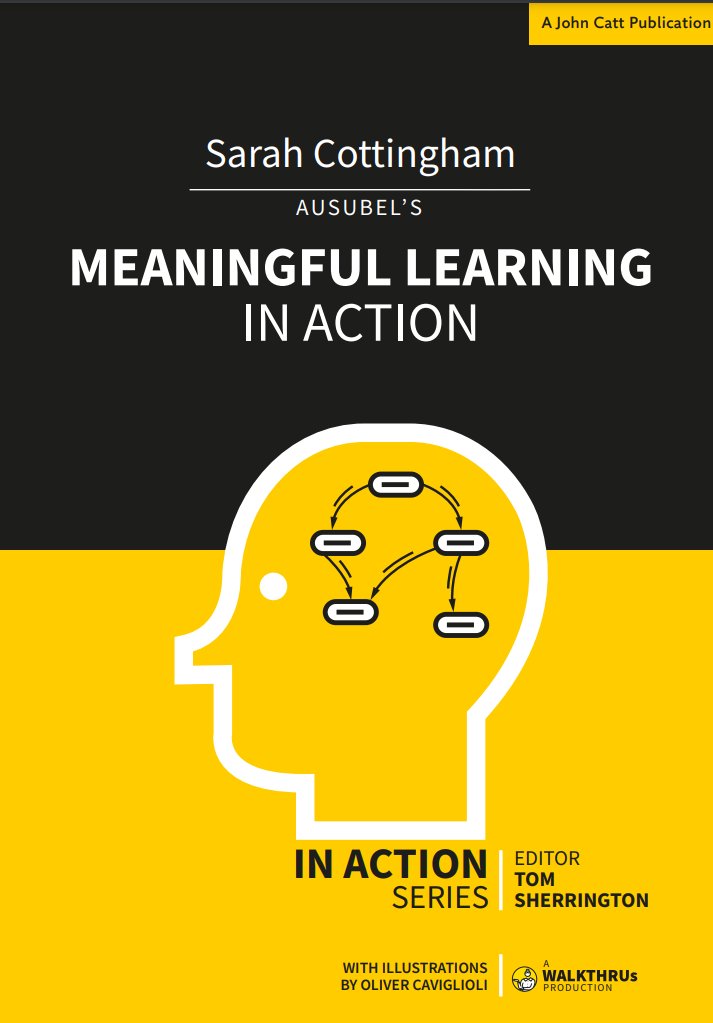
FREE copy of the latest book from the 'In Action' series: Ausubel's Meaningful Learning In Action Just *retweet* this thread and I'll pick a winner tomorrow. Thank you for your support! Here's what reviewers are saying and how to order your copy…
Sarah Cottinghatt tweet media
English
19
598
284
147.3K
Nathan Belcher, Ed.D.
Nathan Belcher, Ed.D.@ntbelcher·
Are you starting a project in a topic that is completely new? If so, here is a guide: “How to Learn — When You Are in the Beginning Stage.” This guide will help you understand how to start as a beginning and progress to the intermediate stage. betterhumans.pub/how-to-learn-w…
English
0
2
2
271
Nathan Belcher, Ed.D.
Nathan Belcher, Ed.D.@ntbelcher·
Most people do not know how to learn, yet everyone is expected to continually improve — which can only happen through learning. Use the link below for a guide on how to create and use mental models, helping you understand the foundations of learning. betterhumans.pub/learning-fast-…
English
0
3
3
272
Nathan Belcher, Ed.D.
Nathan Belcher, Ed.D.@ntbelcher·
Is writing important in your life? Do you need to upgrade your writing? There is great news: A process for writing exists that will help your readers understand your ideas more clearly. Use this summary to upgrade your writing! betterhumans.pub/youve-never-re…
English
0
2
3
285
Nathan Belcher, Ed.D.
Nathan Belcher, Ed.D.@ntbelcher·
How do you use high-impact types of practice? If you want to get better at any task in your personal or professional life, you need to practice. Use this guide to understand and apply high-impact types of practice! @ntbelcher/the-fundamentals-of-practice-maximizing-learning-with-high-impact-types-of-practice-fcf8ca6f8b69" target="_blank" rel="nofollow noopener">medium.com/@ntbelcher/the…
English
0
2
3
191
Nathan Belcher, Ed.D.
Nathan Belcher, Ed.D.@ntbelcher·
You are an expert in your field — however, you still need to learn and grow. This guide will help you understand how to handle challenges in the learning process — continuing your learning in the advanced stage! betterhumans.pub/how-to-learn-w…
English
0
2
3
188
Nathan Belcher, Ed.D.
Nathan Belcher, Ed.D.@ntbelcher·
Getting stuck in a performance plateau is frustrating. Working yourself out of the performance plateau is challenging — use this guide will help you understand how to practice and perform, moving you to the next level! betterhumans.pub/stuck-in-a-per…
English
0
2
2
156
Nathan Belcher, Ed.D.
Nathan Belcher, Ed.D.@ntbelcher·
Are you a designer of curriculum, instruction, and assessment for science courses? Here is a short guide to instructional design, using the idea of mental models to drive student learning — leading to student learning at a high level. medium.com/age-of-awarene…
English
0
3
3
386
Nathan Belcher, Ed.D.
Nathan Belcher, Ed.D.@ntbelcher·
The intermediate stage of learning is challenging. How do you keep improving your knowledge and skills to become advanced in the topic? Here's a guide to help you keep learning in the intermediate stage! betterhumans.pub/how-to-learn-w…
English
0
2
2
128
Nathan Belcher, Ed.D.
Nathan Belcher, Ed.D.@ntbelcher·
Are you starting a project in a topic that is completely new? If so, here is a guide: “How to Learn — When You Are in the Beginning Stage.” This guide will help you understand how to start as a beginning and progress to the intermediate stage. betterhumans.pub/how-to-learn-w…
English
0
2
3
228
Nathan Belcher, Ed.D.
Nathan Belcher, Ed.D.@ntbelcher·
Most people do not know how to learn, yet everyone is expected to continually improve — which can only happen through learning. Use the link below for a guide on how to create and use mental models, helping you understand the foundations of learning. betterhumans.pub/learning-fast-…
English
0
2
2
178
Nathan Belcher, Ed.D.
Nathan Belcher, Ed.D.@ntbelcher·
Is writing important in your life? Do you need to upgrade your writing? There is great news: A process for writing exists that will help your readers understand your ideas more clearly. Use this summary to upgrade your writing! betterhumans.pub/youve-never-re…
English
0
2
2
175
Nathan Belcher, Ed.D.
Nathan Belcher, Ed.D.@ntbelcher·
How do you use high-impact types of practice? If you want to get better at any task in your personal or professional life, you need to practice. Use this guide to understand and apply high-impact types of practice! @ntbelcher/the-fundamentals-of-practice-maximizing-learning-with-high-impact-types-of-practice-fcf8ca6f8b69" target="_blank" rel="nofollow noopener">medium.com/@ntbelcher/the…
English
0
2
2
129