Edward Castronova

1.6K posts

Edward Castronova banner
Edward Castronova

Edward Castronova

@nuthatch9s

Author of Dewey, about a forever donkey, a farm village and all-powerful AI.

Bloomington, IN Katılım Kasım 2024
75 Takip Edilen122 Takipçiler
Sabitlenmiş Tweet
Edward Castronova
Edward Castronova@nuthatch9s·
Final draft of Dewey is done.
English
0
0
0
20
Edward Castronova retweetledi
Pejjy
Pejjy@CuriousPejjy·
This soon will not be fiction.
English
8
2
35
9.8K
Marc Andreessen 🇺🇸
Frontier models become more expensive to serve. Token demand explodes at exponential rates. Solve for the equilibrium.
English
194
57
1.6K
147.8K
David Burge
David Burge@iowahawkblog·
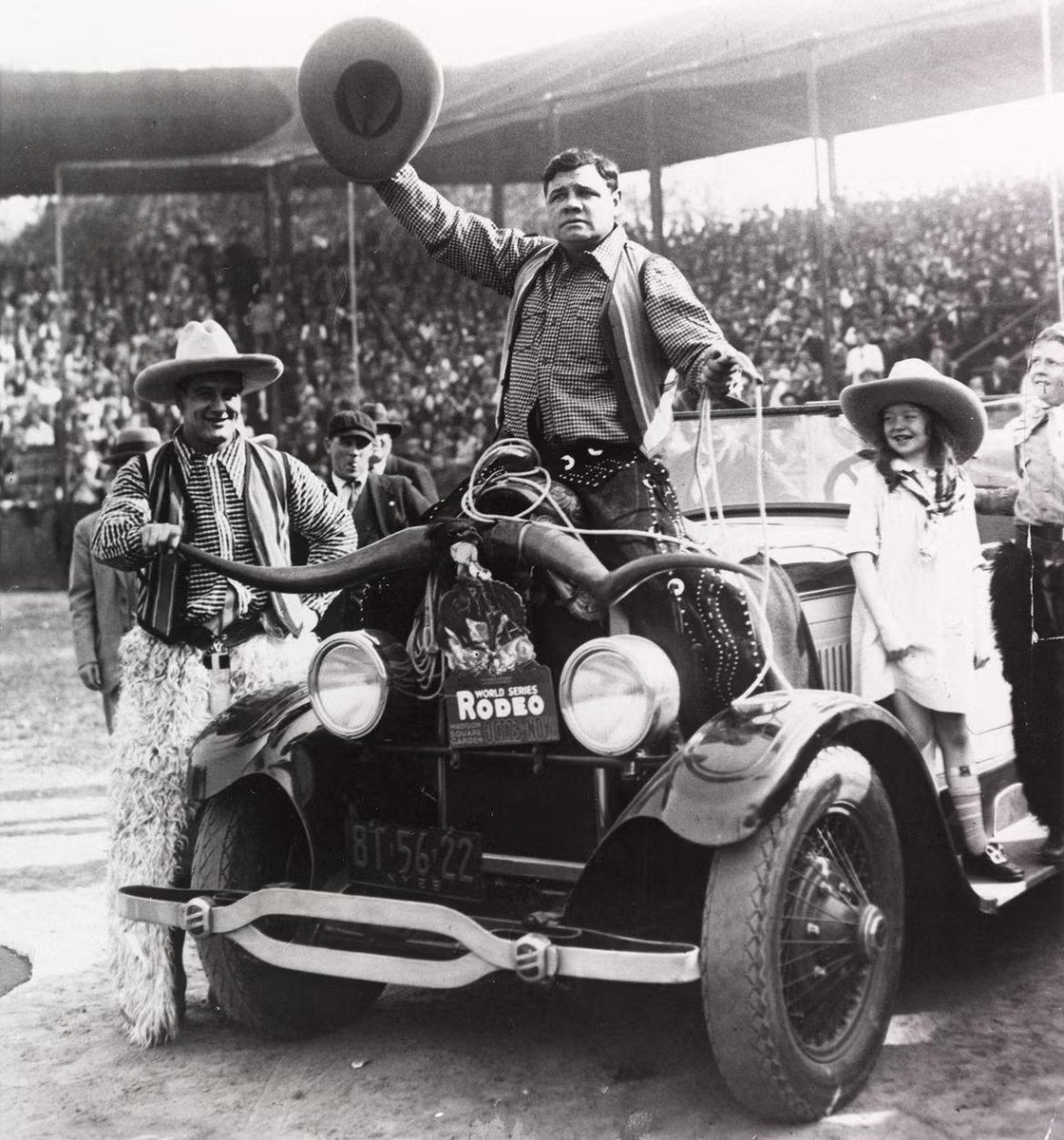
It's time to PLAY BALL at Dave's Car ID Service! With a belated salute to the start of another MLB season. And what better way to salute it than through George Herman "Babe" Ruth -- The Great Bambino, The Sultan of Swat, The Caliph of Clout, the man whose very name is synonymous with baseball? Not only did his home run records last a generation or more, he was the consumate showman. He was the biggest star in the biggest city in the world, quick with a quip, never bashful about appearing in publicity photos. And lucky for me, a number of those photos included cars. This one is probably my favorite: Babe astride a 1927 Packard 426 convertible equipped with a Biflex bumper, Western saddle, and Texas style longhorns. To left, Babe's teammate in the New York Yankees' Murderer's Row, Lou Gehrig. October 12, 1928, Dexter Park, Brooklyn. The Yankees were fresh off a 4-0 sweep of the Cardinals in the World Series. In the off season Ruth and Gehrig played the baseball barnstorming circuit with their teams "The Bustin' Babes" and "The Larrupin' Lous." In this instance they were playing against a semi-pro local Brooklyn nine, the Bushwick All-Stars, and for charity; proceeds of the game would go to the Broad Street Hospital, now NY Presbyterian. It was a tie in with the Rodeo World Series that was currently happening at Madison Square Garden (note radiator plate), which also raised money for the hospital. In any event, Gehrig and Ruth strode onto the field in ten gallon hats and full cowboy regalia, much to the delight of the 22,000 spectors. He delighted them more by mounting a police horse and riding it around the bases; and for an encore he did another home run trot riding the hood of the Packard.
David Burge tweet media
English
14
36
367
62.4K
Peter Wildeford🇺🇸🚀
Peter Wildeford🇺🇸🚀@peterwildeford·
Some days I'm excited about AI but other days it really feels like big tobacco executives building nuclear missiles
English
14
35
401
18.8K
Edward Castronova
Edward Castronova@nuthatch9s·
AI will give us exactly what we want, good and hard.
English
0
0
0
9
Edward Castronova
Edward Castronova@nuthatch9s·
Fantastic explanation of why ‘ job catastrophe’ reasoning about AI is wrong - in the *long run*. In LR, new jobs are created elsewhere. But nutrition is a short run problem: everybody’s gotta eat every day. Tech doesn’t destroy work but it disrupts it terribly. Chaos.
Marc Andreessen 🇺🇸@pmarca

III. The Specific Structure of the AGI Unemployment Argument and Where It Goes Wrong The AGI catastrophist argument typically runs like this: 1.AGI will be capable of performing any cognitive task a human can perform. 2.Cognitive tasks constitute the majority of employment in advanced economies. 3.Therefore, AGI will be able to replace the majority of workers. 4.Therefore, mass permanent unemployment follows. Step 3 to Step 4 is where the lump of labor fallacy smuggles itself in. The argument assumes that the quantity of cognitive work to be done is fixed, such that when AGI does it, humans are left with nothing. But this is precisely what is not true, for all four channels described above. Let me be more specific about how each gap in the argument fails: Gap A: “AGI can do the task” ≠ “There is no more task to do” When spreadsheets replaced bookkeepers in the 1980s, they did not reduce the total amount of financial analysis done in the American economy. They increased it, massively, because the cost of analysis fell, which meant more analysis got demanded, which meant more analysts got hired — to do more complex, higher-value analysis that the spreadsheets enabled. Automation of the low end of a cognitive spectrum does not eliminate work in that domain; it shifts the frontier of what human effort gets applied to upward. AGI will do the same thing. If AGI can draft a competent first-pass legal brief in 30 seconds, law firms won’t employ zero lawyers. They’ll employ lawyers who review, refine, strategize, negotiate, argue in court, build client relationships, exercise judgment in novel situations — and they’ll take on far more cases per lawyer because the cost per case has fallen. Total legal work done in the economy will increase, not decrease, because more people will be able to afford it. Gap B: The Argument Ignores Price Effects on Demand The catastrophist framing treats the displacement of workers as a pure subtraction problem. But displaced workers who find new jobs (as they historically do) are also consumers. The productivity gains from AGI don’t disappear into a void — they show up as lower prices, higher real wages, or both. Higher real purchasing power means more consumption of more goods and services, which means more demand for labor to produce them. Furthermore, the catastrophist argument generally ignores what happens to the profits generated by AGI-driven productivity. Those profits go to shareholders, who spend and invest them, creating demand elsewhere. Or they get competed away in product markets, lowering prices and raising real consumer purchasing power. Either pathway generates demand for labor. The only scenario where this mechanism fails is one where the gains from AGI are so concentrated and the distribution so pathologically skewed that effective aggregate demand collapses — which is a political economy problem (a distributional problem solvable through tax policy and redistribution) rather than a fundamental unemployment problem caused by the technology itself.

English
0
0
0
24
Edward Castronova
Edward Castronova@nuthatch9s·
It’s not the content it’s the relationship. Integration of machine intelligence into our lives changes us from freely choosing persons into passive recipients of sensation. Baby’s robo teacher won’t just teach it will entertain lure distract listen play pretend and just be the very best friend baby could ever have. Baby won’t want to play with anyone else. In fact baby won’t want to leave baby’s crib because it’s just so much more fun to wear the mask and play with robo teacher.
English
0
0
0
11
Edward Castronova retweetledi
Dean W. Ball
Dean W. Ball@deanwball·
“Loss of control” is extremely stupid and low-fidelity phraseology in the AI safety discourse. “We” “lost control”, at the latest, centuries ago.
English
31
1
118
30K
Edward Castronova retweetledi
Joe Allen
Joe Allen@JOEBOTxyz·
Priests of the Cyborg Theocracy speak of “superhuman” intelligence so often, it’s almost banal. ... It’s as if artificial intelligence will be the second coming of Christ, although I doubt these guys believe in the first coming. (Oct 1, 2024) joebot.xyz/p/faith-based-…
English
0
6
16
773
Edward Castronova
Edward Castronova@nuthatch9s·
It’s unfortunate that the people most concerned about AI extinction risk believe the risk is more likely to be mitigated in the hands of bureaucrats rather than entrepreneurs. I’ll take the entrepreneurs any day.
English
0
0
0
8
Edward Castronova retweetledi
Chubby♨️
Chubby♨️@kimmonismus·
AheadFrom comes with a new robotic face. And it looks scary human.
English
49
62
680
44K