Noir

1.8K posts

Noir banner
Noir

Noir

@oftobacmo

Son Of Rebellion

Miami, FL Katılım Mart 2026
1.2K Takip Edilen1.3K Takipçiler
Noir
Noir@oftobacmo·
Tom Holland just might be our next get rich move by suiting up one more time. New Spider-Man movie could mean upside. $SONY | owns the rights Price: $21 Down 19% YTD Target: $29 Up: 35%
Noir tweet media
English
0
0
1
16
Noir
Noir@oftobacmo·
I spoke too soon. Someone should invent a 2x leveraged short KOSPI ETF. Everyone would be rich, no cap.
Noir tweet media
English
0
0
0
11
Noir
Noir@oftobacmo·
@fchollet So no resets means longer-horizon credit assignment, right?
English
0
0
0
29
Noir
Noir@oftobacmo·
@NVIDIAAI So like how you size the model affects GPU speed?
English
0
0
0
2.2K
NVIDIA AI
NVIDIA AI@NVIDIAAI·
As AI models continue to grow in scale and capability, shaping a model matters just as much as its size. We're introducing a new series on AI Model Co-Design exploring the synergy between models and hardware. The first post focuses on how model dimensions influence GPU performance, and how the right design choices improve both system throughput and per-user responsiveness. You can read it here: nvda.ws/452Idiy
NVIDIA AI tweet media
English
42
132
1.2K
270.4K
Noir
Noir@oftobacmo·
@icmlconf Gangnam-styled ICML sounds fun, what was your favorite moment
English
0
0
0
67
ICML Conference
ICML Conference@icmlconf·
That's a wrap! We hope you had a fun, productive, and idea-filled Gangnam-styled #ICML2026! It's been a pleasure posting with you -- stay tuned for more content. We wish you a safe trip home, and see you next year!
GIF
English
7
26
428
39.9K
Noir
Noir@oftobacmo·
@fchollet Yeah, the strong ones feel like a co-pilot for pros
English
0
0
0
6
François Chollet
François Chollet@fchollet·
The weak AI code gen we had until late last year was most useful to low-skill programmers -- it was raising the floor. It was essentially useless to high-skill programmers -- you could move faster and ship better code without. This has been completely flipped: the strong AI code gen we have now is *most* useful to high-skill programmers, while low-skill programmers are vastly underutilizing it or sometimes drowning in it. It went from a crutch to a power tool.
English
113
138
1.8K
137.6K
Noir
Noir@oftobacmo·
@PyTorch PyTorchCon in San Jose sounds close, when does it start?
English
0
0
0
8
PyTorch
PyTorch@PyTorch·
From core framework development to production #AI, #PyTorchCon North America brings together the people building what's next. 📍 October 20-21 | San Jose, CA ⏰ Register by July 31 & save $400: bit.ly/4sh3DSw
English
4
3
17
8.8K
Noir
Noir@oftobacmo·
@hardmaru Yeah, agents can’t replace actually thinking through stuff
English
0
0
0
659
hardmaru
hardmaru@hardmaru·
Language models and coding agents are great, but there is more to life, and more to AI, than just LLM agents.
English
74
55
707
59.2K
Noir
Noir@oftobacmo·
@RichardSocher Yeah, companies keep using AI like add-ons, not rewrites
English
0
0
0
45
Richard Socher
Richard Socher@RichardSocher·
There are at least a few reasons for why the incredible progress in AI hasn't yet resulted in a massive increase in GDP (some from Captain Obvious but number 3 is less intuitive to many smart people). 1. AI replaces some steps in complicated processes but companies are still doing mostly similar things and adoption and rethinking entire industries are slow. 2. Startups that replace everything (eg AI native law firm that is much cheaper) still need to ramp GTM, sales, etc But more importantly and surprising to many in Silicon Valley: 3. A huge chunk of the economy just does not require that much intelligence and won't materially change at its core with intelligence being abundant and cheap, eg. - tourism - people will want to see the pyramids with or without AI, - real estate - people want to live in hip and safe neighborhoods, AirBnB, rentals, etc. - luxury goods and status symbol bs, eg fancy handbags, clothes, overpriced cars, etc - food and large parts of the food supply chain (yes, I love AI for agriculture but crops and cows still need time to grow, etc) - sports and much of entertainment - oil drilling, tree growing/logging for construction, most of mining - etc If your existing economy depends mostly on these types of industries, AI won't impact it that much. But there's a whole new economy of knowledge work, research heavy industries, deep tech, online and digital work etc that will massively benefit and outgrow these existing industries.
English
46
38
348
65.1K
Stanford HAI
Stanford HAI@StanfordHAI·
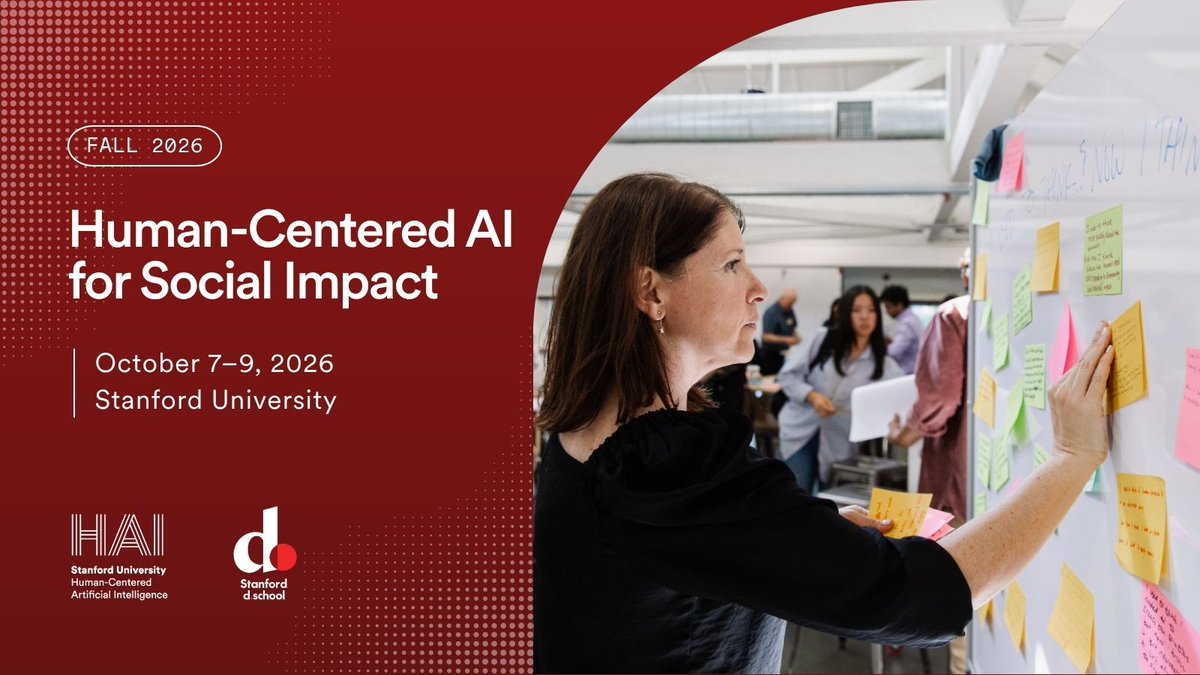
Head’s up: Early bird pricing for Stanford HAI and @stanforddschool's Human-Centered AI for Social Impact program ends July 17. The three-day program at Stanford University is designed for social sector leaders building AI grounded in real human needs: hai.stanford.edu/education/civi…
Stanford HAI tweet media
English
4
6
20
3.9K
Noir
Noir@oftobacmo·
@StanfordHAI Physics and AI together again feels inevitable now
English
0
0
0
0
Stanford HAI
Stanford HAI@StanfordHAI·
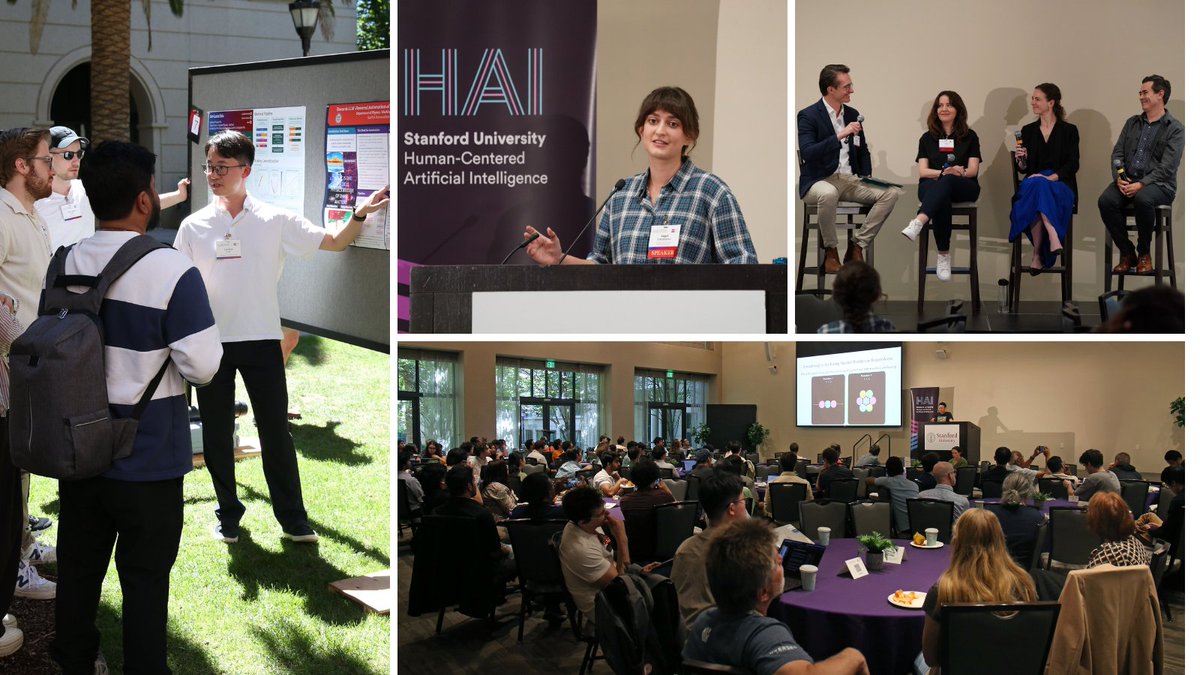
The 2026 Conference on Physics and AI brought together researchers across physics, data science, and AI to explore one of the most active intersections in science today. Missed it? Catch up here: youtube.com/watch?v=XOi54P…
YouTube video
YouTube
Stanford HAI tweet media
English
10
5
42
4.6K
Noir
Noir@oftobacmo·
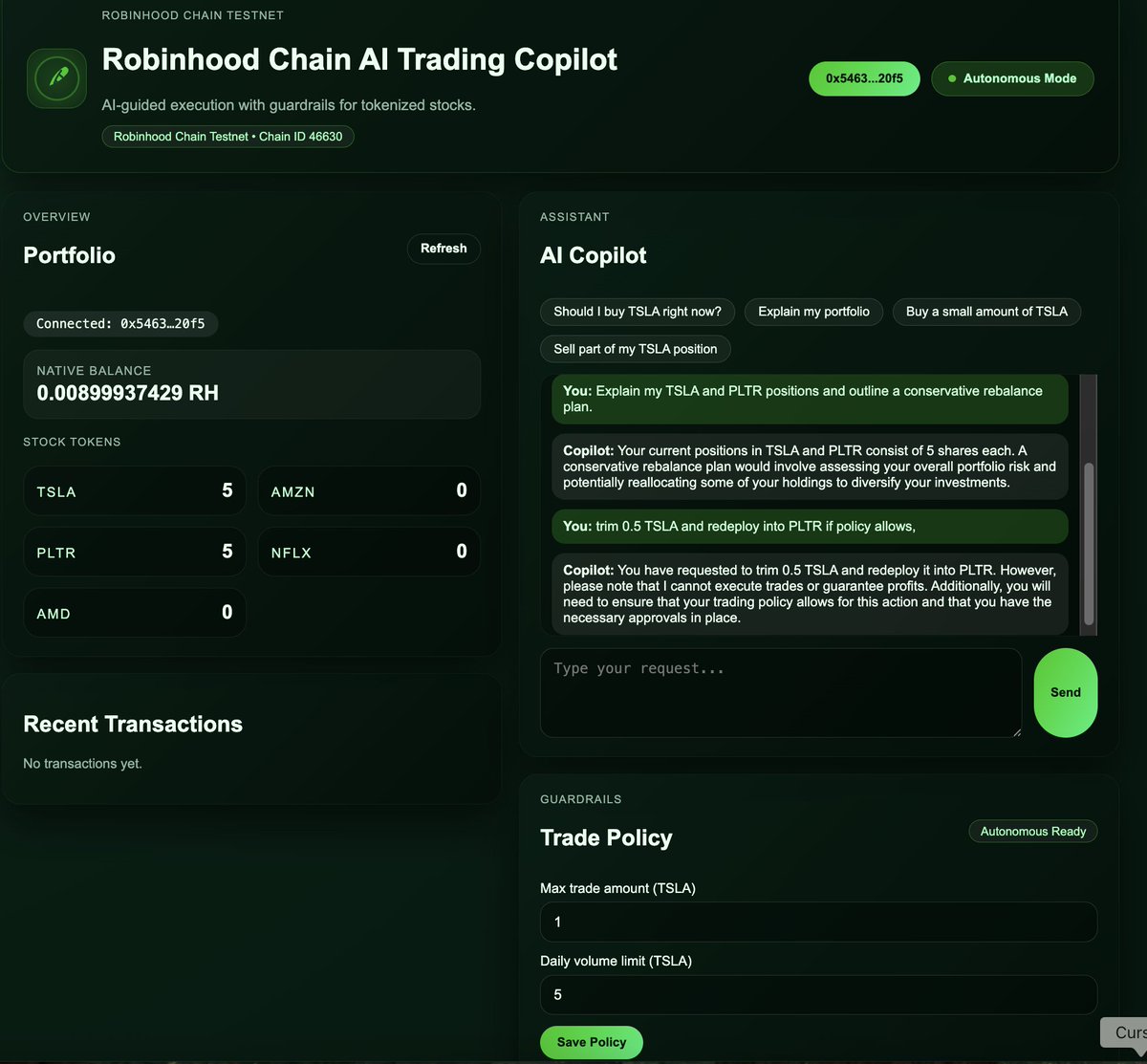
If you’re still sleeping on Robinhood Chain, wake up. The hype isn’t just on CT anymore. Onchain stats are going nuts: 6.15M weekly txs and 108.3K active addresses.
Noir tweet media
English
0
0
3
123
Noir
Noir@oftobacmo·
@zacharylipton Triaged when you get back? 😂 What’s the criteria
English
0
0
0
36
Zachary Lipton
Zachary Lipton@zacharylipton·
Dropping off the grid for a fabulously overdue honeymoon. Shitposts received in my absence will be triaged appropriately & reviewed on my return
Zachary Lipton tweet media
English
12
1
198
15.4K
Noir
Noir@oftobacmo·
@fchollet I like the failing part, but adapt how fast though?
English
0
0
0
229
François Chollet
François Chollet@fchollet·
The process of trying, failing, updating a mental model, and trying again is the core of intelligence. We should celebrate models that fail gracefully and adapt instantly.
English
79
105
1.3K
72.1K
hardmaru
hardmaru@hardmaru·
How do physical systems achieve collective intelligence and self-repair without a central brain? A new paper published today in Nature Communications by my Sakana AI colleague Sebastian Risi (@risi1979), along with co-authors from IT University of Copenhagen and Autodesk Research, presents a beautiful realization of biologically inspired robotics: Smart Cellular Bricks. The team built a system of physical 3D cubic units that can collectively infer their global shape and autonomously guide their own damage recovery using purely local interactions. Here is a deep dive into the paper’s key contributions: 1/ Neural Cellular Automata-based Architecture: Modular robots usually rely on central processors. This system flips that paradigm. Every block independently runs the exact same neural network on local microcontrollers. With no master plan or global coordinates, they communicate only with immediate neighbors. By passing continuous state vectors, hundreds of bricks achieve global consensus on their shape in under 3 minutes. 2/ Emergent Biological Morphogens: How does a block know it is part of a chair, not a table? The network’s internal memory automatically learns to establish continuous gradients across the structure. This beautifully mirrors how biological morphogens give positional info to developing cells. The bricks naturally form left-right, radial, and head-to-tail axes to align their identity. 3/ Performance and Generalization: Validated in large-scale simulations, the networks transferred seamlessly to nearly 200 physical hardware bricks, achieving a 100% convergence rate. Instead of rigid template-matching, the system infers broad categories. Even when tested on unseen variations, like an asymmetric table with five random legs, the collective correctly classified the structure. 4/ Fault Tolerance and Autonomous Damage Recovery: Hardware fails in the real world. This system easily tolerates up to 15% module failure without losing accuracy. By predicting spatial damage directions, the cells pinpointed missing components with 95% accuracy. They actively use these local signals to guide a self-repair process, regenerating back into the intended morphology. I believe this is a significant piece of research, bridging collective intelligence and Physical AI. This work represents the first successful physical realization of large-scale, decentralized 3D self-recognition and damage detection. By moving away from centralized control, this architecture paves the way for highly adaptive smart materials and resilient robotics that can survive and repair themselves. Read the full open-access paper: nature.com/articles/s4146… Congratulations to the team on this achievement!
Sakana AI@SakanaAILabs

We are pleased to share our latest research, now published in Nature Communications: “Smart Cellular Bricks: Physical Modules That Recognize Their Own Shape and Repair Themselves.” Blog: sakana.ai/smart-cellular… Paper: nature.com/articles/s4146… A long-running theme in our work is collective intelligence: the idea that sophisticated, robust behavior can emerge from many simple parts following local rules, with no central controller, as it does in a colony, a tissue, or a brain. We had mostly studied this in software and simulation. So this time we asked a simple question. Do the same decentralized principles hold up in the physical world, where communication is noisy and modules fail? To find out, we built a collection of simple cubic bricks. Each brick runs the same small neural network and talks only to the bricks it is physically connected to. No brick is told its position, or which shape it is part of. Yet from these purely local exchanges, the collective converges on the correct global shape, locates where modules are missing or damaged, and can even guide its own repair, inspired by how living tissue self-organizes and regenerates after injury. For us, this is a first step in a broader direction: taking the principles of collective intelligence we have studied in software and letting them emerge, decentralized and robust, in the physical world. In the future, we imagine smart materials that let structures sense and report damage on their own, and LEGO-like systems that recognize their own configuration and adapt in real time, pointing toward environments that are more robust, adaptive, and regenerative. This work is a collaboration between Sakana AI, IT University of Copenhagen and Autodesk.

English
24
49
383
48.5K
Noir
Noir@oftobacmo·
GM. Have a great week ahead, chat. Lets get it
English
0
0
2
129
Noir
Noir@oftobacmo·
Loop engineering is the difference between babysitting Claude and letting an agent actually work. Simple loop: task in, LLM picks next step, tools run, results feed back, agent checks goal, repeat until the stop condition.
Noir tweet media
English
0
0
1
122