OHO

7.5K posts

OHO

OHO

@ohoinfrench

Everything Finance | Real Estate(Estate Surveyor) | Crypto-Fx

Katılım Mart 2023
95 Takip Edilen112 Takipçiler
OHO
OHO@ohoinfrench·
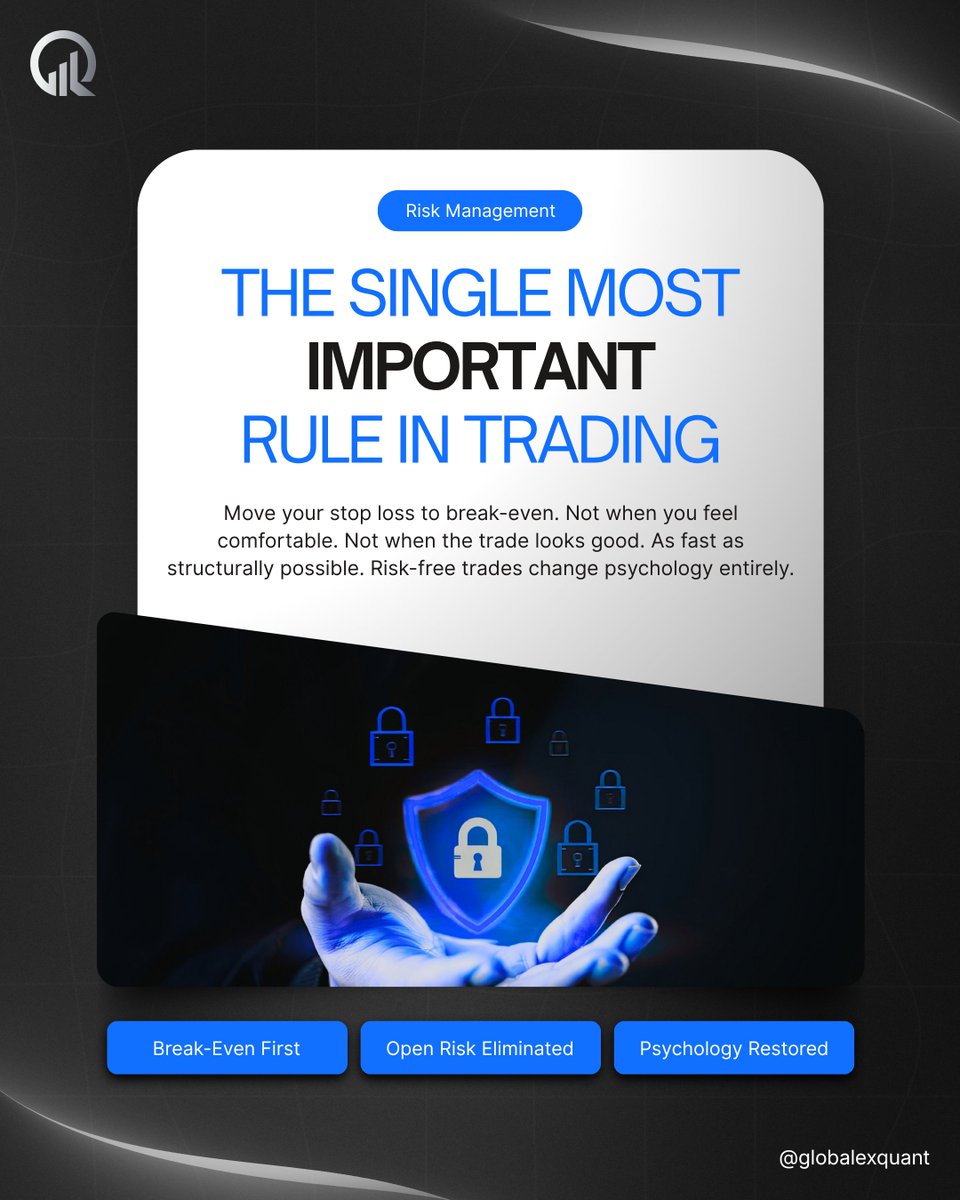
@globalexquant "The adjustment is typically made after the market confirms structural progress, not simply because the trade is currently profitable." This is very important as some people move to break even just because they are in profit and not because of structural progress.
English
0
0
0
7
OHO retweetledi
Globalex Quant | Trading Academy
Risk in trading does not disappear because a trade looks promising. It disappears only when the market structure removes the original reason your stop loss existed. A common mistake is adjusting stops based on emotion or temporary price movement. Moving a stop too early can expose a position to normal market noise. Moving it too late leaves unnecessary capital at risk. Break-even management sits in the middle of those two extremes. Break-Even First Once price has moved far enough to invalidate the initial risk scenario, some traders choose to adjust their stop to the entry price. This effectively removes the original downside exposure from that position. The key point is timing. The adjustment is typically made after the market confirms structural progress, not simply because the trade is currently profitable. Open Risk Eliminated When the stop is moved to the entry price, the original trade risk is no longer active. At that point, the position becomes a trade where the potential outcomes are limited to either no loss or a positive result if the move continues. This type of adjustment does not guarantee profits, but it can reduce the amount of capital exposed to adverse moves. Psychological Impact Risk management also affects decision-making. When the initial downside risk is removed, traders often find it easier to follow their plan rather than reacting emotionally to short-term volatility. The purpose of break-even management is not to avoid losses entirely. Its role is to protect capital once the market has already validated part of the trade idea. 🛡️ Education only. Not financial advice. #globalexquant #riskmanagement #tradingdiscipline #tradingeducation
Globalex Quant | Trading Academy tweet media
English
9
9
11
218
OHO
OHO@ohoinfrench·
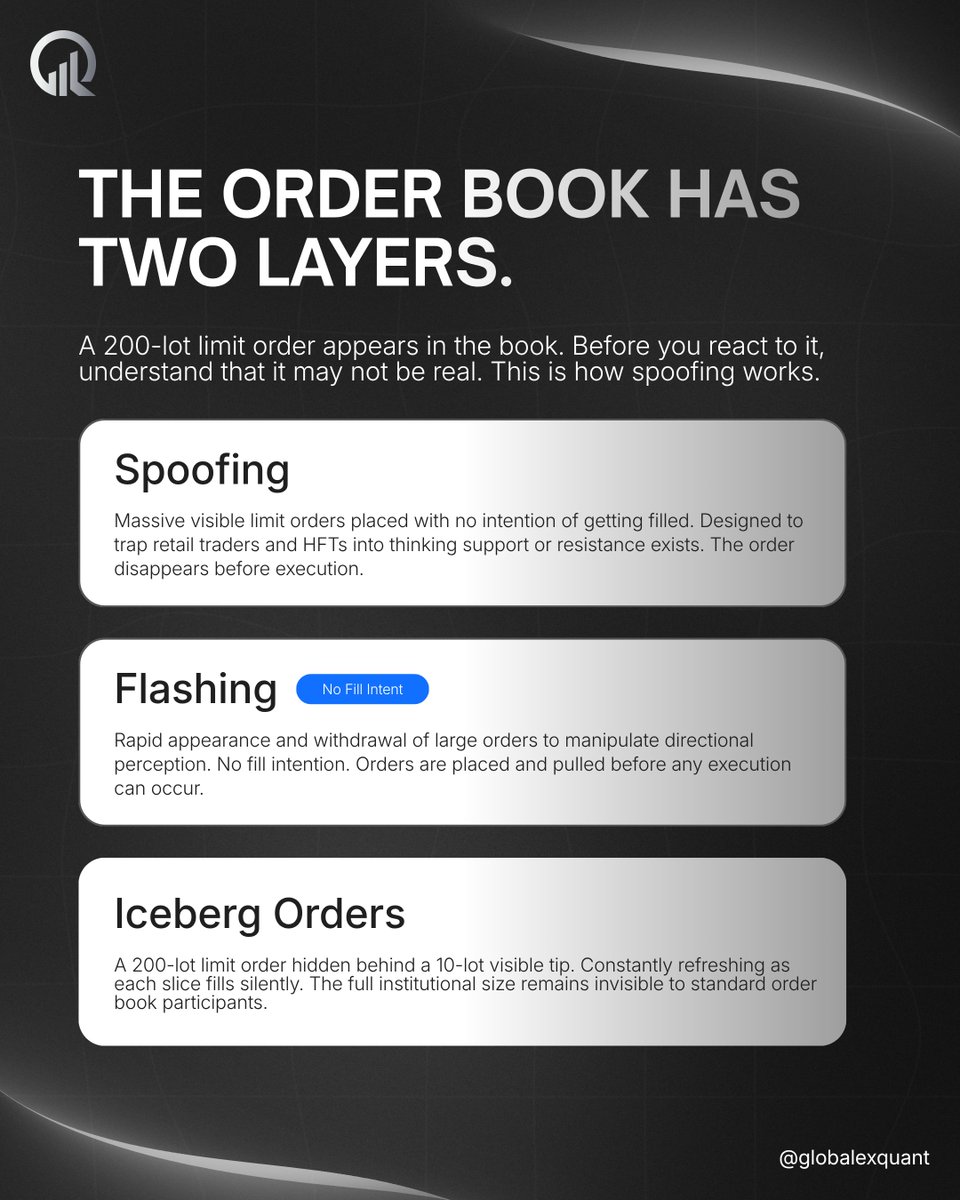
@globalexquant I never knew spoofing was intentionally used to influence perception of orders
English
0
0
0
12
OHO retweetledi
Globalex Quant | Trading Academy
An order book shows visible liquidity, but what appears on the screen does not always represent the full picture. Modern electronic markets operate with different order types and execution behaviors that can make the visible order book only a partial representation of actual market intent. Understanding this distinction is important when interpreting large orders appearing near price. Spoofing Spoofing refers to situations where large visible orders appear in the order book but are removed before execution. The presence of these orders can temporarily influence how other participants interpret supply and demand around certain price levels. Because these orders are cancelled before being filled, the visible liquidity does not necessarily represent real trading interest. Flashing orders In fast electronic markets, large orders can appear and disappear extremely quickly. These orders may be placed and withdrawn within milliseconds, sometimes altering short-term perception of order book pressure without resulting in actual trades. This behavior can make short-term order book signals difficult to interpret without broader context. Iceberg orders Some participants use iceberg orders to execute large positions while revealing only a small portion of the total order size. As each visible portion is filled, a new portion appears, while the full size remains hidden. This mechanism allows large participants to interact with the market while limiting the impact of their full order size on visible liquidity. Because of these mechanics, the order book often contains both visible liquidity and hidden liquidity, and interpreting it requires understanding how different order types operate within electronic markets. 🛡️ Education only. Not financial advice. #globalexquant #orderflow #marketmicrostructure #orderbook #tradingeducation
Globalex Quant | Trading Academy tweet media
English
9
8
14
181
OHO
OHO@ohoinfrench·
@globalexquant The live session, the engagement among those in the server, and the shorts shows that Globalex Academy building something solid.
English
0
0
1
12
OHO retweetledi
Globalex Quant | Trading Academy
Most trading communities share setups and call them education. The Globalex Academy Discord is built differently. It is a space for traders who are done with surface-level content and want to engage with institutional concepts at a serious level. Live trading sessions with Eric. Real-time market analysis across Gold, NASDAQ, Oil, and more. Weekly livestreams covering key levels, session structure, and execution logic sourced directly from the educational framework we publish here. Over 4,000 members are already inside. If that is the level you are working toward, the link is in our bio. 🛡️Educational content only. Not financial advice. #globalexquant #tradingcommunity #tradereducation #livetradingsessions #traders
Globalex Quant | Trading Academy tweet media
English
7
6
11
184
OHO
OHO@ohoinfrench·
@globalexquant The relationship between oil and inflation expectation, as extended high price of oil lead to high production cost.
English
0
0
0
8
OHO retweetledi
Globalex Quant | Trading Academy
Traders watch price charts. Institutional participants watch something else entirely. Before a major move appears on any chart, there is a macro sequence already in motion. Understanding that sequence is what separates reactive trading from analytical positioning. WTI Crude Oil functions as the primary inflation proxy in institutional intermarket frameworks. It is not just an energy market. It is a signal. When oil prices rise consistently, inflation expectations across the broader economy tend to adjust upward with them. Energy costs feed directly into production, transportation, and consumer pricing. Sustained moves in crude are among the first indicators that institutional participants monitor when assessing the macro environment. Fixed income markets respond to real yield expectations, meaning the return on a bond after adjusting for inflation. When inflation expectations rise, the real value of a fixed bond yield compresses. A $100 bond generating a 5% annual return does not deliver 5% in real terms if inflation is moving toward 10%. The purchasing power of that return declines. This is basic yield mathematics, and institutional participants price it in before most retail traders have noticed the move in oil. This is the mechanism behind one of the most documented negative correlations in macro analysis: WTI Crude Oil versus 30-Year Ultra Treasury Bonds. When one rises, selling pressure on the other tends to follow. Not as a rule that works every single time without exception, but as a structural tendency that has been central to institutional macro positioning for decades. The sequence that institutional analysts monitor: Oil prices rise and inflation expectations adjust upward. The real yield on long-duration Treasury Bonds compresses against rising inflation. Holding long-duration bonds becomes less attractive in real return terms. Selling pressure builds on the back end of the bond market, specifically the 30-Year. Understanding this relationship does not require predicting the future. It requires reading the macro environment as it develops and recognising which markets are signalling what before the move is already priced in. This is the foundation of intermarket analysis. And it is where institutional positioning begins. 🛡️ Educational content only. Not financial advice. #globalexquant #macrotrading #crudeoil #inflation #institutionaltrading
Globalex Quant | Trading Academy tweet media
English
6
6
8
205
OHO
OHO@ohoinfrench·
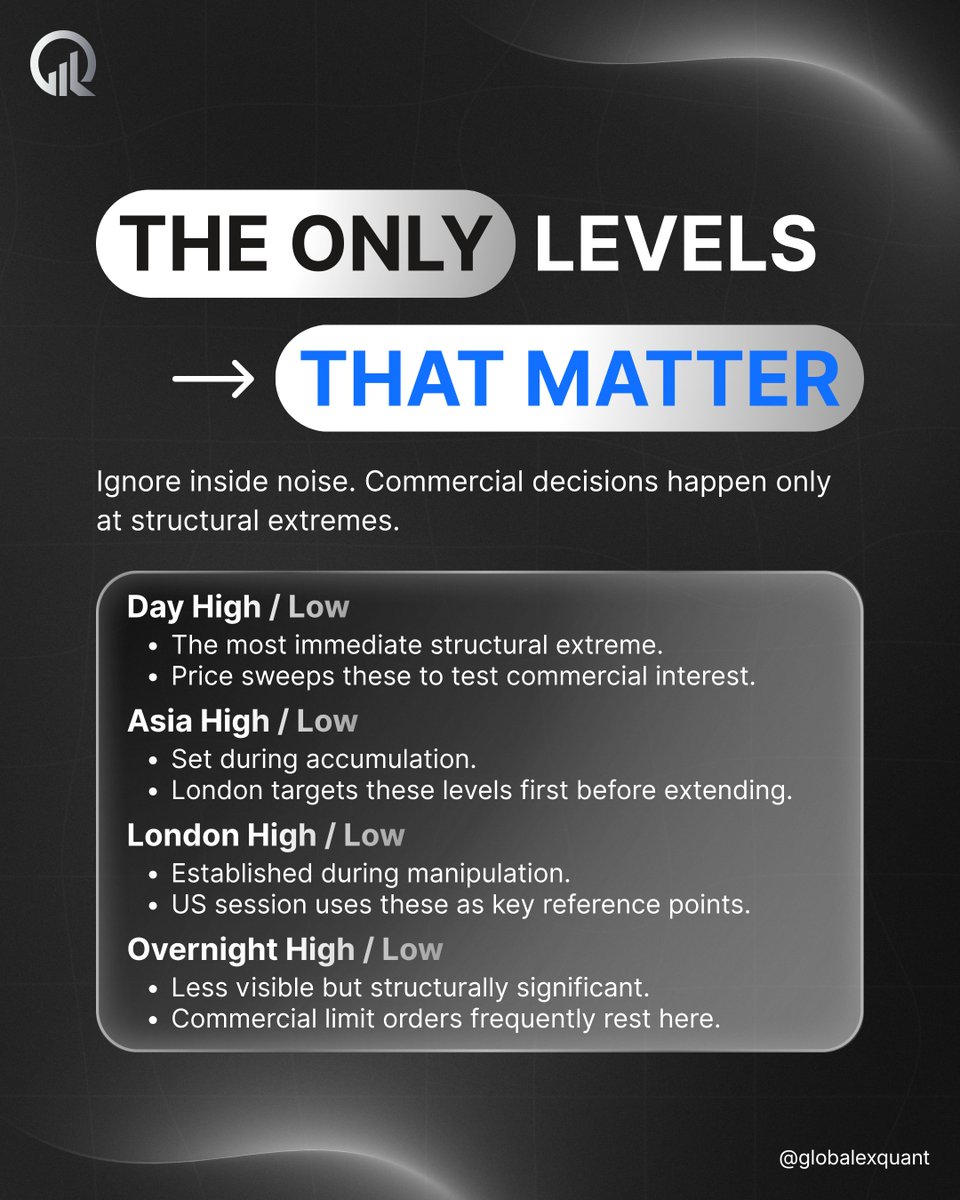
@globalexquant The London high and low may set the tone for the rest of the day.
English
0
0
0
10
OHO retweetledi
Globalex Quant | Trading Academy
Globalex Quant | Trading Academy@globalexquant·
Price structure is not uniform. Certain price levels carry more structural significance than others, and understanding which ones tend to attract the most activity is a core part of reading intraday markets. Day High / Low The day's high and low represent the most immediate boundaries of the current session's price range. These levels are visible to all participants and frequently act as reference points for directional decisions. Price interaction with these extremes often produces measurable responses in order flow. Asia High / Low The Asian session establishes the initial range of the trading day during a period of comparatively lower liquidity. The highs and lows formed during this window are observed by participants in subsequent sessions, particularly as European markets open and liquidity expands significantly. London High / Low The London session introduces a substantial increase in participation. The levels established during this session often serve as structural anchors for the US session that follows, particularly when price revisits these zones during the later hours. Overnight High / Low Levels formed during overnight trading are less visible to participants who focus exclusively on regular session hours. These extremes can represent areas where resting orders have accumulated, making them structurally relevant when price returns to test them. Price tends to travel between these structural extremes rather than moving randomly. Identifying which level is being targeted at any given point provides context for interpreting order flow and market behavior. 🛡️ Education only. Trading involves risk of loss. #globalexquant #marketstructure #liquiditylevels #orderflow #priceaction
Globalex Quant | Trading Academy tweet media
English
7
7
9
214
OHO retweetledi
Globalex Quant | Trading Academy
The equity cash open is one of the most studied windows in professional trading. Understanding why requires looking at what actually happens to market structure during this period. Cash Open Window In the 30 minutes before and after the equity cash open, market participation increases sharply as institutional and retail participants across multiple asset classes enter simultaneously. This concentrated burst of order flow creates conditions that differ significantly from the rest of the trading day. Why It Is Dangerous The sudden surge in volume affects market microstructure directly. Bid-ask spreads widen as liquidity providers adjust to the increased flow. Price moves can become less predictable during this window as large order imbalances interact with thinner resting liquidity. For participants relying on limit order execution, this environment introduces additional execution risk. NASDAQ Sensitivity NASDAQ is a high-beta index, meaning it tends to amplify broader market moves. During the cash open window, this sensitivity is particularly pronounced. The combination of elevated volatility and NASDAQ's inherent reactivity makes this instrument one of the more demanding to navigate during this specific period. The Structural Rule Allowing the initial volume surge to settle before assessing order flow gives a clearer picture of genuine directional participation versus opening noise. Many structured trading approaches incorporate a defined waiting period after the open before considering new entries. 🛡️ Education only. Trading involves risk of loss. #globalexquant #nasdaq #marketstructure #orderflow #equitytrading
Globalex Quant | Trading Academy tweet media
English
6
5
8
204
OHO retweetledi
Globalex Quant | Trading Academy
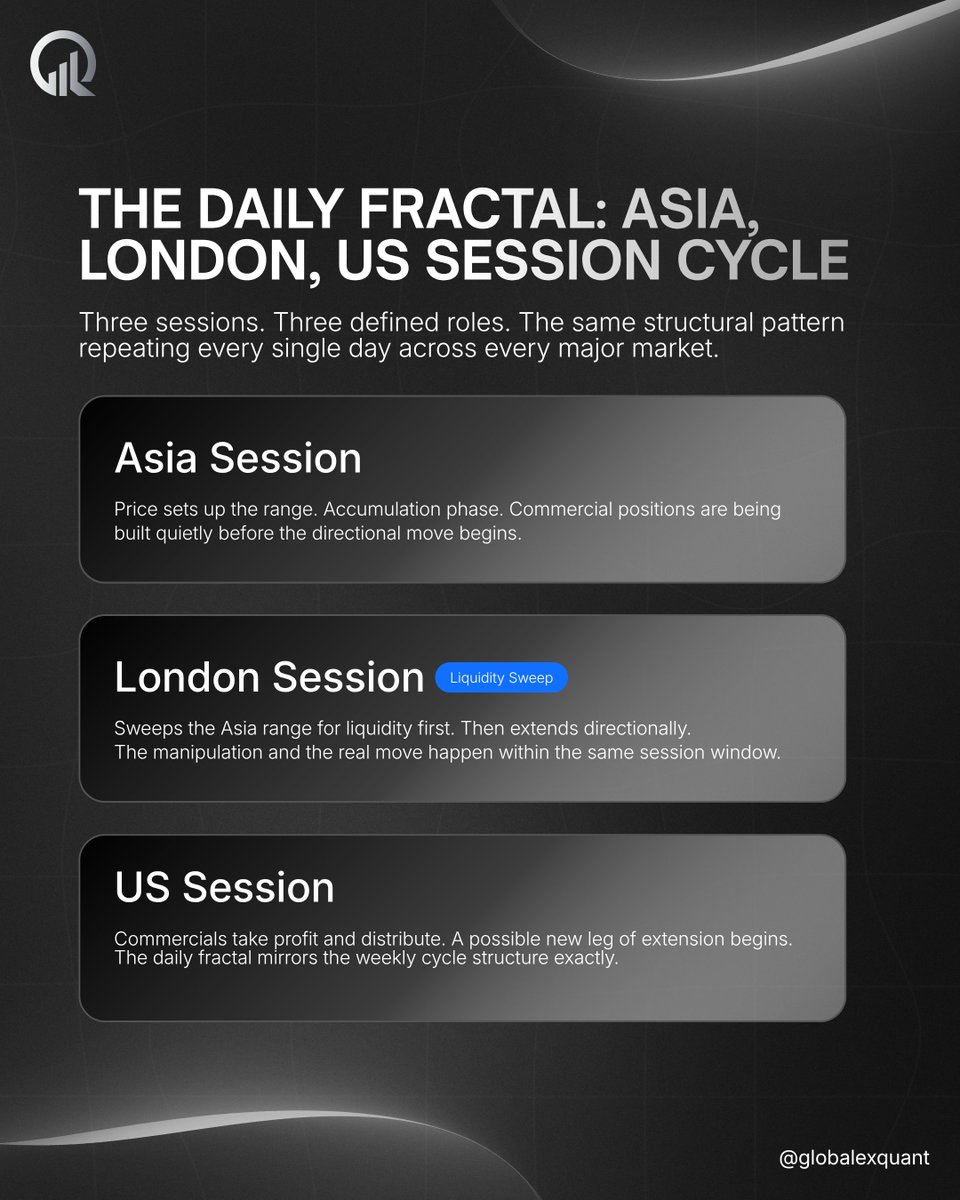
Global financial markets operate across three primary trading sessions each day. Each session has a defined structural role that repeats consistently across major instruments. Asia Session During Asian hours, overall liquidity is lower and price typically develops an initial range. This consolidation phase reflects early positioning as participants establish directional bias ahead of the higher-volume sessions that follow. The highs and lows formed during this period become significant structural reference points for the sessions ahead. London Session As European markets open, liquidity expands significantly and volatility increases. Price frequently interacts with the Asian session highs and lows as new order flow enters the market. Traders who monitor these levels observe that London often establishes the directional bias for the day during this window. US Session When US markets open, participation reaches its highest point of the day across many instruments. Earlier directional moves may continue or be subject to profit-taking and repositioning. The overlap between European and American hours creates the highest liquidity conditions of the trading day. Understanding how each session contributes to intraday structure helps traders contextualize price behavior within a broader market framework rather than reading price movement in isolation. 🛡️ Education only. Trading involves risk of loss. #globalexquant #marketstructure #tradingsessions #liquidity #dailyfractal
Globalex Quant | Trading Academy tweet media
English
7
7
9
159
OHO
OHO@ohoinfrench·
@globalexquant I'm here to learn as much as I can
English
0
0
1
22
OHO retweetledi
Globalex Quant | Trading Academy
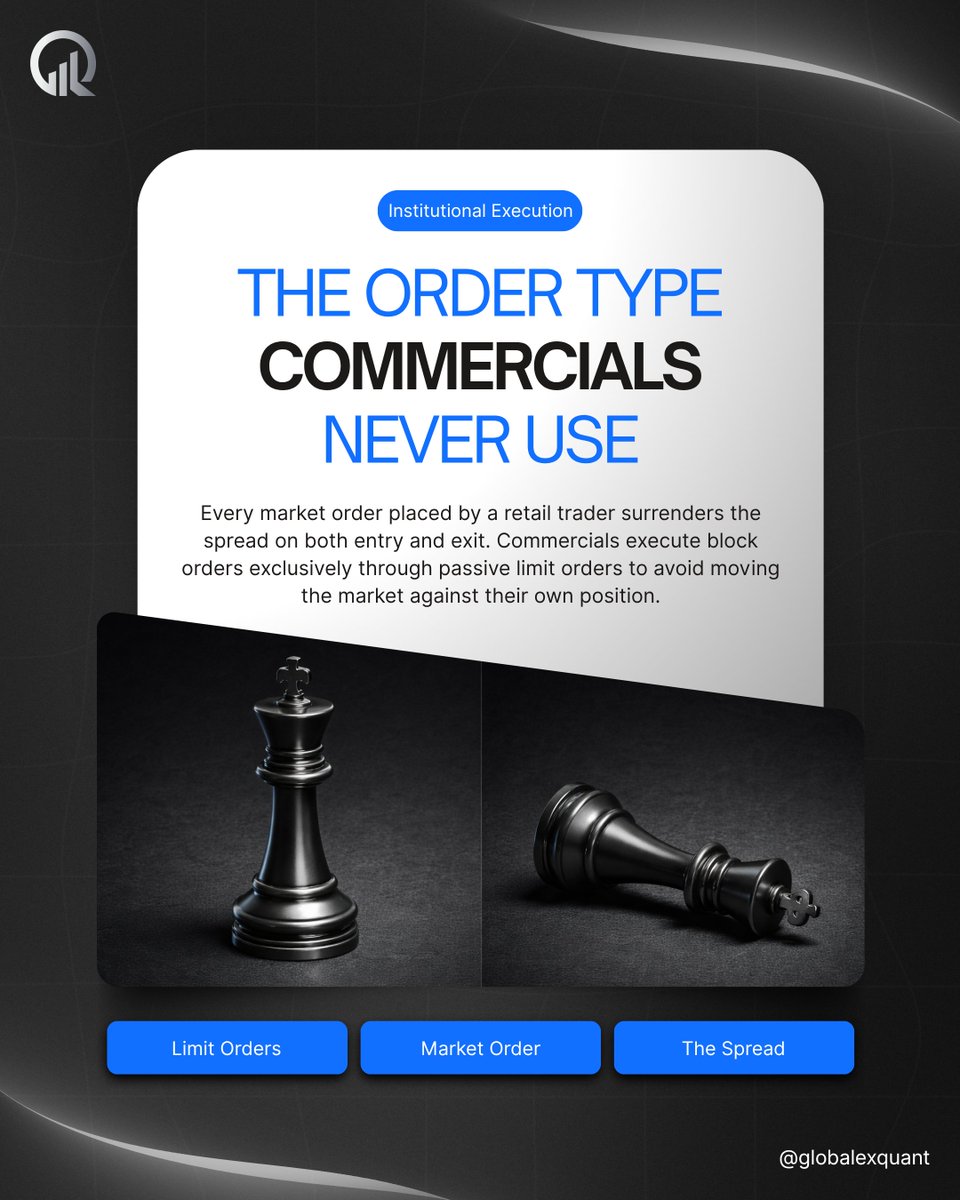
Order type determines how price interacts with your trade. A market order executes immediately at the best available price. Speed is its advantage. The trade is filled instantly against existing liquidity in the order book. The cost of that immediacy is the bid–ask spread and, in fast conditions, potential slippage. A limit order works differently. Instead of crossing the spread, the order is placed passively in the book at a chosen price level. Execution occurs only if the market trades into that price. Because liquidity is being provided rather than taken, the trader avoids paying the spread in the same way a market order would. For larger participants managing substantial position sizes, execution mechanics become important. Entering aggressively with market orders can move price against the position, particularly in thinner liquidity conditions. Passive execution methods allow orders to be distributed across price levels and filled gradually without the same immediate market impact. Understanding how different order types interact with the order book helps traders better interpret price movement, spreads, and execution outcomes across different market environments. 🛡️ Education only. Trading involves risk of loss. #globalexquant #orderflow #execution #limitorders #liquidity
Globalex Quant | Trading Academy tweet media
English
10
12
20
278