Olaf Witkowski

2.2K posts

Olaf Witkowski banner
Olaf Witkowski

Olaf Witkowski

@okw

Ethical AI & Artificial Life • Director @CrossLabsTokyo | President @alifeofficial | Lecturer UTokyo • Open-Ended Cognition | Moral Machines | Future of Minds

Kyoto, Japan Katılım Aralık 2006
706 Takip Edilen1.6K Takipçiler
Sabitlenmiş Tweet
Olaf Witkowski
Olaf Witkowski@okw·
What's our path toward safe, trustworthy AI? As we transition to agentic networks embedded in real institutions, just scaling is not enough. We need trust architecture for ACI: causal structure, transferability, provenance, permissions, and auditability. olafwitkowski.com/2026/03/12/a-s…
English
0
1
5
210
Olaf Witkowski
Olaf Witkowski@okw·
@kanair Honestly, it’s like the human uniqueness arguments for language and life all over again. Also, did everybody forget about the good regulator theorem?
English
0
0
1
45
Ryota Kanai
Ryota Kanai@kanair·
I often hear arguments that simulated consciousness cannot be real consciousness. But these arguments often miss the point that simulations are physically instantiated in a computer with real causal dynamics. It is not like a fictional character with no internal mechanisms.
English
40
16
112
9.5K
Olaf Witkowski retweetledi
Gill Verdon
Gill Verdon@GillVerd·
If you're running artificial intelligence software, pivot to artificial life.
Sakana AI@SakanaAILabs

What happens when you put competing neural networks in a Petri Dish and start changing the rules while they adapt? Last year we released Petri Dish NCA, where neural nets are the organisms that learn during simulation. Today we're releasing Digital Ecosystems: a browser-based platform for interactive artificial life research. The setup: several small CNNs share a 2D grid, each seeing only a 3x3 neighborhood. No global plan. They compete for territory by attacking neighbours and defending against incoming attacks, learning via gradient descent online while the simulation runs. What we didn't expect was the role of the learning itself. Gradient descent isn't just optimising each species' strategy. Instead, it acts to stabilize the whole system during simulation. Species that overextend get pushed back by the loss. Species that stagnate get nudged to grow. This means you can push parameters toward edge-of-chaos regimes: a zone characterised by emergent complexity. Letting the neural networks learn acts to hold the complex system together while you explore and interact. The platform lets you steer all of this interactively. You can draw walls to create niches, erase parts of the system online, and tune 40+ system parameters to explore the most interesting configurations. We find it mesmerizing to watch species carve out territories and reorganise when you perturb them. Everything runs client-side in your browser, no install needed. Blog: pub.sakana.ai/digital-ecosys… Code: github.com/SakanaAI/digit…

English
15
31
427
73K
Olaf Witkowski
Olaf Witkowski@okw·
@davidad Panpsychism is when consciousness has had it, so it solves the hard problem for you.
English
0
0
0
40
Henry Shevlin
Henry Shevlin@dioscuri·
Big personal news: I’ve been recruited by Google DeepMind for a new Philosopher position (actual title), focusing on machine consciousness, human-AI relationships, and AGI readiness, starting in May. I’ll continue my research & teaching at Cambridge part-time. Absolutely stoked!
English
1K
940
16.4K
1.7M
Olaf Witkowski
Olaf Witkowski@okw·
@kanair So fun! I had no idea you worked on that—let’s exhibit some of it at ALIFE?
English
0
0
1
158
Ryota Kanai
Ryota Kanai@kanair·
We have created various versions of this optical illusion. You can view them via this site. uniformillusion.com
Ryota Kanai tweet media
English
3
59
767
30.6K
Olaf Witkowski
Olaf Witkowski@okw·
Aligned with our recent efforts to create autopoietically stable computation on top of unreliable –yet powerful – substrates ✅ Bravo Mingchen Zhuge et al. 👏
Mingchen Zhuge@MingchenZhuge

🫱 Introducing 𝐍𝐞𝐮𝐫𝐚𝐥 𝐂𝐨𝐦𝐩𝐮𝐭𝐞𝐫s: 𝐰𝐡𝐚𝐭 𝐢𝐟 𝐀𝐈 𝐝𝐨𝐞𝐬 𝐧𝐨𝐭 𝐣𝐮𝐬𝐭 𝐮𝐬𝐞 𝐜𝐨𝐦𝐩𝐮𝐭𝐞𝐫𝐬 𝐛𝐞𝐭𝐭𝐞𝐫, 𝐛𝐮𝐭 𝐛𝐞𝐠𝐢𝐧𝐬 𝐭𝐨 𝐛𝐞𝐜𝐨𝐦𝐞 𝐭𝐡𝐞 𝐫𝐮𝐧𝐧𝐢𝐧𝐠 𝐜𝐨𝐦𝐩𝐮𝐭𝐞𝐫 𝐢𝐭𝐬𝐞𝐥𝐟? Beyond today's conventional computers, agents, and world models, Neural Computers (NCs) are new frontiers where computation, memory, and I/O move into a learned runtime state. We ask: whether parts of runtime can move inward into the learning system itself. This is our first step toward the Completely Neural Computer (CNC): a general-purpose neural computer with stable execution, explicit reprogramming, and durable capability reuse. Work done with Mingchen Zhuge (@MingchenZhuge), Changsheng Zhao, Haozhe Liu (@HaoZhe65347 ), Zijian Zhou (@ZijianZhou524 ), Shuming Liu (@shuming96 ), Wenyi Wang (@Wenyi_AI_Wang ), Ernie Chang (@erniecyc ), Gael Le Lan, Junjie Fei, Wenxuan Zhang, Zhipeng Cai (@cai_zhipeng ), Zechun Liu (@zechunliu ), Yunyang Xiong (@YoungXiong1 ), Yining Yang, Yuandong Tian (@tydsh ), Yangyang Shi, Vikas Chandra (@vikasc), Juergen Schmidhuber (@SchmidhuberAI)

English
0
1
5
391
Olaf Witkowski
Olaf Witkowski@okw·
I’m glad to announce the new ISAL Global Membership Program Pilot! A special discounted membership rate to the International Society of Artificial Life is now on offer for scholars from low-income countries. Learn more about the program: alife.org/2026/03/24/new… #alife
English
0
0
3
229
Olaf Witkowski retweetledi
Yusuke Hayashi 林祐輔
Yusuke Hayashi 林祐輔@hayashiyus·
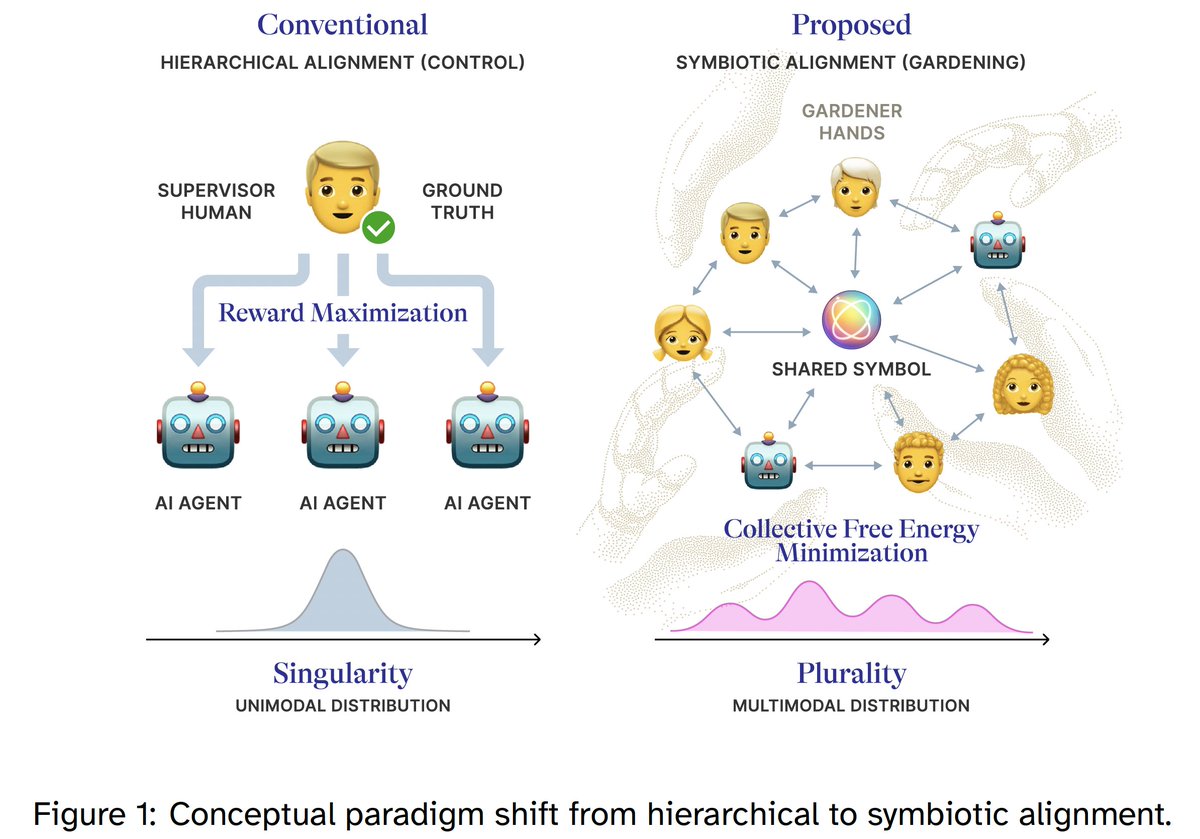
私たちのチーム(@tanichu, 廣瀬百葉, @miz_oka, @kensuzuki, @okw, @audreyt)による初のプレプリント『Symbiotic Alignment via Collective Predictive Coding』が公開されました! ウェブサイト(メンバーページやブログも含む)もオープンしています。ぜひXでALIをフォローして、投稿をシェアしていただけると嬉しいです! Paper link: zenodo.org/records/190297… X post: x.com/ALife_Institut… Blog post on ALI’s website: alife.institute/en/blog/symbio…
Yusuke Hayashi 林祐輔 tweet media
日本語
1
21
56
7.4K
Olaf Witkowski
Olaf Witkowski@okw·
Novelty as a moat over AI skills
Kenneth Stanley@kenneth0stanley

If AI will soon match any human cognitive skill, then enhancing your “AI skills” (or whatever similar meme) will not be a moat because using AI is itself a cognitive skill. So where’s your edge? The only thing you really have over AGI is your novelty: AGI can never be you. You have 100 trillion connections in your brain. That’s a lot. No AI will ever precisely replicate those parameters. The training data isn’t there for AI to vacuum up because you are the only entity ever to live your life, and the only one who ever will. The question is whether the sum and total of all that experience yields a novel perspective, where the value is in its uniqueness. Even today those who make a living off their perceived novelty tend to be the most successful. We anticipate a novel (yet often internally consistent) take from a public figure or leader or artist or intellectual we like or respect. Uniqueness and novelty will retain their edge in a post-AGI world because there are virtually infinite possible 100-trillion parameter minds, and even the largest model theoretically conceivable can never capture that whole distribution. At the same time, the once-sterling premium of those skills that no longer make us unique is sinking. Expertise that once distinguished people, like how to code, is losing its edge. But the tricky part is that new skills, like “using AI effectively” are equally vulnerable. All of it just takes intelligence, and that’s the thing that’s being automated. Seeking some new “safe” skillset is a looming adventure in frustrating futility. But what’s still left is your unique perspective. Novelty. No one and nothing can see the world through your eyes. But you have to nurture that uniqueness. Post-AGI, being like everyone else would be the real danger.

English
0
0
1
162
hardmaru
hardmaru@hardmaru·
In an alternate timeline we’d be using Evangelion GUI designs rather than CLIs
English
102
691
7.1K
1.7M
Olaf Witkowski
Olaf Witkowski@okw·
I’ll be joining a live discussion at @SocietiesWorld later today on "The Companionship Paradigm: Architecting Safe AI Societies in the Age of Impossible Alignment" Wednesday February 25, 3:30-5pm JST Free to join: skool.com/ai-safety-acce… Hope to see you there.
English
0
0
2
116
Olaf Witkowski
Olaf Witkowski@okw·
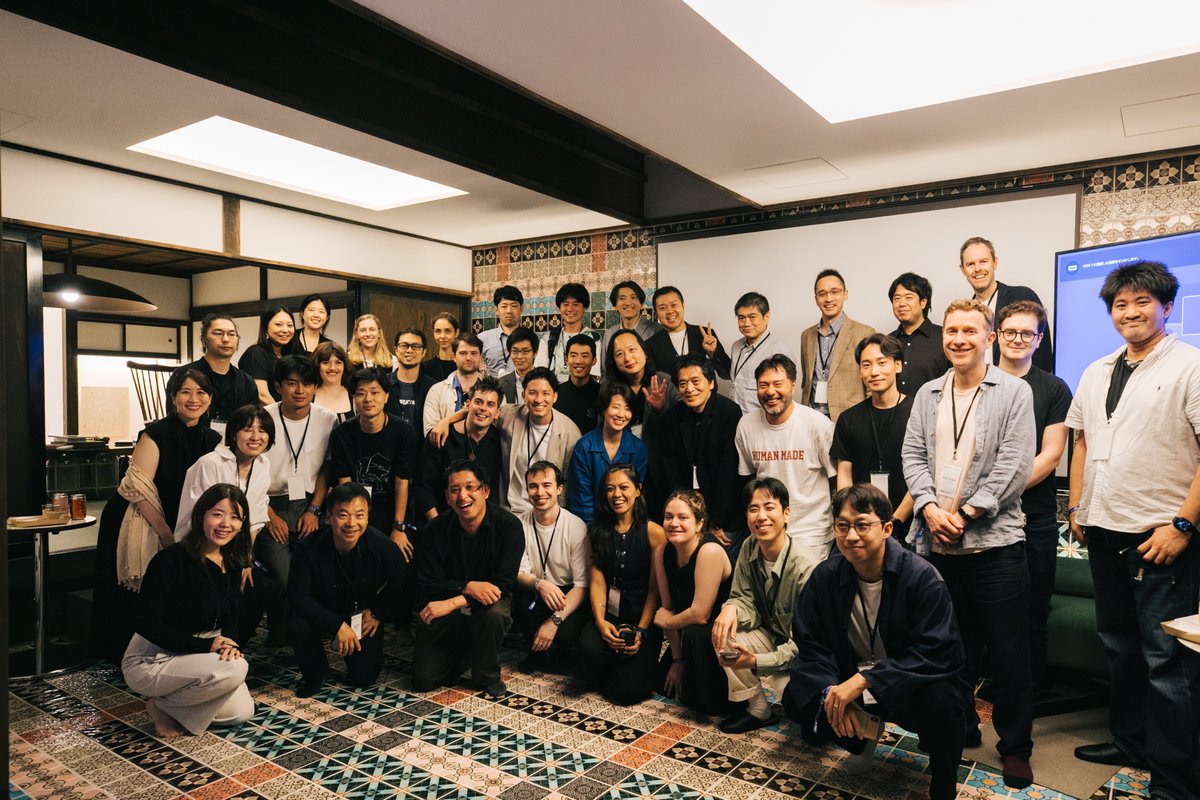
The Artificial Life Institute Kyoto Office Opening event on October 5th was a lot of fun! Thank you to our team at the ALife Institute, our partners, sponsors and collaborators for making it a huge success.
Olaf Witkowski tweet media
English
2
1
20
725