
Olaf Dimigen

182 posts

Olaf Dimigen banner
Olaf Dimigen

Olaf Dimigen

@olafdimigen

Studying the dynamics of Active Vision and Cognition, often with combined eye-tracking/EEG. Tenured Assist. Prof. @univgroningen. On Bluesky.

Groningen, The Netherlands Katılım Ocak 2013
783 Takip Edilen673 Takipçiler
Sabitlenmiş Tweet
Olaf Dimigen
Olaf Dimigen@olafdimigen·
Are you looking for a precise monitor for vision science, eye-tracking, or EEG? In a new preprint, we tested an interesting new display option with excellent timing performance: "High-speed" organic light-emitting diode (OLED) monitors. A summary:🧵[1/n]
Olaf Dimigen tweet media
English
3
46
189
21.5K
Olaf Dimigen retweetledi
Senator Mark Kelly
Senator Mark Kelly@SenMarkKelly·
Just left Ukraine. What I saw proved to me we can’t give up on the Ukrainian people. Everyone wants this war to end, but any agreement has to protect Ukraine’s security and can’t be a giveaway to Putin. Let me tell you about my trip and why it’s important we stand with Ukraine.🧵
Senator Mark Kelly tweet media
English
14.9K
24.9K
153.7K
10.7M
Olaf Dimigen retweetledi
GeoConfirmed
GeoConfirmed@GeoConfirmed·
GeoConfirmed UKR - Misinformation by President Trump. While we typically refrain from political commentary, President Donald Trump's recent statement regarding the war in Ukraine is so egregious that we feel compelled to respond. Several claims made by President Trump have already been debunked. We've included responses from Grok AI for each claim, demonstrating that even Grok refutes the misinformation spread by the president. In this thread, we will provide geolocated footage as a reminder to everyone that Russia invaded Ukraine on February 24, 2022, marking the beginning of this war. 1) The United States has not spent $350 billion on this war, nor has it outspent Europe by $200 billion. In fact, European contributions have surpassed those of the US. Moreover, a significant portion of the American military aid (around 90% !) is spend in the US, reinvesting in the US economy. statista.com/statistics/149… eeas.europa.eu/delegations/un… ifw-kiel.de/publications/n… csis.org/analysis/where… (Grok: x.com/i/grok/share/9…) 2) President Zelensky did not claim that half the American money sent to Ukraine is "missing". He stated that half of the promised funds had not been received, which is a crucial distinction. csis.org/analysis/where… politifact.com/factchecks/202… edition.cnn.com/2025/02/19/pol… (Grok: x.com/i/grok/share/x…) 3) Ukrainian constitution prohibits elections during wartime, a measure designed to protect the democratic process from foreign interference, particularly given Russia's known capabilities in this area... foreignpolicy.com/2023/07/11/ukr… edition.cnn.com/2024/03/30/eur… united24media.com/war-in-ukraine… (Grok: x.com/i/grok/share/i…) 4) President Zelensky is not a dictator, as evidenced by Ukraine's constitutional framework and his commitment to holding elections once hostilities cease. In contrast, it's worth noting that President Putin consistently wins elections in Russia with implausibly high percentages of votes, with opposition that 'falls out of windows", is poisened or jailed, raising questions about the true nature of Russia's electoral process. europarl.europa.eu/doceo/document… oscepa.org/en/news-a-medi… osce.usmission.gov/on-the-russian… japantimes.co.jp/news/2024/03/1… bbc.com/news/world-eur… (Grok: x.com/i/grok/share/a…) 5) President Zelensky has a approval rate above 50% and not 4%. 4% is Russian disinformation. edition.cnn.com/2025/02/19/pol… kiis.com.ua/?lang=eng&cat=… euronews.com/2025/02/19/zel… abcnews.go.com/International/… (Grok: x.com/i/grok/share/I…) 6) There was no NATO expansion to the East, as NATO itself cannot expand. Instead, democratic countries independently decide whether they want to become members of the alliance. The process of joining NATO is voluntary and involves multiple steps, including meeting specific requirements and completing a formal application process. The fact that many of Russia's former neighbors have chosen to seek NATO membership speaks volumes about their perception of Russia and their desire for collective security. The decision of these nations to pursue NATO membership reflects their sovereign right to determine their own foreign policy and security arrangements. It also indicates a preference for the stability and security guarantees that NATO membership offers, rather than remaining under Russian influence. Regarding the famous 'promise': Article 103 of the UN Charter establishes a clear hierarchy in international law. It states that obligations under the UN Charter prevail over obligations under any other international agreement in case of conflict. This supremacy extends beyond just treaties, as it is generally understood to also apply to customary international law. The hierarchy can be summarized as follows: 1) UN Charter obligations 2) Other treaties and customary international law 3) Non-treaty international texts 4) Political promises or commitments 5) Historical claims Russia's invasion of Ukraine clearly violates fundamental principles of the UN Charter, including the prohibition on the use of force against the territorial integrity of another state. Any attempts to justify this action based on lower-ranking considerations like political promises or historical claims are legally irrelevant. euvsdisinfo.eu/report/there-i… nato.int/cps/ra/natohq/… iir.cz/lies-provocati… (Grok: x.com/i/grok/share/f… and x.com/i/grok/share/N… and x.com/i/grok/share/N…) 8) Who initiated this nearly three-year-long war? RUSSIA. As a platform that has analyzed over 50,000 frames/videos related to the conflict, we will remind the president ,with geolocated footage, who started this war: RUSSIA. Russia invaded Ukraine on February 24, 2022, despite repeatedly denying any plans for invasion in the preceding days. x.com/Mike_Pence/sta… edition.cnn.com/2025/02/19/pol… (Grok: x.com/i/grok/share/m…) --- 24 FEB 2022 - Russian tanks crossing the border from Belarus into Ukraine in Senkivka. 52.106063, 31.780644 4Q4J+C7C Sen'kivka, Chernihiv Oblast, Ukraine Sources: x.com/conflicts/stat… 1/11
English
1.3K
10.7K
34K
4.4M
Tim Kietzmann
Tim Kietzmann@TimKietzmann·
@olafdimigen Hi Olaf, @carmen_amme just told me that the supplement can be downloaded from the preprint webpage. See below. Hope this helps, otherwise let us know.
Tim Kietzmann tweet media
English
1
0
1
81
Olaf Dimigen
Olaf Dimigen@olafdimigen·
@TimKietzmann Hi Tim. The preprint refers to "Supporting Information", which seems to be missing, is the complete version available somewhere?
English
2
0
2
98
Olaf Dimigen
Olaf Dimigen@olafdimigen·
@AdnannKurt Photo diode response plots are relative to execution of "flip" command, which exchanges GPU's front and back buffer (the latter containing the new stimulus), so little jitter is expected there. Software used is psychtoolbox.org.
English
1
0
1
82
Adnan Kurt
Adnan Kurt@AdnannKurt·
@olafdimigen Excellent work! Thanks for sharing. How do you get exact timing with stimulation pattern? I mean, how do you eliminatt stimulation trigger jitter due to OS interrupt drlay?
English
2
0
2
277
Olaf Dimigen
Olaf Dimigen@olafdimigen·
Are you looking for a precise monitor for vision science, eye-tracking, or EEG? In a new preprint, we tested an interesting new display option with excellent timing performance: "High-speed" organic light-emitting diode (OLED) monitors. A summary:🧵[1/n]
Olaf Dimigen tweet media
English
3
46
189
21.5K
Olaf Dimigen
Olaf Dimigen@olafdimigen·
@MartinMwiener Correct, we compared to two (arbitrarily chosen) LCDs (IPS & TN). To my understanding, there are 1. "Mini-LED" panels. Means LEDs are used as LCD backlight; therefore also slower than OLED. In contrast, 2. "Micro-LEDs" use miniaturized LEDs as pixels - very interesting in future.
English
0
0
0
105
Olaf Dimigen
Olaf Dimigen@olafdimigen·
@bosscillations We were also looking for: - short input lag (e.g., for eye-tracking) - rapid rise time (e.g., for ERP/VEP) - true black (for pract. infinite contrast ratios) - good viewing angles (for peripheral vision exp.) The "LCD" in my plots was an IPS. It didn't do well in these regards /2
English
1
0
1
110
Olaf Dimigen
Olaf Dimigen@olafdimigen·
@bosscillations I really depends on what you need for your experiment. The (ingenious!) G-Sync trick is great if your main aim are fine-grained stim. durations, your stim. lasts > 1 frame, and you have enough time to "entrain" the VRR to a predictable (e.g., not triggered by a saccade) stim. /1
English
1
0
1
93
Olaf Dimigen
Olaf Dimigen@olafdimigen·
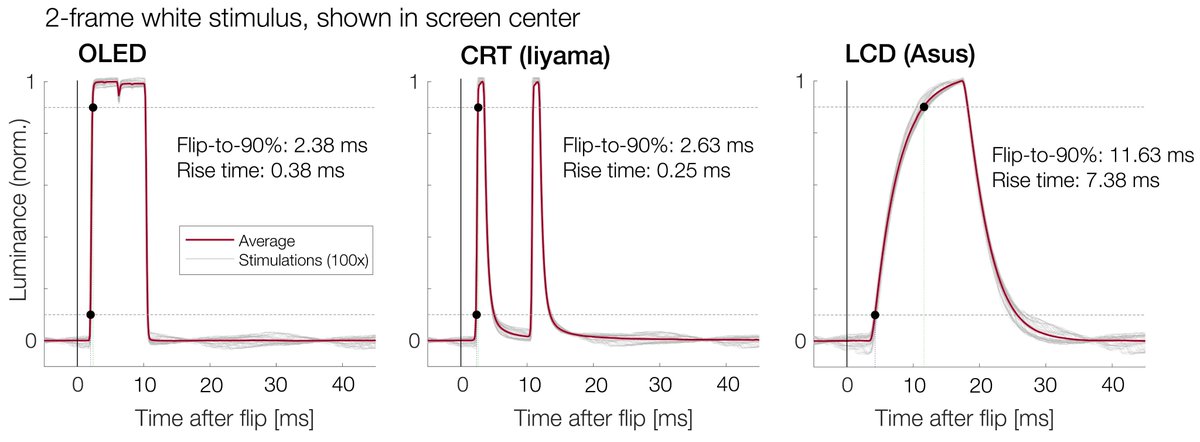
Here's a comparison to a CRT & LCD. The OLED's response times (~0.3 ms) are on par with a CRT, minus the phosphor persistence. Latencies were much better than for the LCD. [5/n]
Olaf Dimigen tweet media
English
1
2
6
1.4K
Olaf Dimigen
Olaf Dimigen@olafdimigen·
Summary: At less than $1000, these OLEDs look like a very appealing option and true CRT-replacement, even for the underfunded visual scientist. All details in preprint, written with co-author Arne Stein: biorxiv.org/content/10.110… [end]
English
2
4
29
1.4K
Olaf Dimigen
Olaf Dimigen@olafdimigen·
We also identified some caveats: Proper monitor settings are crucial to prevent luminance saturation artifacts (due to Auto-Brightness Limiting). See preprint for details. [10/n]
Olaf Dimigen tweet media
English
1
1
2
1.1K
Olaf Dimigen
Olaf Dimigen@olafdimigen·
At 240 Hz, the OLED can draw stimuli with finely graded durations. Here is an example of a white stimulus shown for two frames (8.33 ms). Note the almost square wave-like luminance response: [4/n]
Olaf Dimigen tweet media
English
1
1
2
1.2K
Olaf Dimigen
Olaf Dimigen@olafdimigen·
OLED panels are known for their image quality. Unlike LCDs, their pixels are self-lit, respond rapidly, and can show true black. Only recently, however, OLEDs with high 240 Hz refresh rates became available. We compared one promising model (ASUS PG27AQDM) to CRTs & LCDs: [3/n]
English
1
1
1
1.2K
Olaf Dimigen
Olaf Dimigen@olafdimigen·
Cathode-ray tube (CRT) monitors have long been the gold standard for temporal precision, but are nowadays hard to find. Many labs have moved to LCDs, which suffer from comparatively sluggish and temporally dependent responses, poor viewing angles, and low contrasts. [2/n]
English
1
1
2
1.2K