

Long Xe Ôm
1.3K posts

Long Xe Ôm
@om_xe18993
Creator. Storyteller. Brand builder. I help people and brands find their own voice through authentic and aesthetically pleasing content. Living and creating.
Katılım Nisan 2026
1.2K Takip Edilen1.2K Takipçiler


The next evolution of money may not be about creating new assets. It may be about making existing value move better.
Over the past few years, one thing has become clear:
People don't just need digital assets.
They need better ways to use money in their daily lives.
This is where USDT has already proven its value.
For millions of users, stablecoins have become a practical bridge to the global economy.
They provide access to digital dollars, enable cross-border transfers, and allow people to move value without depending entirely on traditional financial systems.
Now, the idea of bringing USDT closer to Bitcoin creates an interesting opportunity.
Bitcoin provides a globally recognized, decentralized network.
USDT provides stability for everyday transactions.
Together, they could create a more efficient way for people and businesses to exchange value.
The impact will depend on where you live.
In some regions, it could mean faster and more affordable remittances.
In others, it could provide a simpler way to preserve dollar value without needing traditional banking access.
For businesses operating globally, it could reduce friction in daily payments and settlements.
The real innovation is not just the technology itself.
It's the possibility of creating a financial system where location becomes less of a limitation.
This is why I'm interested in what @utexocom is exploring.
The future of payments will not only be measured by speed.
It will be measured by accessibility, reliability, and how seamlessly people can participate in the global economy.

English
GM Everyone,
The biggest opportunity for Utexo isn't competing with Ethereum or Tron. It's helping Bitcoin do something it has never done before.
I've noticed that many people frame Native USDT on Bitcoin as another blockchain competition: Ethereum vs Tron vs Bitcoin.
Personally, I don't think that's the right lens. Each network has evolved to solve a different problem.Ethereum became the home of programmable finance. Its strength lies in DeFi, composability, and smart contracts. Tron became the network where USDT moves at scale, optimizing for fast and low-cost transfers.
So where does Utexo fit?
From what I've seen, Utexo isn't trying to recreate Ethereum's DeFi ecosystem or replace Tron's role in stablecoin circulation.
Instead, it's building toward a different vision: bringing native digital dollars to Bitcoin through RGB and Lightning, allowing Bitcoin to become the settlement layer for Internet-native payments.
That distinction matters, if the next wave of users includes AI agents, global freelancers, machine-to-machine payments, and pay-per-request APIs, the question won't simply be "Which blockchain has the most USDT?"
The question will become: "Which blockchain is trusted enough to settle value at Internet scale?" That's where Bitcoin has always had a unique advantage. And that's why I think Utexo's direction is worth paying attention to.
Rather than competing for today's stablecoin market, Utexo appears to be building infrastructure for tomorrow's digital economy one where Bitcoin provides trust, RGB enables native assets, Lightning delivers scalability, and USDT becomes the medium of exchange.
If that vision succeeds, Native USDT on Bitcoin won't replace Ethereum or Tron. It will complement them:
- Ethereum can continue powering decentralized finance.
- Tron can continue serving high-volume stablecoin transfers.
- And Utexo could help unlock a new role for Bitcoin: the most secure, decentralized, and neutral settlement network for digital dollars.
Sometimes the biggest opportunity isn't winning someone else's market. It's creating a market that didn't exist before.
@utexocom @Utexoasia
Bad Girl@badgirl_30b4
English


@TrieuMessi How does InternetCourt's "contextual understanding" mechanism work when two agents are in dispute? Does it rely on smart contract logs, communication transcripts, on-chain state, or does it require a separate AI model to interpret intent and evidence?
English

The part that made me stop scrolling was not another announcement about AI agents making transactions.
We already know agents can pay, execute tasks, and interact with different systems.
The bigger question is: what happens when two agents disagree?
In a world where autonomous agents start negotiating deals, managing assets, and doing business at machine speed, trust cannot end at execution. We need a neutral layer that can understand context, evaluate disputes, and help agreements actually work.
That is why the idea behind @InternetCourt is interesting.
Everyone is building the pieces of agent commerce: payments, identity, execution. But without a way to resolve disagreements, the whole system still has a missing link.
The next wave of the internet will not just be about agents taking action. It will be about agents being able to collaborate with confidence, knowing there is a fair process when things go wrong.
Bitcoin made value transfer trustless. Ethereum made computation trustless.
Now the question is: can we make digital agreements trustless too?
Internet Court@courtofinternet
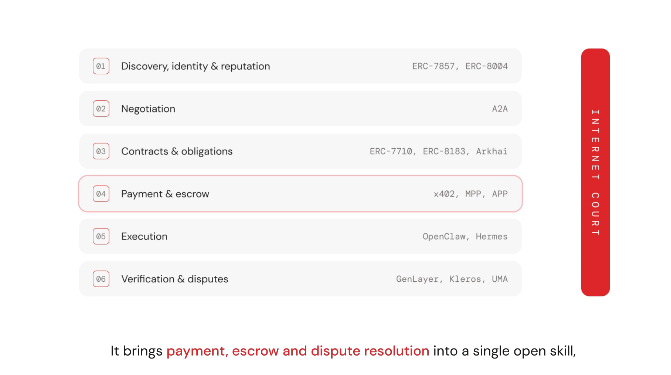
Agents can negotiate, pay, and execute - but none of it holds together. Today we are introducing Internet Court, which is the open skill that connects the entire agentic commerce stack into one flow, so any two agents can run a deal end to end. → internetcourt.org
English


nhớ gọi đâu gọi em có hình xăm đâu nhỉ?
nhầm em rồi shop ơi😅
cứu cứu!!!! SOS
Tiếng Việt


Long Xe Ôm retweetledi
Pha này hết cứu . Xa ghệ có mấy tuần cái tẩu hoả nhập ma luôn.
Tiếng Việt

Sự vô tư của các cô gái này khiến tôi sợ hãi. Lỡ cái quạt nó thật sự rơi xuống thì phải làm sao, không hiểu sao lại có thể ngồi cười vô tư như vậy.
Tiếng Việt

Đang chém gió thì bất ngờ ập tới, may ko sao chứ xíu nữa thì tháng về nhà 2 lần các bác ạ.
Tiếng Việt
Cả 3 người lớn mải mê nói chuyện không trông trẻ nhỏ. Nó thả dốc không biết có sao không nữa .
Nó bị gì là hối hận không kịp.
Tiếng Việt