Sabitlenmiş Tweet
The Operating Function Company
382 posts

The Operating Function Company
@opfn_co
An operating function is a new kind of personal computer where all programs are open, malleable and owned by the user.
US Katılım Mart 2023
95 Takip Edilen918 Takipçiler
The Operating Function Company retweetledi

Vaporware Podcast
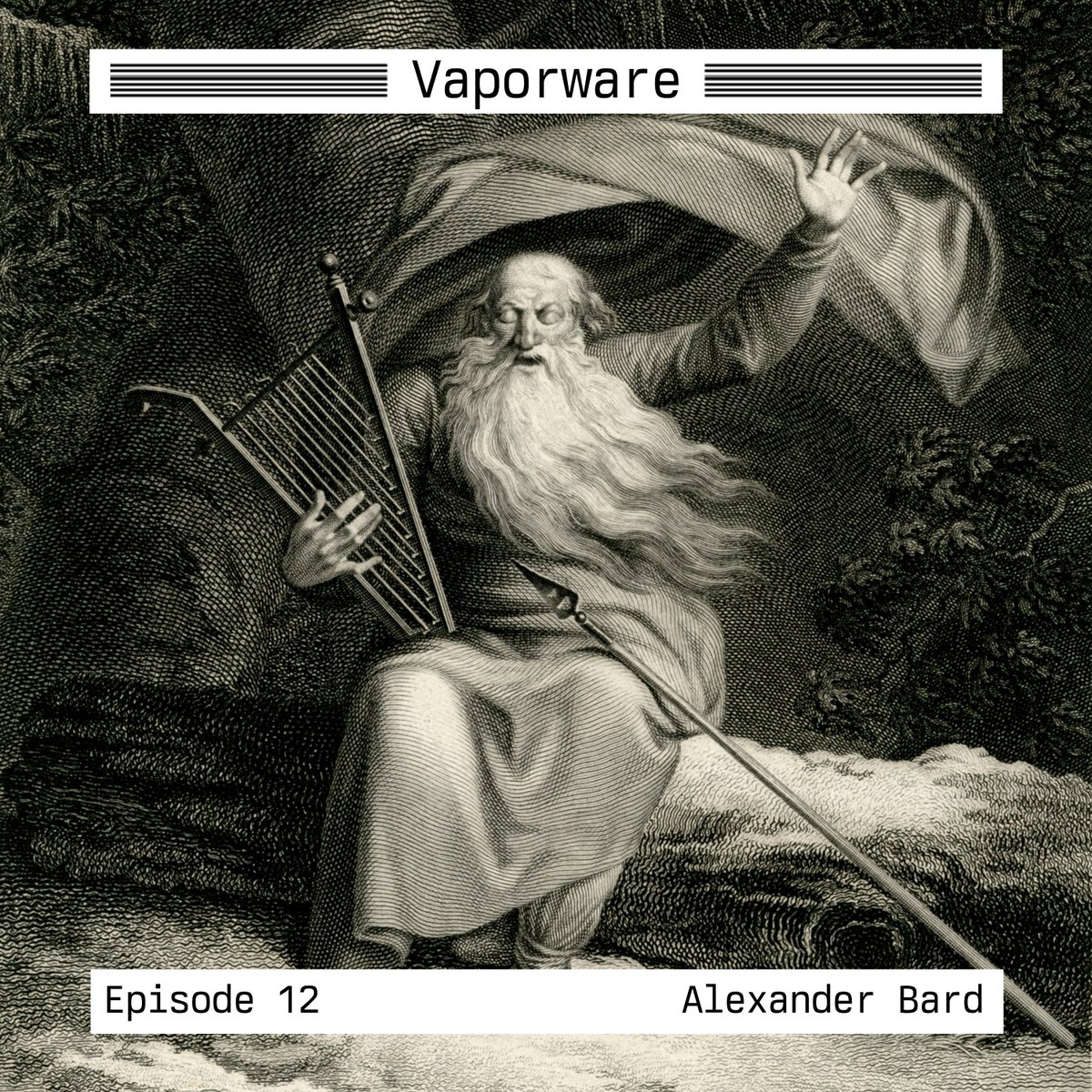
Episode 12: Alexander Bard
This week Daniel @DnlKlr and Chase @harden_hardys are joined by Jack Ek @wereness and his friend, the legendary Alexander Bard @Bardissimo, who describes himself as a “philosopher who writes f***ing books" and is according to his Wiki: a Swedish musician, author, lecturer, artist, songwriter, music producer, TV personality, religious and political activist, one of the founders of the Syntheist religious movement, and member of the bands Army of Lovers & BWO, amongst numerous other projects. More recently, he cofounded a secret society called The Grey Robes, AKA the “Freemasons of Decentralization.”
We cover:
• How Jack and Bard met through Euroburner culture
• Is Bucharest the next Berlin? Or…can there never be a ‘next Berlin’
• Property ownership as lynchpin for scene building
• The secrets of disproportionate Swedish soft power
• America as theater for the rest of the world
• Lessons from Urbit: too Kantian
• Philosophy’s role in engineering
• Behavioral Economics and ‘Nudge Units’
• The need for spirituality when grappling with the ramifications of AI
• AI as a fundamentally truth seeking technology and therefore a threat to authoritarian governments
• The devolution of the internet from Open and flat into a tribal, feudal dark forest.
• Decentralization vs Centralization as the only important political axis
• Tips for community building in a decentralized world (parallelize it)
Artwork: J.F. Clemens after Nicolai Abildgaard, “Ossian’s Swan Song”, 1787

English
The Operating Function Company retweetledi


Vaporware Podcast
Episode 11: Samuel Hammond
This week, Daniel (@DnlKlr) chats about technology, governance and culture with Samuel Hammond (@hamandcheese) , senior economist for the Foundation for American Innovation (@JoinFAI) , a think tank focused on bridging the cultures of Silicon Valley and DC. Sam has an outstanding Substack where he writes about topics surrounding AI development & regulation, as well as the history and future of liberalism, secularism and pluralism.
Topics include:
• The day-to-day of working in a think tank
• What it means to bridge the cultural divide between Silicon Valley and DC
• The real American power centers (New York (finance/media), Texas (energy), Silicon Valley (tech) and how Hollywood has always been subservient
• Embracing pluralism in terms of values, morals and ontological framework
• How to apply the theory of The Second Best to one's general worldview: 'when it is infeasible to remove a particular market distortion, introducing one or more additional market distortions may lead to a more efficient outcome'
• The evolution of liberalism has evolved as a response to periods of extreme conflict (The 30 Years War, for instance)
• Debating whether or not crisis is essential for generating new equilibria in society
• Accelerationism and capitalism as a general intelligence
• Path dependency and historical development
• Exploring scenarios about what happens if AI scaling laws breakdown
• Predictions about AI’s impact on regime change and the rise of AI-native institutions
• Can open source AI keep up? Why it’s important that they keep trying, despite the widening performance gap
• Why Sam isn’t worried about children adapting to technological change
• The coming return of Neo-Medieval societal structures
• Completing the system of Canadian Idealism
Artwork: Edward Hicks, “Peaceable Kingdom”, 1844-1846

English

Listen here or on your favorite player: podcasts.apple.com/us/podcast/epi…
English

The Operating Function Company retweetledi

Spoke to Dan and Harden @__vaporware__
🙏🙏🙏
The Operating Function Company@opfn_co
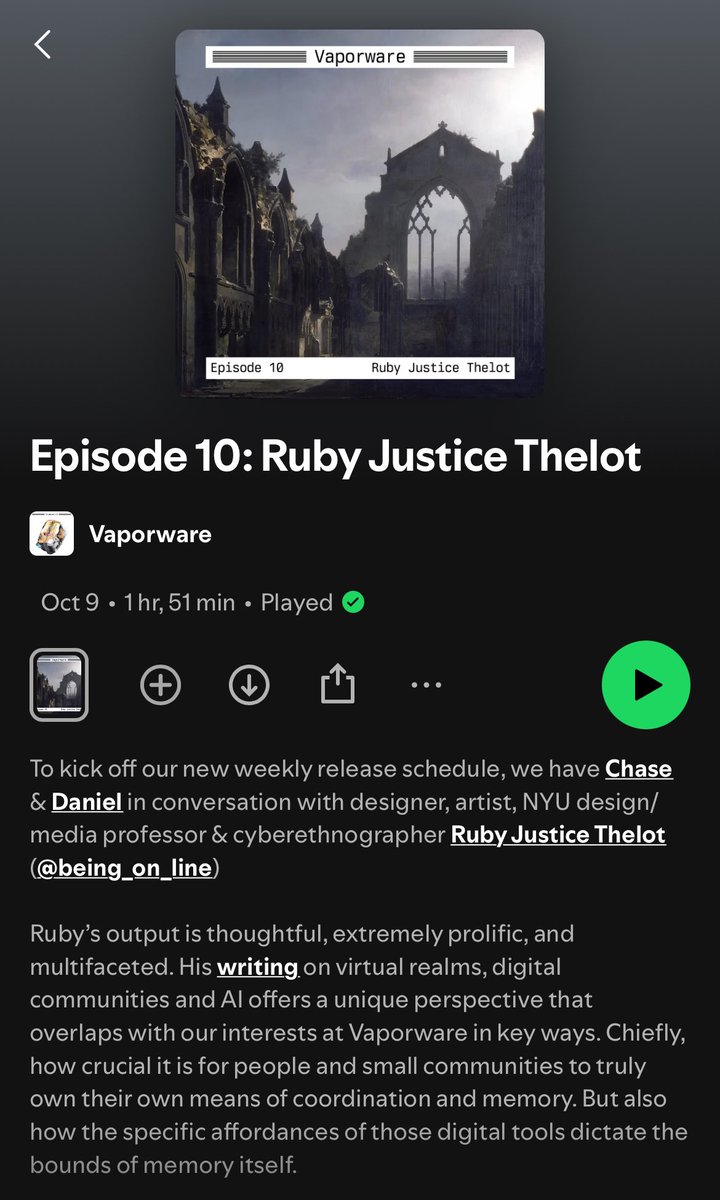
Vaporware Podcast Episode 10: Ruby Justice Thelot To kick off our new weekly release schedule, we have @harden_hardys & @DnlKlr in convo w/ designer, artist, NYU design/media prof. & cyberethnographer Ruby Justice Thelot (@being_on_line)

English

Ruby’s output is thoughtful, extremely prolific, and multifaceted. His writing on virtual realms, digital communities and AI offers a unique perspective that overlaps with our interests at Vaporware in key ways. Chiefly, how crucial it is for people and small communities to truly own their own means of coordination and memory. But also how the specific affordances of those digital tools dictate the bounds of memory itself.
Topics covered :
• Ruby’s new habit of buying old film home movies off eBay
• The concept of ‘Mnemophagy’: “the devouring of memory” and the ephemerality of online culture
• Checkpoints: Ruby’s book about an accidental community that formed in the comment section of a now-deleted YouTube video
• His early internet archiving habits and how they sucked him into academia through meme page admin
• What he’s learned from teaching young designers at NYU and the new generational attitudes towards technology that he sees crystallizing
• How comparing the iPod to the Stem Player made him both optimistic and pessimistic about the future of hardware design
• Why it’s a good thing that 64% of Gen Z call themselves ‘creators’
• The rise of para-content: content about content
• Why we want AI to give us malleable, interoperable, remixable tools, not to repeat forms from the past
• The rise of synthetic training data and concerns about its usefulness or creativity
• Why it’s important to write more non-dystopian sci-fi, so that founders are inspired to build things besides cyberpunk and ‘the Torment Nexus’
Artwork: Louis Daguerre [inventor of the Daguerreotype and the diorama], “The Ruins of Holyrood Chapel”, 1824
English

Vaporware Podcast
Episode 10: Ruby Justice Thelot
To kick off our new weekly release schedule, we have @harden_hardys & @DnlKlr in convo w/ designer, artist, NYU design/media prof. & cyberethnographer Ruby Justice Thelot (@being_on_line)
English

Fred Scharmen (@sevensixfive) discussing the findings of Gerard O' Neill's 1975 NASA/Stanford Summer study program on Vaporware Podcast episode 9 (A Stanford Torus would only cost a trillion bucks)
English