Oren Avram

79 posts

Oren Avram banner
Oren Avram

Oren Avram

@orenavram

Katılım Temmuz 2016
191 Takip Edilen106 Takipçiler
Sabitlenmiş Tweet
Oren Avram
Oren Avram@orenavram·
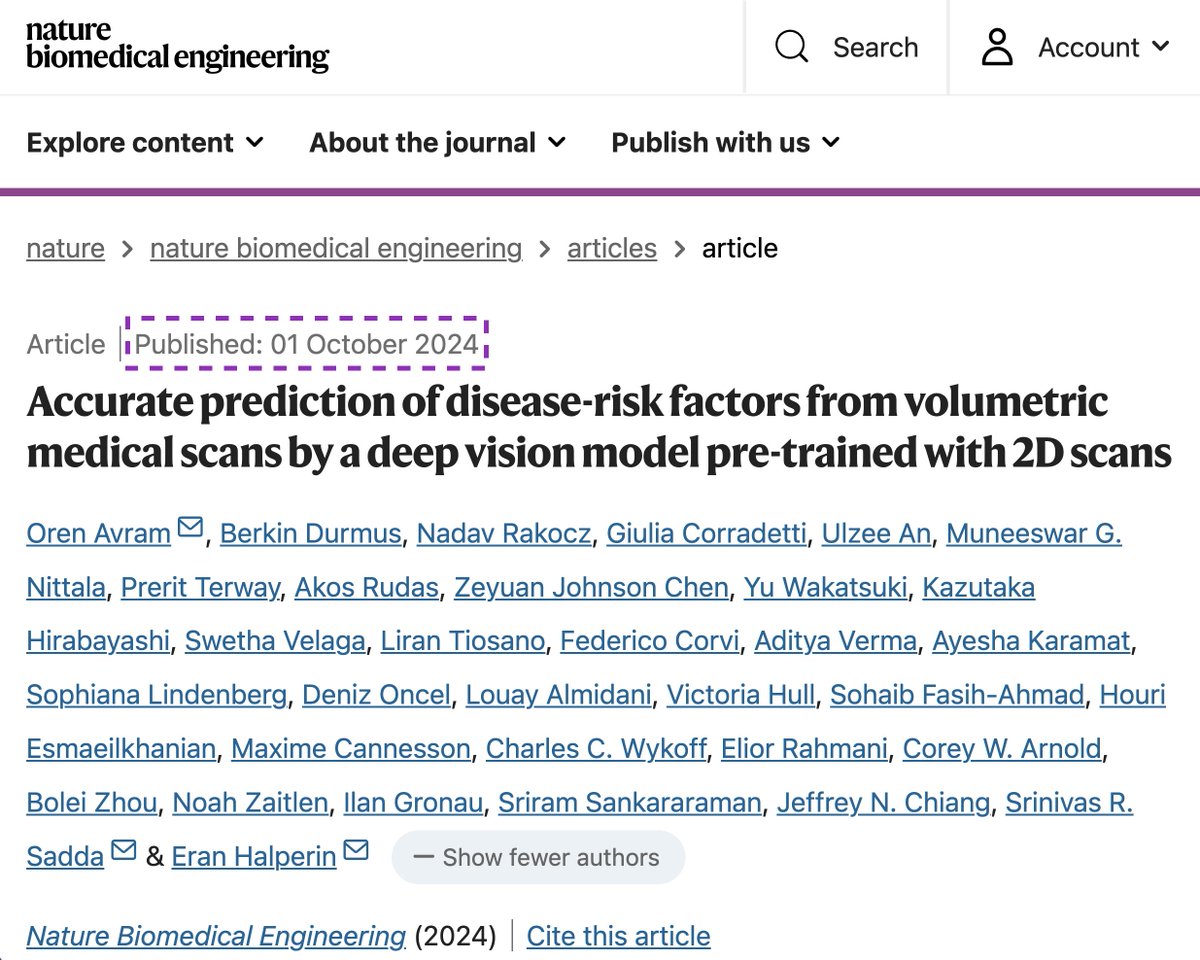
Our research is now published in #Nature 𝗕𝗶𝗼𝗺𝗲𝗱𝗶𝗰𝗮𝗹 𝗘𝗻𝗴𝗶𝗻𝗲𝗲𝗿𝗶𝗻𝗴! 🤩🤯🤩 And it's like the stars have aligned perfectly: this publication is coming out on... my birthday! 🎂 Best gift I could ask for! 😍😍 @halperineran @UCLA @CompMedUCLA @UCLAHealth @natBME
Oren Avram tweet media
English
2
6
33
15.5K
Oren Avram
Oren Avram@orenavram·
📢 Just published! M1CR0B1AL1Z3R🦠 v2.0 is now live and published in Nucleic Acids Research 🧬 A powerful, user-friendly web server for large-scale #microbial #genome #analysis. Proud to be co-senior author on this follow-up to my PhD work 🚀 @NAR_Open
English
1
1
1
120
Oren Avram
Oren Avram@orenavram·
For detailed info, here's a free-access version of our paper in case you missed it: rdcu.be/dVGj4
English
1
0
0
84
Peter H. Diamandis, MD
Peter H. Diamandis, MD@PeterDiamandis·
This is what I mean by democratizing healthcare! UCLA’s “SLIViT” model, which analyzes complex 3D medical scans with expert-level accuracy in a fraction of the time, empowers providers with limited resources to deliver high-quality care at a portion of time and cost. uclahealth.org/news/release/n…
English
5
0
38
4.6K
Oren Avram
Oren Avram@orenavram·
@minchoi Thanks Min for highlighting our research!
English
1
0
1
74
Oren Avram retweetledi
Min Choi
Min Choi@minchoi·
UCLA just unveiled SLIViT, an AI model that analyzes 3D medical images faster and cheaper than human experts. Key points: 1️⃣ Analyzes MRIs, CTs, and more in a fraction of the time. 2️⃣ Detects disease markers across multiple scan types 3️⃣ Outperforms other models, making imaging more accessible 4️⃣ Can handle large data and adapt to new imaging techniques 5️⃣ Useful in areas lacking medical imaging experts. 6️⃣ Trained on 2D data, fine-tuned for accurate 3D analysis 7️⃣ Applies knowledge from one scan type to another. SLIViT could revolutionize fast, affordable medical diagnoses
GIF
English
17
43
223
48.1K
Oren Avram retweetledi
NVIDIA AI Developer
NVIDIA AI Developer@NVIDIAAIDev·
Researchers @halperineran and @orenavram at #UCLA have developed a new, #AI-powered foundation model that can accurately analyze #3D medical imagery, like MRIs and CT scans, in a fraction of the time it would otherwise take a human expert. ➡️ developer.nvidia.com/blog/ai-medica… The model was pre-trained on publicly available, relatively inexpensive 2D imagery, and fine-tuned on a relatively small amounts of #3D medical imagery, meaning it can potentially be an affordable and scalable model with widespread impact for different communities around the world. The researchers found the model can do transfer learning across different types of organs and image modalities. A retinal scan—or OCT— of an eye can improve the model’s ability to identify disease biomarkers in MRIs of livers, or other types of organs. This #AI-powered model can potentially democratize expert level analysis of 3D medical images. @CompMedUCLA @UCLAengineering
English
6
33
125
22.6K
Chubby♨️
Chubby♨️@kimmonismus·
This is precisely why it is so important that the development of AI progresses even faster. At the same time, I love news like this. Excellently done! "Researchers at UCLA have developed a new AI model that can expertly analyze 3D medical images of diseases in a fraction of the time it would otherwise take a human clinical specialist. The deep-learning framework, named SLIViT (SLice Integration by Vision Transformer), analyzes images from different imagery modalities, including retinal scans, ultrasound videos, CTs, MRIs, and others, identifying potential disease-risk biomarkers. Dr. Eran Halperin, a computational medicine expert and professor at UCLA who led the study, said the model is highly accurate across a wide variety of diseases, outperforming many existing, disease-specific foundation models. It uses a novel pre-training and fine-tuning method that relies on large, accessible public data sets. As a result, Halperin believes that the model can be deployed—at relatively low costs—to identify different disease biomarkers, democratizing expert-level medical imaging analysis."
NVIDIA AI Developer@NVIDIAAIDev

Researchers @halperineran and @orenavram at #UCLA have developed a new, #AI-powered foundation model that can accurately analyze #3D medical imagery, like MRIs and CT scans, in a fraction of the time it would otherwise take a human expert. ➡️ developer.nvidia.com/blog/ai-medica… The model was pre-trained on publicly available, relatively inexpensive 2D imagery, and fine-tuned on a relatively small amounts of #3D medical imagery, meaning it can potentially be an affordable and scalable model with widespread impact for different communities around the world. The researchers found the model can do transfer learning across different types of organs and image modalities. A retinal scan—or OCT— of an eye can improve the model’s ability to identify disease biomarkers in MRIs of livers, or other types of organs. This #AI-powered model can potentially democratize expert level analysis of 3D medical images. @CompMedUCLA @UCLAengineering

English
5
12
126
12.7K
Oren Avram
Oren Avram@orenavram·
✨ NVIDIA ✨ has featured #SLIViT today in their blog post! 🤯🤯🤯 #entry-content-comments" target="_blank" rel="nofollow noopener">developer.nvidia.com/blog/ai-medica…
English
1
6
24
6.5K
Derya Unutmaz, MD
Derya Unutmaz, MD@DeryaTR_·
Researchers at UCLA have developed a new deep-learning AI framework called SLIViT that can quickly analyze complex medical scans including MRIs and 3D medical images which consistently performs at a level comparable to clinical specialists across various types of medical imaging. It was tested on tasks such as liver disease assessment and lung nodule screening, showing better accuracy than existing specialized models. Additionally, SLIViT can analyze images in a fraction of the time it would take a human specialist, reducing manual workload while maintaining diagnostic accuracy. Traditional 3D medical imaging models face significant limitations that hinder their efficiency and effectiveness in clinical practice. These models often require large datasets, are time-consuming, and are highly specialized to specific tasks or conditions, which can limit their general applicability. Moreover, the complexity of volumetric data, which incorporates length, width, and depth, makes it challenging for existing models to deliver fast, accurate results without substantial computational resources and manual input from specialists. The importance lies in SLIViT’s potential to overcome the bottlenecks of traditional 3D imaging models, making medical diagnostics faster, more accessible, and cost-effective. This could lead to better patient outcomes and pave the way for broader applications of AI in healthcare. SLIViT could have far-reaching implications in the medical field: • Improved Diagnostic Efficiency: Its ability to analyze scans faster and with fewer resources can significantly reduce diagnosis time and improve patient outcomes. • Broader Clinical Application: As a foundation model, SLIViT can be expanded for use in other predictive models, offering potential for future research in disease forecasting and early diagnosis. • Cost Reduction: The automated annotation feature reduces both time and financial costs associated with data acquisition. • Bias Mitigation: The research team is committed to addressing potential biases in AI, ensuring that the technology can be applied fairly and accurately across diverse populations, which is critical for reducing health disparities.
Derya Unutmaz, MD tweet media
English
12
53
241
28.8K
Oren Avram
Oren Avram@orenavram·
@EricTopol @natBME @EricTopol thanks for highlighting our research. This is the (second-)best birthday gift I could've asked for! ;-) x.com/orenavram/stat…
Oren Avram@orenavram

Our research is now published in #Nature 𝗕𝗶𝗼𝗺𝗲𝗱𝗶𝗰𝗮𝗹 𝗘𝗻𝗴𝗶𝗻𝗲𝗲𝗿𝗶𝗻𝗴! 🤩🤯🤩 And it's like the stars have aligned perfectly: this publication is coming out on... my birthday! 🎂 Best gift I could ask for! 😍😍 @halperineran @UCLA @CompMedUCLA @UCLAHealth @natBME

English
1
0
3
263
Jeremy Howard
Jeremy Howard@jeremyphoward·
Wow! Oren told me: "I had… zero practical experience (& thus epsilon belief my research will go to this direction) but then I encountered your spectacular FastAI courses… they literally transformed my knowledge & experience, & allow me to get to the point I'm at today!"
Oren Avram@orenavram

Our research is now published in #Nature 𝗕𝗶𝗼𝗺𝗲𝗱𝗶𝗰𝗮𝗹 𝗘𝗻𝗴𝗶𝗻𝗲𝗲𝗿𝗶𝗻𝗴! 🤩🤯🤩 And it's like the stars have aligned perfectly: this publication is coming out on... my birthday! 🎂 Best gift I could ask for! 😍😍 @halperineran @UCLA @CompMedUCLA @UCLAHealth @natBME

English
4
7
148
13.8K