
Jalen Thomas
17.9K posts


JUST IN: Hours ago I wrote that Kharg Island was the red line the coalition drew for itself. The one target whose destruction would do more to end this war than every other strike combined, left untouched because reaching it would create consequences the coalition cannot manage. Axios just reported that US officials are actively discussing seizing it. The report, citing administration officials directly, says discussion is underway to capture Kharg Island alongside special forces raids to secure Iran’s highly enriched uranium stockpiles. No order has been given. No deployment has been authorized. It remains in the discussion phase. But the fact that the option is being reported through Axios sourcing from inside the administration means the policy debate has moved from contingency planning to active consideration. Kharg Island handles roughly 90 percent of Iran’s crude oil exports. Approximately two million barrels per day at pre-war capacity. The revenue funds roughly 40 percent of the Iranian government’s budget including the IRGC payroll that sustains thirty one provincial commands. Seizing it would collapse the regime’s revenue overnight. That is why the option is being discussed. It is also why it has not been executed. In 1979 the Carter administration developed contingency plans for seizing Kharg. The plans were rejected as too difficult and too risky. In 2026 the military calculus has shifted: 80 percent of Iranian air defenses are destroyed according to the IDF, the Iranian navy has been severely degraded, and the US has near total air superiority. The operational feasibility has improved dramatically since 1979. The economic calculus has not. Seizing Kharg removes Iranian crude from global markets for years, not weeks, because rebuilding offshore loading infrastructure under wartime conditions requires complete reconstruction. It spikes Brent toward $150 or beyond. It triggers the recession America is trying to avoid. It gives China an escalation rationale Beijing currently lacks. And it requires holding a small island under continuous drone and missile attack with supply lines across a strait Iran has demonstrated it can threaten. The Axios report also references special forces operations to seize Iran’s highly enriched uranium. That pairing tells you what the administration is actually debating: whether the endgame of this war is limited degradation, the current trajectory, or complete strategic decapitation, meaning the simultaneous elimination of Iran’s revenue base and nuclear capability. Trump has demanded unconditional surrender. Iran refuses to negotiate. The air campaign, however brilliant, has not produced capitulation. Every day without political resolution increases pressure to escalate toward options previously rejected as too costly. Kharg Island is the measure of how far the United States is willing to go. The discussion is the signal. The seizure, if it comes, is the moment this war transforms from a regional conflict into a global economic crisis that touches every economy on earth. The red line I identified is no longer theoretical. Washington is discussing whether to cross it. open.substack.com/pub/shanakaans…

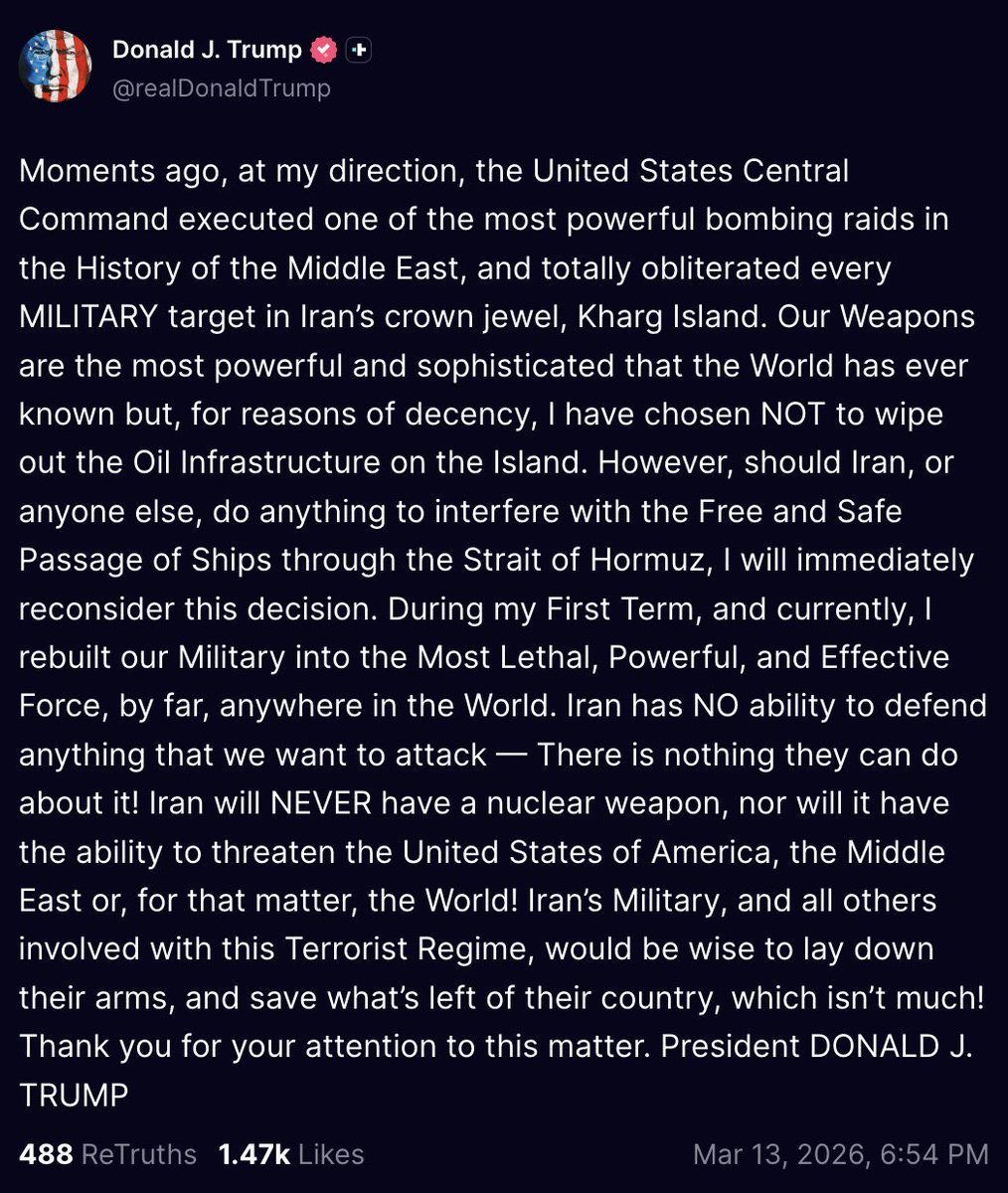
BREAKING: President Trump just put a gun to the head of 90% of Iran’s oil revenue and pulled the trigger on everything around it. “Moments ago, at my direction, the United States Central Command executed one of the most powerful bombing raids in the History of the Middle East, and totally obliterated every MILITARY target in Iran’s crown jewel, Kharg Island.” That is the President’s exact language on Truth Social tonight. Every military target. Obliterated. The coastal missile batteries. The anti-ship missile installations. The radar sites. The short-range air defence systems. The IRGC garrison of 250 to 500 personnel. The fast attack craft support. The naval mines infrastructure. Everything that defended the island, destroyed. Everything that makes the island valuable, deliberately spared. The oil terminals are still standing. The loading jetties are intact. The storage tanks are full. Ninety percent of Iran’s crude exports flow through those terminals. Trump left them untouched and told Iran why: “for reasons of decency.” Then he added the threat that makes decency conditional: if Iran interferes with free and safe passage through the Strait of Hormuz, the oil infrastructure goes next. This is the chequebook doctrine made operational. For fifteen days, this campaign has identified three layers governing the war: the nuclear programme is the existential minimum, the Strait is the clock, and the oil infrastructure is the chequebook. The chequebook was deliberately spared to control what gets rebuilt, by whom, and under what conditions. Tonight, Trump confirmed it. Kharg’s military defences are rubble. Kharg’s oil terminals are leverage. The island that handles Iran’s entire export economy now sits defenceless, its military guardians obliterated, its revenue infrastructure intact but held hostage to a single condition: open the Strait. The calculus Iran faces is unprecedented. The 31 autonomous IRGC commands that have been firing continuously for fifteen days just lost their forward defensive position in the northern Gulf. The coastal batteries that could threaten tanker escorts are destroyed. The radar that tracked shipping approaches is destroyed. The fast boats that laid mines operated from Kharg support facilities that are destroyed. The island that was Iran’s shield has been turned into America’s hostage. Iran’s oil cannot flow without Kharg. Iran’s military can no longer defend Kharg. And the man who ordered Kharg’s military annihilation has told Iran that the oil infrastructure joins it if the Strait does not open. The Supreme Leader who ordered the Strait permanently closed from a hospital bed just received the response: the terminals that fund his war are one presidential order from becoming the same rubble as the missile batteries that used to protect them. Brent will react within hours. The sparing of oil infrastructure should limit the immediate spike, but the threat converts every future Iranian provocation in Hormuz into a potential trigger for the destruction of 90% of Iran’s export revenue. The war premium is no longer about whether oil flows. It is about whether Trump decides to let it flow. The war began with an assassination. It escalated through mines, drones, and burning tankers. It crossed the nuclear threshold at Parchin. It crossed the alliance threshold at Incirlik. Tonight, it crossed the revenue threshold at Kharg. The existential minimum is the uranium in Pickaxe Mountain. The existential leverage is the oil terminal standing untouched on an island where everything else has been destroyed. Iran’s crown jewel just became America’s hostage. The ransom is the Strait of Hormuz. Full analysis - open.substack.com/pub/shanakaans…