🚀 Maria Alvarez

9.5K posts

🚀 Maria Alvarez banner
🚀 Maria Alvarez

🚀 Maria Alvarez

@ostraperlera

Empresaria. Autista. Corazón de alcachofa. Escribo sobre tecnología, economía y los cambios del presente aquí. Mi primer libro es Hijos del optimismo.

Madrid Katılım Eylül 2009
2.1K Takip Edilen12.6K Takipçiler
Sabitlenmiş Tweet
🚀 Maria Alvarez
🚀 Maria Alvarez@ostraperlera·
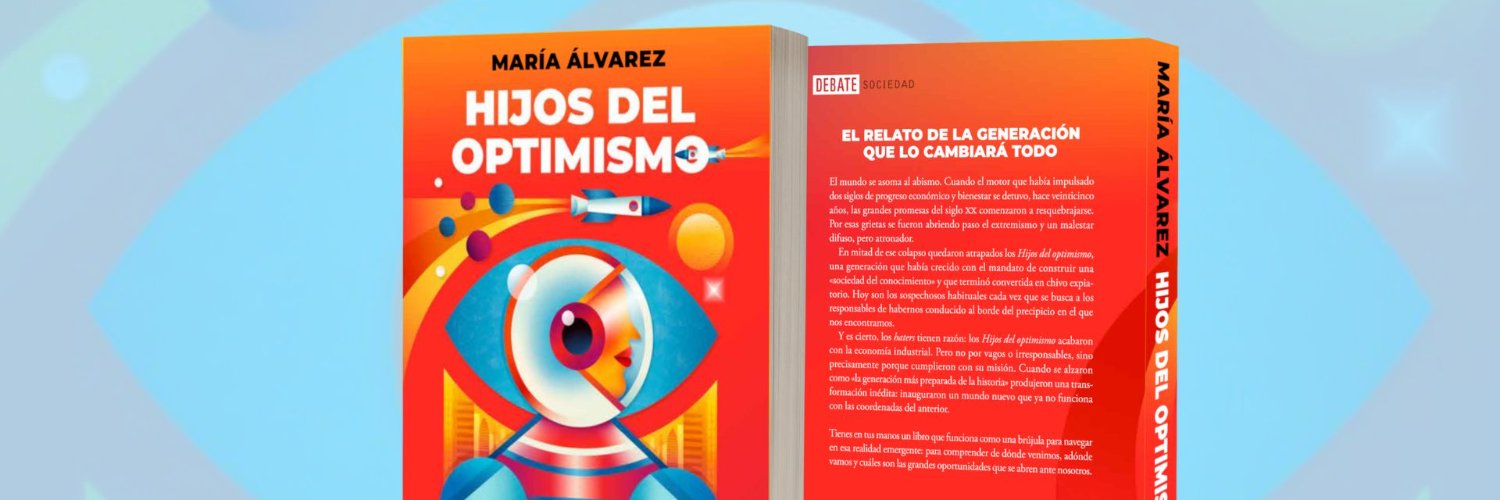
¿Por qué parece que el mundo está a punto de explotar? Durante años he buscado la respuesta en la historia, la tecnología y la economía. Hoy la puedes encontrar en mi libro "Hijos del Optimismo", que te devolverá la confianza en el futuro. ¡YA EN VENTA! hijosdeloptimismo.com
🚀 Maria Alvarez tweet media
Español
1
1
8
13.9K
🚀 Maria Alvarez
🚀 Maria Alvarez@ostraperlera·
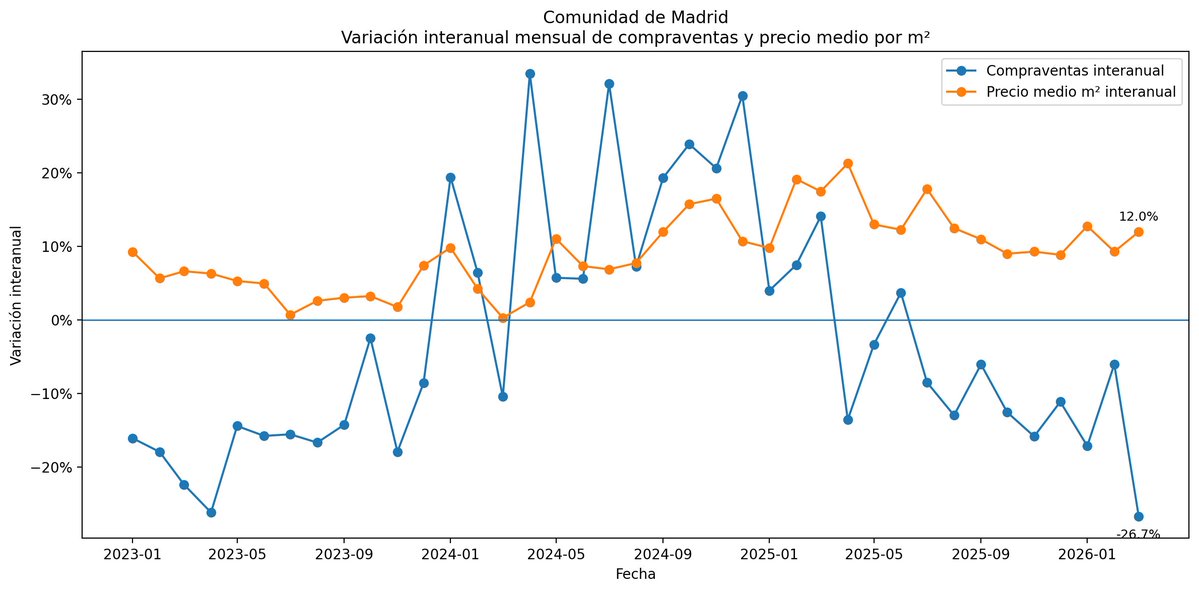
@rugomor Si España sigue, aunque sea de lejos, la tendencia internacional, en unos meses veremos como se consolida la tendencia. Ahora mismo somos un outlier.
🚀 Maria Alvarez tweet media
Español
1
0
1
110
Rubén
Rubén@rugomor·
@ostraperlera Ojo, son datos de asking price de "Pisos.com". Comparando con otros portales las bajadas no se reproducen (Valladolid es el ejemplo). Sin embargo, si nos vamos a datos de notarios, en zonas como Madrid el precio está desacoplado de las compraventas.
Rubén tweet media
Español
1
0
0
159
🚀 Maria Alvarez
🚀 Maria Alvarez@ostraperlera·
Hace casi un año anticipé que la vivienda iba a caer. Porque es el fin del ciclo, sí. Pero sobre todo por la burbuja de la IA, que amenaza con destruir los empleos de los que luego tienen que pagar por los pisos. O datacenters, o casitas. Os dejo el enlace abajo.
Ignacio Ezquiaga@IgnacioEzquiaga

El recorte de precios de oferta que se observa ya en muchas ciudades españolas, paralelo a varias ciudades en Europa, podría estar mostrando el fin de la fase más especulativa del ciclo de la vivienda: aquella en la que las #expectativas de ganancia determinaban las decisiones.

Español
6
4
19
3.2K
🚀 Maria Alvarez retweetledi
Danny Hernández 🦴
Danny Hernández 🦴@danny8002·
Te mentí, no vamos a ver Netflix, vamos a leer la encíclica de León XIV.
Español
9
369
2.4K
21K
🚀 Maria Alvarez
🚀 Maria Alvarez@ostraperlera·
@elarjonauta Sí, claro. Todo puede pasar. También alguien puede resolver lo de la computación cuántica y toda esta conversación dejará de ser importante. Tú crees que la IA va a poder llegar a escribir un -buen- libro? O que siempre será una muleta de los escritores?
Español
1
0
1
28
Daniel Arjona
Daniel Arjona@elarjonauta·
@ostraperlera Es posible que sea así ahora, María, pero hablamos de algo que no existía prácticamente hace seis meses. ¿Cómo podemos saber dónde habrá llegado dentro de otros seis?
Madrid, Spain 🇪🇸 Español
1
0
1
85
🚀 Maria Alvarez
🚀 Maria Alvarez@ostraperlera·
Al hilo de esto, una opinión sobre mi experiencia. La IA agéntica de programación es como un carpintero cutre. Le pides una mesa, te la hace medio bien: pasable. Cuando le pides que arregle un poco una pata que se ha quedado suelta, en lugar de desmontar, saca la cinta americana
Daniel Arjona@elarjonauta

La IA agéntica puede estar ahora mismo disparando la productividad o no y ser solo un quemadero de toneladas de tokens y pasta sin resultados. Podemos afirmar una y cosa y la contraria porque AÚN no lo sabemos cc @ostraperlera

Español
3
1
2
582
🚀 Maria Alvarez retweetledi
Stefan Schubert
Stefan Schubert@StefanFSchubert·
Real wages are turning negative in the US and are on track to do so in the UK, too
Stefan Schubert tweet media
English
6
16
97
11.6K
🚀 Maria Alvarez
🚀 Maria Alvarez@ostraperlera·
Con un problema más, y es que cuanta más información tiene que manejar, más se inclina a cometer errores (y se dispara el consumo de tokens). Mi intuición me dice que la IA agéntica acabará siendo como es ahora para los escritores: una muleta que hay que usar con mucho cuidado.
Español
0
0
0
82
🚀 Maria Alvarez
🚀 Maria Alvarez@ostraperlera·
En el fondo creo que la IA funciona igual con el código que con el lenguaje natural: le puedes pedir que te ayude, que haga una lista, que mejore un párrafo, pero si confías en que escriba un libro entero va haciendo un frankenstein que en un momento dado se vuelve ingestionable.
Español
2
0
0
92
Daniel Arjona
Daniel Arjona@elarjonauta·
La IA agéntica puede estar ahora mismo disparando la productividad o no y ser solo un quemadero de toneladas de tokens y pasta sin resultados. Podemos afirmar una y cosa y la contraria porque AÚN no lo sabemos cc @ostraperlera
Ethan Mollick@emollick

We have, as far as I can tell, no good tests of the productivity impact of the autonomous coding tools that appeared starting in December 2025. Every paper out there is from prior to the Claude Code/Codex revolution. A huge gap in our knowledge about what is happening in coding.

Madrid, Spain 🇪🇸 Español
1
0
2
819
🚀 Maria Alvarez retweetledi
Ihtesham Ali
Ihtesham Ali@ihtesham2005·
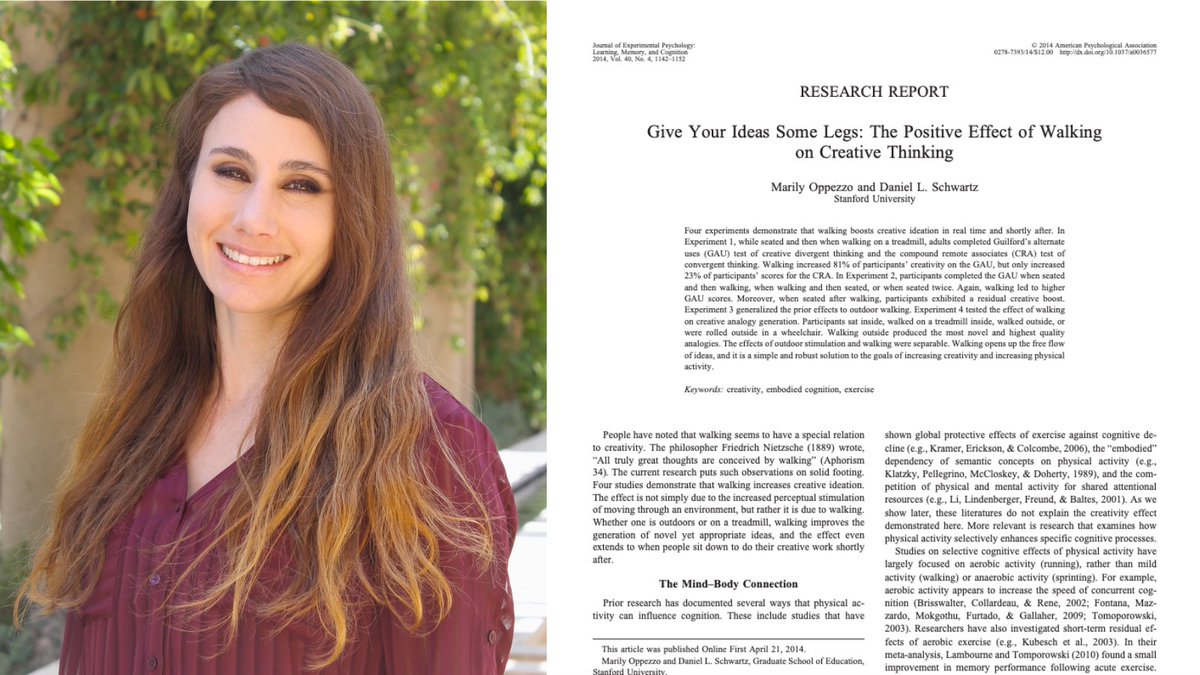
A Stanford psychologist spent 4 years proving that the simple act of walking generates 60% more creative ideas than sitting, and the experiment she designed to kill every alternative explanation is one of the most decisive findings in modern psychology. Her name is Marily Oppezzo. She got the idea for the study while walking with her advisor at Stanford to discuss her thesis topic, and the paper she eventually published in the Journal of Experimental Psychology in 2014 is sharp enough that it should have ended the seated meeting on the day it came out. She ran 4 experiments on 176 people. Same person tested twice. Once sitting, once walking. The creativity tasks were the standard ones psychologists have used for decades to measure how good a brain is at generating novel useful ideas. The result was almost too clean to publish. 81% of participants in the first experiment produced more creative ideas while walking than while sitting. In the second experiment, 88%. In the third, 100%. Every single person walked into a more creative version of themselves. On average, people generated 60% more novel useful ideas the moment their legs started moving. The skeptical question is the obvious one. Maybe it was the fresh air. Maybe it was the scenery passing by. Maybe it was the change of environment doing the work, not the walking itself. Oppezzo killed every one of those explanations with one experimental decision. She put people on a treadmill facing a blank wall. No scenery. No fresh air. No environmental change. Just legs moving in place while staring at white drywall. The 60% boost held. Then she ran the experiment that closed the case completely. She took participants outside in two conditions. Half of them walked through a Stanford courtyard. The other half were pushed through the exact same courtyard in a wheelchair. Same outdoor stimulation. Same scenery passing at the same speed. The only difference was whether the legs were moving. The walkers produced dramatically more novel high-quality ideas than the wheelchair group. The outdoors did almost nothing on its own. The walking did everything. This is the part of the study that hit hardest when I read it the first time. She also tested the opposite kind of thinking. Convergent thinking. The kind where there is one right answer and you have to narrow down to it. Word puzzles where 3 words share a hidden fourth word that connects them. The seated participants did slightly better on these. Walkers got slightly worse. Walking is not a general intelligence enhancer. It does one specific thing. It opens up the divergent search inside your brain. The part that generates options. The part that produces unexpected connections. The part that takes a problem and finds five ways into it instead of one. When you need to converge on the single right answer, sit down. When you need to find the answer in the first place, get up. The mechanism is now well understood. Walking selectively activates what neuroscientists call the default mode network, the system inside your brain that runs when you are not consciously focused on anything. The DMN is where mind-wandering happens. Where memories cross-reference each other. Where ideas that have been sitting in separate folders inside your head finally bump into each other. When you sit at a desk and force yourself to concentrate, you suppress the DMN. When you walk at a natural pace, the executive part of your brain gets just busy enough handling the walking that the DMN comes online and starts doing the work that focus was blocking. The most useful finding in the entire paper is the one almost nobody quotes. The boost did not turn off the moment people stopped walking. Participants who walked first and then sat back down stayed elevated. Their next round of seated creativity work was still significantly better than people who had been sitting the whole time. The rest lingered for at least several minutes after the legs stopped moving. You do not need to do creative work while walking. You need to walk before the creative work. The brain holds the state. The history of this is the part that should haunt anyone who still does meetings in chairs. Charles Darwin built a gravel loop behind his house in Kent called the Sandwalk and walked it 3 times a day for the rest of his life. The theory of evolution was developed one lap at a time on that path. Nietzsche walked up to 10 hours a day during the years he wrote his most important books and openly said the work was conceived on his feet. Beethoven composed for the morning and walked for 5 hours every afternoon with a pencil in his pocket for when something landed. Kahneman said the best thinking of his Nobel Prize-winning career happened on leisurely walks with Amos Tversky. Steve Jobs refused to take important conversations sitting down. He held them on foot. Every one of them was using the system Oppezzo would not measure until 2014. They just did not know what to call it. The question worth sitting with is the one almost nobody asks. Every meeting you have ever attended sitting around a table was a meeting held at a fraction of the brain power that was actually available to the people in the room. Every brainstorm that got stuck inside a conference room. Every problem you tried to solve at a desk and gave up on. Every idea you could not quite get to. The intervention is the easiest one in modern science. No supplement. No app. No subscription. No training program. Just a pair of legs and 15 minutes. The Stanford lab proved it. The philosophers knew it. The neuroscience explains it. And almost everyone reading this is still trying to think their way out of problems sitting completely still.
Ihtesham Ali tweet media
English
199
2.1K
8.1K
825.3K
🚀 Maria Alvarez
🚀 Maria Alvarez@ostraperlera·
@Amunt2581611 Dicho de otra manera: ¿Eso de "liberalizar" en qué se concreta? Porque si se concreta en que los ayuntamientos permitan más cosas, eso es un debate que hay que llevar al ámbito local y dejar de dar la turra. IMHO.
Español
1
0
0
74
🚀 Maria Alvarez
🚀 Maria Alvarez@ostraperlera·
@Amunt2581611 Soy consciente. Mi argumento es que esa batalla política donde algunos abogan por "liberalizar" como si fuera la panacea es falsa. El suelo ya está tan liberalizado como quiere el consenso politico (la ley es de Aznar). Y son las CCAA las que no van más allá 🤷‍♀️.
Español
1
0
0
211
PacoPepe
PacoPepe@Amunt2581611·
x.com/i/status/20545… Confundir la liberalización del régimen de suelo con el libre mercado urbanístico es un error técnico .La Ley 6/1998, que citas,no liberalizó el suelo,sino que eliminó una distinción administrativa y fue declarada inconstitucional en aspectos (STC 61/1997)
🚀 Maria Alvarez@ostraperlera

El suelo en España ya está liberalizado. El suelo, en España, ya está liberalizado. El. suelo. en. España. ya. está. liberalizado. EL SUELO EN ESPAÑA YA ESTÁ LIBERALIZADO. Desde 1996. En esta red social hay gente muy pesada que estudia muy poquito. boe.es/buscar/doc.php…

Español
2
0
0
297
🚀 Maria Alvarez retweetledi
Gary Marcus
Gary Marcus@GaryMarcus·
As one of the first people to warn about a possible AI backlash—years ago—let me tell you this: it’s going to get much, much worse. It breaks my heart that AI—something I spent my whole life thinking about—is likely to become a dirty word, and that it has been subverted so deeply by arrogance and greed.
Gary Marcus@GaryMarcus

it’s great! you can pay for the infrastructure that will eventually take your jobs! and if it fails and the bubble bursts? you can bail the hyperscalers out, and watch your pension fund die.

English
83
167
980
83.8K
🚀 Maria Alvarez retweetledi
Evis Drenova
Evis Drenova@evisdrenova·
One fascinating consequence of GLP-1s/Ozempic: For decades, people said that big pharma would never release actually effective obesity drugs because they’d lose too much money from downstream chronic disease treatment. We’re seeing almost the exact opposite.
English
134
310
7.8K
1.2M