1/5 Very happy to share our work on flexible, multiscale cell type assignment for subcellular spatial transcriptomics, now in @Naturenature.com/articles/s4158…
Arguably one of the least utilised but most powerful features of persistent homology (PH) is functoriality. Large swathes of data come pre-divided into distinguished, disjoint subsets (a priori/via clustering). A functorial PH pipeline lets us analyse how these subsets interact!
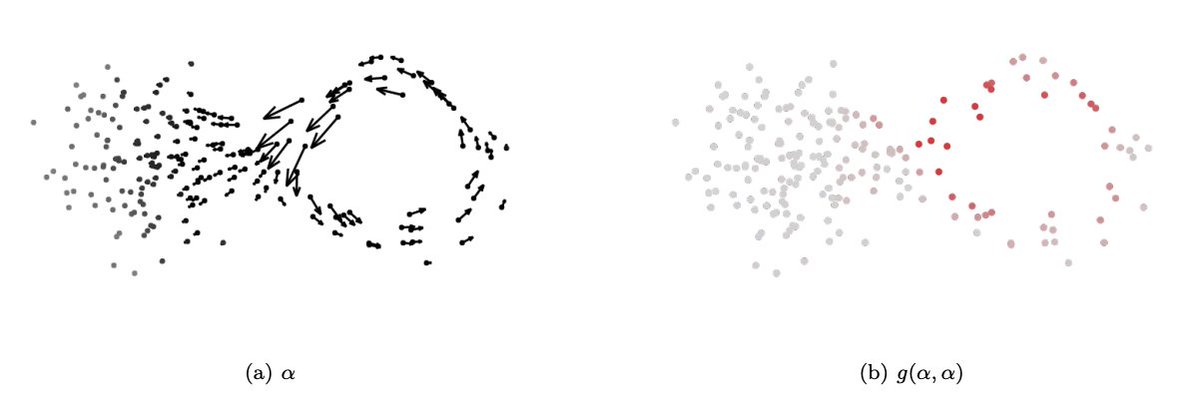
Really pleased to finally share my preprint: Diffusion Geometry
(1/4) Diffusion geometry defines Riemannian geometry for data and probability spaces!
arxiv.org/abs/2405.10858
Baby #2 is due any day now, and I am too wired to do the intelligent thing (i.e., sleep).
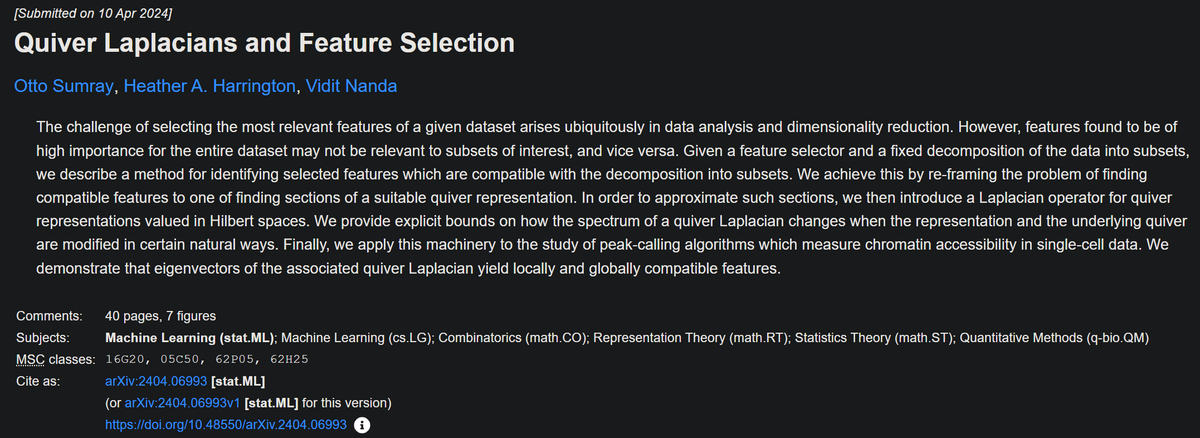
So please join me, the wonderful @osumray, and @haharrington on a journey through some fun machine learning & representation theory.
1/11
Starting a new TDA project? Need persistent homology on cubical complexes and a custom filtration in C++? Or just a Rips filtration but in parallel and using Python? Wading through all those repos giving you a headache? 1/3
We might have missed your favourite package or not tagged all its capabilities so please feel free to contribute with a PR at github.com/cat-list/cat-l… 3/3
I'm very excited to announce that our latest pre-print just went up on the arxiv, joint work with @haharrington and Ulrike Tillmann.
Grounded persistent path homology: a stable, topological descriptor for weighted digraphs
arxiv.org/abs/2210.11274
🚨 New pub out at @Entropy_MDPI, developing topology-informed methods to identify interesting gene expression patterns in scRNA-seq datasets. Fun @OxUniMaths x @Ludwig_Cancer Oxford collab led by Renee Hoekzema, Lewis Marsh, @osumray, Helen Byrne, and @haharrington. Quick 🧵: