Thomas Chaplin

35 posts

Thomas Chaplin banner
Thomas Chaplin

Thomas Chaplin

@tomrchaplin

Mathematician, programmer and climber

Oxford, England Katılım Eylül 2020
118 Takip Edilen63 Takipçiler
Sabitlenmiş Tweet
Thomas Chaplin
Thomas Chaplin@tomrchaplin·
Arguably one of the least utilised but most powerful features of persistent homology (PH) is functoriality. Large swathes of data come pre-divided into distinguished, disjoint subsets (a priori/via clustering). A functorial PH pipeline lets us analyse how these subsets interact!
English
1
6
20
4K
Thomas Chaplin retweetledi
Iolo Jones
Iolo Jones@iolo_jones·
I'm super excited to have a new preprint - Manifold Diffusion Geometry Diffusion geometry *robustly* measures curvature, dimension, and tangent spaces of data! arxiv.org/abs/2411.04100
GIF
GIF
English
23
187
1.2K
125.5K
Thomas Chaplin
Thomas Chaplin@tomrchaplin·
We extend this result to the coloured case. Our proof is very much an adptation of their's to the chromatic case. Moreover, we show that if ν refines μ then DelČᵣ(ν) ↘ DelČᵣ(μ). This is achieved via a novel Morse function, that is compatible with the Čech filtration function.
English
1
0
4
200
Thomas Chaplin
Thomas Chaplin@tomrchaplin·
In the monochromatic case, Bauer and Edelsbrunner showed that there are simplicial collapses (and hence homotopy equivalances) Čᵣ(X) ↘ DelČᵣ(X) ↘ 𝒜ᵣ(X) where DelČᵣ(X) is the Delaunay triangulation but with Čech filtration values instead of alpha filtration values.
English
1
0
4
167
Thomas Chaplin
Thomas Chaplin@tomrchaplin·
Arguably one of the least utilised but most powerful features of persistent homology (PH) is functoriality. Large swathes of data come pre-divided into distinguished, disjoint subsets (a priori/via clustering). A functorial PH pipeline lets us analyse how these subsets interact!
English
1
6
20
4K
Thomas Chaplin
Thomas Chaplin@tomrchaplin·
Note: - If μ gives a unique colour to each point, we recover the Čech filtration, Č(X). - If μ gives the same colour to every point, we recover the alpha filtration, 𝒜(X). - At every filtration value 𝒜ᵣ(μ) ≃ Čᵣ(X). - When there are few colours, 𝒜(μ) is sparser than Č(X).
1
0
3
160
Thomas Chaplin
Thomas Chaplin@tomrchaplin·
Intuitively speaking, this means any map of point clouds, that can be described purely in terms of inclusion of colours, induces an inclusion of subfiltrations. Therefore, we can use PH to study the spatial relationships between points of different colours!
English
6
0
3
156
Thomas Chaplin
Thomas Chaplin@tomrchaplin·
The chromatic alpha filtration (due to di Montesano et al.) provides a trade-off between functoriality and sparsity. For a coloured point cloud μ:X → {0,...,s}, you get a filtration, 𝒜(μ), s.t. given I ⊆ J ⊆ {0,...,s}, there is an inclusion 𝒜(μ⁻¹( I )) ↪ 𝒜(μ⁻¹( J ))
English
1
1
3
199
Thomas Chaplin
Thomas Chaplin@tomrchaplin·
VR has a fatal flaw - there are too many simplices, which slows down PH. For low-dim data, we often turn to the alpha filtration, since it is sparser. However, this filtration is NOT functorial 😔 (removing a point from a Delaunay triangulation does not yield a sub-triangulation)
English
1
1
3
189
Thomas Chaplin
Thomas Chaplin@tomrchaplin·
The Vietoris-Rips pipeline has this property: Given Y⊆X⊆ℝᵈ, there is an inclusion VR(Y) ↪ VR(X). Applying persistent homology, we get a map f: PH(VR(Y)) → PH(VR(X)). Letting Y=🔵, X=🟠∪🔵 in the picture, ker₁(f) detects that the orange points "fill in" the blue points.
Thomas Chaplin tweet media
English
1
0
3
222
Thomas Chaplin retweetledi
Vidit Nanda
Vidit Nanda@viditnanda·
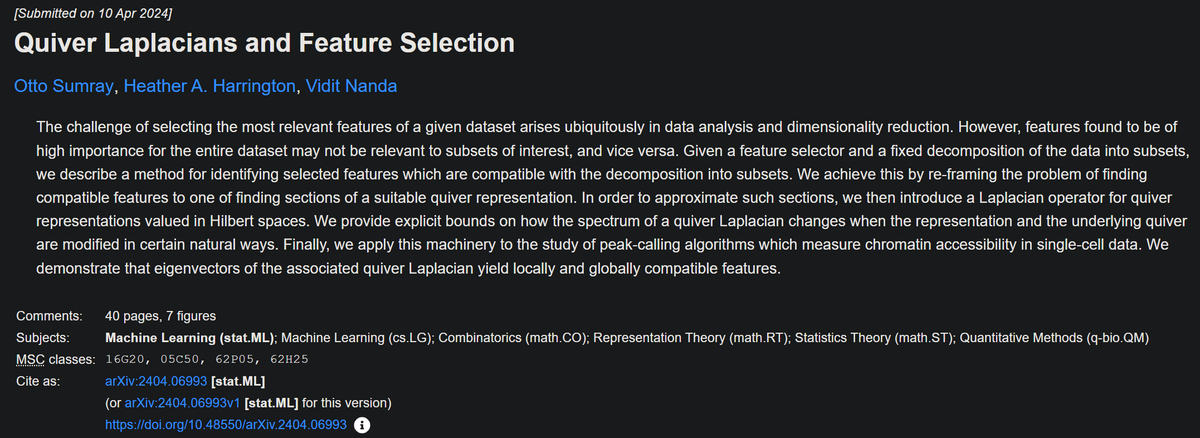
Baby #2 is due any day now, and I am too wired to do the intelligent thing (i.e., sleep). So please join me, the wonderful @osumray, and @haharrington on a journey through some fun machine learning & representation theory. 1/11
Vidit Nanda tweet media
English
3
24
118
28.2K
Thomas Chaplin retweetledi
Ximena Fernández
Ximena Fernández@pi_ene·
Ever wondered how music recognition apps like Shazam work or why they fail? Can Algebraic Topology improve in audio ID algorithms? Our new work in collaboration with @Spotify, 'Topological Fingerprints for Audio ID', arxiv.org/pdf/2309.03516… dives deep into this problem. [1/n]
Ximena Fernández tweet media
English
9
152
710
99.3K
Thomas Chaplin
Thomas Chaplin@tomrchaplin·
@prof_g @osumray Thank you! Yes, that tag indicates that the package can produce representatives for the generators. Hopefully we tagged all the right packages. In a future update we could add tool-tips to explain each tag.
English
0
0
1
26
prof-g
prof-g@prof_g·
nice job! i'm a little confused as to what is meant by the tag type/representative. does that mean it gives representatives of explicit generators? if not, can you add a tag that indicates whether the package gives you explicit generators in the original data?
English
1
0
0
40
Thomas Chaplin retweetledi
Otto Sumray
Otto Sumray@osumray·
Starting a new TDA project? Need persistent homology on cubical complexes and a custom filtration in C++? Or just a Rips filtration but in parallel and using Python? Wading through all those repos giving you a headache? 1/3
English
1
17
47
10.9K