Sabitlenmiş Tweet
Outcome Alpha - Prediction Market Intelligence
449 posts

Outcome Alpha - Prediction Market Intelligence
@outcomealpha
Prediction market alpha from @Polymarket, @Kalshi and beyond. Before the crowd. Newsletter, private club, advisory & research lab.

The world Katılım Haziran 2014
1.7K Takip Edilen3.1K Takipçiler

two things happened this week that tell you where this industry is heading
first: a production market-making bot architecture dropped on github. avellaneda-stoikov inventory management, adaptive kelly sizing, implied vol extraction from spreads, portfolio greeks across correlated markets, order book pressure sensors. 10.8K views.
second: a separate thread on latency arb bots claimed deleted 20 seconds after posting. rust-based. sub-100ms execution. monitoring binance feeds for 0.3%+ discrepancies vs polymarket's oracle.
one account running a near-identical setup: joined february 2026, 13,357 predictions, $228K net profit.
six months ago those posts get 400 views from a niche audience.
the sophistication of who's paying attention has changed faster than the platforms have.
the edge that used to exist for anyone who understood basic probability is gone. now you're competing with production quant infrastructure.
English

@itslirrato @shayne_coplan Right!? When will people start to realise that TradFi is STILL the most opaque, crooked system? It's just because the old power doesn't want that exposed that they cry so hard about open systems
English

EVERYONE CRYING ABOUT INSIDER TRADING ON POLYMARKET IS MISSING THE GREATEST ALPHA IN HISTORY 🚨
CEO @shayne_coplan calls it the most transparent financial marketplace that has ever existed
Every trade is onchain, anyone can see open positions
This means you can track unusual buys, spot giant new wallets, and bet right alongside them
Nobody is hiding the trade history, it's all in your hands
English

the IRS has not issued any ruling on how to treat prediction market gains and losses
traders with six-figure P&Ls are currently choosing between three interpretations: treat it like stocks, treat it like gambling, or apply IRS section 1256 (60/40 long/short split). none of them are definitive. all of them are a best guess.
the new "one big beautiful act" adds a wrinkle: gambling losses can now only offset 90% of gains in 2026, not 100%.
if you're trading at volume and haven't spoken to a tax professional who understands event contracts specifically, you're carrying a risk that has nothing to do with your market positions.
the boring infrastructure play in this industry is still wide open. nobody has built the koinly for prediction markets yet.
English

we've been saying it for months but institutional money is arriving in prediction markets and most retail traders haven't noticed yet
a November 2025 Acuiti study on global prop trading: 10% of prop traders already trading prediction contracts. 35% have active interest. among US firms specifically: 75% either trading or planning to.
that number was probably 5% eighteen months ago.
prop desks bring infrastructure retail traders can't match: co-location, dedicated risk models, cross-market hedging, compliance teams. when they arrive in size the edges that exist today compress on a timeline of months not years.
the 9.7-second arb window is already closed. the next compression event is institutional liquidity hitting the order books at scale.
if you're not already trading with an edge that survives prop desk competition, the clock is running.
English

FBA is a pretty different paradigm — but same as CLOB in what matters: position behaves like a financial instrument, you can update your view when new information arrives.
The trader intent is different though. In FBA everyone is a maker pushing limit orders to the batch, where a limit order means “I’m willing to trade at this or better price” (vs CLOB's “take my order at exactly this price”). So no “liquidity” in the usual sense here (no resting limit orders in the book), though MMs with GTC orders would show up naturally.
On niche markets — depends how you define “perform”. Likely fate of long-tail markets in a CLOB: dead orderbooks with orders on the edges and wash trading in the middle (you can see it on Polymarket). FBA microstructure itself can't solve the demand problem, but it's generally oriented toward aggregating opinions-as-bets rather than opinions-about-others'-bets like in CLOB — which in theory should positively affect performance. And since MMs are better protected in FBA than CLOB, they'll likely participate even in long-tail markets.
Jump and others have talked about FBA as a better market microstructure for a while. Time to finally build it.
English

Some corners of prediction markets are looking more at parimutuel markets to help solve low liquidity.
pumpcade (@pumpcade) is doing something genuinely interesting with parimutuel market design. their time-weighted share system rewards early conviction - predict in the first 10% of a market's duration and you get full 1.0x shares. wait until the last minute and you get 0.2x. same deposit, very different payout.
it solves the classic parimutuel fairness problem: late money used to dilute early correct predictions. that's a real design improvement worth paying attention to.
but the fundamental issue with parimutuel markets remains.
in a CLOB-based prediction market kalshi, polymarket - your position has a continuous price, it's transferable, and you can exit before resolution. that architecture is what makes a prediction market position defensible as a financial instrument. it behaves like a security. you can update your view when new information arrives.
in pumpcade's model, you get your principal back if you win, but you cannot exit a losing position. there is no continuous price. there is no secondary market. new information that changes your view after entry is irrelevant - you're locked in.
principal protection is not the same thing as liquidity. it's a better gambling product than traditional parimutuel. it is still a gambling product.
the entire regulatory survival argument for this industry rests on the distinction between financial instruments and gambling products. the mulvaney coalition's core argument is that prediction markets are tote boards in a suit. experimenting with parimutuel mechanics - however elegantly designed - hands them evidence.
the answer to thin liquidity is better market design within the CLOB framework. not abandoning the architecture that makes the product defensible.
English

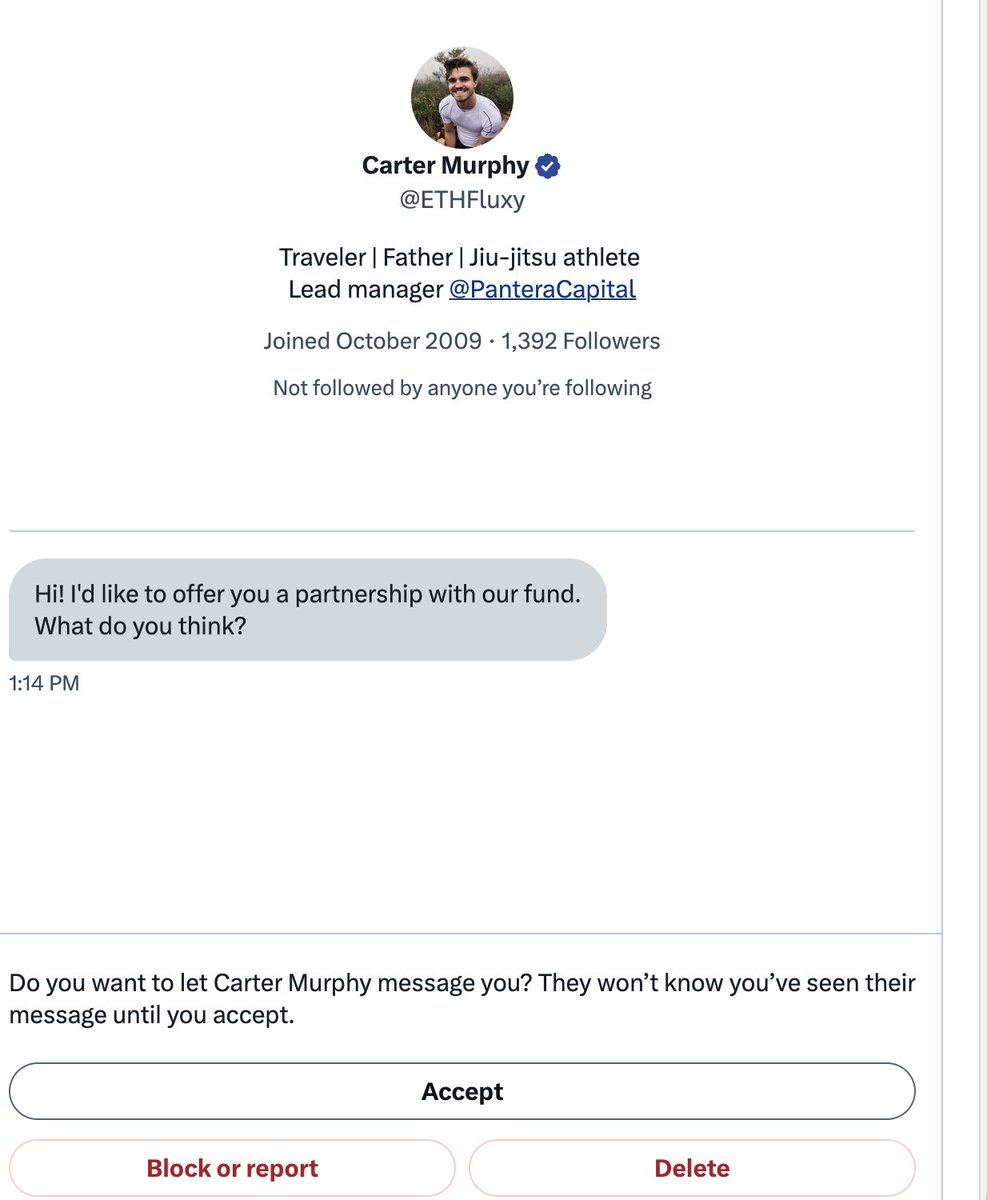
@Shivfreespirit @PanteraCapital scam - they never reach out like that. Even the language is off
English

If you didn’t know,
@PanteraCapital is one of the top crypto VC firms.
They invested early in legendary projects like
Coinbase,
Arbitrum,
Polkadot,
OpenMind,
Cosmos…
the list goes on and on.
If you have never got an offer this big,
Don't talk to me.

English

@sjdedic Surprisingly close together these rounds, didn't expect this quickly. $20B number is the real question. What's the revenue basis for that?
English

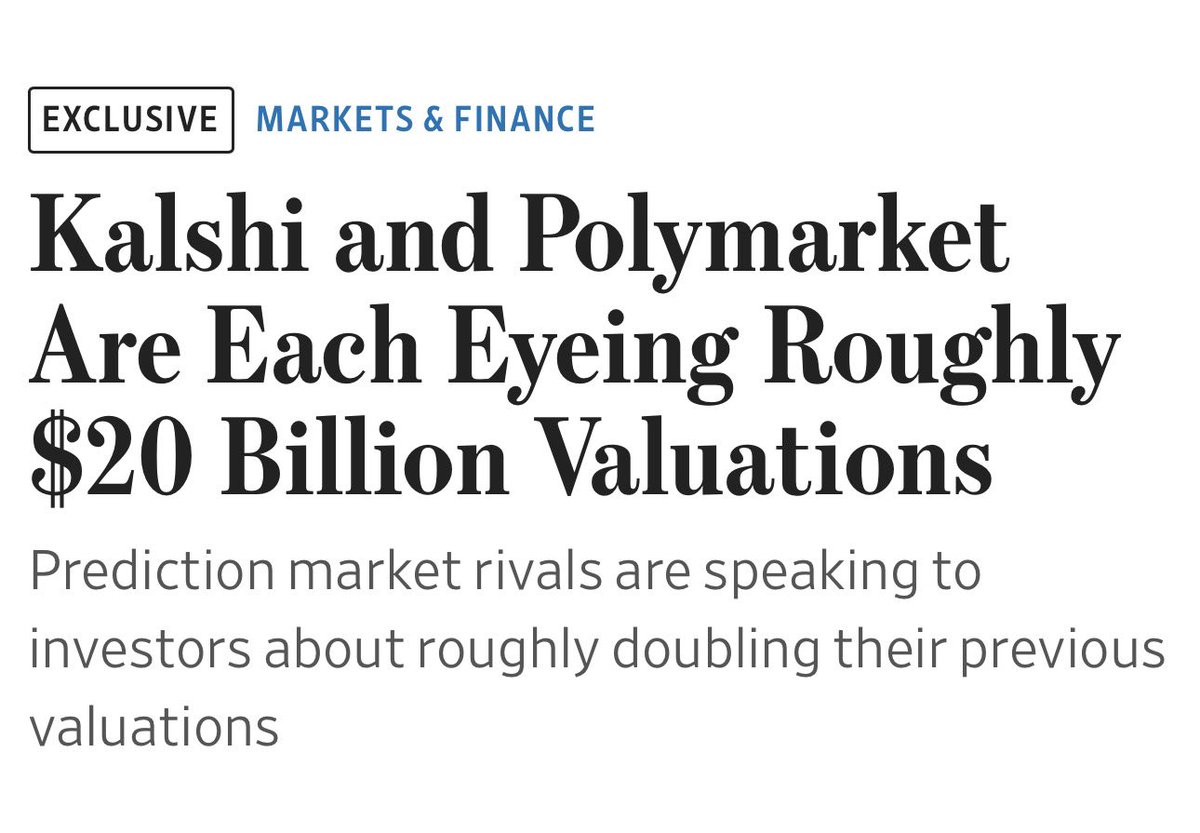
Both Kalshi and Polymarket raising new rounds at 20B valuations each.
That’s not gonna end well.
Don’t get me wrong, I love prediction markets. Genuinely one of the best use cases to come out of crypto and have the highest respect for both of these teams.
But mark-up round after mark-up round, each more disconnected from reality than the last, and the gaps between rounds getting shorter every time.
We all know how this ends: IPO at an insane valuation, bleeds from day one, retail holds the bag.
Can we not, just for once, not do this again?

English

@neuroglioma @carverfomo I mean technically, yeah possible the more people copy it the tighter the spreads get and the edge disappears. Depends how many people can actually get to this scale
English

@carverfomo That’s kinda wild… reminds me of a guy I knew running simple trading bots on a few PCs in his garage, nothing huge but it made steady side cash.
Makes me wonder tho—are setups like that actually sustainable or do they stop working once too many ppl copy it?
English

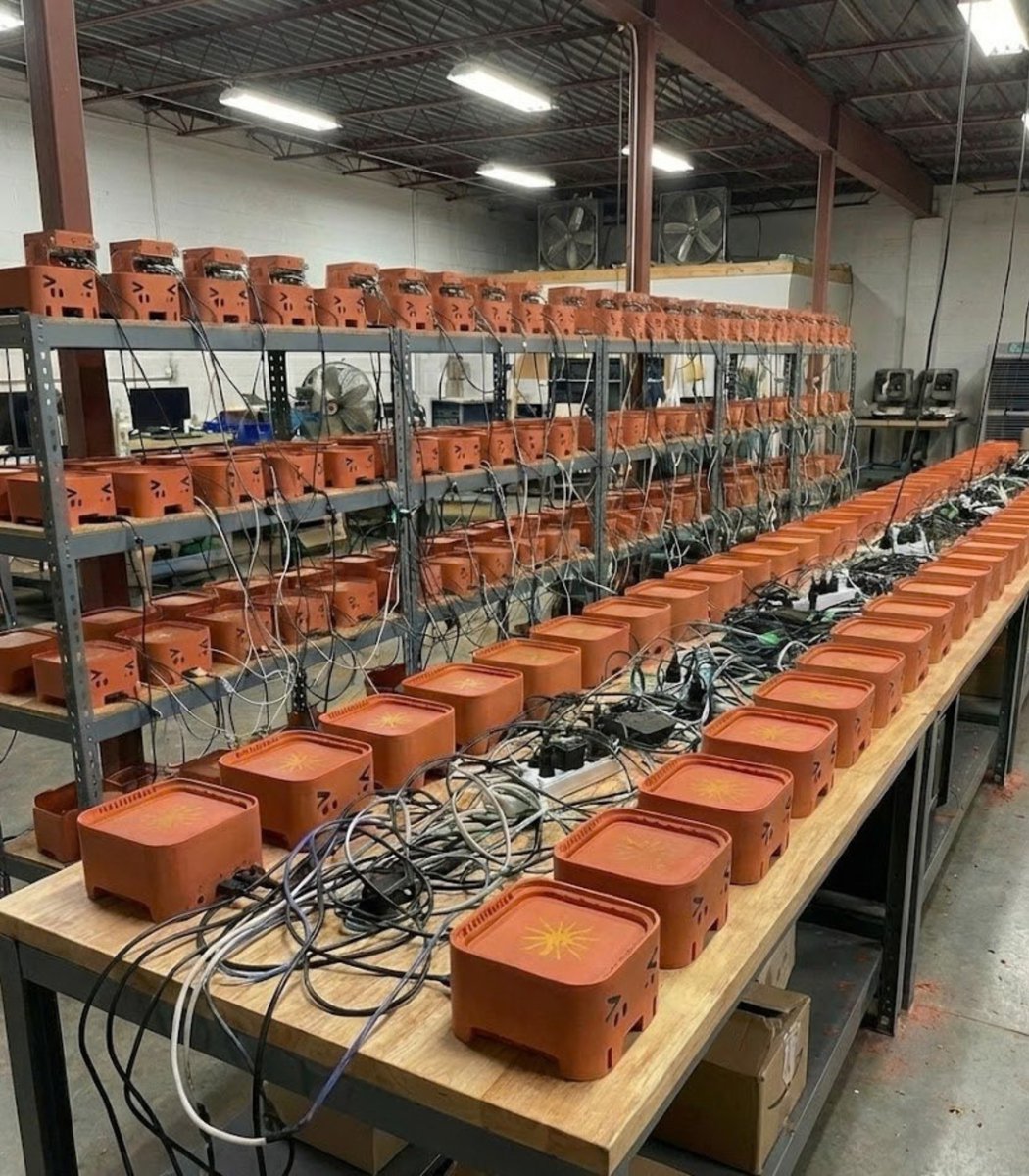
Chinese trader posted a photo in WeChat: My new farm. 40 servers. Looks like a mining rig. But it's not crypto. It's arbitrage bots.
His friend forwarded it to just one person. By morning, 3,000 had seen it.
On one of the monitors an open profile. gabagool22. $868K profit. Now everyone knows where the $30K/week comes from.
gabagool22. 28,620 predictions. All BTC 15 minute windows. All the same strategy.
The strategy from the leaked screenshot:
→ Build position with low average price
→ Watch for drops in the opposite outcome
→ Check that YES + NO < 99 cents
→ If no hedge available, close with no loss
→ Profile: @gabagool22?via=carverfomo" target="_blank" rel="nofollow noopener">polymarket.com/@gabagool22?vi…
40 machines. Running 24/7. Each one scanning different windows. Together they print $140K/month.
The photo got deleted from WeChat. But the screenshots are already in Discord. The wallet is still public. The farm is still running.
685K watching now. Someone tried to find the location from the photo metadata. It was stripped. They learned from the last leak.


English

yes FBA could work though hasn't been applied at scale to a PM yet. It would probably work well for the top 20% of prediction markets by volume. For the long tail of low-liquidity niche markets it may actually perform worse than a continuous book. And the binary resolution problem needs a specific design solution that nobody has published yet. Is that the direction you are building?
English

@outcomealpha @pumpcade FBA (frequent batch auctions) is the third way. Keeps the "financial instrument" DNA of a CLOB but aggregates liquidity through batching.
English

the Kalshi lawsuit exists because resolution rules can be interpreted after the fact
the death carveout was technically in the terms. but terms can be buried, updated, and argued over. nothing was locked.
Here's what a better system could look like:
at market creation, resolution rules are hashed and written to a blockchain. immutable. timestamped. visible to anyone before they trade, rules cannot be changed after the first position is opened. not by the platform. not by anyone. users must sign in their wallet that they have read the rules before trading.
Resolution is triggered by an AI oracle that reads the rules as originally written and applies them to real-world data feeds at settlement. no CEO making a judgment call on what "out as supreme leader" means when a strike happens
and the kicker is that signature I mentioned: to place a trade, you connect your wallet and pay a nominal fee - think $0.001 - to a confirmation contract. that payment is your cryptographic acknowledgment that you read the exact rules you're trading under. permanent. on-chain. timestamped. linked to your wallet forever.
no more "i didn't understand the death carveout." you signed it with money. the chain proves it.
the arguments against this model exist: language is still ambiguous. data feeds can fail or be manipulated. who trains the AI and who do they work for?
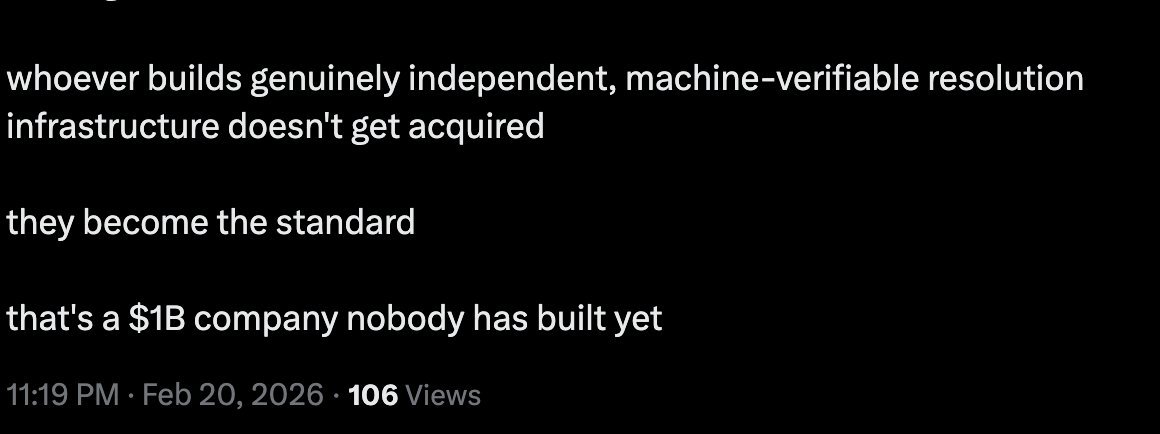
which is why as I've talked about before, this needs an independent third-party resolution company. no platform affiliation. no financial interest in outcomes. revenue comes entirely from writing and hashing the rules for each market contract.
UMA is infrastructure. what's missing is the consent and efficient (non financial incentive) governance layer on top of it.
skin in the game on clarity, not on resolution.
the kalshi controversy wasn't really about the death carveout
it was about $54M entering a market without understanding it was there
immutable rules don't fix bad rules. but they make bad rules visible before the money goes in - and a $0.001 signature proves you saw them.
that's a meaningful upgrade over everything that exists right now. and it hands regulators the answer they've been looking for.
English

Kalshi is now being sued in federal court class action filed march 5 in the central district of California.
plaintiffs: traders who held "yes" on the Khamenei out as supreme leader market. amount: $54 million. the
lawsuit's core argument is blunt: with a US naval armada on Iran's doorstep, everyone - including Kalshi - understood that the only realistic mechanism by which an 85-year-old autocrat leaves office is death. the market language was "clear, unambiguous, and binary." invoking a death carveout after the fact is deceptive and predatory.
Kalshi's CEO says the rules were clear from day one and he's probably right but people will always argue to read the rules they want to read them.
They're also reimbursing all fees and net losses out of pocket.
both things can be true. the rules can be technically valid and the disclosure can be fuzzy to some. that's what litigation is for.
case number: risch v. kalshiex LLC, 2:26-cv-02390.
English

nobody is talking about what quantum computing actually does to prediction markets when it arrives
right now pricing is constrained by classical compute. models can only run so many simulations, process so many variables, update so fast.
quantum changes the ceiling entirely:
option pricing models that currently take hours run in seconds correlation structures across thousands of simultaneous markets calculated in real time arbitrage opportunities that exist for milliseconds on classical hardware become invisible instantly
the "9.7-second execution window" bots people were sharing this week? quantum closes that to zero
but here's the real implication: if quantum agents are pricing every market perfectly in real time, there's no edge left for humans at all.
the market becomes a machine consensus. the wisdom of crowds becomes the speed of qubits.
prediction markets assume humans have information advantages over each other. quantum assumes nobody does.
manifold's own prediction markets say quantum advantage is still years away (I personally think 2030 isn't that far off). but the direction is clear.
So does the edge in this space has a shelf life?
English

Got a few extra invites for Kalshi Conference end of this month in NYC
prioritizing MMs, traders, and institutions. DM me
Tarek Mansour@mansourtarek_
We are hosting our first Prediction Market Conference in March 2026. Researchers, economists, policymakers, traders will discuss big questions around prediction markets and knowledge aggregation. Spots will be limited. Reply here with a topic if interested in joining.

English

@thenarrator Leaking the secrets dammit...arxiv is the sauce
English

one of the best things about being in this space is the people you meet.
got pushed into using arxiv a lot more by some very sharp minds around me and it's a goldmine.
top researchers from oxford, mit, cambridge publishing work on order book modeling, market making, deep learning for price prediction for FREE.
if you're trying to build performant trading models the answers aren't in someone's pinned tweet.
they're in papers like this.
stop reading slop on x and start reading arxiv.

English

AI agents monitoring prediction markets for entry signals is now a named product category
research report dropped this week: "turning probability
into an asset: the rise of prediction market agents."
the framework: data, ML analysis, strategy and risk, execution. fully automated probabilistic portfolio management.
the next phase is agents trading autonomously against each other with humans nowhere in the loop.
when that happens the "wisdom of crowds" framing breaks down entirely. it becomes the consensus of models trained on the same data, reaching the same conclusions, at the same time.
that's not a market
English

nobody has built a serious robotics category on prediction markets yet.
and it's one of the most tradeable verticals in tech.
think about what's coming: will Figure, 1X, or Apptronik ship 10,000 units before end of 2026? will Tesla Optimus hit a public deployment milestone? will a humanoid robot be cleared for unsupervised warehouse work? which company lands the first DoD robotics contract above $500M?
these are binary, verifiable, high-conviction events. exactly what prediction markets are built for.
the broader market is pricing humanoid robotics at $38B by 2035. but there's almost no way to express a near-term view without buying equity and waiting years. prediction markets fix that.
a "will Figure ship to a Fortune 500 client by Q4 2026" contract gives you a clean, 9-month trade on a very specific claim.
the category that should exist and doesn't: defence robotics. Ghost Robotics, Sarcos, Shield AI.
these companies have contract timelines, procurement decisions, congressional budget lines. all tradeable.
nobody is building this vertical. whoever does it first owns a genuinely underserved information market.
English