Clarence Hu

4.1K posts

Clarence Hu banner
Clarence Hu

Clarence Hu

@panabee

Founder of https://t.co/7SvowNvKgW and https://t.co/JEOmdXCbLV. I fail to succeed.

Silicon Valley Katılım Mayıs 2009
703 Takip Edilen1.3K Takipçiler
Clarence Hu
Clarence Hu@panabee·
Transformers may indeed get superceded, but this is the evolution LLM doomers overlooked: LLMs don’t need to encapsulate AGI, if they can organize and orchestrate systems that do.
Maziyar PANAHI@MaziyarPanahi

Gemma 4 looks at a parking lot. Decides what to ask. Calls SAM 3.1. "Segment all vehicles." 64 found. "Now just the white ones." 23 found. One model reasoning and orchestrating. One model executing. Both running locally on a MacBook. MLX. No cloud. No API.

English
1
0
1
38
Clarence Hu
Clarence Hu@panabee·
100%. Our lab is open-sourcing a system prompt, custom GPT, and Claude skill to automate this, plus a protocol for reporting and discovering data artifacts. Most ML teams lack the biology/healthcare expertise to discern dataset limitations, which then propagate into models. Lung cancer in never smokers (LCINS) and lung cancer data exemplifies the problem starkly. Another one is pathogen studies based on TCGA and PCAWG.
English
0
0
0
764
Anshul Kundaje
Anshul Kundaje@anshulkundaje·
Could AI agents have found this kind of artifact? And if so why have they not found such issues so far? Has anyone tried "Find cryptic issues in this data from a new platform". Will it find novel artifacts like this one? Folks developing new assays & platforms should try this.
Jackson Weir@jacksonweir4

We found a surprisingly large technical artifact hiding in a widely-used scRNA-seq technology. In all Flex v1 datasets we’ve analyzed, we see hundreds of DE genes between probe set barcodes. More on why this matters and what to do about it below: biorxiv.org/content/10.648… (1/n)

English
3
11
79
37.2K
Clarence Hu
Clarence Hu@panabee·
So sorry to hear about your wife, Barton, and your own battle, Fidji. @DeryaTR_ shared an article with some ME/CFS ideas. Independently, our lab collaborated with a Stanfor doctor to propose needed steps in a paper. Happy to share both, or @DeryaTR_ perhaps can share the article since I don’t have it handy. ME/CFS is sadly underinvestigated and marked by obvious gaps.
English
1
0
1
34
Julie Zhuo
Julie Zhuo@joulee·
@bartonsmith @fidjissimo I'm so sorry to hear that your wife is going through these difficulties. Wishing you both more relief and healing ahead.
English
1
0
1
72
Fidji Simo
Fidji Simo@fidjissimo·
If there is one good thing that can come out of having my health issues exposed to the world, it’s raising awareness for complex chronic conditions like POTS, MECFS, Long Covid or EDS. 🧵 businessinsider.com/what-is-pots-f…
English
134
182
1.6K
207.6K
Clarence Hu retweetledi
Massimo
Massimo@Rainmaker1973·
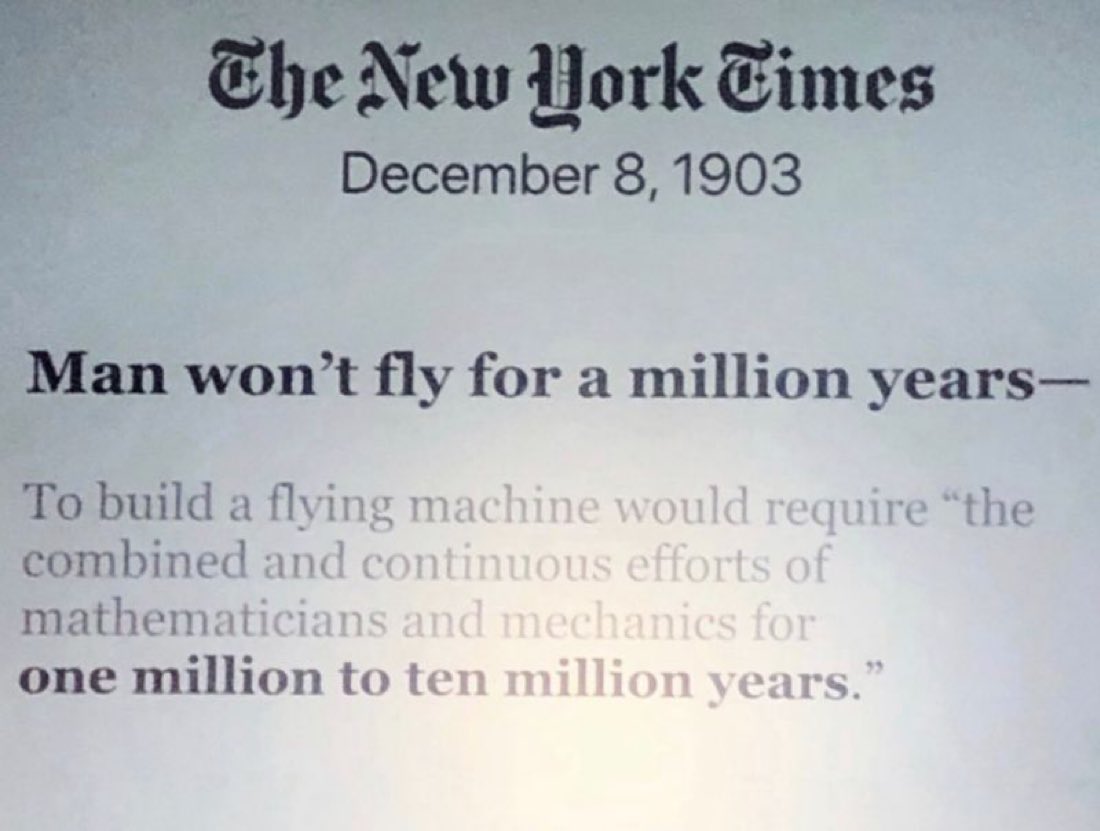
This was published 9 days before Wright brothers’ Kitty Hawk made its first successful flight.
Massimo tweet media
English
104
333
2.2K
101K
Clarence Hu
Clarence Hu@panabee·
This is insightful and should reshape the debate about the FDA's role. Pristine conditions are suitable for academia, but real-world disease and human biology are devilishly messy. Purists may demand large jumps, but both theory and evidence demonstrate that innovation may follow a less flashy, more incremental arc. Requiring big steps for innovation precludes other paths, particularly low-risk ones and incremental ones. Together and over time, these smaller steps and alternate paths could yield greater advancements. Tech is replete with evidence supporting this perspective. Combined with the statistical limits of small sample sizes -- which routinely occur in ultra-rare diseases and gene therapy trials -- this reinforces the urgent need to objectively evaluate the optimal role for the FDA in advancing human health.
Rod Wong, MD@docrodwong

a lot of folks point to dmd as a case study to support an fda that was too lax. the argument is these products increase dystrophin by only ~1%, and no trials have shown an improvement in function. instead of arguing about this, let's consider the consequences of such a 'mistake'. the system paid for drugs that don't work, patients didn't benefit. but... the revenues proved there was an opportunity and this incentive unleashed an innovation flywheel that is now producing drugs that increase dystrophin to near carrier/normal levels. these products are going to be transformative, possibly a cure for many patients. if the first gen products had never been approved, this flywheel is very unlikely to have ever started. we are living thru a similar process in Alzheimer's with abeta drugs (and those glp1s we all love, was a similar journey that started with byetta's approval in '05). when debating where to set the line, it is important to understand this nature of innovation, what seems too incremental a step is often the key to laying a foundation for transformative innovation.

English
0
0
1
63
Clarence Hu
Clarence Hu@panabee·
“Sunlight is the best disinfectant.” - Supreme Court Justice Louis Brandeis — Increasing trust is like dieting: easy to say, hard to do. Increased government transparency will be one of AI’s enduring benefits, even if it takes years to unfold. Local will benefit first then state then federal.
Andrej Karpathy@karpathy

Something I've been thinking about - I am bullish on people (empowered by AI) increasing the visibility, legibility and accountability of their governments. Historically, it is the governments that act to make society legible (e.g. "Seeing like a state" is the common reference), but with AI, society can dramatically improve its ability to do this in reverse. Government accountability has not been constrained by access (the various branches of government publish an enormous amount of data), it has been constrained by intelligence - the ability to process a lot of raw data, combine it with domain expertise and derive insights. As an example, the 4000-page omnibus bill is "transparent" in principle and in a legal sense, but certainly not in a practical sense for most people. There's a lot more like it: laws, spending bills, federal budgets, freedom of information act responses, lobbying disclosures... Only a few highly trained professionals (investigative journalists) could historically process this information. This bottleneck might dissolve - not only are the professionals further empowered, but a lot more people can participate. Some examples to be precise: Detailed accounting of spending and budgets, diff tracking of legislation, individual voting trends w.r.t. stated positions or speeches, lobbying and influence (e.g. graph of lobbyist -> firm -> client -> legislator -> committee -> vote -> regulation), procurement and contracting, regulatory capture warning lights, judicial and legal patterns, campaign finance... Local governments might be even more interesting because the governed population is smaller so there is less national coverage: city council meetings, decisions around zoning, policing, schools, utilities... Certainly, the same tools can easily cut the other way and it's worth being very mindful of that, but I lean optimistic overall that added participation, transparency and accountability will improve democratic, free societies. (the quoted tweet is half-ish related, but inspired me to post some recent thoughts)

English
0
0
0
36
Clarence Hu
Clarence Hu@panabee·
Apple, Amazon, Microsoft, and Samsung arguably benefit the most if open AI can truly match proprietary AI in the real world, not only on benchmarks. Together, they could supercharge growth of open AI and donate $500m each year -- a rounding error and less than 0.5% of collective capex. They could do much more to foster open AI.
English
0
0
0
27
Clarence Hu
Clarence Hu@panabee·
@plainyogurt21 @Vulpescap Agreed on data problems, particularly given small sample sizes and the devilish diversity of humans. Look at the Daraxonrasib forecast. Custom model != replacing frontiers, plus usage depends on system design and how deep the biology/drug analysis extends.
English
1
0
0
68
Adu Subramanian
Adu Subramanian@plainyogurt21·
@panabee @Vulpescap I think right now: you could get to the peak of predicting trial results. But biology doesn't have a) enough data and b)precise info so it'll never be perfect........when multiple MD PHDs can't predict MLTX fail..... Also, no custom models needed,Bitter lesson bro.
English
1
0
0
127
Adu Subramanian
Adu Subramanian@plainyogurt21·
Most of my TL is poo pooing this analysis because it used what most would say is an obvious short as the use case (and still came up with a 1/3 PoS) This is actually p cool and sets the framework for how to predict trial results. Now, using that for alpha ? NGMI
Rohil Badkundri@rohilbadkundri

We used AI to predict the failure of a Phase 3 trial before the results were announced. Today, we're publishing 10 more predictions for the future. Thread 🧵

English
4
2
24
9.3K
Clarence Hu
Clarence Hu@panabee·
@Vulpescap @plainyogurt21 Simpler analogy: GPT is like Cramer, no true innovation. Many groups are working toward systems capable of accurate predictions (both for trial design and prediction), which would be true innovation.
English
1
0
0
41
Clarence Hu
Clarence Hu@panabee·
Any model (and human) can sound informed to non-experts (e.g., oncologist opining on a cardiology trial PoS). GPT sounds smart, but try investing blindly off its predictions. Many groups are building smarter systems. This is one effort. It's hard given the complexity and opacity of human biology, but true innovation is delivering accurate predictions. No public model is there yet, including GPT.
English
1
0
0
51
Clarence Hu
Clarence Hu@panabee·
Must test prospectively, but depends on model and most importantly, data. Like humans, GPT is naive unless prompted carefully and given the right data. OX40 and $SNY exemplify how the right system *should* have predicted KS. Unclear if a custom model is needed, but this is a noble initiative regardless. More needed to advance healthcare.
English
1
0
0
152
Vulpes Bio
Vulpes Bio@Vulpescap·
@plainyogurt21 Im confused about how the predictions/theses are different from what chatGPT pro would give you in 10 mins and thus why this is cool
English
2
0
5
888
Clarence Hu
Clarence Hu@panabee·
If one of the greatest tech CEOs in history can get hoodwinked into acquiring the wrong team and appointing the wrong AI leader, it will be fascinating to see what happens if big pharma decides splashy AI acquisitions become necessary. AI/ML expertise should be mandatory for board members of public companies. Any ML researcher could have warned this tech CEO against his plan, supported by years of empirical evidence.
English
0
0
0
49
Clarence Hu
Clarence Hu@panabee·
One benefit of automated labs will be more negative data, which is another output. Imagine all the latent knowledge trapped in failed experiments. Consider how much science can advance not only by unlocking these insights but also by avoiding dead ends. How many times have labs run comparable experiments, only to find the same negative result discovered by another lab but never published? Reporting methods and results takes time, but automation can reduce this to one click. Professional scientists must also worry about prestige and IP. Passion scientists lack such obligations. They can share knowledge freely, even if negative and “low impact". In aggregate, the value of negative findings may rival or even eclipse the impact of some positive findings. Another automation benefit: faster, smaller reports. No need for manuscripts. Just share experiments as they are conducted, much like with Weights and Biases in machine learning.
English
0
0
1
148
Jason Kelly
Jason Kelly@jrkelly·
The thing to look at in biotech is your reagent costs as a % of your total research spending - inclusive of lab space, EHS, equipment maintenance, lab labor costs, etc. Lab data is the concrete output of biotech product development work. When you make most types of lab data you use reagents -- so reagent spend is the usage-based pricing of biotech. At most companies/research sites (that aren't DNA sequencing centers) it is <5% of the research budget... We need to fix that in biotech.
Henry Lee@hhlee

If your scientists are not making at least making a million constructs // sequencing thousands of colonies via Plasmidsaurus // generating petabytes of imaging data…

English
4
2
58
14.1K
Clarence Hu
Clarence Hu@panabee·
Also anonymize the applications.
English
0
0
0
28
Clarence Hu
Clarence Hu@panabee·
This seemed like a bad joke at first. This is one of the most powerful roles in biotech, and by extension human health. Decisions can impact the research agenda of both academic labs and corporations, and thus real-world patients. Posting this like a normal job breaks every convention and cheapens the job on the surface. Yet if you follow convention, you are limited to the networks of who is in power, whether via recruiters or elsewise. What if the most creative, most capable person of driving innovation and balancing safety sits outside the network? Anyone can submit their candidacy for elected roles. Why not for key appointed roles? These are still critical — tenures may span administrations and touch consequential issues. After initially mocking the idea, I not only now endorse this, but I think it should be mandatory for all key appointments. Further, all applications should be made public for maximum transparency, as well as the decision rationale on who to advance to the final round. Meritocracy and transparency are the ingredients for vibrant government.
U.S. FDA@US_FDA

Are you ready to shape the future of public health at the highest levels? The FDA is seeking an exceptional executive leader to serve as the Center Director for CBER—a role at the forefront of regulating life-saving biological products, vaccines, and emerging therapies. This is an opportunity to protect and advance public health on a national scale. You'll work on cutting-edge science, shape critical regulatory policy, and lead a team dedicated to ensuring the safety and effectiveness of biological products that save lives. Apply by April 3, 2026. #FDAJobs usajobs.gov/job/862056100?…

English
1
0
0
110
Clarence Hu
Clarence Hu@panabee·
In ML, supermodels have dominated since GPT-3, but the smart model paradigm is finally starting to shift from fringe to credible. Labs like ours have long believed the future of AI will mirror the computing industry, where supercomputers tackle the most complex cases but smartphones are what get used by billions of people. Simple example: you don't need Einstein to build ecommerce websites. Someone smart and reliable is enough. 2026 will see more labs raise money around this hypothesis.
English
0
0
1
65
Clarence Hu
Clarence Hu@panabee·
Super cool. Hope he earns enough to retire. Experiment: wealthy person seeds a $1m community fund. The fund gives $100k grants to ventures like this on the verge of breaking out. No equity, no debt. Only the expectation to give back to the fund on success. All is public, awards and back-donations. After the 3rd grant, automate awards. Open source the alg. Let the community harden the alg against gamification the way open source hardens software security. How long would the fund last?
Jason Walls@walls_jason1

Yesterday Mark Cuban reposted my work, DM'd me, and told me to keep telling my story. So here it is. I'm a Master Electrician. IBEW Local 369. 15 years pulling wire in Kentucky. Zero coding background. I didn't go to Stanford. I went to trade school. Every week I'd show up to a home where someone just bought a Tesla or a Rivian. And every time, someone had already told them they needed a $3,000-$5,000 panel upgrade to install a charger. 70% of the time? They didn't need it. The math is in the NEC — Section 220.82. Load calculations. But nobody was doing them for homeowners. Electricians upsell. Dealers don't know. And the homeowner just pays. I got angry enough to build something about it. I found @claudeai. No coding experience. I just started talking to it like I'd explain a job to an apprentice. "Here's how load calcs work. Here's the NEC code. Now help me build a tool that does this." 6 months later — @ChargeRight is live. Real software. Stripe payments. PDF reports. NEC 220.82 calculations automated. $12.99 instead of a $500 truck roll. I'm still pulling wire. I still take service calls. I wake up at 5:05 AM for work. But something shifted. Yesterday @vivilinsv published my story as Claude Builder Spotlight #1. Mark Cuban saw it. The Claude community showed up. And for the first time, I felt like this thing I built in my kitchen might actually matter. I'm not a tech founder. I'm a dad who wants to coach little league and be home for dinner. I just happened to build something that helps people. If you're in the trades and thinking about using AI — do it. The barrier isn't technical skill. It's believing you're allowed to try. EVchargeright.com

English
0
0
0
73