Patrick Salyer

530 posts

Patrick Salyer

Patrick Salyer

@patricksalyer

Partner, Mayfield (@MayfieldFund); Previous CEO @ Gigya (Acquired by SAP); Father of 3 girls.

Katılım Mayıs 2007
816 Takip Edilen1.4K Takipçiler
Patrick Salyer
Patrick Salyer@patricksalyer·
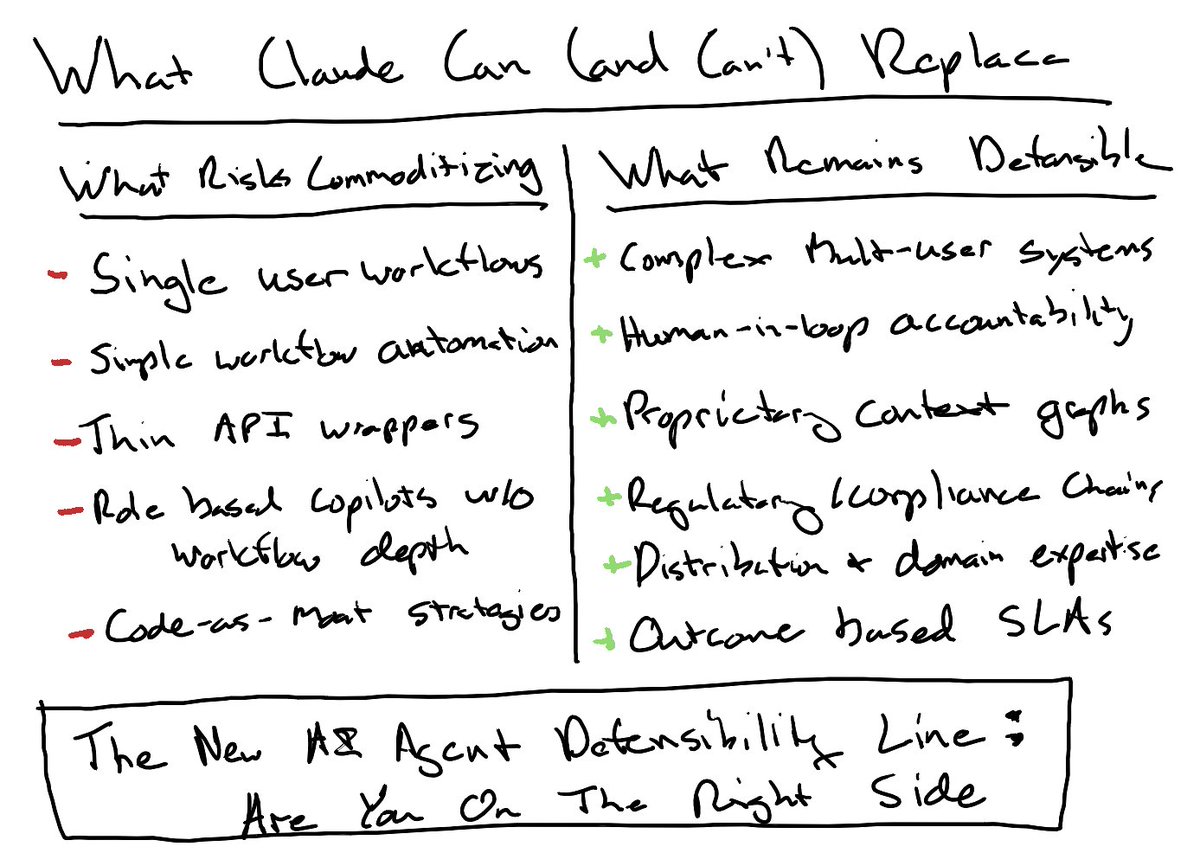
Claude Code means code is becoming commoditized. Claude Cowork means agentic work is becoming a platform feature. The question I've been thinking about is if both of those trends accelerate, what is defensible for AI agent companies? -- My current “Top 10” for AI Agent defensibility: 1. Own a complex system of action. Build multi-user queues, handoffs, escalation paths, and approvals. If removing the LLM still leaves you with a valuable workflow product, you are closer to defensible. 2. Human-in-the-loop mandate. High-stakes decisions where errors have legal, financial, or safety consequences require human judgment and accountability. 3. Build proprietary workflow logic. Focus on domain-specific policies, exception taxonomies, deterministic checks, and regression tests for agent behavior. As coding gets cheap, maintaining correctness under change is the hard part. 4. Accumulate a context graph. Capture the graph of decisions made, exceptions resolved, and outcomes achieved. General agent platforms can read your data, but they cannot replicate your history of action and resolution. 5. Pursue a regulatory moat. Agents can’t get licensed, certified, or audited. Compliance requires human accountability chains. 6. Achieve a proprietary data flywheel. Not static data—but live, continuously generated data from operations that compounds in value. 7. Physical world or marketplace integration. Physical infrastructure and marketplaces create moats that are capital-intensive to replicate. 8. Earn trust through distribution. A defensible go-to-market likely requires a considered purchase and domain expertise selling into a particular buyer or vertical. 9. Security posture. Autonomous agents create a new security boundary. You need sandboxing, scoped credentials, and audit trails to survive enterprise scrutiny. 10. Sell outcomes, not software. Offer throughput guarantees, accuracy SLAs, and reduced operational risk.
Patrick Salyer tweet media
English
0
0
1
127
andrew chen
andrew chen@andrewchen·
AI is makes software cheaper to build, but not easier to distribute This is the core conflict for years to come
English
339
118
1.4K
148.8K
Patrick Salyer
Patrick Salyer@patricksalyer·
@lennysan @sherwinwu Great summary. Striking how fast the AI coding stack evolved: Search (Copilot) to Autocomplete (Cursor) to Agents (Codex/Claude Code) in just 3 years.
English
0
0
0
125
Lenny Rachitsky
Lenny Rachitsky@lennysan·
My biggest takeaways from @sherwinwu: 1. AI is writing virtually all code at OpenAI. 95% of the engineers use Codex, and engineers who embrace these tools open 70% more pull requests than their peers, and that gap is widening over time. 2. The role of a software engineer is shifting from writing code to managing fleets of AI agents. Many engineers now run 10 to 20 parallel Codex threads, steering and reviewing rather than writing code themselves. 3. The average PR code review time has dropped from 10-15 minutes per PR to 2-3 minutes. Every pull request at OpenAI is now reviewed by Codex before human eyes see it, and Codex surfaces suggestions and catches issues up front. This allows engineers to focus on more creative and strategic work while dramatically increasing productivity. 4. The models will eat your scaffolding for breakfast. When building AI products, don’t optimize for today’s model capabilities. The field is evolving so rapidly that the scaffolding (vector stores, agent frameworks, etc.) that seems essential today may be obsolete tomorrow as models improve. 5. Build for where the models are going, not where they are today. The most successful AI startups build products that work at 80% capability now, knowing the next model release will push them over the line. 6. Top performers become disproportionately more productive with AI tools. AI tools amplify the productivity of high-agency individuals, so the gap between top performers and everyone else is widening. The ROI on unblocking and empowering your best people compounds faster than ever in an AI-augmented environment. 7. Most enterprise AI deployments have negative ROI because they’re top-down mandates without bottom-up adoption. Success requires both executive buy-in and grassroots enthusiasm. Sherwin recommends creating a “tiger team” of technically-minded enthusiasts (often not engineers) who can explore capabilities, apply AI to specific workflows, and create excitement throughout the organization. 8. The one-person billion-dollar startup is coming, but with unexpected second-order effects. As AI makes individuals more productive, we’ll see not just billion-dollar solo founders but an explosion of small businesses: hundreds of $100M startups and tens of thousands of $10M startups. This will transform the startup ecosystem and venture capital landscape. 9. Business process automation is an underrated AI opportunity. While Silicon Valley focuses on knowledge work, most of the economy runs on repeatable business processes with standard operating procedures. There’s massive potential to apply AI to these workflows, which are often overlooked by the tech community. 10. The next two to three years will be the most exciting in tech history. After a relatively quiet period from 2015 to 2020, we’re now in an unprecedented era of innovation. Sherwin encourages everyone to engage with AI tools and not take this moment for granted, as the pace of change will eventually slow. 11. AI models will soon handle multi-hour tasks coherently. Today’s models are optimized for tasks that take minutes, but within 12 to 18 months we’ll see models that can work on complex tasks for upward of six hours. This will enable entirely new categories of products and workflows. 12. Audio is the next frontier for multimodal AI. While coding and text get most of the attention, audio is hugely underrated in business settings. Improvements in speech-to-speech models over the next 6 to 12 months will unlock significant new capabilities for business communication and operations.
Lenny Rachitsky@lennysan

"Engineers are becoming sorcerers" @SherwinWu leads engineering for @OpenAI’s API platform, which gives him a unique view into what’s going, where things are heading, and what the future of software engineering looks like. Over 95% of engineers at OpenAI use Codex daily, each works with a fleet of 10-20 parallel AI agents, and he's seeing the productivity gap between AI power users and everyone else widening. In our conversation, discuss: 🔸 Why the next 12-24 months are a rare window of opportunity 🔸 Why “models will eat your scaffolding for breakfast” 🔸 What OpenAI did to cut code review times from 10mins to 2mins 🔸 How AI is starting to change the role of managers 🔸 Why most enterprise AI deployments have negative ROI Watch below and find it on YouTube here 👇 youtu.be/B26CwKm5C1k

English
86
245
1.8K
438.4K
sarah guo
sarah guo@saranormous·
because of AI, is it easier to rapidly build a software business for 2 years and harder to hold onto it for 20?
English
36
3
126
16.5K
Patrick Salyer
Patrick Salyer@patricksalyer·
I had the opportunity to meet Steve Kerr - 9 time NBA Champion. I asked about the secret of championship teams. His answer surprised me: Joy. Joy in celebrating the team's success-essential to chemistry and winning. Joy that fuels energy, resolve, and resilience over the ups and downs of a long season. Joy that keeps the team loose, despite immense expectations. Joy that propels a competitive spirit, vital for growth and development This stuck with me.
Patrick Salyer tweet media
English
0
0
3
815
Patrick Salyer
Patrick Salyer@patricksalyer·
CEOs need to make sure managers are doing the right things; managers need to make sure the team is doing the things right.
English
0
0
2
75
Patrick Salyer
Patrick Salyer@patricksalyer·
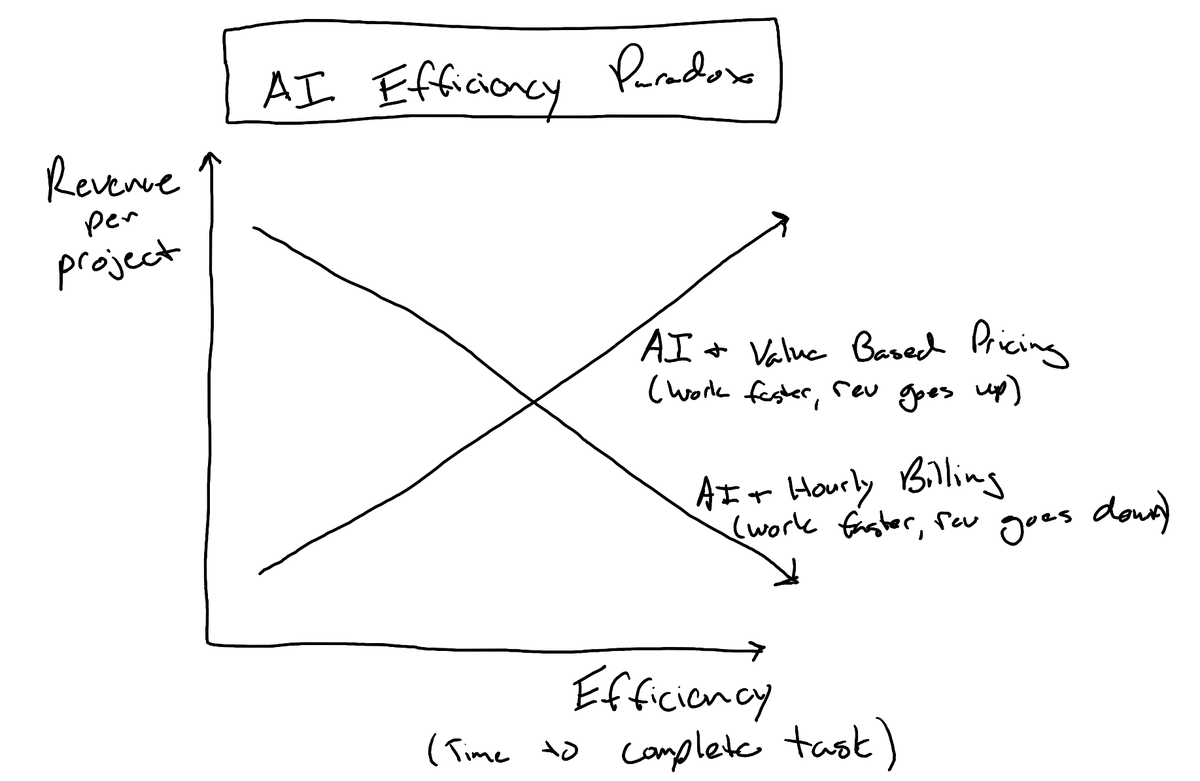
Agentic AI kills the billable hour. We’re moving from selling time to selling value.
Patrick Salyer tweet media
English
0
0
0
51
Patrick Salyer
Patrick Salyer@patricksalyer·
@jasonlk Agree. What are the 6 use cases today? Outbound SDR, Inbound SDR, what else?
English
0
0
0
31
Jason ✨👾SaaStr.Ai✨ Lemkin
AI Agents work in GTM today. We've got 6+ in production now. They work for sales, they work for outbound, they work for marketing. But ... They don't work well without a lot of training. That means they don't really work well as self-serve products and at low price points. For now at least. Most of the vendors taking off have effective ACVs of $50k-$100k+. That lets them use FDEs and other resources to help train the AI agents for the customers, often over an extended period. And that works well -- today. If you train the AI agents well. What's next? Doing this >well< for small customers and self-serve. It's a real challenge. But it's one we're excited to see play out.
English
9
0
48
7.5K
Patrick Salyer
Patrick Salyer@patricksalyer·
Nvidia's IPO valuation was ~$300M pre at a ~$120M revenue run rate. 🤔
English
0
0
0
50
Patrick Salyer
Patrick Salyer@patricksalyer·
$6.7T in AI data center capex is projected by 2030. I've been thinking about the same thing that is everyone's mind - is the revenue there to justify it? Global ad spend ($1T) and software ($0.6T) aren’t enough. The math only works when you factor in labor. $30T of annual white collar labor spend can be unlocked as AI Agents touch every enterprise role. As I meet with founders building AI Teammates, I can see this will happen. The real question is how long will it take. The reality: <10% of enterprises are actually scaling Gen AI in production (Mckinsey). It's not if, but how long it takes.
English
0
0
0
54
Garry Tan
Garry Tan@garrytan·
Everytime I get mad at people in the cheap seats criticizing founders in the arena, I remind myself of what Giannis said. Arguably my favorite response to a reporter ever.
English
225
1.2K
9.6K
737.9K
Dr. Jon Slotkin
Dr. Jon Slotkin@slotkinjr·
I have a guest essay in @nytimes today about autonomous vehicle safety. I wrote it because I’m tired of seeing children die. Done right, we can eliminate car crashes as a leading cause of death in the United States @Waymo recently released data covering nearly 100 million driverless miles. I spent weeks analyzing it because the results seemed too good to be true. 91% fewer serious-injury crashes. 92% less pedestrians hit. 96% fewer injury crashes at intersections. The list goes on. 39,000 Americans died in crashes last year. More than homicide, plane crashes, and natural disasters combined. The #2 killer of children and young adults. The #1 cause of spinal cord injury. We’ve accepted this as the price of mobility. We don’t have to. In medicine, when a treatment shows this level of benefit, we stop the trial early. Continuing to give patients the placebo becomes unethical. When an intervention works this clearly, you change what you do. In driving, we’re all the control group. Cities like DC and Boston are blocking deployment. And cities are not the only forces mobilizing to slow this progress. It’s time we stop treating this like a tech moonshot and start treating it like a public health intervention that will save lives. Link to article below. 👀 this video of Waymo cars evading crashes with people and vehicles. I especially note the ones that require it having a 360° view. My sincere thanks to Alex Ellerbeck and @acsifferlin for their wisdom and sure hand in editing this piece.
English
334
1K
6.4K
1.8M
Patrick Salyer
Patrick Salyer@patricksalyer·
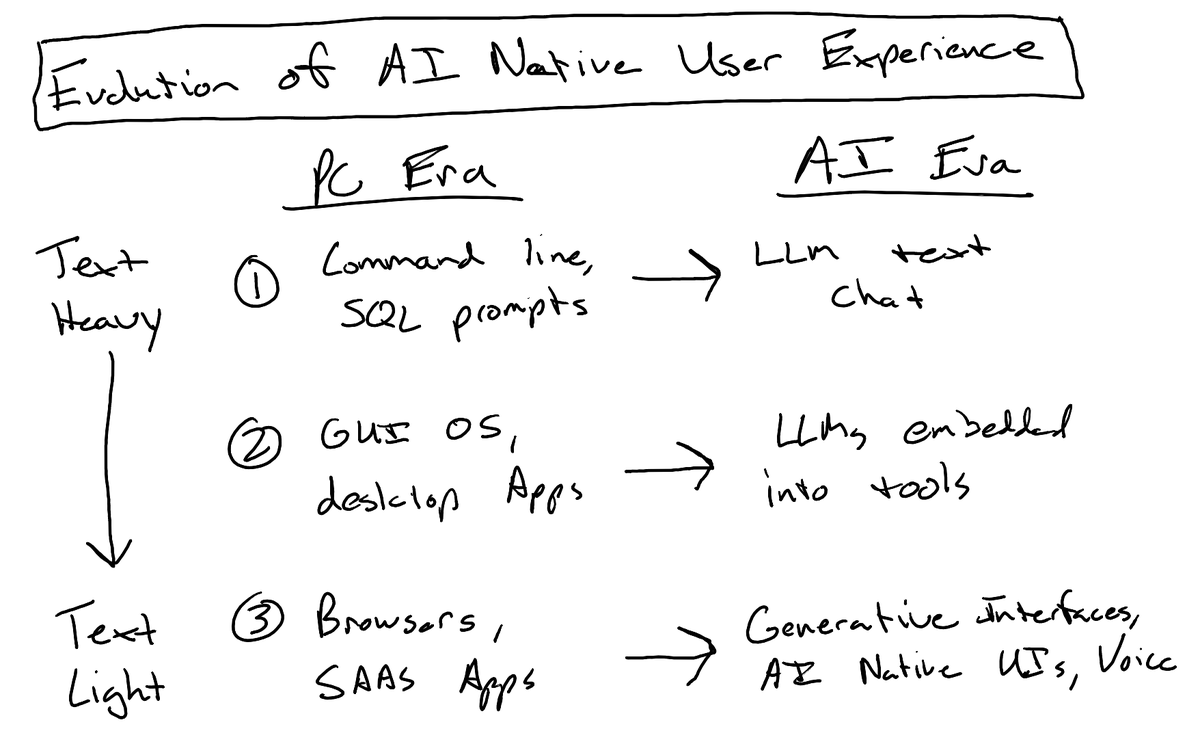
Text-based AI feels like a hammer looking for a nail. Long-form chat isn’t how work gets done. In the PC era we moved from command lines → GUIs → SaaS. In the AI era, a real battleground will soon be UX and we will move from LLM Chat -> Gen UX / AI Native UI / Voice
Patrick Salyer tweet media
English
0
0
0
98
Patrick Salyer
Patrick Salyer@patricksalyer·
@levie 💯 … love the simplicity of this framework and feels spot on
English
0
0
0
42
Aaron Levie
Aaron Levie@levie·
Quick way to figure out AI agent opportunities: what work would a company want to do far more of, or finally do for the first time, if it was vastly easier to get the talent to do it. Wherever this work exists is where AI agents will emerge.
English
40
32
373
60K
Patrick Salyer
Patrick Salyer@patricksalyer·
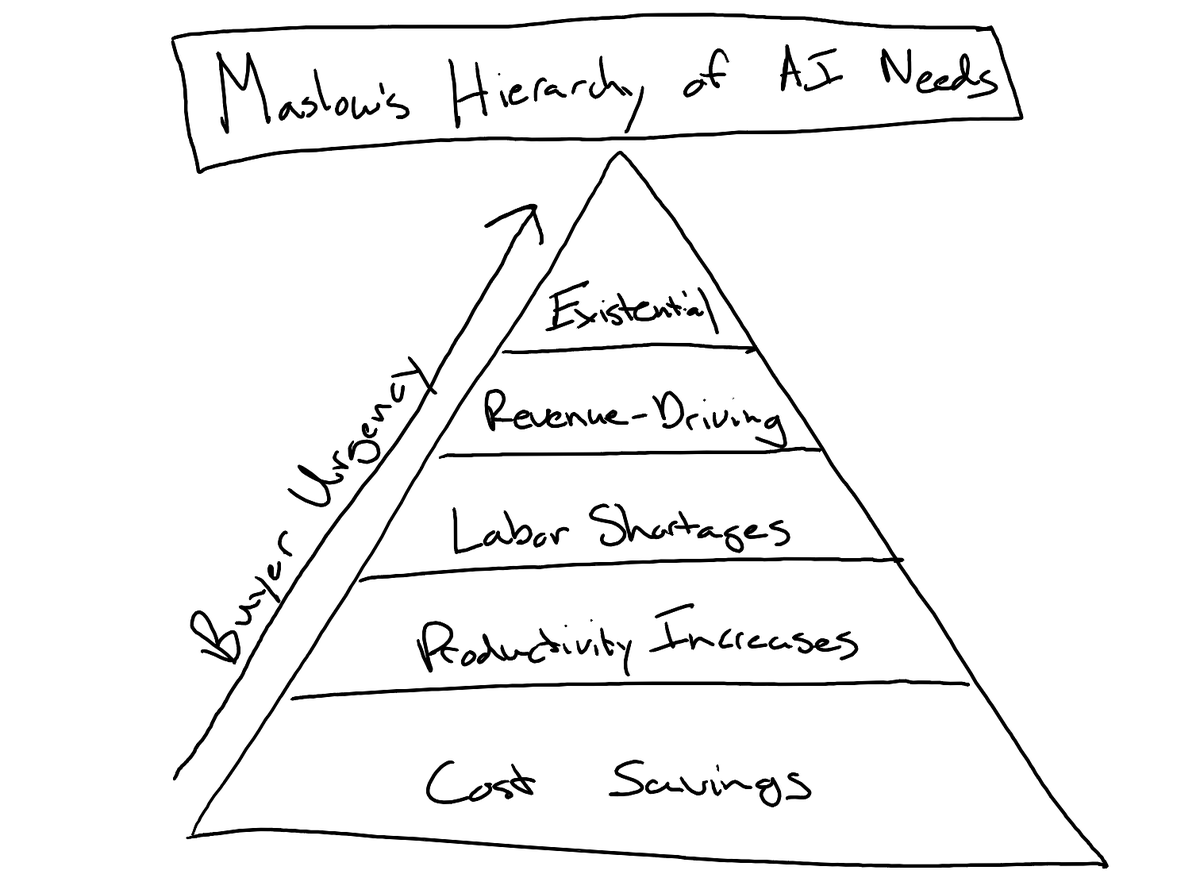
Maslow’s for enterprise AI Adoption (buyer urgency top→bottom): 1) Existential risk 2) Revenue 3) Labor shortages 4) Productivity 5) Cost Savings
Patrick Salyer tweet media
English
0
0
1
69
Patrick Salyer
Patrick Salyer@patricksalyer·
Pre-Seed is the new Seed. Seed is the new Series A. Series A is the new Series B.
English
0
0
1
90
Patrick Salyer
Patrick Salyer@patricksalyer·
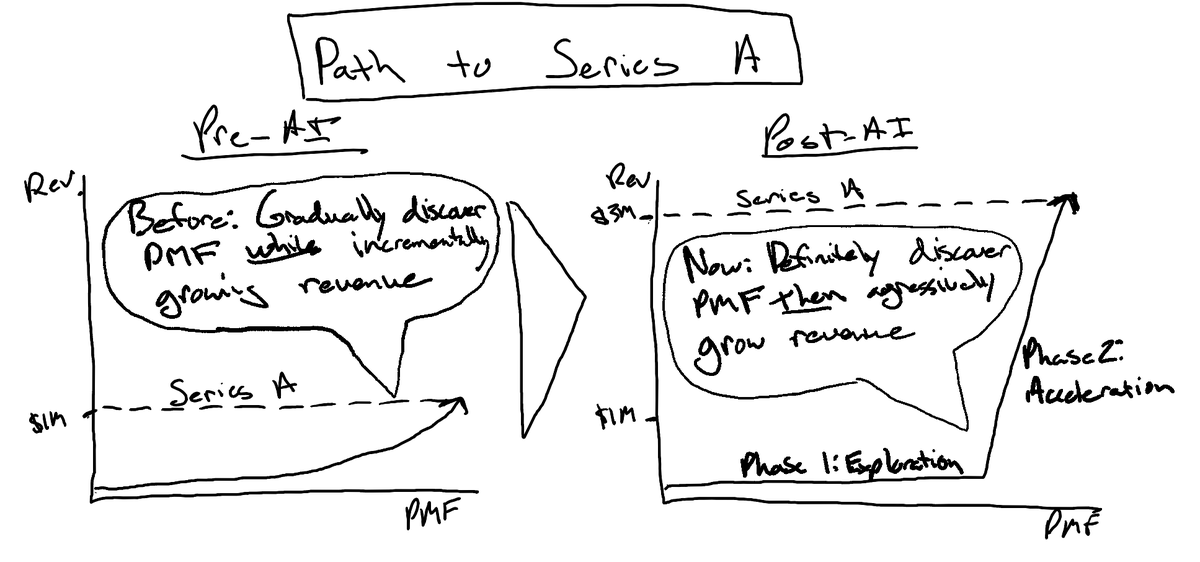
Seed → Series A is shifting Seed is about PMF: solve a real pain for a focused segment, make customers happy, repeat. The change is the bar—and the slope. Pre-AI: A ≈ PMF + ~$1M ARR. Now: A ≈ PMF + ~$3M ARR + velocity. Implications? Phase 1: Exploration, Phase 2: Accelerate.
Patrick Salyer tweet media
English
0
0
1
122
Patrick Salyer
Patrick Salyer@patricksalyer·
@jaminball Good caveat below...can now repurchase all the stock I sold this morning...
English
0
0
0
94
Patrick Salyer
Patrick Salyer@patricksalyer·
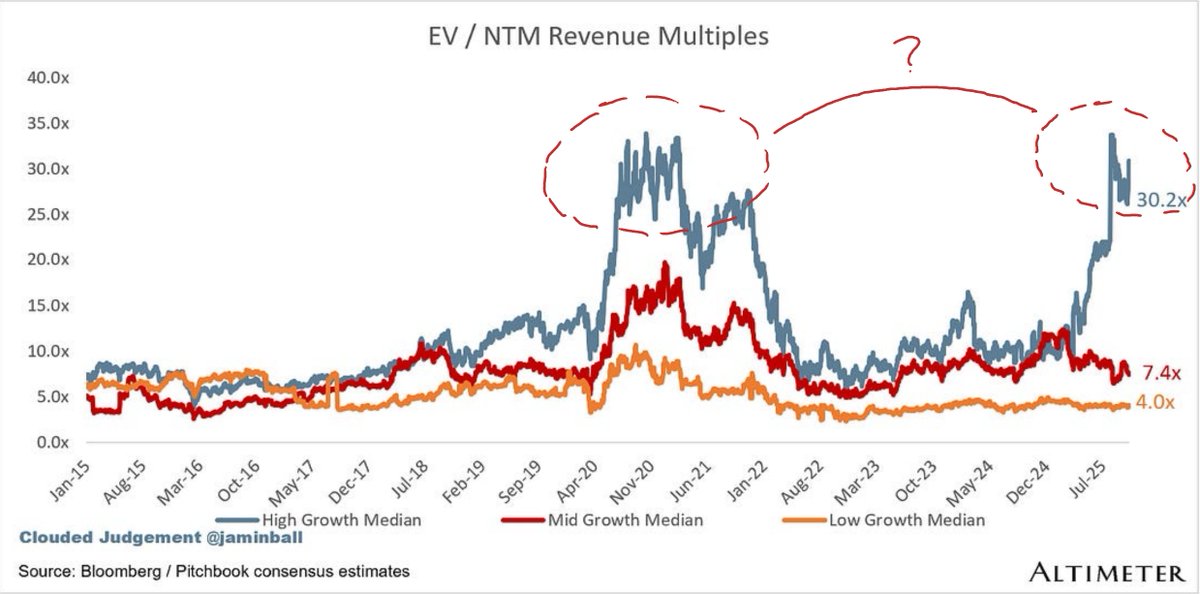
Valuations for high growth tech companies are starting to look awfully familiar to another time I can remember... Credit to @jaminball for putting out great content.
Patrick Salyer tweet media
English
2
0
1
1.4K