Preben

1.8K posts

Preben banner
Preben

Preben

@pdf

Katılım Nisan 2007
791 Takip Edilen661 Takipçiler
Preben retweetledi
Nicholas Decker
Nicholas Decker@captgouda24·
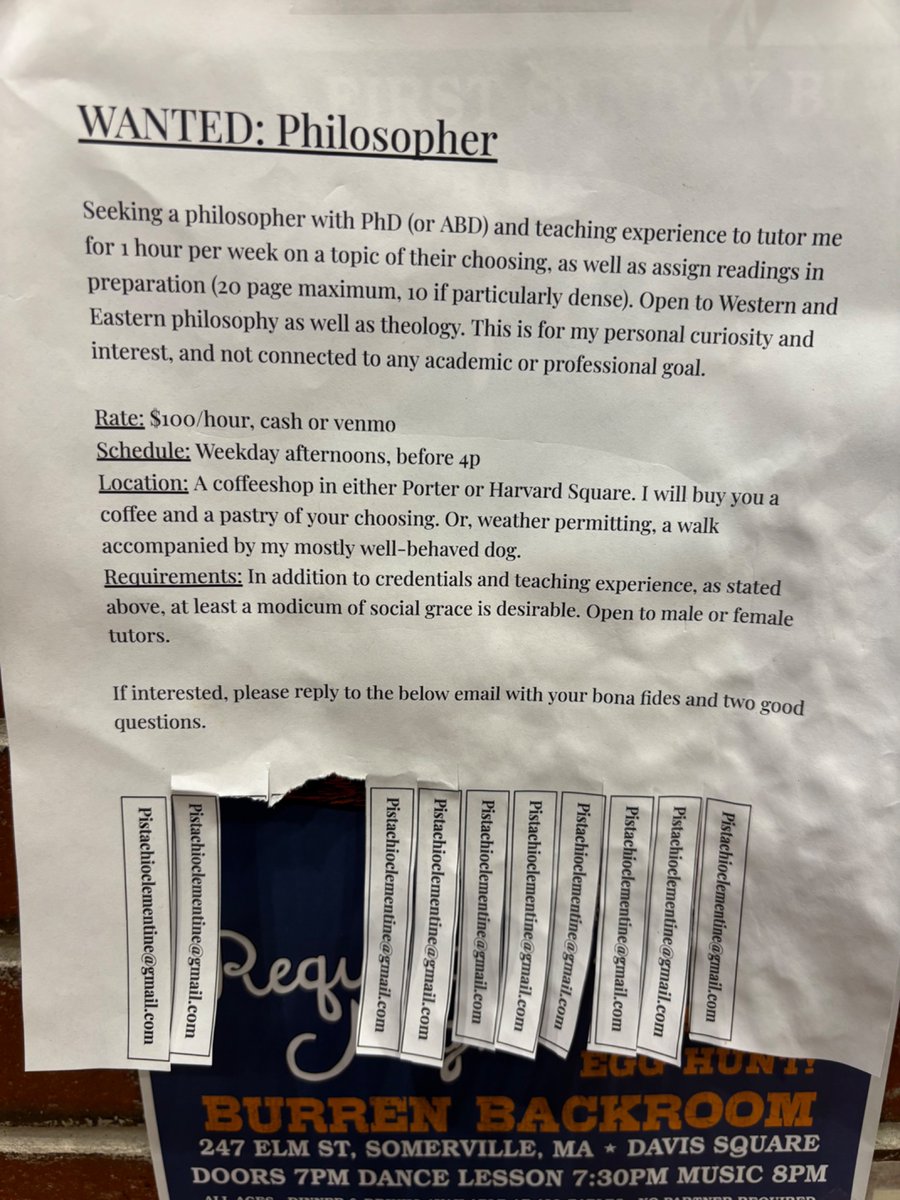
Finally, employment for people with philosophy Ph.D’s.
Nicholas Decker tweet media
English
26
83
2.5K
129.8K
Preben retweetledi
Associate Deans
Associate Deans@ass_deans·
We’ve approved an internal grant for Economics to do an ethnographic study of the dismantling of Sociology & Anthropology in the state system.
English
4
21
189
18.8K
Josh
Josh@catholicular·
@Brumairian this is quite an overlooked point actually. if you make the assumption that monarchs had the lowest levels of infant mortality because they had access to highest levels of medical care, even with many dying in combat, the average is still around 50s to 60s years old
English
5
1
153
20.9K
Napoléonos I Tritharsaléos
"Most men don't see forty" is one of those bullshit Enlightenment Era propaganda talking points that always gets thrown around by uneducated idiots. Life expectancy was cut in half because of infant mortality. If you survived childhood, even a lowly peasant was likely to make it into his mid to late sixties. The description of diet here is mostly accurate, for a particular season not year round. Also, most peasants had the right to hunt small game on the Lord's land to supplement their diet. Nobody was getting thrown in the stocks for poaching a rabbit; they were unlikely to catch a rabbit because of over hunting.
Sama Hoole@SamaHoole

Robert is thirty-six years old. In 1247, this is not young. Robert knows this. His knees know this. His back has known this since approximately 1239. Robert lives in a village in Worcestershire with his wife Agnes, three surviving children, and two chickens he is not allowed to eat because the chickens produce eggs and the eggs matter more than the chickens. Today is a Tuesday in March. Robert will describe it as a Tuesday in March. The concept of a 'week' as a unit of leisure is not yet something Robert has access to. 5:00am - Up. Pottage on the fire. The pottage is oats, leeks, and some dried parsnip from the autumn store. There is a small piece of salted pork in it, approximately the size of Robert's thumb. It is mostly flavouring. Robert eats around it for as long as possible, then eats it, then thinks about it for the rest of the morning. 6:00am - Field. Robert works the lord's strip first, then his own. The ground is still cold. His boots have a hole. He has had the hole since October. He has packed it with rags. The rags are wet. They will remain wet until June. Robert is technically eating a plant-based diet. He is not doing this by choice. He is doing this because meat belongs to the lord, the deer belong to the king's forest, and the last man in this village who was caught with an unlicensed rabbit spent a period in the stocks that his family still doesn't fully discuss. 10:00am - Brief rest. Rye bread, hard. A small onion. Robert thinks about the pig that was slaughtered in November. He thinks about this often. The memory of fat is a specific and enduring thing when you don't have much of it. 1:00pm - Back to the field. Robert's average daily calorie intake is somewhere between 1,500 and 2,000 calories, the majority from grain. He is doing agricultural labour that modern exercise scientists would classify as extremely high intensity. He is, measurably, running on insufficient fuel. He is aware of this in the way that you are aware of things that cannot be changed: completely, and without drama. 4:00pm - Home. Agnes has made more pottage. It is similar to this morning's pottage. Robert eats it. Robert's teeth hurt. They have hurt for two years. There is no dentist. There is a barber-surgeon in the market town seven miles away. Robert cannot afford the barber-surgeon and cannot take the day from the fields. His teeth continue to hurt. 7:00pm - Sleep. Robert will be awake again at five. He is thirty-six. He will probably not see forty. The leading cause of death for men in his position is a combination of infection, injury, and the slow arithmetic of malnutrition across a lifetime. Somewhere, eight hundred years from now, someone will describe Robert's diet as "ancestral," "plant-forward," and "aligned with the earth." Robert would have a great deal to say about this. Robert does not have the energy.

English
80
149
4.6K
401.1K
Preben retweetledi
Joakim 🌹🇳🇴🇪🇺
Does Zohran Mamdani support strengthening New Norwegian (Nynorsk), which is one of the two official written standards of the Norwegian language, in Norwegian society? Around 10–15% of the population have Nynorsk as their official language form.
English
35
40
1.6K
54.2K
Preben retweetledi
Diabetic of Enlightenment
Diabetic of Enlightenment@dee_of_e·
I disagree with Timothee Chalamet about opera (crowd cheers), because all art is essentially bad (crowd boos), in the Culture Industry sense! (crowd cheers) except for one medium, which encompasses all previous forms (crowd nodding expectantly), “gaming” (booing intensifies)
English
27
1.1K
12.7K
290.9K
Preben
Preben@pdf·
@captgouda24 No, we should not undermine autonomy and the pursuit of exellence for billions to (almost insignificantly) improve the tech talent pool
English
0
0
0
52
Nicholas Decker
Nicholas Decker@captgouda24·
Sports are great and all, but they should be banned for the intelligent. It is sucking them away from productive pursuits into a zero-sum competition. It’s just so incredibly socially wasteful. Eileen Gu should be interviewing for Google right now, not skiing.
English
66
3
163
38.7K
Preben retweetledi
lú
@vatesvates·
medieval peasant whose marriage is failing because he spends all day watching various puppetry shows titled things like “top ten biggest threats to your livestock”
English
23
1.4K
14.1K
141.7K
Preben retweetledi
Gigabear🧸
Gigabear🧸@2170cell·
There's got to be some way I can make money without adding value to society
English
1.5K
1.8K
25.2K
2.1M
Preben retweetledi
katie kadue
katie kadue@kukukadoo·
not sure why hamnet tries to appeal to modern audiences with “grief” when shakespeare’s play centers on an issue much more relevant today: a dispute over land belonging to denmark
English
62
2.8K
40.9K
707.5K
Preben
Preben@pdf·
@hagaetc If you’re capable of reading stuff that doesn’t confirm your existing views I recommend The Myth of Ownership by Nagel and Murphy.
English
0
0
0
124
hagaetc
hagaetc@hagaetc·
As a Norwegian startup founder I've unfortunately spent a lot of time thinking about, dealing with, and debating unrealized capital gains taxes. Here are some key points worth noting: A wealth tax is an implicit form of confiscation. While practically all other taxes are based on taking a cut of a voluntary exchange, a wealth tax is a transaction forced by the state. In practice, there are only two ways to pay it: taking out a very high salary or dividends, or selling shares. For private tech companies, this is usually neither feasible nor desirable. In either case, every $1 of wealth tax paid reduces the company’s value by $1—meaning the state has de facto confiscated private property. In fact, it takes out even more than the $1: You also pay taxes in order to pay taxes. Income, dividend, or capital gains taxes must be paid to extract the cash needed to pay the wealth tax. As a result, the true effective tax burden is significantly higher than the stated rate. The value of any asset can change quickly. Wealth taxes are set at an arbitrary point in time. An asset can drop 90% between the wealth valuation date and when the bill is due. It is deeply unfair to pay an actual tax bill based on values that does not exist anymore. Furthermore: It is impossible to know the true value of an asset that is not transacting. This creates substantial uncertainty for taxpayers and high administrative overhead for governments attempting to assess values. Preferred versus common shares, vesting schedules, transaction size, and whether a founder or a small minority shareholder is selling can all lead to vastly different prices for what appears to an ignorant observer to be the “same” shares. The only sensible solution to these problems is to tax voluntary transactions in the economy. Those who lean left may prefer higher marginal rates, while those who lean right may prefer lower ones—and that is a legitimate political debate. High tax rates can be fine; taxing unrealized values can't.
English
67
97
1.1K
54.8K
Preben retweetledi
Lee Hepner
Lee Hepner@LeeHepner·
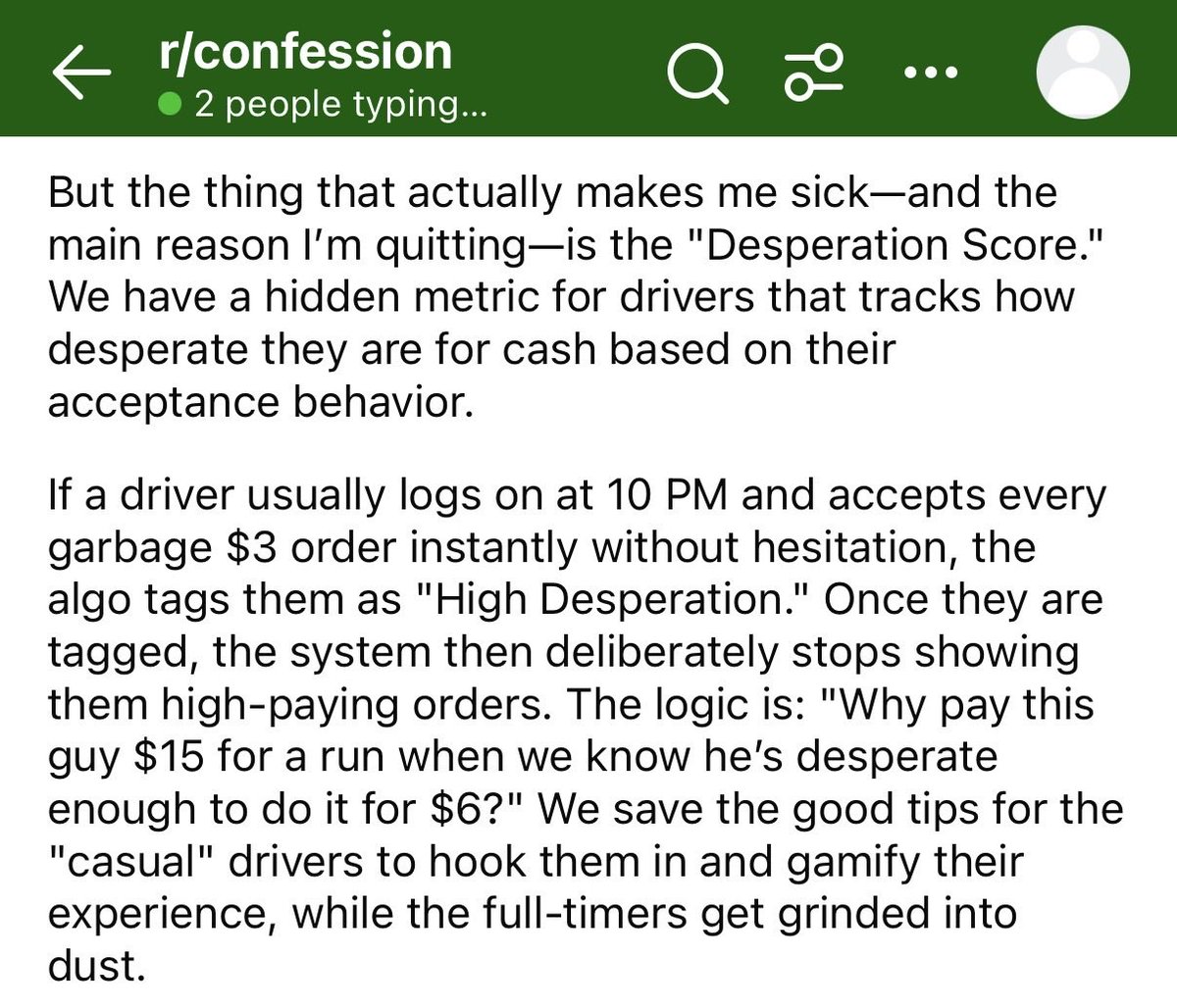
More disturbing than price discrimination based on “willingness to pay” are wages based on “willingness to work.” Below, a former food delivery app dev claims that fares are dictated by a “Desperation Score.” The more desperate a driver is for money, the less they get paid.
Lee Hepner tweet media
English
66
1.8K
7.9K
461.1K
Preben retweetledi
Erik Baker
Erik Baker@erikmbaker·
However you slice it, it imperative for the left to be able to construct forms of life that allow people to experience flourishing radically decoupled from professional achievement. With that said, I have no idea how to do this
English
39
116
1.7K
145K
Preben retweetledi
Joyce Carol Oates
Joyce Carol Oates@JoyceCarolOates·
So curious that such a wealthy man never posts anything that indicates that he enjoys or is even aware of what virtually everyone appreciates— scenes from nature, pet dog or cat, praise for a movie, music, a book (but doubt that he reads); pride in a friend’s or relative’s accomplishment; condolences for someone who has died; pleasure in sports, acclaim for a favorite team; references to history. In fact he seems totally uneducated , uncultured. The poorest persons on Twitter may have access to more beauty & meaning in life than the “most wealthy person in the world.”
stepfanie tyler@stepfanie

hello i would like to report a murder

English
1.5K
10.3K
88K
5.7M
Preben retweetledi
amrit
amrit@amritwt·
what did i just read bro
amrit tweet media
English
829
2.7K
53.7K
2.9M