
Shings retweetledi
Shings
676 posts



Shings retweetledi

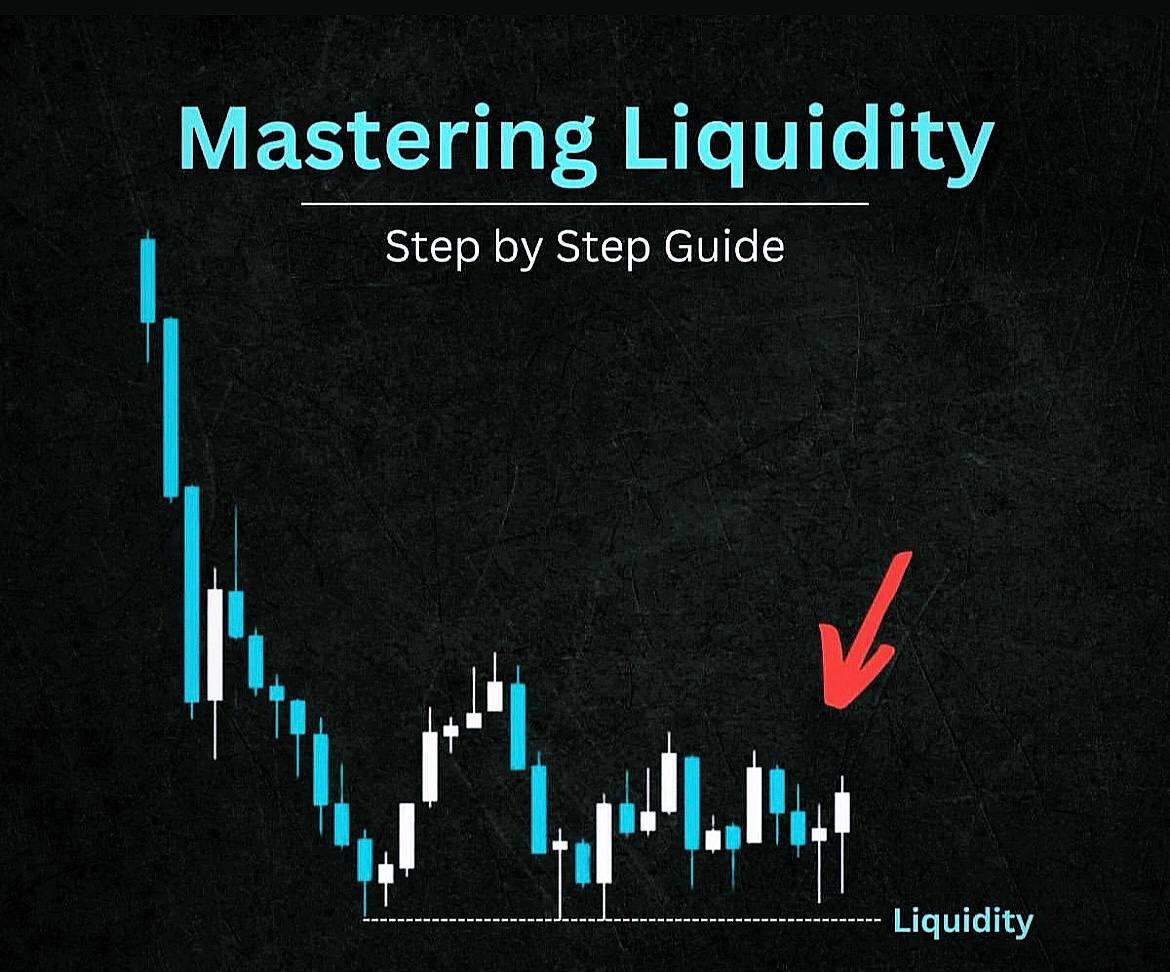
In this THREAD I will explain Liquidity.
1. What is “Liquidity”?
2. How to understand and use Liquidity.
3. How to MASTER Liquidity.
🧵(1/8)
English
Shings retweetledi


Shings retweetledi

False Move Week Beginning explained in 60 seconds :)
#cryptotrading #marketmakers
Dubai, United Arab Emirates 🇦🇪 English
Shings retweetledi

Plenty of times I receive this controversial question:
"How much does an altseason lasts, mate?"
Ok, I got you..you're afraid of selling too early or too late, isn't it?
Let's therefore bring some data analyzing what happened in the past to have a compass for the future.
🔸Byproduct of human's greed
Read the title, then read it twice.
Now you have the perfect definition of what an altseason is.
It's not something that happens during the first or middle phase of the cycle where Bitcoin takes the spotlight (contrary to what most accounts want you to believe for engagement purposes) but instead during the last phase of the cycle.
This is logical as retails start to pay attention exclusively when BTC breaks the past ATH and the media attention threshold drastically raises, "forcing" them to look at cheap coins that can turn them into intra-day millionaires.
In this chart you can find the correlation between the break of BTC's ATH and the drop in BTC D. which flashes risk aversion and retails inflow.
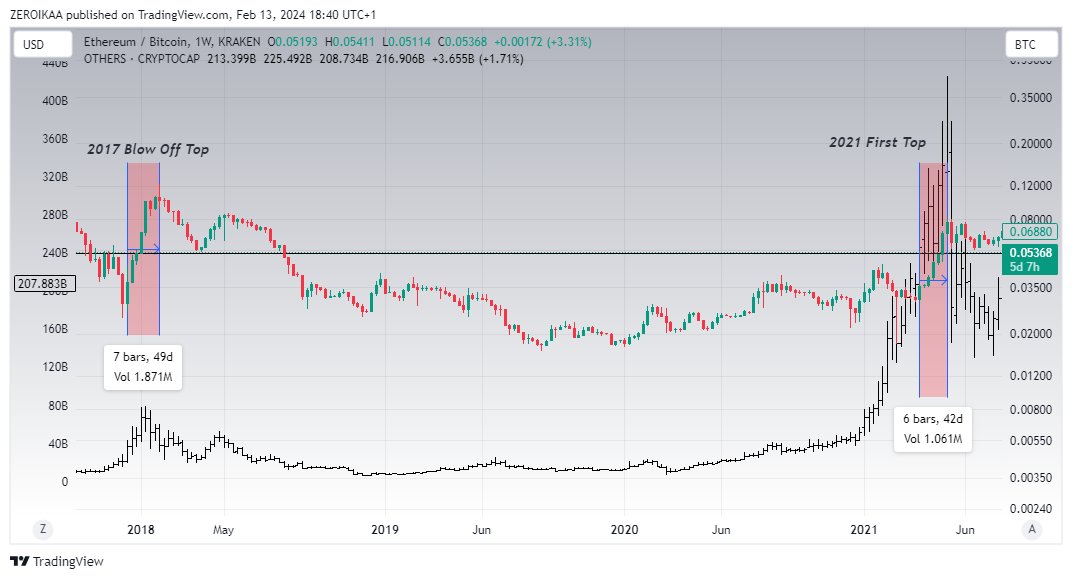
🔸Ethereum/Bitcoin pair
One of the biggest signal for evaluating if we're entering the altseason, is surely looking at the BTC D. to drop but also to the ETH/BTC breakout, which are inversely correlated.
By looking at the past 2 cycles, we can find an interesting data : the parabolic move made by ETH/BTC and which leads to the whole altcoin sector to rise fast lasts approximately 40 days, less or more.
In the classic green/red colors you can see ETH making the parabolic move, while in black the OTHERS chart, which represents the purest state of the altcoin market.
🔸"Wait, does this mean we have just 40 days to make money?"
Well, no.
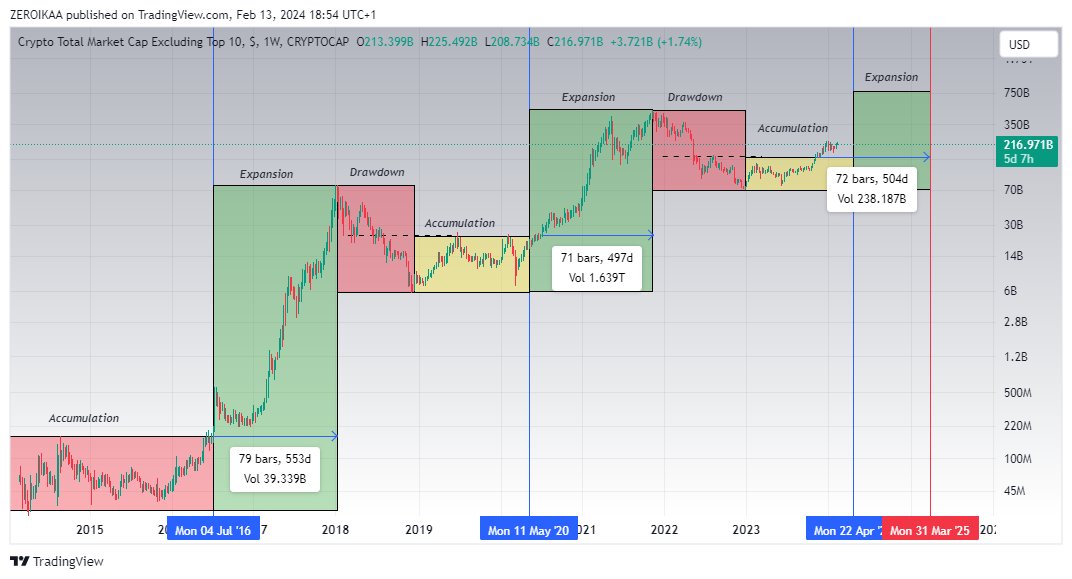
If you look at the OTHERS chart, you can see that historically speaking, from when it abandons the accumulation stage to the expansion stage pic, approximately 500 days pass.
This means that you if you're positioned since the accumulation stage (4/6 months prior to the halving is the sweet spot) you'll likely to enjoy big profits all the way up, without caring too much about the perfect top.
What's interesting to notice here, is that it seems we already left the accumulation stage, and projecting another 500 days of expansion, would put the altcoins top around the Q1 of 2025. (to take with a pinch of salt)
But if we peak earlier than the common cycle, this can be a potential outcome.
🔸In conclusion, what we can evince?
Focusing on how much an altseason can last isn't the best way to approach the market, as it would likely "force" you to wait for the perfect moment to sell everything, severely increasing the risk of selling too late.
What matters, in my opinion, is positioning ourselves earlier than the masses and then evaluating:
- When BTC break its previous ATH
- When BTC D. starts to drop
- When OTHERS starts to go parabolic
- When ETH/BTC starts to outperform
All of these 4 signals are crucial for determining when we have to raise our attention threshold and start looking for de-risking from the market (together with your hairdresser asking for financial advice and celebrities promoting crypto projects)
Just take note, and that's one of the most important things, that retails will not look for HTF closure below key zones. (🔨)
That's why they'll become exit liquidity.


English
Shings retweetledi

Google presents PIVOT
Iterative Visual Prompting Elicits Actionable Knowledge for VLMs
demo: huggingface.co/spaces/pivot-p…
project page: pivot-prompt.github.io
propose a novel visual prompting approach for VLMs that we call Prompting with Iterative Visual Optimization (PIVOT), which casts tasks as iterative visual question answering. In each iteration, the image is annotated with a visual representation of proposals that the VLM can refer to (e.g., candidate robot actions, localizations, or trajectories). The VLM then selects the best ones for the task. These proposals are iteratively refined, allowing the VLM to eventually zero in on the best available answer. We investigate PIVOT on real-world robotic navigation, real-world manipulation from images, instruction following in simulation, and additional spatial inference tasks such as localization. We find, perhaps surprisingly, that our approach enables zero-shot control of robotic systems without any robot training data, navigation in a variety of environments, and other capabilities. Although current performance is far from perfect, our work highlights potentials and limitations of this new regime and shows a promising approach for Internet-Scale VLMs in robotic and spatial reasoning domains.
English
Shings retweetledi


Shings retweetledi

This repository covers 60+ Implemented end-to-end #DataScience and #MachineLearning projects: github.com/Coder-World04/… by @NainaChaturved8
—————
#DataScientists #DeepLearning #AI


English
Shings retweetledi

PCA is one of the most useful procedures used in machine learning.
PCA stands for "Principal Component Analysis." It's an unsupervised learning technique used everywhere.
Look at the attached picture. Using a PCA variation, we can remove the background and isolate the people in the image.
That's impressive for such a simple technique!
PCA's main goal is to reduce the dimensionality of data.
It helps us boil down data to its most important features. It's like lossy compression for your data.
You benefit from PCA every day, even if you don't know it. From visualizing data in two dimensions to helping us train models faster. Every-freaking-where.
I know this is starting to sound like a love letter, so I'll stop here.
If you don't have better plans for your weekend, watch a video or two about PCA. It will be well worth it.

English
Shings retweetledi

The Gemini Advanced prompting guide is live!
I've started to add prompt examples demonstrating Google's Gemini Advanced capabilities.
If you are curious about prompts and tasks to try, this guide should be a good starting point.
From preliminary experiments, Gemini Advanced shows promising capabilities around reasoning, math word problem solving, education tasks, code generation, image understanding, and a wide range of creative tasks.
As I mentioned yesterday, it takes a bit of prompt tuning to get the right results but I think this will improve exponentially in future iterations.
The safety guardrails are there and you will more often than not encounter them, especially when you are prompting tricky questions.
These are just preliminary tests. We will continue to document capabilities and limitations. An extended model guide coming soon. Stay tuned!
Link to guide below ↓

English
Shings retweetledi

2024 will bring tons of new project launches!
But most of their tokens can be obtained almost for free.
Here's what you need to do to avoid regrets:
- Stake $DYM and $XAI
- Stake $TIA on @stride_zone for $stTIA
- Bridge to @zksync via @Orbiter_Finance
- Interact on @zerolendxyz / @VestExchange and complete quests on @guildxyz
- Bridge funds via @jumperapp from zkSync to Arbitrum
- Deposit into @HyperliquidX to trade for earn points
- Deposit and trade on @aevoxyz
- Borrow/Lend on @Dolomite_io
- Bridge via @Hyperlane_xyz Arbitrum - Neutron - Manta and deposit LP to @ApertureFinance
- Create new Binance Web3 Wallet, deposit and bridge $BNB, $USDT, $ETH via @PolyhedraZK bridge from Arbitrum to Mantle
- Use @Minterest platform for lending on @0xMantle Network
- Bridge funds via @RangoExchange from Mantle to Ethereum
- Deposit $ETH to @modenetwork and complete quests
- Restake 1+ $ETH on @eigencloud / @puffer_finance / @KelpDAO
- Bridge via @deBridgeFinance to Solana
- LP and Trade on @Parcl to earn points
- Deposit into vaults on @MeteoraAG
- Interact on @Kamino_Finance
- Use all @phantom features
- Bridge funds via @RangoExchange from Solana to BNB
- Deposit and trade on @KiloEx_perp
- Bridge via @DLN_Trade from BNB to @base
- Trade on @IntentX_
- Engage on @Farcaster and buy warps on $5 via $ETH on Base
- Bridge funds via @BungeeExchange from Base to Zora
- Deploy, mint NFTs on @ourZORA and bridge via ZoraBridge to ETH
- Bridge to @Scroll_ZKP via Scroll native bridge
- Trade and LP on @ambient_finance
- Use all @Rabby_io features
- Interact with testnets: @AvailProject, @fuel_network, @berachain, @AleoHQ
English
Shings retweetledi

Step-by-step guide to build AI agents for structured and unstructured data.
Step 1: Define the Chunking Strategy
- Break down your documents into manageable pieces (chunks).
- Decide on the chunk size and whether there should be overlap between chunks.
Step 2: Apply an Embedding Strategy
- Transform the chunks into embeddings using advanced models like E5 and BERT. This makes the unstructured data more accessible for computational processes.
Step 3: Implement a Document Retriever for Text
- Develop a retrieval system that queries and fetches relevant chunks based on the embeddings generated in Step 2.
Step 4: Use a Large Language Model (LLM)
- Feed the relevant chunks into an LLM to understand and process the content within the context of a user's prompt.
Step 5: Extract Metadata
- From structured data sources, extract metadata which includes schemas, sample data, and summaries.
Step 6: Implement a Document Retriever for Metadata
- Create a retrieval system specifically for querying metadata.
Step 7: Integrate SQL Querying with a Data Warehouse
- Use SQL queries to interact with the structured data housed in a data warehouse.
Step 8: Develop a Prompt Refinement Engine
- This engine classifies user prompts and generates document retriever queries to find the most relevant information.
Step 9: Create a Response Post-processor
- Aggregate and summarize responses, and create attachments if needed (like PDFs or docs).
Step 10: Deliver the Response
- The final, relevant response is then presented to the user.
This strategy ensures that AI agents can effectively process and understand both structured and unstructured data, providing comprehensive and contextually relevant responses.

English
Shings retweetledi

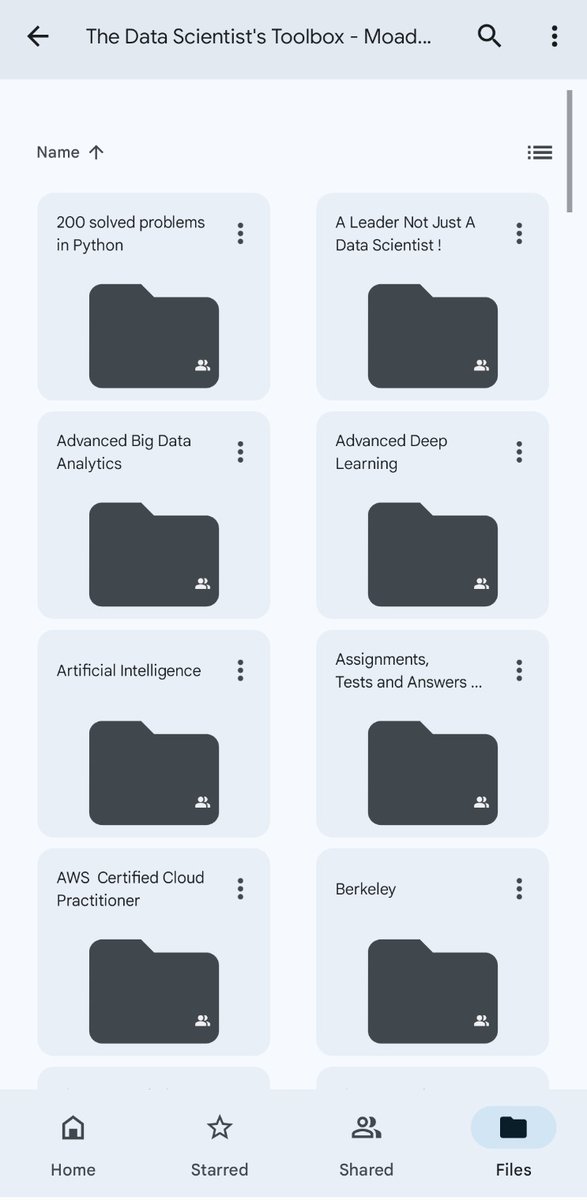
Are you finding it difficult to afford expensive paid courses?
I'm offering you access to 10 complimentary courses 🦑:
1. Artificial Intelligence
2. Machine Learning
3. Cloud Computing
4. Ethical Hacking
5. Data Analytics
6. AWS Certified
7. Data Science
8. BIG DATA
9. Python
10. MBA
To receive them, simply:
- Like and retweet
- Comment "Free"
- Make sure you're following (so I can send you a direct message)


English
Shings retweetledi

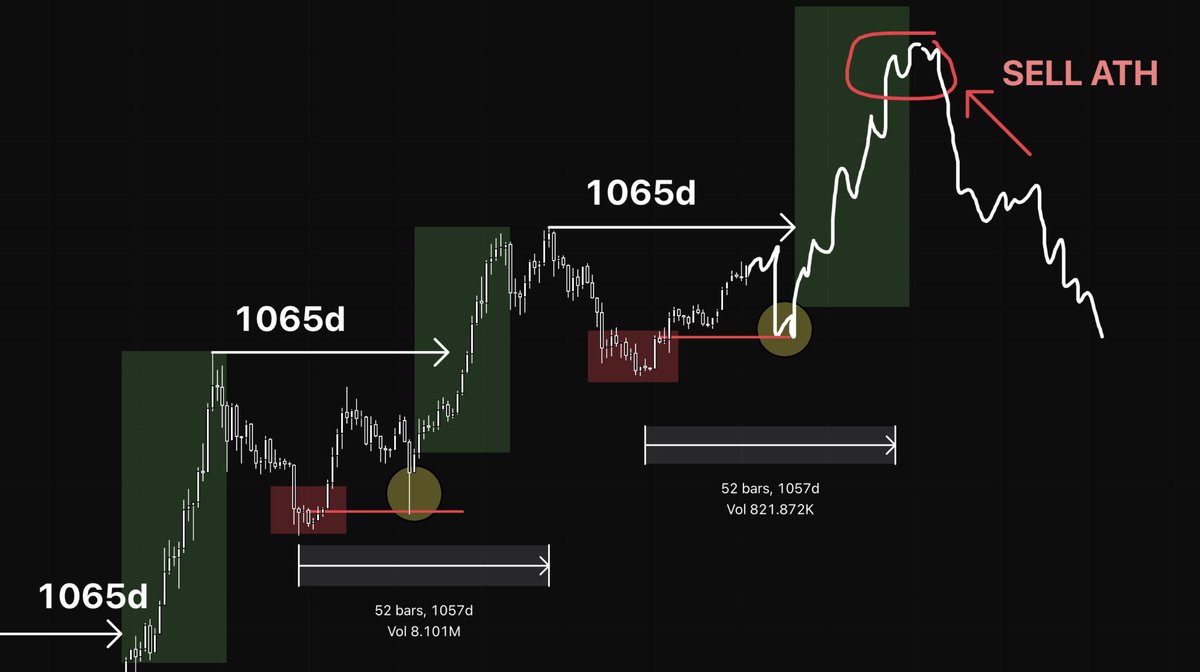
People who knows market cycle model made Millions in bull run 2021!
The biggest take off is coming in 155 days..
▓▓░░░░ 38% - Now
▓▓▓▓▓ 100% - October 2025
Here's Ultimate playbook on how to sell ur crypto at ATH..🧵👇
English
Shings retweetledi

Testnet airdrops are the easiest way to turn $0 into thousands of dollars.
$APT testnet users made $7.5k+, and recently, $ALT + $ZETA users were handsomely rewarded.
There are 5 FREE testnet airdrops I'm currently farming.
Find out what they are 👉 youtu.be/6b7llgIzcoM

YouTube

English
Shings retweetledi

What is the greatest challenge of WEB3?
Undoubtedly, it's user experience.
I just uncovered a GameChanger set to revolutionize UX, and guess what?
Powered by @LayerZero_Labs and @CelestiaOrg, it's still a hidden gem with its public sale live NOW!
Don't sleep on this! 🧵🔽

English
Shings retweetledi

Shings retweetledi

Proxy-tuning is a way to adapt LLMs without changing the model's weights.
Following up on the proxy-tuning paper discussion from last week, I implemented it in code and gave it a try. It actually works: lightning.ai/lightning-ai/s…
In a nutshell, the method is like this:
1. Select a base LLM (e.g., an untuned 7B Llama 2 model) smaller and cheaper than the target LLM (e.g., a 10x larger, untuned 70B Llama 2 model).
2. Finetune this smaller base LLM to obtain a small finetuned LLM (e.g., instruction-finetune a 7B Llama 2 model to get a finetuned 7B model).
3. Compute the output difference between the base model (step 1) and the tuned model (step 2).
4. Add this difference in outputs to the target LLM's outputs.
5. Normalize the modified outputs from step 4, and then generate the answer.
I tried the following query:
"If I have 5 apples and eat 2, but then find 3 more on my way home, how many do I have?"
The proxy-tuned model was indeed able to answer correctly, whereas the base models failed: "You start with 5 apples and eat 2, so you have 5 - 2 = 3 apples left. Then, you find 3 more apples on your way home, so you have 3 + 3 = 6 apples in total."
Using the same approach, it was also possible to give Llama 2 13B coding abilities via CodeLlama 7B.
English
Shings retweetledi

Fed up with "I don't have a PC, so I can't farm airdrops" excuses.
Guess what? You can make your first $10K-$100K on airdrops even with just a phone
How? Keep reading.
Will delete this thread soon 👇🧵

English
Shings retweetledi
Advances in Multimodal LLMs
In the last couple of weeks, we saw a spike in multimodal LLMs (MM-LLMs) research papers.
Among these publications, there was a nice comprehensive survey summarizing 26 existing MM-LLMs.
It also includes training recipes to enhance these models, insights, and some promising research directions.
It's incredible how easy it has become to tune and augment these systems. This is also thanks to the recent open-source efforts around MM-LLMs, including datasets, benchmarks, and models.

English