
Sabitlenmiş Tweet
pheoniz
6.2K posts


pheoniz
@pheonizwill
i eat shit, talk shit, and trade shit
Katılım Mayıs 2018
1.6K Takip Edilen916 Takipçiler

@BogiaBNBAster @godfred_xcuz just at the beginning of the lock. there is no top up until the next cycle
English

@godfred_xcuz I have a question based on your example: If bitcoin:native 's price pumps to 200k, 500k, etc., do we need to buy more blockstack:native to maintain the 5% ratio to get the max yield? Or is it enough to just meet the 5% requirement at the beginning?
English

I think the math is mathing for Self-custodial Bitcoin Staking and Bitcoin holders are going to eat so well 😋
Proposed Fixed APY: 3%
1 BTC: ~$78k (current market price)
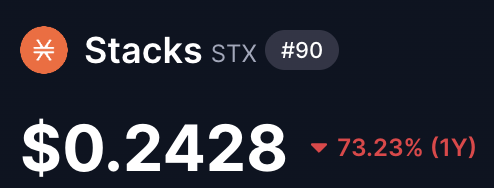
1 STX: ~$0.24 (current market price)
5% of Bitcoin value: $3.9k (16,250 STX)
So the bonding participant will lock 1 bitcoin:native + 16,250 blockstack:native ) to earn 0.015 bitcoin:native ($1,170) 🤯
This without losing your keys to your BTC. No wrapping. No bridging. No custody.
Algorithm.btc@godfred_xcuz
Before you stake BTC on Stacks, here's what you need to understand. Bitcoin staking on Stacks is currently the only BTC-denominated, self-custodial yield in the entire Bitcoin ecosystem. No wrap. No bridge. No counterparty. Your keys, your Bitcoin. The Protocol Bond: BTC + STX Bitcoin staking mechanism is enforced by 2 blockchains, Bitcoin and Stacks, that have been battle-tested over bull and bear cycles. To participate in Bitcoin staking on Stacks, you create what's called a protocol bond, a paired position of bitcoin:native and blockstack:native. Here's how each side works: bitcoin:native side: Your Bitcoin is locked directly on Bitcoin mainnet using a native Bitcoin script called OP_CHECKLOCKTIMEVERIFY (CLTV), a Bitcoin scripting system that allows a transaction output to be made unspendable until some point in the future. This protects your BTC to be unspendable until the bonding period. No one, not even the Stacks protocol, can move your BTC. The standard lock period is 25,200 Bitcoin blocks (~6 months). blockstack:native side : STX is locked on the Stacks network as the economic capacity for your bond. For a target yield of 3% APY, 5% of your BTC value in STX is required. This ratio is calculated at lock time. No top-ups needed during the bonding period. Early Exit BTC locking in Bitcoin staking is not a binding obligation, but it's a technical request. If you want out early, you can request an exit, and your BTC is returned at the very next Bitcoin block (~10 min). However, your STX stays locked until the full bonding period ends, and any remaining yield is forfeited. In short, BTC can exit early; STX cannot. No Slashing. Ever. - There are no validators to misbehave with your BTC. - No software downtime to punish. - No lending or borrowing counterparty risk hiding in the background. Your BTC principal is never at risk from the Bitcoin staking protocol. The Yield in BTC. 3% APY is the target fixed yield, driven by Stacks miner bid activity. The yield is distributed every 1,050 Bitcoin blocks (~ 1 week) for the duration of the bonding period to all eligible protocol bond participants. The One Real Risk If STX drops more than ~60% against BTC during your 6-month bond, you become net negative in BTC terms. That's the trade-off. Though you're not risking your BTC to the Bitcoin staking protocol, you're taking on STX price exposure as the cost of participation. In weak market conditions, the protocol manages yield through: - capacity constraints, - reserve buffers, - and algorithmic adjustment. Why TradFi Gets This Faster Than Most Crypto Natives. Institutional Bitcoin desks already think in bond structures, lock-up periods, fixed income, and capital efficiency ratios. This maps directly onto frameworks they use every day. For institutions, Bitcoin staking on Stacks with a protocol bond system might not be a new concept. It's a familiar instrument built on the hardest collateral in the world.
English
@alexrudloff @axopoa pivoting is healthy, what they are trying to solve is difficult. the feedback is fair. a lot of investors lost money and are still under water.
if it makes you feel differently, it looks like the bottom is in for a trade
English

@pheonizwill @axopoa I mean, maybe. The institutional thesis is at least a thesis.
Unfortunately it seems to fit a pattern with stx where they just pivot to the next far off thing and celebrate each new white paper along the way, so it raises a lot of cynicism.
English

English

@pheonizwill @alexrudloff @axopoa lol where when who - its all a secret, no transparency in this project, only kiss ass ball lickers and those that question stuff get isolated!
English
@alexrudloff @axopoa they're going for few people with large volume
English
@axopoa there's no amount of money, sips or white papers that can side step whether or not useful products exist for a large volume of people.
English
with the latest developments from Stacks and their PoX-5 white paper.
i am revisiting this for $ZEC and would like feedback from the community
pheoniz@pheonizwill
@SatsRunner @zcash an innovation of @stacks is how it enabled bootstrapping of programmable layers with PoX + clarity $zcash wants to be productively, programmed, zkprivate cash. @zooko is trying to do it with PoS, but it should be with PoX. there are a few ways you could approach it.
English






Everyone who says Pengu Morning today is going on a very special list 🐧

English
train is leaving. all aboard!
pheoniz@pheonizwill
the last chance to buy $ZEC under $500, forever, is coming up here
English

@pheonizwill @CobraCrypto What is the highest? Will it surpass bitcoin at some point?
English

@DarskyMark72088 @CobraCrypto in a world of probabilities, ~$413 is the lowest, then it will go up.
z cash is breaking out here because the accumulation phase is done. strong hands are not selling, and short term speculators are out.
anyone holding is waiting for the first comma
English
@pheonizwill @CobraCrypto Why not? We will make a fortune in the near future. What is the lowest it will go?
English
@CobraCrypto It needs to bottom out. Around 200$ would be perfect
English
