Phil Duncan retweetledi
Phil Duncan
343.5K posts

Phil Duncan
@philduncan
CU TIGER GRAD. No DMs. No lists.
global Katılım Ağustos 2008
5.6K Takip Edilen3.1K Takipçiler
Phil Duncan retweetledi


A birth certificate proves citizenship in this country. Trump does not want that to be the case.
If the Supreme Court rules in Trump’s favor in the birthright citizenship case, a U.S. passport will be the only way to prove citizenship.
“If you don’t have [a U.S. passport], you’re not going to be able to register to vote,” Marc Elias said.
English
Phil Duncan retweetledi

In 1997, loggers marked a thousand-year-old redwood tree for destruction.
A 23-year-old woman named Julia Butterfly Hill climbed the tree in protest.
She didn’t come down for 738 days.
The tree was a massive coast redwood in Northern California later named “Luna.”
For roughly a thousand years, Luna had survived storms, fires, wars, and entire civilizations rising and falling.
Then a logging company decided she was worth more as lumber.
Julia climbed 180 feet into the canopy with a harness, ropes, and a small platform barely six feet wide.
At first, nobody expected her to last long.
Most tree-sits lasted days.
Maybe weeks.
Julia stayed through two winters.
She survived 80 mph storms that violently whipped the tree back and forth through the night. She strapped herself to the platform so she wouldn’t be thrown to her death while sleeping.
She endured freezing rain, isolation, insects, exhaustion, and constant fear.
Logging helicopters flew low overhead trying to intimidate her down.
Security teams blocked supplies.
And one by one, she watched nearby ancient redwoods get cut down around Luna.
Still, she stayed.
Over time, her protest became international news.
Using a solar-powered phone high in the canopy, Julia spoke to reporters about old-growth forests, clear-cutting, erosion, biodiversity, and corporate destruction of ancient ecosystems.
The longer she stayed, the harder it became for the logging company to ignore her.
Finally, after 738 days in the tree, an agreement was reached.
Luna would be permanently protected.
When Julia finally climbed down in December 1999, her body had adapted so completely to constant movement that standing on solid ground made her collapse.
But Luna survived.
Years later, someone even tried to kill the tree with a chainsaw attack.
Luna survived that too.
She is still alive today.
Julia Butterfly Hill didn’t stop all logging.
She didn’t save every forest.
But she proved something powerful:
Sometimes resistance is not loud.
Sometimes resistance is simply refusing to move.
A thousand-year-old tree is still standing today because one woman decided comfort, fear, and convenience mattered less than protecting something ancient and alive.

English
Phil Duncan retweetledi

Executive Mansion,
Washington, Nov. 21, 1864.
Dear Madam,--
I have been shown in the files of the War Department a statement of the Adjutant General of Massachusetts that you are the mother of five sons who have died gloriously on the field of battle.
I feel how weak and fruitless must be any word of mine which should attempt to beguile you from the grief of a loss so overwhelming. But I cannot refrain from tendering you the consolation that may be found in the thanks of the Republic they died to save.
I pray that our Heavenly Father may assuage the anguish of your bereavement, and leave you only the cherished memory of the loved and lost, and the solemn pride that must be yours to have laid so costly a sacrifice upon the altar of freedom.
Yours, very sincerely and respectfully,
A. Lincoln

English
Phil Duncan retweetledi

You've seen this scar on older people's arms. That weird little starburst on the shoulder.
It's not from a normal shot.
The smallpox vaccine wasn't injected like a regular jab. They used a bifurcated needle - basically a tiny fork with two prongs. Invented in 1965 by a guy named Benjamin Rubin, who ground down the eye of a sewing machine needle to make it.
Here's the wild part. You dip the needle in the vaccine and one drop gets caught between the prongs. That's the whole dose. Then you jab the arm 15 times, fast. Quick shallow pricks, just deep enough to draw a bit of blood and slip the weakened virus into the skin.
Your immune system does the rest. Red bump. Blister. Pus. Scab. Falls off. Scar for life.
The mark isn't from the needle. It's from your body fighting the virus. And the reason it looks like a starburst instead of a dot? Those 15 rapid punctures.
That scar is basically a receipt. Proof you survived one of the deadliest diseases in human history before we wiped it off the planet.

English
Phil Duncan retweetledi

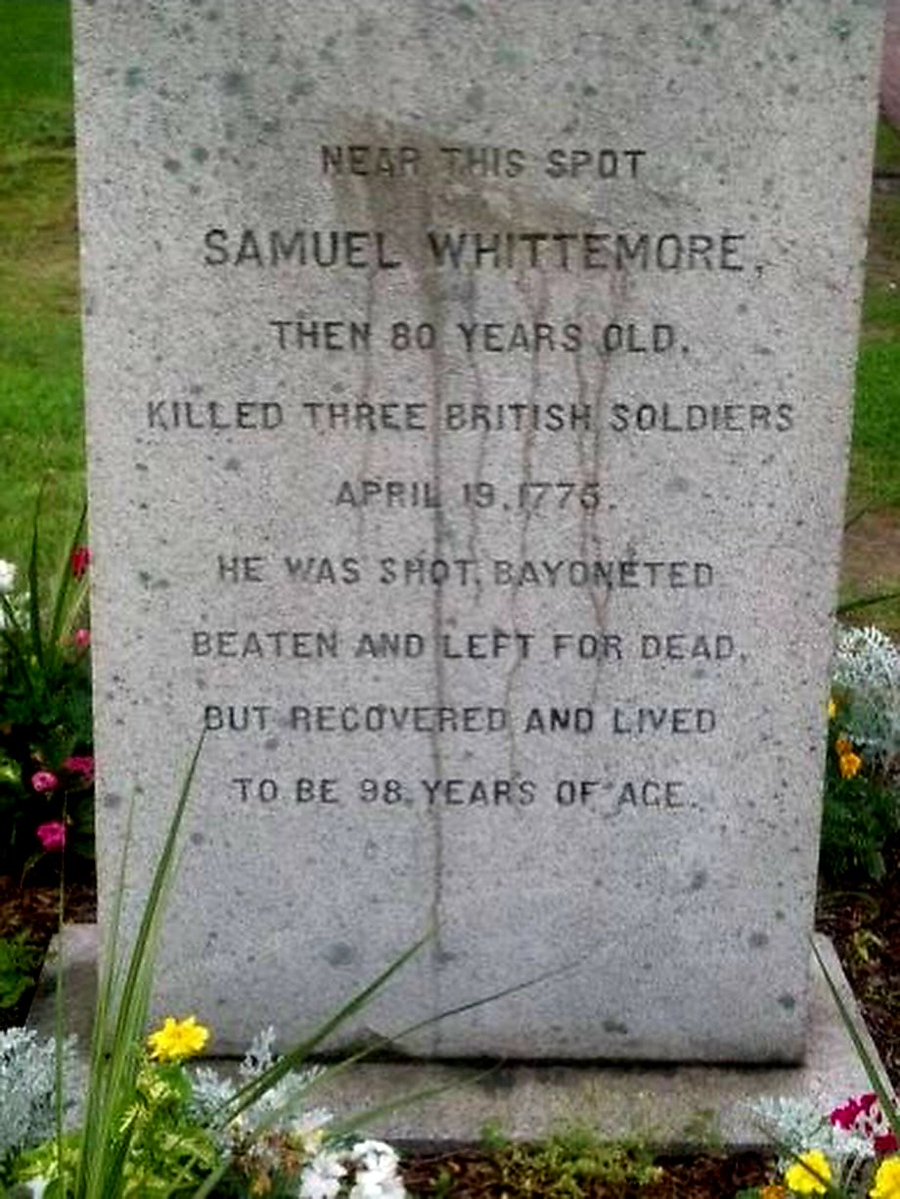
The legendary story of Samuel Whittemore.
In 1775, while working in his fields, Whittemore, a former officer from the French and Indian War, noticed a British relief force advancing to support retreating troops.
He quickly loaded his musket and took cover behind a stone wall, where he ambushed a group of grenadiers from the 47th Regiment, killing one soldier. He then drew his dueling pistols, and fired twice more, killing a second grenadier and mortally wounding a third.
As he fired his third shot, a British detachment closed in on his position. Whittemore drew his sword and charged them. He was shot in the face, bayoneted repeatedly, and left for dead in a pool of his own blood.
Colonial forces later discovered him still trying to reload his musket to continue fighting. He was carried to Dr. Cotton Tufts in Medford, who believed his injuries were fatal.
Against all odds, Whittemore survived and lived another 18 years, eventually passing away of natural causes at the age of 98.

English
Phil Duncan retweetledi

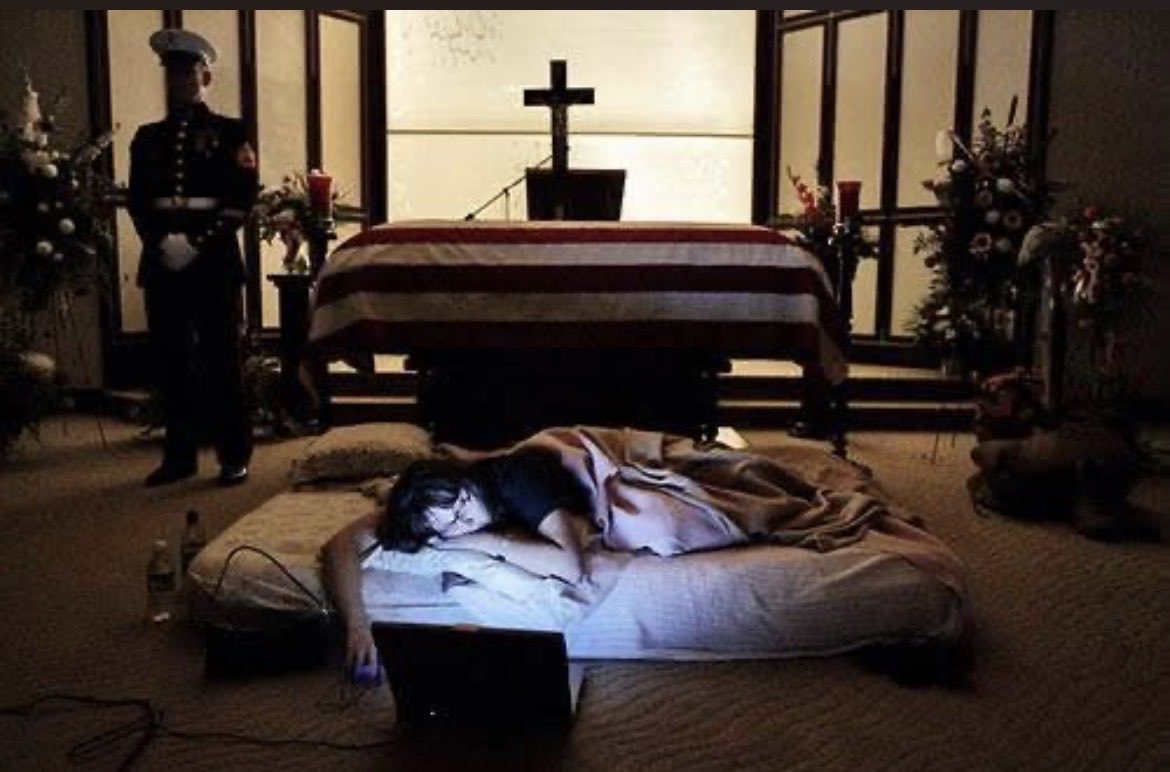
The image depicts Katherine Cathey, the pregnant widow of U.S. Marine 2nd Lt. James “Jim” Cathey, lying on an air mattress on the floor in front of her husband’s flag-draped casket the night before his burial. A Marine honor guard stands vigil in the background.
Jim Cathey was tragically killed in action in Iraq in August 2005. Overcome with grief, Katherine refused to leave her husband’s casket. She requested to spend one final night with him. Two Marines went to great lengths to provide her with a makeshift bed, using a mattress and pillows on the floor. One Marine stood guard over her and the casket throughout the night.
This powerful and Pulitzer Prize-winning photograph was captured by Todd Heisler in 2005 as part of his series “Jim Comes Home” for the Rocky Mountain News.

English
Phil Duncan retweetledi

In 1939, as over 425,000 Soviet troops invaded Finland, a 5'3" farmer with no scope and perfect aim took position in the snow. His name was Simo Häyhä, and he wasn't just a soldier.
Before the war, he was a competitive sharpshooter, known for hitting targets others missed
He wore white camouflage, packed snow in his mouth to hide his breath, and used iron sights to stay invisible. Then he got to work. In less than 100 days, he recorded over 500 confirmed kills-the most in sniper history. The Soviets called him
"The White Death." They shelled the forests. Sent snipers. Launched entire offensives. None of it stopped him. Until one day, an explosive bullet hit him in the face. By a miracle, Simo survived the war. But never spoke of what he'd done.
English
Phil Duncan retweetledi

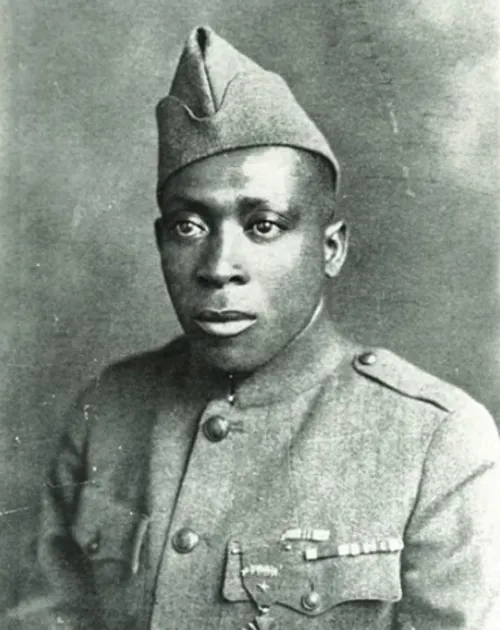
WW1 Medal of Honor recipient who is well worth remembering today.
U.S. Army Sergeant Henry Johnson, aka "Black Death" of the 369th Infantry Regiment, known as the Harlem Hellfighters.
His actions stopped the German raid, prevented the enemy from breaking through the lines, and saved his comrade.
The French awarded him the Croix de Guerre avec Palme (their highest valor award) almost immediately — one of the first Americans to receive it.
This single fight earned him the enduring nickname “Black Death.”
While on sentry duty with Private Needham Roberts, Johnson and Roberts came under surprise attack by a German raiding party of at least 12–24 soldiers.
Despite being badly outnumbered and wounded multiple times:
Johnson fought back with his rifle, then used it as a club when it jammed.
He threw grenades.
In brutal hand-to-hand combat, he used a bolo knife (machete-like weapon) to kill several Germans.
He rescued the wounded Roberts from being captured.
He continued fighting even after being shot and stabbed 21 times.

English
Phil Duncan retweetledi

🇺🇸 Take a minute to reflect on the hallowed grounds of the Normandy American Cemetery in France on this Memorial Day. Perched on a bluff overlooking Omaha Beach — the very site where our heroes launched the greatest assault for liberty in human history — lie the final resting places of 9,389 American warriors who gave their last full measure of devotion during D-Day in World War II.
These are not just graves. They are monuments to American courage, sacrifice, and the fierce belief that freedom is worth dying for. Among them:
• 307 Unknown Soldiers — forever honored, never forgotten.
• 1,557 names inscribed on the Walls of the Missing — their spirits still watching over the cause they served.
• 45 pairs of brothers who fought and fell together.
• Three Medal of Honor recipients and four heroic American women buried side by side with their brothers-in-arms.
This sacred cemetery was established on June 8, 1944, just days after the invasion. This was the first American WWII cemetery on European soil. A permanent reminder that when evil threatened the world, America answered the call.
To every American who stormed those beaches, climbed those cliffs, and never came home: Your blood bought our tomorrow. Because of you, the light of liberty still shines bright across the globe.
We will never forget. We will never falter.
God Bless our Fallen Heroes. God Bless the United States of America. ❤️🤍💙
English
Phil Duncan retweetledi

If you see wild turkeys in your neighborhood, you're seeing one of the biggest conservation wins in American history.
They were down to just 30,000 birds in the 1930s. There are now over 6 million across the US.
They're excellent natural pest control, eating beetles, snails, mice, and even ticks.
A wild turkey in your yard isn't a pest, but a native species that almost disappeared and came back because hunters, biologists, and state wildlife agencies spent 50 years bringing it back.

English
Phil Duncan retweetledi

RIP Clarence B. Jones, civil rights legend. His personal reflections as MLK’s lawyer & speechwriter are subject of new documentary coming to DC/DOX in June: THE BADDEST SPEECHWRITER OF ALL. Won Grand Jury Prize at Sundance & is coming to Netflix. We need to celebrate our heroes.
Ritchie Torres@RitchieTorres
I am heartbroken over the passing of a civil rights hero: Clarence B. Jones, who served as counsel and close confidant to Dr. Martin Luther King Jr., a co-organizer of the March on Washington, and a co-writer of the immortal “I Have a Dream” speech. Clarence Jones is one of the greatest heroes I will ever meet. To have known a moral giant on whose shoulders so many of us stand is a gift from God that I will cherish for the rest of my life. Dr. Jones not only practiced law. He transformed it. And we are all better for it. May his memory be a blessing.
English
Phil Duncan retweetledi

Bombay, 1885. In a courtroom, a 22-year-old woman listened as a man claimed he had a legal right to her. His name was Dadaji Bhikaji. According to the law, he was her husband. To her, however, he was nothing of the sort.
Rukhmabai had been married at the age of eleven. The union had been arranged by her family, as was common for many girls in India at the time. After the wedding ceremony, she returned to live with her mother, expected to join her husband once she reached adulthood.
But her life took a different path.
After her stepfather's death, her mother married Dr. Sakharam Arjun, a progressive physician who believed in women's education. For the first time, Rukhmabai was given access to learning. She studied English, mathematics, and science, gaining an education that was exceptionally rare for a woman of her era.
By the time she reached adulthood, she had made up her mind: she would not live with a man she had never chosen.
Dadaji Bhikaji refused to accept her decision. In 1884, he filed a lawsuit seeking the restoration of his “conjugal rights,” asking the court to compel Rukhmabai to move in with him and fulfill the role of a wife.
Her response was unequivocal. She did not recognize the marriage as valid. She had been a child, incapable of giving meaningful consent, and she regarded the man as a stranger.
Her words caused outrage.
In colonial India, child marriage was deeply entrenched in society and supported by long-standing traditions. Challenging the practice meant confronting social norms, religious authorities, and established customs.
The case quickly became a national sensation. Newspapers across India and Britain reported on every development. Public opinion was sharply divided. Conservatives accused her of attacking tradition, while reformers saw her struggle as a fight for justice and personal freedom.
Rukhmabai refused to remain silent.
Writing under the pseudonym “A Hindoo Lady,” she published articles and letters in newspapers, condemning child marriage and criticizing a society that denied education to girls. She described the devastating impact that forced marriages had on the lives of young girls.
One of her most famous letters, published in The Times of India in 1885, recounted how child marriage had affected her own life. The letter was reprinted widely and sparked debate far beyond India's borders.
Yet public attention could not shield her from the law.
In March 1887, the court delivered a harsh ruling. The judge ordered that Rukhmabai must either live with her husband or face six months in prison for contempt of court.
Her answer came immediately.
She would rather go to prison.
The declaration shocked the public. A young woman willingly choosing imprisonment over submission to an unwanted marriage was almost unimaginable at the time.
Reactions were swift and intense. Some newspapers attacked her relentlessly, while others rallied to her defense. The controversy reached the highest levels of the British colonial administration.
Eventually, an out-of-court settlement was reached. Dadaji Bhikaji agreed to withdraw the case in exchange for financial compensation. Rukhmabai won the freedom she had fought so fiercely to protect.
But her story did not end there.
Her case had exposed a troubling reality: in India, the legal age of consent was only ten years old. Public pressure and reform campaigns helped bring about legislative change. In 1891, the age of consent was raised to twelve. Although still far too low by modern standards, it marked an important first step toward reform.
Then came a new challenge.
Determined to become a doctor, Rukhmabai pursued medical studies. After facing obstacles in India, she was admitted to the London School of Medicine for Women. With support from reformers and charitable organizations, she traveled to England to continue her education.
She studied there for six years.
In 1895, she returned to India as a qualified physician, becoming one of the country's first female doctors.
The girl who had been forced into marriage at eleven had become a respected medical professional.
For decades, she dedicated her life to treating women and children, improving women's healthcare, and advocating for girls' education. She never married again. When asked why, she reportedly replied with characteristic wit that she had already had enough experience of marriage to last a lifetime.
Rukhmabai died in 1955 at the age of ninety-one, having witnessed profound changes in both India and the status of women.
For many years, her name remained largely forgotten. Today, she is remembered as a pioneering figure whose courage helped pave the way for reforms in women's and children's rights.
It all began in a courtroom, when a judge presented her with two choices: obey or go to prison.
She chose freedom.

English
Phil Duncan retweetledi