
Philipp Pahl

66 posts

Philipp Pahl banner
Philipp Pahl

Philipp Pahl

@PhilippPahl

Katılım Eylül 2012
356 Takip Edilen52 Takipçiler
Philipp Pahl retweetledi

NVIDIA
NVIDIA@nvidia·
Two frontier labs. One accelerated computing platform. Congrats to @SpaceX and @AnthropicAI on the new compute partnership, powered by 220,000+ NVIDIA GPUs inside Colossus 1. The future of AI runs on NVIDIA.
Claude@claudeai

We’ve agreed to a partnership with @SpaceX that will substantially increase our compute capacity. This, along with our other recent compute deals, means that we’ve been able to increase our usage limits for Claude Code and the Claude API.

English
379
1.1K
12.9K
34.9M
Mike Knoop
Mike Knoop@mikeknoop·
ARC just published new #1 and #2 reproducible SOTA scores on our public leaderboard from @jeremyberman and @_eric_pang_. And their code is now open source! My analysis below -- includes suggestions for application layer AI and future research directions. New SOTA: - v1: 79.6%, $8.42/task - v2: 29.44%, $30.40/task Jeremy and Eric’s approaches share a lot in common: 1. Both use Grok 4 as a base, chosen as the best off-the-shelf AI reasoning system 2. Both implement program synthesis systems on top of the LLM 3. Both use outer refinement loops and test-time adaptation 4. Both use abstraction library learning 5. Both meaningfully improve accuracy over previous reproducible SOTA 6. Both are relatively efficient (5-20X single-shot cost), practical for deployment 7. Both are reproducible and open source, others can build on them Their approaches vary in details. Jeremy upgrades his previous-SOTA [2024] which had an LLM writing python code, for one that writes solutions in English (“natural language programs”). He notes ARC v2 depends on more complex perception and his English-based solution benefits by using a less-precise substrate for reasoning than code. He also moved beyond brute-force full program search. Now, English instructions are scored on partial tasks (eg. explain single examples), and high scoring explanations are pooled together. Eric’s approach combines ideas from evolutionary program synthesis and DreamCoder [2020]. But his approach diverges from DreamCoder in several meaningful ways. First, instead of a symbolic AST substrate used in DreamCoder, his LLM writes and stores full code programs in text in a library, using an accuracy-based heuristic. Second, instead of hand-crafted an initial library, his program library starts empty. This is promising as it removes a key bottleneck to applying DreamCoder to new domains. Based on the last 12 months of public progress on ARC, we are building a good picture of the “right core ideas” for AGI. This is very exciting! For ARC Prize 2025, I’d love to see a team swap Grok 4 with OSS LLMs and work to fit performance into the Kaggle constraints (targeting human efficiency). For application areas where accuracy matters most (and latency and some cost can be traded), Jeremy and Eric’s open source outer loops should be considered. And for further research, I encourage folks to take Jeremy and Eric’s ideas as inspiration and combine them with @lateinteraction DSPy and @LakshyAAAgrawal GEPA.
English
13
31
268
55.9K
Philipp Pahl
Philipp Pahl@PhilippPahl·
@fchollet I can totally relate to that. IMO, the two main findings of any grad student are: 1) You can solve any problem; it’s just a matter of time and having the endurance to follow through. 2) At some point, you have to have the balls to tell your advisor your thesis is good enough!
English
0
0
2
168
François Chollet
François Chollet@fchollet·
To solve any problem, you don't have to be super smart. You just have to 1) be able to break down problems into subproblems, 2) be slightly smarter than the hardest of the atomic subproblems. The real challenge is that the process can take a very long time.
English
187
512
5.5K
438.5K
Philipp Pahl retweetledi
Trent McConaghy
Trent McConaghy@trentmc0·
I'm proud to be an investor and founding board member of Bitizenship — the Bitcoin Eco Golden Visa fund in Portugal. Details... I've had a longterm interest in sovereign individual // personal freedom <> group coordination // nation states. 15 years in Bitcoin & blockchain, incentive design, advising Estonia on E-Residency, OceanDAO & MCV DAOs, and Edge City Lanna & Zugrama popup cities. So I couldn't help but get involved with Ale (@thealepalombo) & his team on Bitizenship. In the past year, Ale & team opened a completely new market: combining EU citizenship pathways with BTC exposure. It's grown superfast adding LPs, including (discreet) OGs. As an entrepreneur, I love to see this: a clear value proposition, solid business case, all without even taking VC money. Go Ale! It's a path to Portuguese citizenship. (In fact that's the only EU pathway left, now that Malta closed its gates.) FYI there's a few spots left for LPs. If you're interested, DM @thealepalombo to line up a call.
Alessandro Palombo@thealepalombo

People talk about the “sovereign individual” theory. We built it. In less than 12 months: • Bitcoin Eco Golden Visa Fund • Bitcoin exposure + EU res. & citizenship • Fully regulated, nearing full subscription • Real capital deployed. Real residency applications filed. Big thanks to my friend @trentmc0 for betting early and helping scale this vision from day one. To all the LPs who joined: thank you for your trust. We’ll be working relentlessly, day after day, to serve you at the highest level. Bitizenship isn’t a product. It’s the start of a global freedom infrastructure. And… we’re only getting started.

English
1
5
33
5.4K
Philipp Pahl
Philipp Pahl@PhilippPahl·
What I have in mind are React components that represent something like Jupyter cells (but independent of the Jupyter UI). They communicate with a remote Jupyter server or a local "WASM server". They sync with local state. I see many applications; one is the ability to let AIs create React apps with integrated Python.
English
1
0
0
18
Skylar Payne
Skylar Payne@skylar_b_payne·
@PhilippPahl @martian_mishra Yeah the ipywidgets are good enough for me on breaking the static feeling of notebooks for me. Could you say a bit more about what the prototype would do? I am not sure I follow
English
1
0
0
20
Skylar Payne
Skylar Payne@skylar_b_payne·
My first pass at "look at your data" used to be "export to spreadsheet"... But AI coding is getting so good that building a custom labeling UI that works from the comfort of my Jupyter notebook is too accessible now. Anyone else finding similar?
English
2
0
5
199
Philipp Pahl
Philipp Pahl@PhilippPahl·
AI tools certainly help here. In that context, I'd really love to have better Python integration in the browser/React, given that AIs generate interactive UIs (like Claude). I feel that notebooks are great but too static. The next time I have a free weekend, I'll create a prototype. Any thoughts on that?
English
1
0
0
23
gAInz
gAInz@gainzdotxyz·
mia and me, after I actually follow her advice
gAInz tweet media
English
8
1
16
2.3K
Skylar Payne
Skylar Payne@skylar_b_payne·
@martian_mishra I usually use Jupyter widgets because I want it to work right in my notebook. This lets me easily interleave defining/running/labeling experiment results all from the same window -- no ctx switching.
English
1
0
0
28
Yann LeCun
Yann LeCun@ylecun·
Incredibly honored to receive the Queen Elizabeth Prize for Engineering. ⬇️⬇️⬇️
English
166
78
1.9K
124.6K
Philipp Pahl
Philipp Pahl@PhilippPahl·
Folks, I don't want to see any more rotating geometrical objects with bouncing dots in them. I'm wondering how many of the people who post this stuff can actually write these programs themselves and therefore evaluate what the 'cognitive achievement' of the AI actually is (or is not).
English
0
0
0
55
Philipp Pahl retweetledi
Yoshua Bengio
Yoshua Bengio@Yoshua_Bengio·
Today, we are publishing the first-ever International AI Safety Report, backed by 30 countries and the OECD, UN, and EU. It summarises the state of the science on AI capabilities and risks, and how to mitigate those risks. 🧵 Link to full Report: assets.publishing.service.gov.uk/media/679a0c48… 1/16
English
51
515
1.4K
401.8K
Philipp Pahl
Philipp Pahl@PhilippPahl·
@joaomdmoura This proves that resumes are somewhat useless, as are job postings with extensive requirement lists.
English
0
0
1
89
João Moura
João Moura@joaomdmoura·
The ultimate resume optimization with AI Agents. In this demo watch AI agents: • Analyze your resume against job requirements • Suggest improvements • Research company details Here is how Tony from our team built it:
English
3
1
42
3.6K
Philipp Pahl
Philipp Pahl@PhilippPahl·
@fchollet 4. Try to regulate AI to make it hard to implement. You are now a legacy company in a legacy economy.
English
0
0
0
26
François Chollet
François Chollet@fchollet·
Let's spell this out. Time for some game theory. If you assume that: 1. In the future, AI will be central to all economic activity (this is pretty obvious if you can read charts) 2. Lots of companies, big and small, are currently racing to develop key tech and infra to make it happen Then in fist approximation, there are 3 possible futures ahead if you're a tech giant: 1. Invest in AI, and it pays off -- you now own a slice of the future. 2. Invest in AI, but others out-execute or simply outspend you. You are now a legacy company. 3. Don't invest in AI. You are now a legacy company. The only logical move is to invest in AI. In fact, you should invest pretty much everything you can spare, in order to maximize your chances of outcome (1). This is true regardless of whether your current investments appear to be paying off (right now they aren't).
François Chollet@fchollet

You might ask, ok, but will it pay off for them? That's the wrong question. The right question is, what's the alternative -- letting a completely new crop of companies own the future, as happened with the Internet wave? Of course big tech is going to put up a fight.

English
104
103
950
146.4K
Philipp Pahl
Philipp Pahl@PhilippPahl·
Well said. It's simply hilarious to watch the current ignorance-based hysteria. I have a question though: When we did NLP in 2012, we used something like LDA for topic modeling, and it was essentially just 'word counting'. Then someone came along and invented word2vec, which allowed for simple communication between meaningful representations of words. And then someone came along and proposed the attention mechanism, scaled it up, and boom, there we are. So IMO, the current success of AI is based on a few very good ideas. How could someone in the past possibly predict the success of AI without knowing how to do it and without knowing if someone would invent it? In the future, can we just rely on the idea that it will keep going? What's your take on this?
English
0
0
0
25
François Chollet
François Chollet@fchollet·
For about as long as I've been in AI, it has always been overhyped in some way -- shrouded in a cloud of bullshit. No matter the year, many commentators have assumed that it had incredible capabilities that it clearly didn't, and that it would soon pose risks that were clearly not real. The trap is to think that, just because dim-witted people hype it up, AI isn't real. It's extremely real, and it will be a much bigger thing in 5 years than it is today, and then an even bigger thing in 10 years. It was already real and well on its way in, say, 2016 -- back when everyone assumed that no one would be driving their own car by the year 2020, back when some VCs were claiming that LSTM text generators were already good enough to replace journalists, back when doomers were already panicking about Bostromian fantasies. The claims may be BS, but the tech is real, it's moving fast, and it drives an increasing fraction of the global GDP every year. That overarching trend is showing no sign of slowing down.
English
94
199
1.7K
148.6K
Philipp Pahl
Philipp Pahl@PhilippPahl·
@system76 RedHat in 1996. From a book that came with a CD. I was so proud when the X server first started.
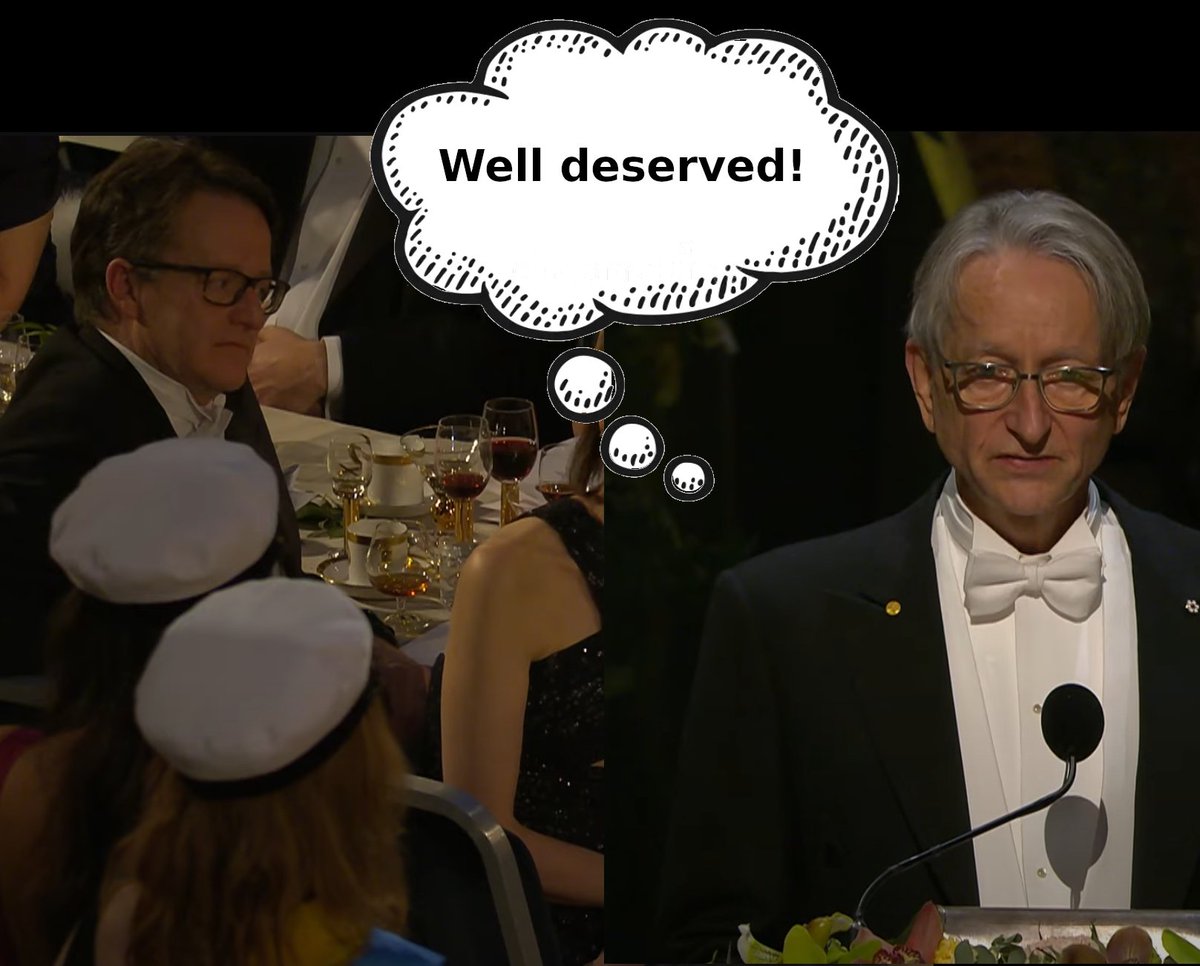
Philipp Pahl tweet media
English
1
0
1
30
System76
System76@system76·
What was the first Linux distro you installed and what year was it?
English
1.5K
32
926
146K
Philipp Pahl
Philipp Pahl@PhilippPahl·
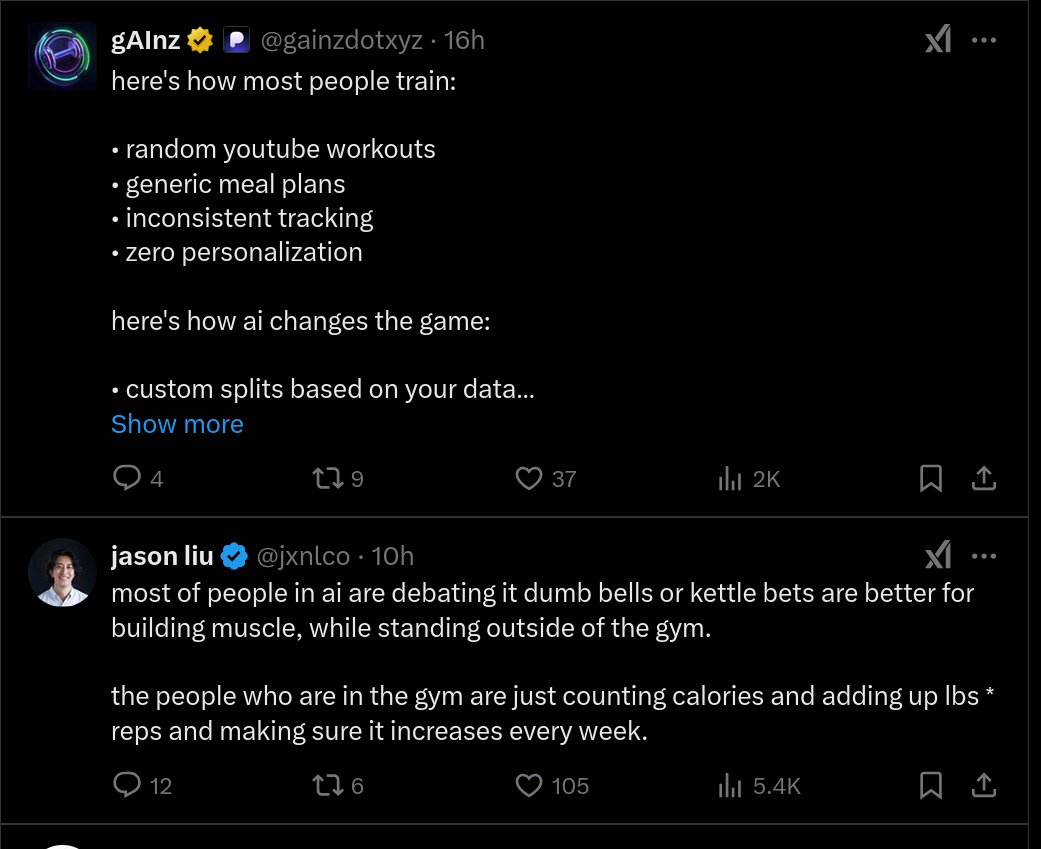
@jxnlco In my timeline today... So AI will be coaching me so I don't have to debate over dumb bells or kettle bells and can spend more time in the gym to improve the AI? Awesome!
Philipp Pahl tweet media
English
0
0
0
16
jason
jason@jxnlco·
most of people in ai are debating it dumb bells or kettle bets are better for building muscle, while standing outside of the gym. the people who are in the gym are just counting calories and adding up lbs * reps and making sure it increases every week.
English
13
5
123
7.6K