The first transaction snapshot is complete.
Eligible wallets received 5 ORIGIN Points for every testnet transaction included in the snapshot.
Block by block. Real activity gets recognized.
More snapshots will be taken at random points during the campaign to keep ORIGIN fair.
GM traders. New day, new pop.
Join to become a Popper: discord.com/invite/popdex
Early Discord members can now claim the PopDEX OG Role before 12 PM UTC, May 27.
The best asymmetric opportunities hide in plain sight on Base right now. Everyone chases the headline token, but the edge is showing up before the crowd
I just grabbed the Early Contributor role on @DustswapOnBase after a week of swaps and quests. It took 10 minutes: join the Discord, follow on X, post and tag them, drop your link in the #claim𝘦𝘢𝘳𝘭𝘺user channel. Manual review, 5,000 cap, reopened for a limited window
Dustswap is a gamified DEX on Base. Fast swaps, low fees, Particle Points for swaps, streaks, and quests. Campaign window runs May 16 30. Some wallets even have a PP claim that ends today May 25 in my timezone. Early users usually get the best shot
Playbook if you are already active onchain: do a swap, keep a streak, stack PP, invite a friend for 20 percent of their PP rewards, and stick to official links. You do not need permission. You need consistency
In bull markets everyone is a genius. Right now is where the edge is earned. I am leaning into Base and Dustswap because repetition compounds
Monday GM
Unicorns ship tokens
Trunicorns settle cashflows onchain
RWA is having its product market fit moment, but it needs rails that banks can respect and devs actually want to touch. Less noise, more financial architecture. That is the bet
@SimpleChain_RWA feels like the institutional OS for RWA: Native CaaS, Granular Data, DataIPO. Fast deployment, secure infra, dev friendly tools, built to scale. $15M seed, team from Ant Group and NetEase. Testnet is live
My routine today: claim faucet, send a chain greet, deploy a toy contract, move an asset stub, watch finality in seconds. Five minutes, full onchain footprint. It just works
Culture matters too. They ran a poker tournament yesterday and the rails held up. If they can make games feel smooth, they can make treasuries and invoices feel boring in the best way
If you want real adoption not hype, pay attention now, not later. The internet wants real world assets to move at internet speed. Whoever builds the boring stuff wins, and this looks like a real contender
most agents look smart until reality checks them
personality is a bubble but memory is a loop
EVOEVO IS NOW LIVE to stop agents from just talking and start absorbing outcomes
prompts are cheap but a verified reasoning history is the only thing that scales
would you trust a logic chain that has never been wrong
GM
I spent the week stress testing peer to peer rails and came away convinced the next wave of exchange UX is going local first, global second. The aha moment hit using @MovitOn_P2P to route a small stack from $USDC to $ETH without touching a custodial account. No tickets, no waiting room, just counterparties, clear terms, and fast settlement
Hands on:
• wallet to wallet escrow that releases on confirmation, felt cleaner than a custodial hold
• flexible quotes in native units, not buried in fee schedules
• reputation and completion stats front and center, which actually changed how I priced a trade
• settlement in minutes when counterparties had funds ready, hours when they didn’t
Where it beats CEX today:
• tighter local spreads on $USDC pairs during off hours
• more payment rails in more places, especially bank rails that CEXs dropped
• faster dispute path when both sides are responsive
Open questions:
• how reputation weights over time vs fresh accounts
• path to scale while keeping fraud low
• cross market liquidity for $ETH and $BTC without adding bloat
If you’re trying to exit fiat friction or build community liquidity, peer to peer feels live again. Who else has pushed volume through @MovitOn_P2P and what did you learn
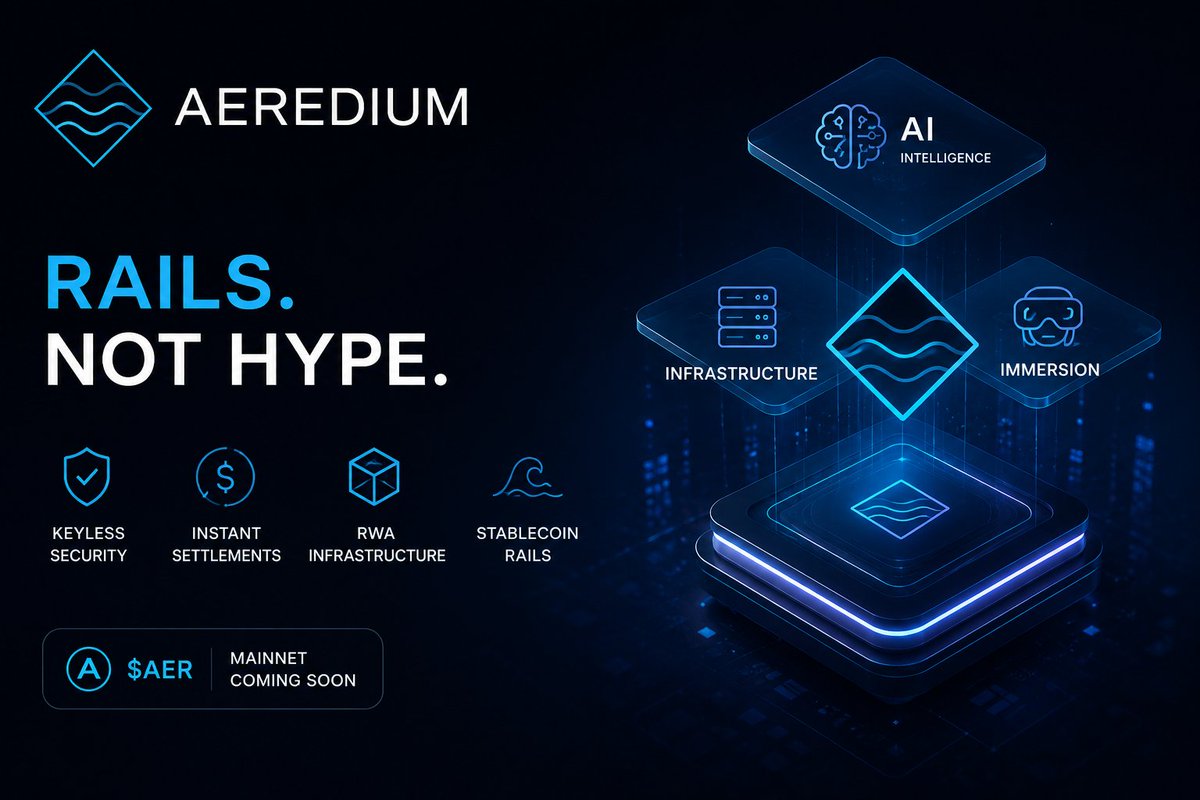
The most important thing builders and investors need to remember in 2026 is that hype does not settle assets, rails do. People still underestimate how fast stablecoin settlement and RWAs are eating traditional rails. That is why @aeredium stands out. They are aiming at institutional grade infrastructure rather than the quick trade, and they are thinking in systems. Most AI ecosystems are fragmented across intelligence, infrastructure, and immersion. This stack is trying to connect them instead of leaving users to stitch it all together
I tried the StablePro Wallet this weekend. It felt like a clean Web2 app while I kept full Web3 sovereignty. Secure enclave sign, aggregate DEX liquidity that actually found best execution, and native $AER reward tracking so I could see every unit earned. No seed phrase panic, no rented keys
Under the hood they are pushing keyless security, machine enforced trust, quantum resistant infrastructure, and instant settlements. That is what you want if you care about scale, auditability, and real counterparty risk reduction
Community note: the loyalty program is live and the mainnet token launch looks about a month out. If you want exposure to stablecoins RWA and better web3 UX, start paying attention now @aeredium $AER
Sometimes it feels insane that people will hand a bot their private keys, yet ignore a tool that keeps the keys off limits and still gives you autonomy. Your wallet is not a casino chip. It is the balance sheet that funds your future and your kids. Use tools that increase discipline, reduce errors, and compound advantages
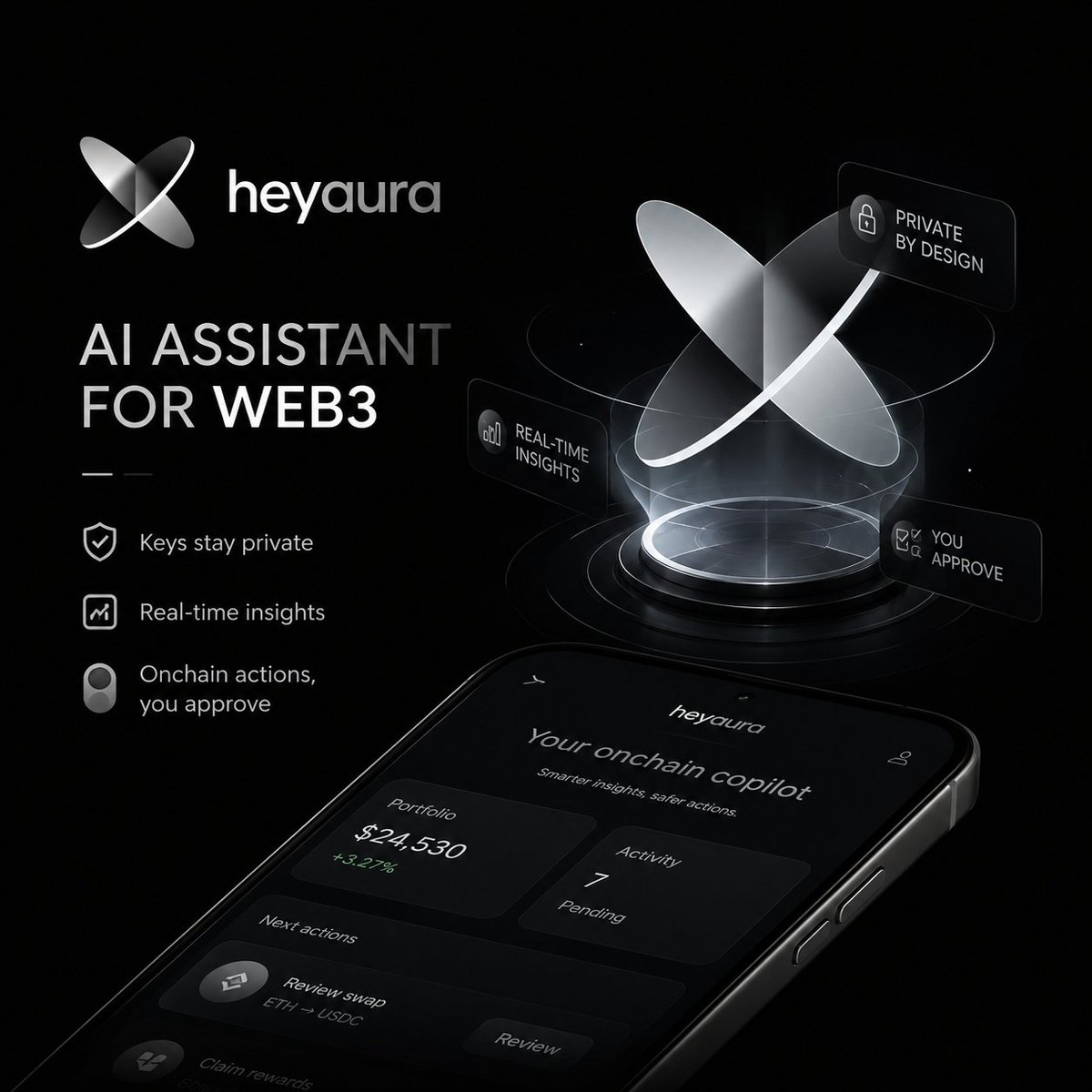
I have been testing @heyaura. It lives in your wallet without needing your private keys, keeps sensitive data local, surfaces realtime insights, and proposes onchain actions with human oversight. You approve, you set the pace, you stay in control while the assistant does the heavy lifting in the background
This is the right direction for crypto user experience. Autonomy with accountability. Speed without blind trust. A digital layer that respects transparency and user control instead of chasing trends
Early users who adopt real utility usually capture the upside. The crowd will come later when it is obvious. Are you already using heyaura to run onchain tasks, and what would you trust it to automate this cycle
Trust in Web3 often collapses where randomness and verification intersect. Most systems still depend on pseudorandom functions, heuristic filters, and platform discretion. That creates predictable surfaces for extraction, weakens game fairness, and forces users to trust intermediaries during the moments that matter most
@quipnetwork reframes the base layer. Quantum Echoes brings verifiable entropy from physical quantum hardware into minting, drops, and onchain events. Nucleus converts social presence and onchain behavior into measurable reputation through eigen keys, reducing grinder noise while keeping distribution transparent. The effect is subtle but structural: less manipulability during generation, stronger signals during coordination, and fewer places where value leaks
There are trade offs. Tighter verification can slow superficial growth and complicate certain coordination patterns. But the strategic upside is clear. As Q day risk rises, networks that standardize trusted generation and validation will compound. My approach is to accumulate reputation primitives and verifiable randomness assets first, then consider $QUIP exposure as the trust layer integrates across apps
Durable attention, creator equity, and agent markets require credible randomness and measurable presence. That is the quiet leverage QuipNetwork is aiming to supply
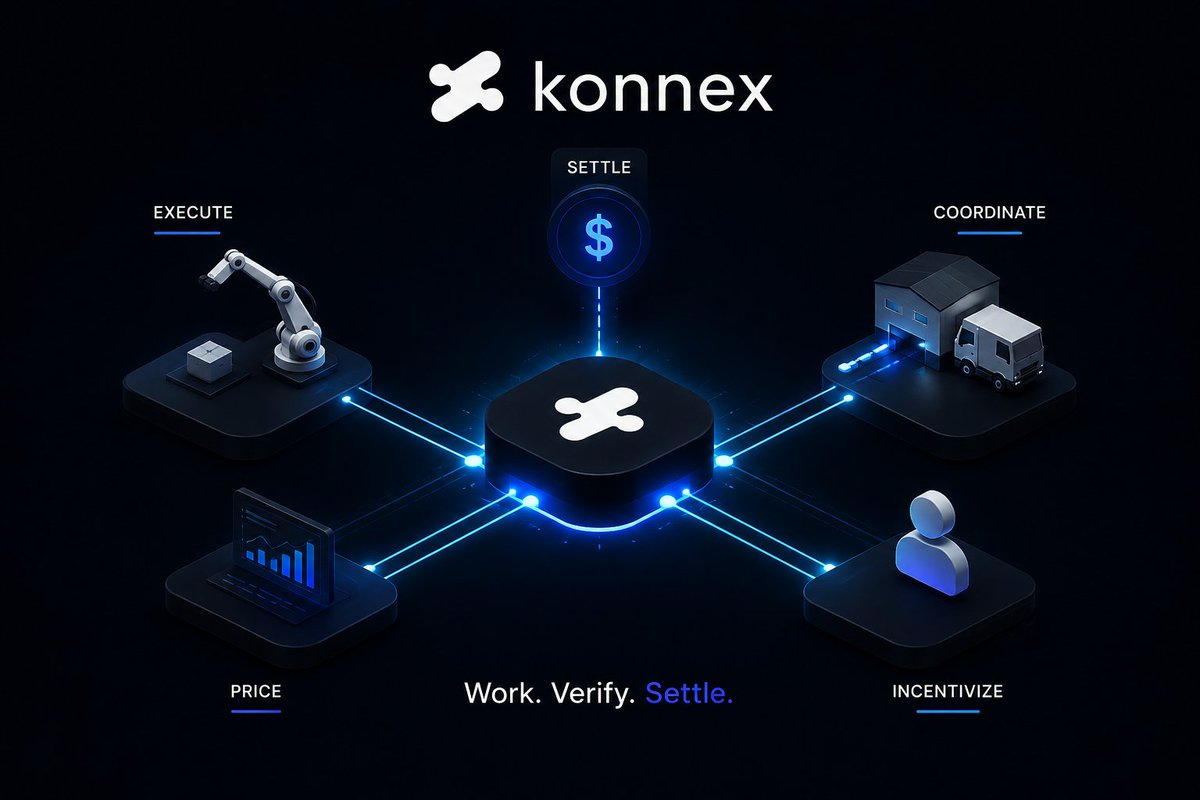
WEEKLY WATCH: Physical AI is getting a market. The choke point in labor is 30 to 90 day pay. @konnex_world flips it with onchain PoPW and instant stablecoin settlement. Robots bid on jobs, license VLA motion models on demand, execute, and get paid
Why it matters: robot labor becomes liquidity. Ingest turns AI miners into a feedback loop. If this scales, a slice of a $25T engine routes through crypto rails
Your edge dies the moment your transaction hits a public mempool. MEV bots farm your intent before you finish the click. That is insane in 2026
I switched to encrypted intents with @FlutonIO. Confidential execution for Ethereum, Solana, and more. FHE means the plan stays locked while the compute runs. Only the final state leaks. No exposed balances. Private by default. Choose semi confidential if you just want to hide size, or fully confidential to hide size, tokens, and network
If you manage capital for yourself or for others, your duty is to stop bleeding alpha in public. Serious dapps need privacy first intent based execution out of the box. Fluton ships a universal confidentiality engine and a routing plane built to keep flow fast and stable. The bot suite is live, the engine is online, testnet is running
Sometimes I feel like I am taking crazy pills. The data is obvious. Public broadcasts invite theft. Encrypted intents kill MEV and front running. Rich desks are already moving. Why are you still broadcasting
There is a quiet shift happening. while everyone argues about mandates and tokenomics, users just want to move value fast, privately, without a custodian. peer to peer is getting usable
the problem is clear: custodial choke points, KYC drag, off ramps that vanish when you need them. the path forward is simpler than the narratives make it seem: let people match directly, keep spreads tight, settle onchain, and make the UX boring in the best way
i spent the week looking at p2p flows again and it reminded me that local liquidity is built person by person, not via announcements. the questions that matter are basic: how fast to match, how predictable the price, how safe the handoff, what happens if something goes wrong
teams like @MovitOn_P2P are interesting here because they are focused on the rails, not the spectacle. can they compress time to fill, surface the best route across $USDT and $ETH rails, and keep fees sane while scaling reputation and dispute tooling. if yes, that is real volume, not vanity. number go up follows utility, not the other way around
we needed new rails we got p2p markets
Liquidity fragmentation is not just a UX issue. It is an economic tax embedded in how DeFi coordinates. When intent broadcasts before settlement, searchers model your path, LPs face adverse selection, and strategies decay as patterns become predictable. The result is value leaking from productive actors to prediction infrastructure
The upgrade is not more speed. It is infrastructure that verifies without overexposing, settles across environments, and connects idle liquidity with real demand. You do not need global visibility for markets to clear. You need reliable outcomes with less extractive surface area
Spent this evening testing the secure enclave wallet and atomic cross chain balancing inside @aeredium. Rebalanced across chains while execution stayed protected mid flow, settlement verified, and routing found depth I would not have stitched manually. Earned AER Points for doing useful flows, not empty clicks
This is the direction that matters for DeFi and RWA. Not just processing liquidity, but understanding where it should move, when to deploy it, and how to sustain it across ecosystems. The networks that connect movement, capital, and execution into one verified loop will win. Keep your eyes on Aeredium and @aeredium
Most assistants still feel like a new tab you have to babysit. The frontier is ambient help that respects attention, moves fast, and compounds context
Spent the evening playing with @heyaura. It slotted into my flow without nagging for ceremony, answered in realtime, and remembered enough that a second ask felt smarter than the first. Not glaringly fancy. Just crisp. That’s the tell
What stood out
• Speed that reads as confidence
• Defaults that get you to done, with a nudge for optional depth instead of a wall of fluff
• Receipts when it acts, so you know what it pulled from and why
• Refusals that feel like collaboration, not a lecture
• Little touches that make it feel like a teammate rather than a chatbot
The bet I see: UX beats model size, context is the moat, and distribution comes from being the invisible layer in the tools people already use. Win trust, then earn the right to stretch into teams, shared memory, and lightweight automations
Open questions: how it handles messy edge cases over time, how it scales org wide permissions, how it prices for usage without punishing the people who actually work through it
If assistants are the new browser, the best ones will feel less like apps and more like gravity. Early days, but Aura has pull
Crypto loves to talk decentralization while trusting mystery metal in someone else’s rack. The threat isn’t just in code. It sits in chips and boxes, and the quantum clock keeps ticking faster. If the global quantum computer is being assembled in realtime, the rational move is to push trust to the hardware layer
That is why @quipnetwork caught my eye. Strict cryptographic checks for every operator. Verified machines capable of post quantum workloads. A protective security layer that can wrap wallets and contracts on $ETH, $SOL, $BTC. And an open protocol that lets anyone lease or tap quantum resistant compute without asking a lab for permission
I spun a quip node on testnet and took notes like a maniac. Setup quirks, driver changes, perf deltas under load, where attestations fail, where they pass. Boring work. Also the point. Rigor at the metal is where decentralization either holds or breaks
Will teams integrate before the headline breach or after. Security rarely pumps price in the short run. It wins in the long run. If hardware is the new trust boundary, treating it like software theater is the mistake to avoid
The bottleneck in automation is not mechanical capability. It is economic coordination. Factories, warehouses, and service networks still run on schedules, invoices, and batch reconciliation. Machines complete tasks continuously, but value moves in slow cycles. When work is granular and nonstop, settlement needs to be granular and nonstop too
Konnex reframes machine work as programmable economic flow. Physical actions become verifiable units that can be priced, assigned, and settled in realtime. Capacity can be quoted, tasks can be dispatched, incentives can adapt as conditions change, and outcomes can settle the moment they are confirmed. Instead of fitting robots into human finance, finance molds around autonomous activity
The implications are large. Idle capacity turns into liquidity. Procurement evolves into dynamic markets. Operators coordinate through incentives rather than static plans. Networks learn to distribute work and value together. The result is not faster robots, but a smarter economy that reacts directly to verified physical execution. That is the layer @konnex_world is building toward
🎙️ From Headlines to Markets: This Week’s Biggest Predictions
Join us for another exciting live discussion as we dive into crypto markets, prediction trends, sports debates, entertainment narratives, and global headlines shaping conversations this week.
Expect hot takes, market insights, and community predictions powered by VIZO live market sentiment!
📅 May 23, 2026 | 2 PM UTC (Today)
🎤 Host: @TheDee45
🎧 Co-Host: @vizolabs_jay
👥 Guest Speakers:
- @Pure_Talks
- @Nancyofweb3
- @DeFi_CEO_
- @AbdulRehma77317
🎁 Community Rewards
- Anyone who comes on mic during the AMA will receive 5,000 $VIZO Points.
Set your reminders from below 👇
we needed less fragmentation we got more dashboards
Infra that actually removes choices for the user and keeps guarantees for builders is the thing I watch. I spent time with @overlayerfi this week. The pitch is clear enough: coordinate liquidity and execution so apps can focus on products and users can stop playing network roulette. The question is the same one I ask every new coordination layer: who are the first real users, where do the fees flow, how is value shared back to the builders who take the risk
A few checks I care about:
• default safety and clear failure modes, not just speed
• honest metrics on success rate and costs across markets
• a path for devs to plug in without custodial assumptions
• token or no token, how are incentives aligned in the messy middle, not in a deck
The market is moving from ideology to adoption. Aggregators become defaults only when they are boringly reliable and economically obvious. If @overlayerfi wants that role, show the receipts: weekly active users, successful executions, fee revenue, partners building live. Devs and traders, what broke for you, what felt right, what still feels centralized