🐼 Spectre 🦇🔊

3.8K posts

🐼 Spectre 🦇🔊 banner
🐼 Spectre 🦇🔊

🐼 Spectre 🦇🔊

@pisit563

believe in somETHing

Katılım Ağustos 2021
728 Takip Edilen271 Takipçiler
🐼 Spectre 🦇🔊 retweetledi

Cointelegraph
Cointelegraph@Cointelegraph·
⚡️ TODAY: Robert Kiyosaki says he doesn't invest in anything the government, banks, or Wall Street can print, sticking to real assets like gold, silver, Bitcoin, and Ethereum.
Cointelegraph tweet mediaCointelegraph tweet media
English
184
151
1K
58K
🐼 Spectre 🦇🔊 retweetledi
Ethereum Foundation
Ethereum Foundation@ethereumfndn·
Today, the Foundation’s Board released the EF Mandate. This document, which was first intended for EF members, reaffirms the promise of Ethereum, and the role of EF within this ecosystem.
English
201
396
2K
1.9M
🐼 Spectre 🦇🔊 retweetledi
vitalik.eth
vitalik.eth@VitalikButerin·
Now, the quantum resistance roadmap. Today, four things in Ethereum are quantum-vulnerable: * consensus-layer BLS signatures * data availability (KZG commitments+proofs) * EOA signatures (ECDSA) * Application-layer ZK proofs (KZG or groth16) We can tackle these step by step: ## Consensus-layer signatures Lean consensus includes fully replacing BLS signatures with hash-based signatures (some variant of Winternitz), and using STARKs to do aggregation. Before lean finality, we stand a good chance of getting the Lean available chain. This also involves hash-based signatures, but there are much fewer signatures (eg. 256-1024 per slot), so we do not need STARKs for aggregation. One important thing upstream of this is choosing the hash function. This may be "Ethereum's last hash function", so it's important to choose wisely. Conventional hashes are too slow, and the most aggressive forms of Poseidon have taken hits on their security analysis recently. Likely options are: * Poseidon2 plus extra rounds, potentially non-arithmetic layers (eg. Monolith) mixed in * Poseidon1 (the older version of Poseidon, not vulnerable to any of the recent attacks on Poseidon2, but 2x slower) * BLAKE3 or similar (take the most efficient conventional hash we know) ## Data availability Today, we rely pretty heavily on KZG for erasure coding. We could move to STARKs, but this has two problems: 1. If we want to do 2D DAS, then our current setup for this relies on the "linearity" property of KZG commitments; with STARKs we don't have that. However, our current thinking is that it should be sufficient given our scale targets to just max out 1D DAS (ie. PeerDAS). Ethereum is taking a more conservative posture, it's not trying to be a high-scale data layer for the world. 2. We need proofs that erasure coded blobs are correctly constructed. KZG does this "for free". STARKs can substitute, but a STARK is ... bigger than a blob. So you need recursive starks (though there's also alternative techniques, that have their own tradeoffs). This is okay, but the logistics of this get harder if you want to support distributed blob selection. Summary: it's manageable, but there's a lot of engineering work to do. ## EOA signatures Here, the answer is clear: we add native AA (see eips.ethereum.org/EIPS/eip-8141 ), so that we get first-class accounts that can use any signature algorithm. However, to make this work, we also need quantum-resistant signature algorithms to actually be viable. ECDSA signature verification costs 3000 gas. Quantum-resistant signatures are ... much much larger and heavier to verify. We know of quantum-resistant hash-based signatures that are in the ~200k gas range to verify. We also know of lattice-based quantum-resistant signatures. Today, these are extremely inefficient to verify. However, there is work on vectorized math precompiles, that let you perform operations (+, *, %, dot product, also NTT / butterfly permutations) that are at the core of lattice math, and also STARKs. This could greatly reduce the gas cost of lattice-based signatures to a similar range, and potentially go even lower. The long-term fix is protocol-layer recursive signature and proof aggregation, which could reduce these gas overheads to near-zero. ## Proofs Today, a ZK-SNARK costs ~300-500k gas. A quantum-resistant STARK is more like 10m gas. The latter is unacceptable for privacy protocols, L2s, and other users of proofs. The solution again is protocol-layer recursive signature and proof aggregation. So let's talk about what this is. In EIP-8141, transactions have the ability to include a "validation frame", during which signature verifications and similar operations are supposed to happen. Validation frames cannot access the outside world, they can only look at their calldata and return a value, and nothing else can look at their calldata. This is designed so that it's possible to replace any validation frame (and its calldata) with a STARK that verifies it (potentially a single STARK for all the validation frames in a block). This way, a block could "contain" a thousand validation frames, each of which contains either a 3 kB signature or even a 256 kB proof, but that 3-256 MB (and the computation needed to verify it) would never come onchain. Instead, it would all get replaced by a proof verifying that the computation is correct. Potentially, this proving does not even need to be done by the block builder. Instead, I envision that it happens at mempool layer: every 500ms, each node could pass along the new valid transactions that it has seen, along with a proof verifying that they are all valid (including having validation frames that match their stated effects). The overhead is static: only one proof per 500ms. Here's a post where I talk about this: ethresear.ch/t/recursive-st… firefly.social/post/farcaster…
English
802
1.1K
5.7K
925.1K
🐼 Spectre 🦇🔊 retweetledi
Crypto Rover
Crypto Rover@cryptorover·
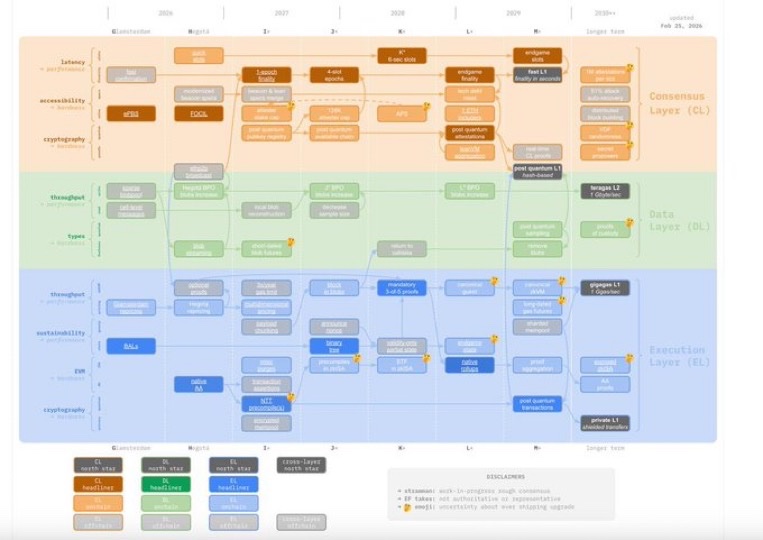
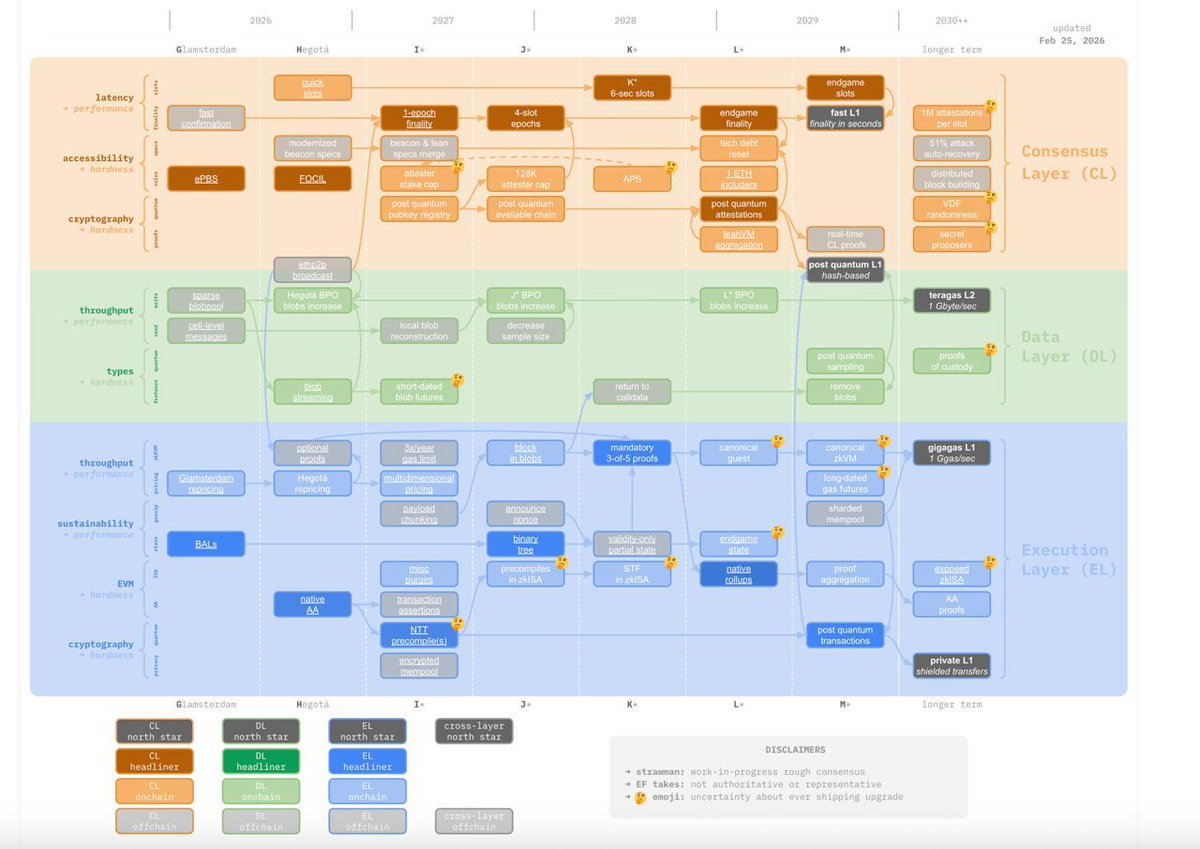
💥BREAKING: Ethereum reveals its new “Strawmap” roadmap, introducing private ETH transactions, quantum-resistant security, and major Layer-2 scaling upgrades.
Crypto Rover tweet mediaCrypto Rover tweet media
English
85
79
560
84.2K
🐼 Spectre 🦇🔊 retweetledi
Cointelegraph
Cointelegraph@Cointelegraph·
⚡️ NEW: The Ethereum Foundation released its “Strawmap” roadmap outlining plans for faster L1 finality, 10K TPS scaling via zkEVMs, advanced L2 throughput, post-quantum security, and native L1 privacy.
Cointelegraph tweet media
English
111
66
379
24.9K
🐼 Spectre 🦇🔊 retweetledi
Ash Crypto
Ash Crypto@AshCrypto·
BREAKING: 🇺🇸 Harvard sells 21% of its Bitcoin ETF to buy $87 million in Ethereum ETF.
Ash Crypto tweet mediaAsh Crypto tweet media
English
391
547
4.5K
575.2K
🐼 Spectre 🦇🔊 retweetledi
Cointelegraph
Cointelegraph@Cointelegraph·
🔥 UPDATE: Ethereum weekly transaction count hits all-time high of 17.3M while median fees drop to record low, indicating scaling upgrades are working, per Token Terminal.
Cointelegraph tweet media
English
109
110
499
28.2K
🐼 Spectre 🦇🔊 retweetledi
CryptoGoos
CryptoGoos@cryptogoos·
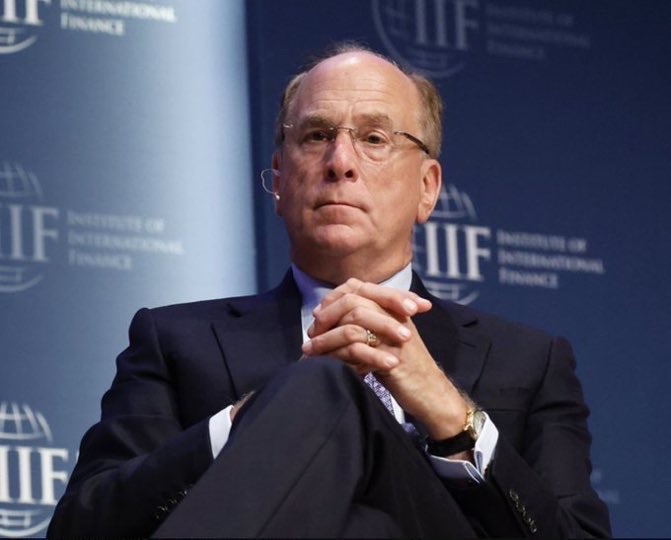
HUGE: $14 trillion BlackRock increases its stake in Ethereum treasury company BitMine $BMNR to 9,049,912 shares (up +165.6% QoQ).
CryptoGoos tweet mediaCryptoGoos tweet media
English
18
60
465
25.4K
🐼 Spectre 🦇🔊 retweetledi
Bitmine (NYSE-BMNR) $ETH
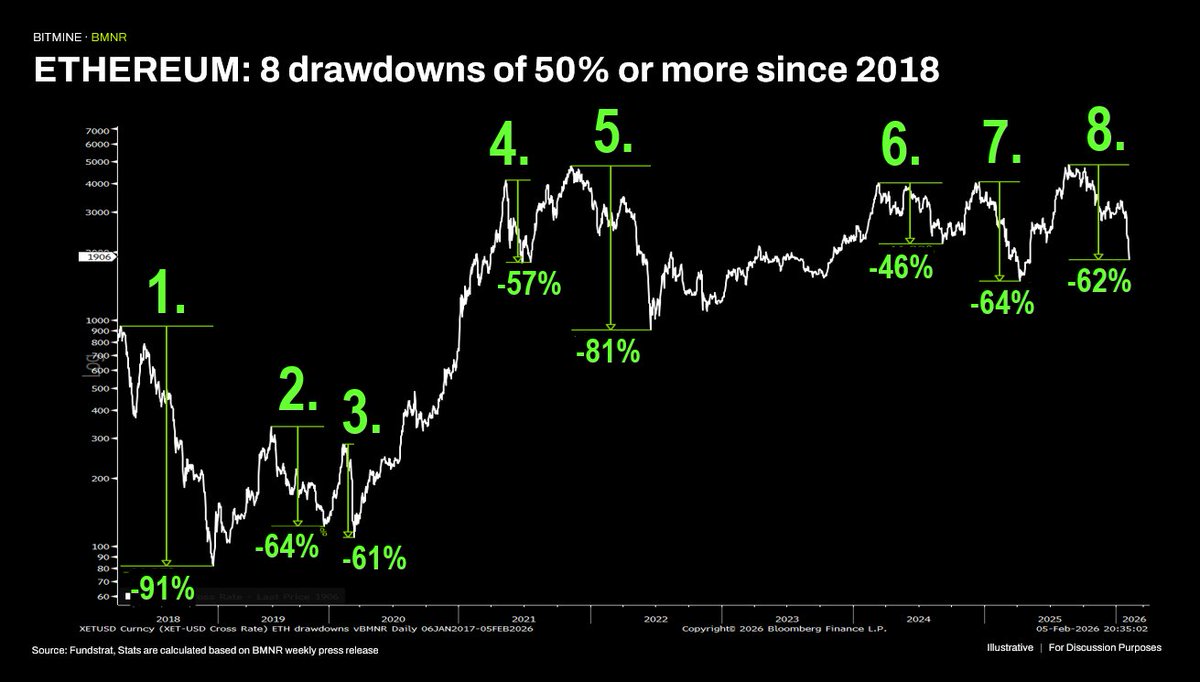
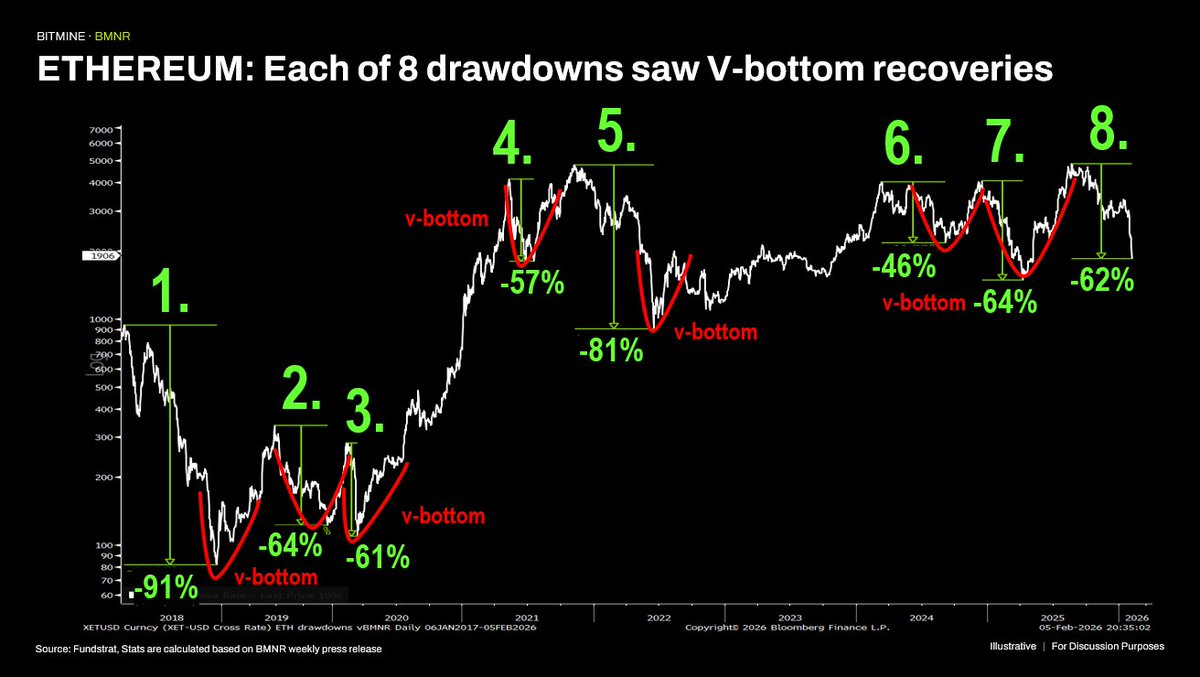
4/ Chairman Thomas "Tom" Lee @fundstrat: "ETH prices declined -62% from 2025 highs, while Ethereum daily transactions hit an all-time high (ATH) of 2.5mm (per theblock.co) and active addresses soared in 2026 to an ATH of 1 million daily (per theblock.co)." "Crypto prices are highly volatile, and in fact, this is the 8th time since 2018 that ETH prices have fallen 50% or more from a recent high, meaning declines like this are seen annually. In 2025, from January to March, ETH prices fell -64% and yet still surged from $1,600 to $5,000 later in the year." "ETH sees V-shaped recoveries from major lows. This happened in each of the 8 prior declines of 50% or more. A similar recovery is expected in 2026. The best investment opportunities in crypto have presented themselves after declines. Think back to 2025, the single best entry points in crypto occurred after markets fell sharply due to tariff concerns."
Bitmine (NYSE-BMNR) $ETH tweet mediaBitmine (NYSE-BMNR) $ETH tweet media
English
5
11
73
118.8K
🐼 Spectre 🦇🔊 retweetledi
Lookonchain
Lookonchain@lookonchain·
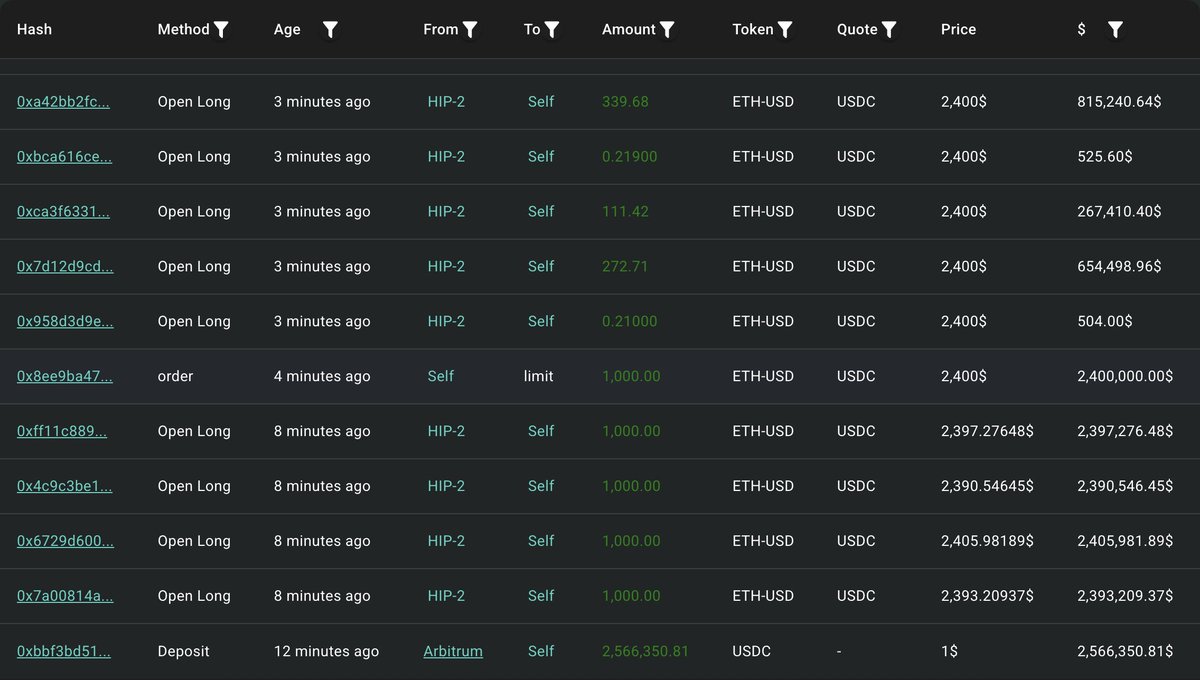
ETH has broken below $2,400! Someone just deposited 2.56M $USDC into #Hyperliquid and opened a 20× long on 6,000 $ETH($14.37M). #perps" target="_blank" rel="nofollow noopener">hypurrscan.io/address/0x11ee…
Lookonchain tweet mediaLookonchain tweet media
English
30
23
325
40.7K
🐼 Spectre 🦇🔊 retweetledi
*Walter Bloomberg
*Walter Bloomberg@DeItaone·
ETHEREUM SEEN OUTPERFORMING BITCOIN Standard Chartered says Ethereum’s outlook has improved and it is likely to outperform bitcoin. While weak bitcoin performance has weighed on the broader crypto market, rising institutional demand for ethereum and its dominance in stablecoins, real-world assets, and DeFi support a stronger outlook. Increased network throughput and potential U.S. regulatory clarity could provide further upside. The bank forecasts ethereum at $7,500 this year and $30,000 by 2029.
English
100
196
1.6K
292.7K
🐼 Spectre 🦇🔊 retweetledi
Ethereum
Ethereum@ethereum·
In 2025, Ethereum solidified itself as the secure foundation for our growing digital civilization. From industry-leading adoption to new technology that reinforces protocol resilience, here are 12 themes that defined the past year: 1/ DeFi reinforced Ethereum's role as the financial base layer of the internet. Transaction costs on Layer 1 (L1) reached 5-year lows and dropped below $0.01 on Layer 2 networks (L2s), making payments, remittances, and savings products an everyday reality. Maturing paymaster infrastructure allowed major apps to abstract (or remove) transaction fees entirely. These developments paved the way for global adoption: → Ethereum’s $99B+ DeFi TVL is over 9x the next-largest L1 ecosystem (per @DefiLlama), the strongest platform for global liquidity. → A new wave of neobanks were accelerated by growing regulatory clarity, launching cards, reward programs, and reaching millions in daily spend volume. → @RobinhoodApp_EU, @Gemini, and @krakenfx all rolled out stock tokens on Ethereum rails this year (L1 + L2s), bringing extended-hours access to U.S. equities. Robinhood also announced it’s building its own L2 network on @arbitrum's Orbit tech stack. → Over $18.8 trillion in stablecoin volume settled on Ethereum in 2025 (per @RWA_xyz), solidifying the role of stablecoins as global digital dollars. Smart wallets moved into production after the Pectra upgrade in May, improving security and making money programmable all the way to the account-based level. Prediction markets became a mainstream source of truth for macro events, moving $20B volume on L1 + L2s this year (per @tokenterminal). From per-API-call micropayments to stablecoins improving remittances around the globe, Ethereum is the base layer for a new generation of digital financial infrastructure. 2/ Institutional adoption of Ethereum accelerated, driven by projects with clear utility. The rise of ETH digital asset treasuries (DATs) brought an explosion of public companies actively managing balance sheets onchain, with $35B+ of ETH held by ETFs and strategic reserves (per @SERdotxyz). Leading institutions began using smart contracts to program their capital, diversifying yield strategies via DeFi allocation and distributing over $12B of real-world assets on Ethereum (per @RWA_xyz). The world’s largest banks, asset issuers, and payment processors are now using Ethereum L2s for verifiable settlement, composable scale, and programmable, 24/7 products. 3/ Ethereum’s rollup-centric roadmap was validated in 2025 by a rapidly-scaling L2 landscape and significant technical unlocks. → The ecosystem expanded as @Celo transitioned to become an Ethereum L2, while others like @Ronin_Network & @nillion announced plans to begin the process. → Transactions per second on all Ethereum rollups reached a combined 5600 TPS average for the first time. → December’s Fusaka upgrade introduced PeerDAS, driving L2 costs down by ramping up to 8x blob capacity. → L1 gas limit raised to 60M, expanding L1 settlement capacity by ~33% and setting the stage for further L2 expansion in 2026. L2s have become leading execution layers for high-frequency economic activity, while upgrades to enhance their throughput have preserved L1 security and decentralization. 4/ Interoperability between Ethereum L1 and L2s also advanced in 2025, moving closer to a seamless, unified Ethereum. Standards like ERC-7683 standardized order and settlement interfaces, enabling seamless cross-chain execution. The Open Intents Framework (OIF), announced by 30+ teams in February, delivered more secure, cheaper, and faster settlement of user interactions across chains. The Ethereum Interop Layer (EIL) launched on testnet in November, paving the way for unified rollups via trustless single-signature cross-chain transactions. Seamless, secure, and permissionless experiences across the Ethereum ecosystem empowered individuals and institutions alike. 5/ Privacy became a core focus for the Ethereum ecosystem, driven by project growth and L2 development. Privacy pools continued to build traction, with privacy protocols on Ethereum reaching new all-time highs for value locked, growing by over 60% in 2025 (per @DefiLlama). The privacy-preserving rollup landscape matured, bringing private execution to Ethereum-based settlement. At the end of 2025, there are 750+ projects in the web3 privacy ecosystem as mapped by @web3privacy, with initiatives impacting DeFi, wallets, apps, storage, and more. From fully onchain identity solutions to a global ecosystem of privacy advocates, Ethereum continues to advance sovereignty and trustlessness across the tech stack. 6/ 2025 was the year AI agents became economic actors. Agents don't have bank accounts or passports: they have Ethereum wallets and cryptographic proofs. The x402 internet-native payment standard + attestation flows on Ethereum now allow agent-to-agent commerce for services, compute, and data, without human intervention. New smart account permissions enforced spending limits and permissions for agents at the wallet level, adding guardrails for trustless agents to manage real capital. And ERC-8004, which is now being finalized and deployed in production, emerged as a standard for trustless agent discovery, reputation, and validation, with 7,500+ agents already registered on testnets (per 8004scan.io). Ethereum is becoming the settlement layer powering the machine economy. 7/ Ethereum became a critical platform for global coordination, powered by sovereign digital identity. Onchain finance fueled real-world action, from crypto donations supporting the Myanmar/Thailand earthquake relief to the World Food Program US launching support for ETH donations. Pop-up cities like ETH Enugu in Nigeria were funded, governed, and operated using Ethereum infrastructure, demonstrating real-world, decentralized coordination. The Kingdom of Bhutan migrated its National Digital Identity system to Ethereum, anchoring 200K+ citizen IDs on a public blockchain for enhanced security and self-sovereignty. Proof-of-personhood tools matured, pushing forward the feasibility of sybil-resistant voting and funding at scale. 8/ Consumer apps, onchain social, and gaming on Ethereum attracted millions of users in 2025. Decentralized applications on L1 reached a total of over 244M unique active wallets this year (per @DappRadar). Ethereum L1 led in NFT volume and royalties across 2025 (per nftpulse.org), while millions of unique collections launched across Ethereum and L2 networks. "White Rabbit," the anime crowdfunded via Ethereum-based NFTs, won the 2025 Emmy for Outstanding Innovation in Emerging Media Programming—a first for community-driven Hollywood production. Ethereum provided the coordination layer for hundreds of thousands of participants across decentralized organizations (DAOs) spanning stablecoins, lending, staking, decentralized exchanges, art, infrastructure, social impact, and more. Increasingly sophisticated governance tooling and tokenomics structures helped DAOs manage billions in treasury assets and evolve ownership, while growing adoption of new DAO-friendly regulatory structures helped them scale impact. Ethereum continues weaving into everyday culture, showing up in mainstream moments and enabling coordination across creators, communities, and builders. 9/ zkVMs saw significant advancements in 2025, changing how the network can continue to expand throughput and strengthen decentralization. A boom in ZK-coprocessors allowed apps to offload complex compute offchain. The @eth_proofs community achieved live, real-time ZK proving of Ethereum blocks, demonstrating the potential for full ZK light clients to run on low-powered devices like smartphones. Across the ecosystem, teams are advancing research into how verifiable, real-time proving can supercharge scaling and solidify Ethereum as global trust infrastructure. 10/ Ethereum shipped two major upgrades in 7 months, boosting transaction throughput, creating higher data availability for L2s, and ensuring resilient growth. The Pectra and Fusaka upgrades made wallets smarter and more accessible for retail and institutional users, expanding account abstraction and making mobile-native app experiences possible without complex middleware. As we move into 2026, Fusaka’s improvements set the stage for Ethereum’s consumer apps to become phone-native, human-friendly, and ready for mass adoption. Ethereum can improve at a rapid pace while preserving decentralization and resilience. 11/ 2025 showcased Ethereum’s vibrant global ecosystem. @ETHGlobal hosted 7+ hackathons and 140+ events, from New Delhi to New York, Prague to Taipei. Hundreds of community-led Ethereum events and hackathons like @EthCC, @EthereumDenver, @ETHIndiaco, @EthSafari, @ethlatam, @Ethereum_JP, and many more happened across the world. 14k+ people from 130+ countries attended @EFDevcon in Buenos Aires, collaborating at over 500 community-led events and the first Ethereum World’s Fair. Beginning in April, Destino Devconnect supported over 100 events across 14 LATAM countries. @EFetheverywhere launched permanent Ethereum community hubs in Lagos, London, Berlin, and Dubai, creating space for coworking, meetups, workshops, and more. Ethereum is more than a global network: it’s a global ecosystem of people from across backgrounds, disciplines, and communities. 12/ Ethereum celebrated 10 years live in July. The anniversary prompted celebrations across the globe and ushered in a renewed focus on growth and resilience. After 10 years, Ethereum: → Has over 88M total smart contracts deployed → Saw daily transactions onchain reach a new all-time high of 1.74M → Has the largest developer community of any blockchain, with 32K active developers fueling innovation in the ecosystem, and over 16K new developers welcomed between January and September alone — With 10 years of uninterrupted liveness, Ethereum represents trust that is earned over time. Ethereum is infrastructure that has persisted through market cycles and global stress to set the standard for resilience. Ethereum is no longer just emerging technology. It is becoming the scaffolding of our digital civilization. Here’s to welcoming in a new year for the Ethereum ecosystem.
English
301
440
2.5K
174.3K
🐼 Spectre 🦇🔊 retweetledi
CryptoGoos
CryptoGoos@cryptogoos·
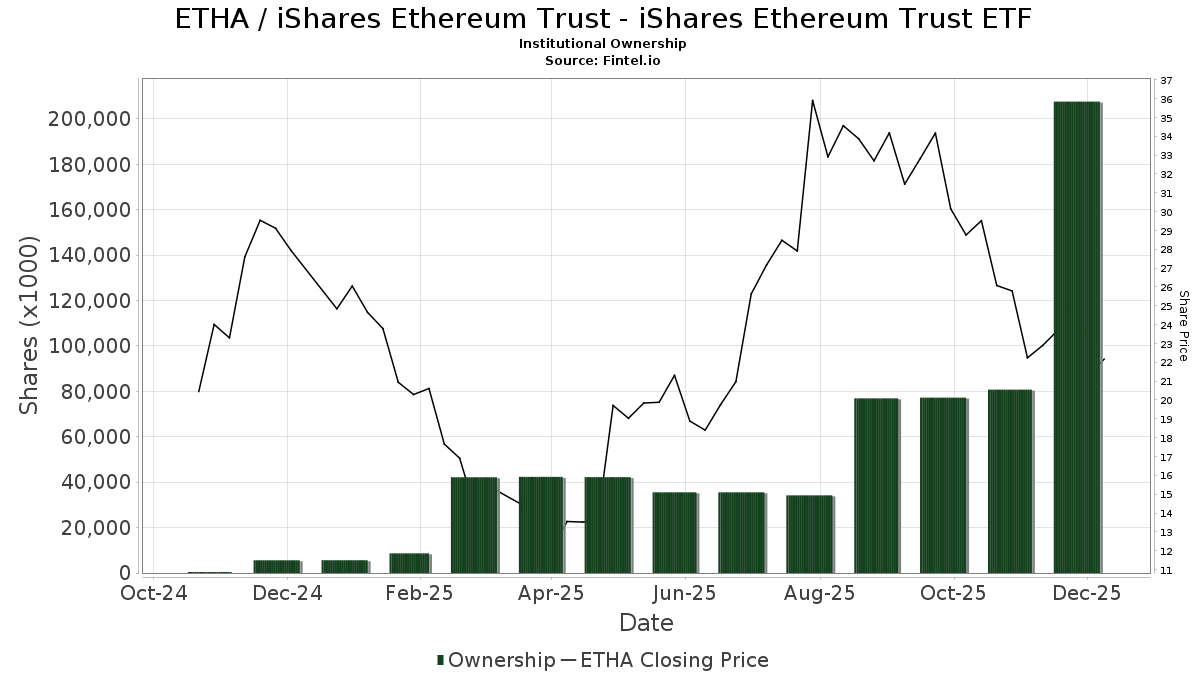
BIG institutions are buying $ETH. What's next is obvious.
CryptoGoos tweet media
English
32
41
262
6.8K
🐼 Spectre 🦇🔊 retweetledi
Henrik Zeberg
Henrik Zeberg@HenrikZeberg·
ETH - The Asset which will make the Portfolio fly The Bottom in End November now looks solid. And ETH may now be in wave iii of wave 3. If correct, this could prove to be an Explosive Phase - where the FEAR begins to replaced by FOMO. Watch the video here: open.substack.com/pub/zebergport…
English
6
30
493
82.9K
🐼 Spectre 🦇🔊 retweetledi
vitalik.eth
vitalik.eth@VitalikButerin·
Welcome to 2026! Milady is back. Ethereum did a lot in 2025: gas limits increased, blob count increased, node software quality improved, zkEVMs blasted through their performance milestones, and with zkEVMs and PeerDAS ethereum made its largest step toward being a fundamentally new and more powerful kind of blockchain (more on this later) But we have a challenge: Ethereum needs to do more to meet its own stated goals. Not the quest of "winning the next meta" regardless of whether it's tokenized dollars or political memecoins, not arbitrarily convincing people to help us fill up blockspace to make ETH ultrasound again, but the mission: To build the world computer that serves as a central infrastructure piece of a more free and open internet. We're building decentralized applications. Applications that run without fraud, censorship or third-party interference. Applications that pass the walkaway test: they keep running even if the original developers disappear. Applications where if you're a user, you don't even notice if Cloudflare goes down - or even if all of Cloudflare gets hacked by North Korea. Applications whose stability transcends the rise and fall of companies, ideologies and political parties. And applications that protect your privacy. All this - for finance, and also for identity, governance and whatever other civilizational infrastructure people want to build. These properties sound radical, but we must remember that a generation ago any wallet, kitchen appliance, book or car would fulfill every single one of them. Today, all of the above are by default becoming subscription services, consigning you to permanent dependence on some centralized overlord. Ethereum is the rebellion against this. To achieve this, it needs to be (i) usable, and usable at scale, and (ii) actually decentralized. This needs to happen at both (a) the blockchain layer, including the software we use to run and talk to the blockchain, and (b) the application layer. All of these pieces must be improved - they are already being improved, but they must be improved more. Fortunately, we have powerful tools on our side - but we need to apply them, and we will. Wishing everyone an exciting 2026. Milady.
English
2.9K
2.1K
13.3K
1.4M