Designing Better Artefacts

14K posts

Designing Better Artefacts

Designing Better Artefacts

@pmholling

Senior Lecturer in Aerospace Engineering, expert on uncertain decision making- Retweets are things I find interesting, but do not, always reflect my opinions.

Manchester, UK Katılım Kasım 2011
346 Takip Edilen445 Takipçiler
Designing Better Artefacts
Designing Better Artefacts@pmholling·
@L__Bow @danc00ks0n This is wind speed limits going into Effect at Walney and then easing. You see power roll out and then back on as speed slow down. The ones posted above are significantly more abrupt.
Designing Better Artefacts tweet media
English
0
0
1
33
Lewis Bowick
Lewis Bowick@L__Bow·
@danc00ks0n In that post he mentions "transmission curtailment". Seagreen is curtailed loads because the network capacity hasn't been built for it yet. I'm not clear on whether that's what his post today is showing.
English
3
0
2
115
Lewis Bowick
Lewis Bowick@L__Bow·
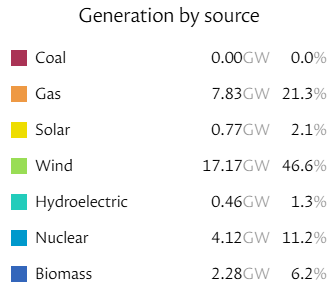
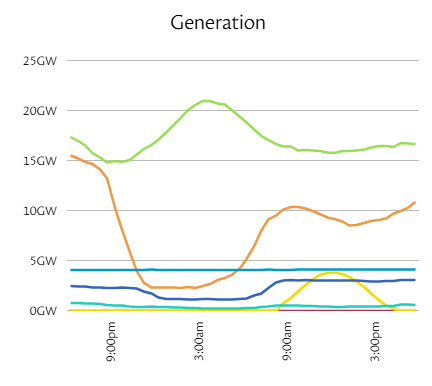
As Storm Éowyn tore across the UK today, exposed wind farms held steady as the top contributor to our grid the whole time (green line). Detractors love to talk about "windmills" shutting down when it's too windy, but at national scale they perform through the fiercest storms
Lewis Bowick tweet mediaLewis Bowick tweet media
English
11
9
29
2.5K
Designing Better Artefacts
Designing Better Artefacts@pmholling·
@Anapecalleddave Obviously combustion plants has slightly more predictable output. However, the trends going forward would seem to have been towards a more homogenous fleet. Given other trends we would like have walked into more of the French nuclear and PW GTF issues.
English
1
0
1
36
David
David@Anapecalleddave·
I've seen it repeatedly cited here that the capacity market costs are a cost of renewables because it is back-up. This to me is an undue simplification of energy market design. Imagine the long-run (total) cost of solar or wind was under the short run (fuel) cost of gas >
Kathryn Porter@KathrynPorter26

@Anapecalleddave @PeterSmartpower @janrosenow In the UK it was introduced to make sure there was enough generation to back up when there's no wind and sun. That is a fact. In the UK the Capacity Market is a cost of renewables

English
2
0
0
225
Martin Pollard
Martin Pollard@TechnicalVault·
@KathrynPorter26 @1233krc @neso_energy If you're not recycling grid scale batteries for the metal inside them then something has gone wrong with the market. It seriously should not be cheaper to dig raw lithium out the ground and refine it than refining it from what is essentially just high quality raw material.
English
1
0
0
88
Kathryn Porter
Kathryn Porter@KathrynPorter26·
Yesterday the GB power market came within 580 MW of demand control or a blackout on what was the tightest day since 2011 or before @neso_energy issued its first Electricity Market Notice of the winter and third (quickly cancelled) Capacity Market Notice
English
92
586
1.7K
455K
David
David@Anapecalleddave·
@cristoforestman @JavierBlas You can just cap domestic prices (Norway even already does this!) and use export revenues to fund the differential. That involves the state capturing some of the rent but this is hardly a new thing (see obsolescing bargain).
English
1
0
0
32
Javier Blas
Javier Blas@JavierBlas·
Norway is (very) unhappy that its electricity prices are soaring due to demand from Denmark, UK and Germany via inter-connectors when the wind isn't blowing. “It’s an absolutely shit situation,” said Norway’s energy minister Terje Aasland. ft.com/content/f0b621…
English
92
459
1.6K
249.1K
Designing Better Artefacts
Designing Better Artefacts@pmholling·
@Anapecalleddave Most of the standing charge, on electricity is in DNO/day charges. This tends to be higher in less ‘used’ regions where there is extra capacity, but the equipment still needs to be maintained. Though some is definitely from depreciation.
English
0
0
0
27
Designing Better Artefacts
Designing Better Artefacts@pmholling·
@Anapecalleddave The fact is that some things cost purely by time not by usage. If you charge for those based on usage not time you are forcing a cross subsidy from high users to low. That won’t necessarily get the outcome you want.
English
1
0
0
34
David
David@Anapecalleddave·
This basically offers a subsidised electricity connection to second home owners. Low usage does imperfectly correlate with low income but this is better managed through targeted rebates. We could call it the "winter fuel allowance".
Martin Lewis@MartinSLewis

NEWS: @Ofgem announces firms to offer a 'no standing' charge Price Cap as well as the normal one. Here's my official MSE comment on it... "While today's Ofgem announcement on standing charges isn't the best possible outcome, it's the best outcome that Ofgem can deliver unilaterally, to do more would require government intervention – and that hasn't happened. "Standing charges are a £338 a year poll tax on energy bills, a moral hazard disincentivising lower users from cutting their bills. They also punish customers that only use gas for central heating in winter, many of whom are elderly, by making them pay for every day in summer. It's by far the biggest single subject of complaint I get from the public about energy bills. "The best outcome would be to slash standing charges within the Price Cap, yet as that'd mean the cost of each unit of energy needed to increase, it'd require the Government to put in special support for vulnerable high energy users – such as those charging electric wheelchairs, or those with illnesses that require a very warm home. That hasn't happened (yet?). "Instead, I'm pleased its alternative path follows our submission suggestion of a dual Price Cap, one as now, a 'higher standing charge, lower unit rate', and a new 'no standing charge, higher unit rate' version that'll benefit lower users. "Yet the Price Cap was designed to be a safety-net tariff for customers who don't or can't engage in switching. The problem with presenting a choice of Price Caps is many vulnerable people won't make that choice. So I will be making representation to Ofgem to ensure firms are mandated to default lower-use Price Cap customers on to the no standing charge tariff – or at least do that for those on the Priority Services Register."

English
2
1
4
231