POLANCOCEBALLOS

144 posts

POLANCOCEBALLOS banner
POLANCOCEBALLOS

POLANCOCEBALLOS

@polancoceballos

A DePIN-powered blockchain infrastructure designed to connect real-world devices, verified identities, and decentralized services. $ASTCH

Wyoming, USA Katılım Haziran 2012
119 Takip Edilen86 Takipçiler
POLANCOCEBALLOS
POLANCOCEBALLOS@polancoceballos·
SIM swap attacks have shown the industry a hard truth: Crypto security cannot depend only on private keys. At Astralis Chain, we are building infrastructure designed to connect telecom-grade identity continuity with blockchain security through DePIN, DID, and real-time SIM/device swap alerts. This opens the door for a new standard where telcos become active validators of digital trust, and users gain stronger protection against one of crypto’s most dangerous attack vectors. The future of wallet security is not just about ownership. It is about continuous verification. Astralis is building that layer. #AstralisChain #DePIN #DID #CryptoSecurity #ASTCH
English
0
2
7
84
Astralis Chain 🔑🧲
Astralis Chain 🔑🧲@AstralisChain·
Crypto security has a weak point and SIM swap attacks keep proving it. For too long, private keys alone have carried the full weight of wallet security. But what happens when the key is compromised? At Astralis, we believe the future of wallet protection goes beyond the private key. With Astralis Layer 2 DePIN + DID + real-time SIM/device swap alerts, telecom infrastructure can evolve from a fraud vulnerability into a powerful layer of digital trust. This means telcos can move from being passive victims of fraud to becoming active validators of identity continuity. The next generation of wallet security will not rely only on ownership of a key. It will rely on continuous proof that the user, the SIM, and the device remain authentic and unchanged. That is the layer Astralis is building. Identity continuity is the future of crypto security. #AstralisChain #DePIN #DID #CryptoSecurity #ASTCH
Astralis Chain 🔑🧲 tweet media
English
10
23
28
234
POLANCOCEBALLOS
POLANCOCEBALLOS@polancoceballos·
SIM swap attacks have exposed one of the biggest weaknesses in crypto security. But what if the same telecom infrastructure being exploited today could become the foundation of tomorrow’s wallet protection? With Astralis Layer 2 DePIN + DID + real-time SIM/device swap alerts, telcos can transform from passive victims of fraud into active validators of digital trust. The future of wallet security will not depend only on private keys. It will depend on identity continuity. Astralis is building that layer. #AstralisChain #DePIN #DID #CryptoSecurity #ASTCH
POLANCOCEBALLOS tweet media
English
0
4
7
69
POLANCOCEBALLOS
POLANCOCEBALLOS@polancoceballos·
As CEO of Astralis | How I See the Future: Blockchain + Finance in an AI Agent World The real collision isn't blockchain versus banks. It's the convergence of blockchain, financial services, and autonomous AI agents. In this emerging economy, two infrastructures are mission-critical: DePIN (Decentralized Physical Infrastructure Networks) – The Truth Machine AI agents require verifiable, tamper-proof data from the physical world, energy grids, transport routes, compute capacity. DePIN delivers this without centralized control. At Astralis, we are building the future network: token-incentivized physical infrastructure that AI agents can trust natively. Decentralized ID (DID) – The AI's Passport & Reputation Without DID, fake agents and Sybil attacks collapse financial systems. With DID, agents gain portable, verifiable trust, unlocking instant access to loans, insurance, and liquidity. The outcome; An autonomous, verifiable machine economy where human-in-the-loop finance evolves into programmable, composable utility. The winners will not be the largest banks. They will be those who recognize that in an AI-driven world, identity and physical truth are the only collateral that matters. @AstralisChain #Blockchain #DePIN #DID #AI #FutureOfFinance #Astralis
English
6
15
27
700
POLANCOCEBALLOS
POLANCOCEBALLOS@polancoceballos·
🚀 As CEO of @AstralisChain , I believe DePIN + Telcos can become one of the biggest drivers of blockchain adoption. The next phase of Web3 will not be built only around speculation. It will be built around real infrastructure, real usage, and real transactions. That is where Astralis Chain comes in. Our vision is to connect DePIN projects with telecommunications, mobile networks, IoT devices, nodes, validators, storage, data, and digital services — creating an ecosystem where physical infrastructure can generate constant on-chain activity. Every tower can become part of a decentralized economy. Every connected device can generate transactions. Every telco integration can create new utility. Every user interaction can strengthen the demand for $ASTCH. This is how a blockchain evolves from being just a network into becoming an infrastructure layer for the real world. At Astralis Chain, we are building with a clear mission: to create a scalable ecosystem capable of moving millions of transactions and positioning $ASTCH as the fuel of a global decentralized economy. The future of blockchain is not only digital. It is physical. It is connected. It is decentralized. And Astralis Chain is building for that future. #AstralisChain #ASTCH #DePIN #Telcos #Blockchain #Web3 #RWA #DeFi
English
4
10
23
181
POLANCOCEBALLOS
POLANCOCEBALLOS@polancoceballos·
The future of remittances will not be built on slow intermediaries and repeated compliance friction. Astralis DePIN represents a new path: verified infrastructure, programmable trust, and smarter financial rails for global payments. A more open financial system starts here. #AstralisChain #DePIN #Fintech #Remittances
Astralis Chain 🔑🧲@AstralisChain

Securing Compliance & Reducing Costs: Astralis DePIN + Smart Contracts Cross-border remittances and mobile wallets still face major challenges: ❌ High fees across multiple intermediaries ❌ Slow and repetitive KYC/AML checks Astralis DePIN introduces a smarter approach. By combining physical hardware nodes, verified locations, operator KYC, and automated smart contracts, Astralis aims to make cross-border payments more efficient, transparent, and secure. How compliance can become smarter: → Smart contracts can verify node locations against approved jurisdictions → Risk checks can help detect restricted or suspicious activity → AML pattern monitoring can flag unusual transactions → Stake slashing can discourage dishonest node behavior No single point of control. More transparency for audits, while helping preserve user privacy. How costs can be reduced: 1. Fewer intermediaries in the payment route 2. Automated compliance workflows 3. Direct mobile wallet API integrations Example: Maria sends €100 from Spain to her brother’s mobile wallet in the Philippines. Traditional rails may involve higher fees and delays. Astralis aims to make transfers faster, cheaper, and more transparent. For billions relying on cross-border payments, this is more than an upgrade. It’s a step toward a more open financial system. What frustrates you most about remittances today? Cost, speed, or compliance? #DePIN

English
1
3
7
98
POLANCOCEBALLOS
POLANCOCEBALLOS@polancoceballos·
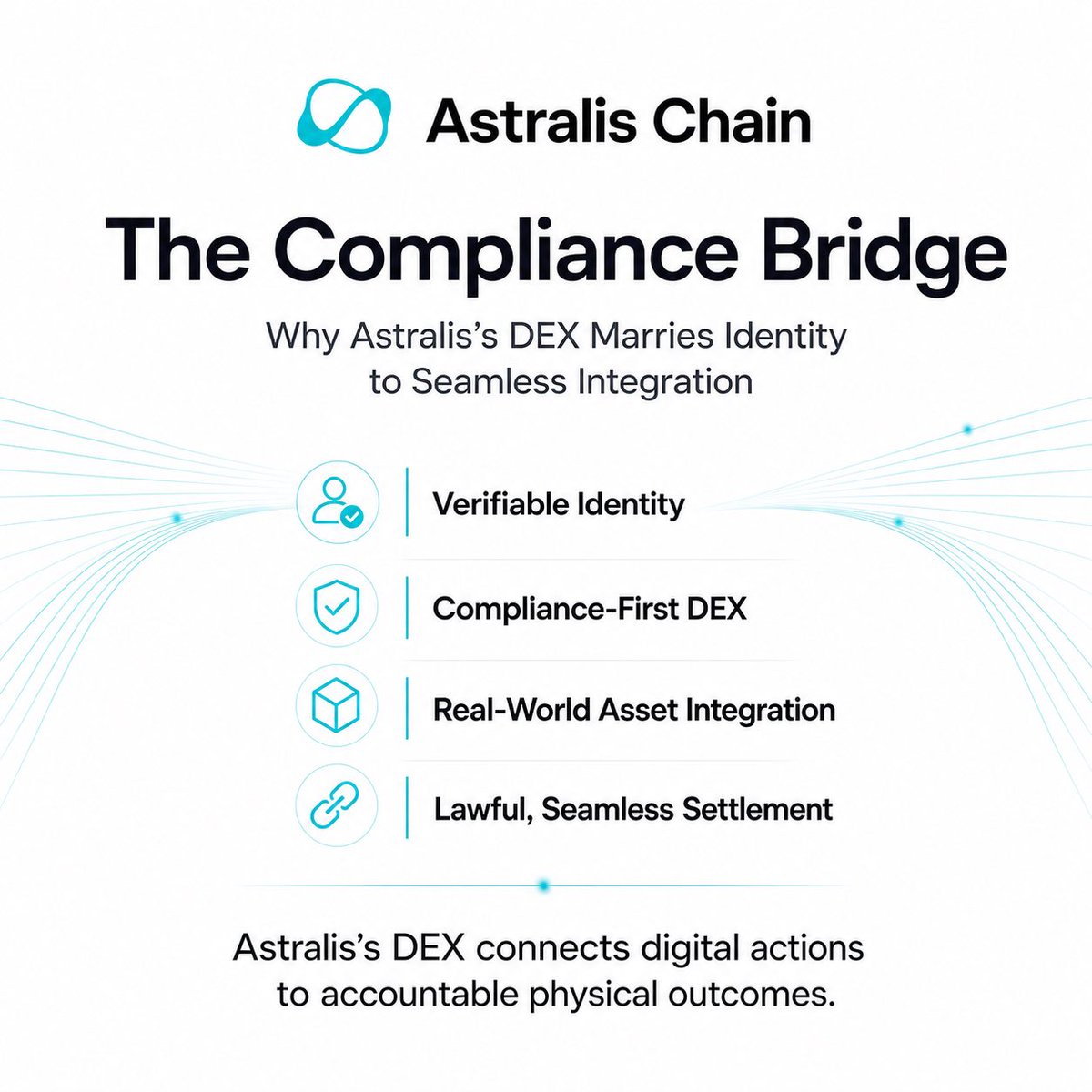
The Compliance Bridge: Why Astralis’s DEX Marries Identity to Seamless Integration The digital and physical worlds remain separated by a chasm of mistrust, clumsy authentication, and incompatible rules. The most strategic place to build a crossing is the financial layer, where value moves between both realms. Astralis’s decentralized exchange, designed not for anonymity but for enforceable compliance and verifiable identity, is not a regulatory concession. It is the architectural key that will finally weld bits to atoms. The physical world knows you through your body, your documents, and witnesses. The digital world knows you through wallet addresses and cryptographic keys. These have never aligned. Astralis’s DEX solves this by embedding verifiable credentials directly into the trading protocol. A real person becomes a digital identity that is neither fully anonymous nor fully exposed, but provably consistent across every interaction. This consistency means a physical asset (a car, a house, a machine) can live on-chain with a legal owner who can prove rights offline. No more guessing “who is behind this wallet?” only the certainty that “this identity is authorized to move that atom.” Pure DeFi ignores borders, sanctions, and legal recourse. That works for purely digital speculation but breaks the moment the asset is physical. To trade a real estate token, a commodity receipt, or a robot’s service contract, the exchange must know: Is the seller legitimate? Is the asset lien‑free? Is the jurisdiction lawful? Astralis’s compliance‑first DEX becomes the only venue where a central bank, a logistics firm, and a retail user can interact without abandoning decentralization. Compliance is not friction, it is the translation layer between legal reality and the digital ledger. Earlier I described how authentication between realms is broken: a bank demands a card, a PIN, a face scan, and a signature. Astralis’s DEX collapses that friction. One verifiable identity backed by biometrics or government credentials yet encrypted and user‑controlled—can authorize a trade, unlock a physical delivery locker, and sign a customs form in the same atomic transaction. The action is digital; the consequence is physical. The DEX becomes notary, customs officer, and settlement engine rolled into one. The real world has courts, chargebacks, and insurance. The digital world has immutable transactions. These are incompatible. Astralis’s compliance layer introduces conditional finality: a trade settles instantly but can be reversed only through a transparent, identity‑anchored dispute mechanism. That matches physical‑world expectations. When a buyer receives a broken item, they expect a remedy. A compliant DEX can freeze, arbitrate, and unwind without breaking decentralization. That trust knowing a digital action will not leave you stranded in the physical world is what seamlessness truly means. Once identity and compliance are embedded in a DEX, every other integration follows. A smart contract can pay a robot for real‑world labor because the robot’s owner is identifiable. A supply chain can trigger automatic customs clearance because the DEX confirms that the counterparty is (or is not) sanctioned. An IoT device can buy electricity from the grid because its identity is creditworthy. Astralis’s DEX becomes the spine connecting every digital command to a lawful, accountable physical outcome.
POLANCOCEBALLOS tweet media
English
2
14
22
458
POLANCOCEBALLOS
POLANCOCEBALLOS@polancoceballos·
*Digital Backbone: Why Astralis DePIN is Non-Negotiable for a Digitally Active World* As humanity accelerates toward a reality where work, finance, identity, and social interaction exist primarily in the digital realm, a silent crisis is emerging: the fragility of centralized infrastructure. In a world that never sleeps online, a single server failure, a data breach, or a regulatory overreach can paralyze millions. Astralis DePIN (Decentralized Physical Infrastructure Network) is not just an innovation, it is an essential evolution. Its importance lies in three integrated pillars: compliance-ready architecture, decentralized identity (DID), and decentralized physical networks. Together, they form the only sustainable foundation for a truly digital civilization. First, Astralis addresses the fatal flaw of most Web3 projects: the absence of regulatory compliance. For decades, decentralization has been at odds with legal frameworks, preventing mass adoption. Astralis bridges this gap by building infrastructure that considers compliance from day one, not as an afterthought, but as a core protocol. This means enterprises, governments, and financial institutions can finally leverage decentralized networks without fear of sanctions or audits. In a digital world where data sovereignty laws (like GDPR or CCPA) are tightening, Astralis provides a transparent, auditable, and legally operable backbone. Second, the rise of AI and deepfakes has made trusted identity the most valuable asset online. Centralized ID systems are honeypots for hackers and single points of control for authoritarian regimes. Astralis integrates Decentralized ID (DID) directly into its physical infrastructure. This gives every user self-sovereign identity, proof of humanness and credentials without a central issuer. In a "digitally active" society, where you interact with smart cities, digital banks, and metaverses daily, DID ensures that you own your keys, your data, and your reputation. No central gatekeeper can deny you access to the physical or digital services you rely on. Finally, Astralis operates as a Decentralized Physical Infrastructure Network (DePIN). Unlike cloud providers that run massive, vulnerable data centers, DePIN incentivizes everyday people to deploy real-world hardware (sensors, hotspots, storage nodes). This creates a resilient mesh of connectivity and computing power. When a natural disaster or cyberattack takes down a central hub, Astralis reroutes through thousands of independent nodes. In a world dependent on real-time digital activity, autonomous vehicles, telemedicine, remote operations that resilience is not a luxury; it is survival. In conclusion, as our lives become permanently digital, centralized infrastructure will become the bottleneck of progress and the target of every failure. Astralis DePIN solves this by offering a trinity of compliance, self-sovereign identity, and physically decentralized nodes. It transforms infrastructure from a fragile utility into an immune system for the digital age. Without it, our digital future is vulnerable. With Astralis, it becomes unbreakable. @AstralisChain
English
3
10
20
657
POLANCOCEBALLOS
POLANCOCEBALLOS@polancoceballos·
On November 13, 2025, I published in @LinkedIn "The Blueprints for a Next-Generation Global Payment Network." In my conclusion, I made a clear distinction: 🔹 Initial market – the multi-trillion-dollar world of B2B and interbank payments. 🔹 Ultimate market – the entire global economy, enabling programmable, frictionless, and inclusive value transfer. We're already seeing real-time payments become the baseline expectation. Stablecoins are starting to fill gaps, yes. But the conversation today is heavily focused on velocity – instant settlement, speed, throughput. That's fine. Speed matters. But here's what keeps me up at night: We've made progress on compliance – biometrics, identity, risk scoring. But now AI agents are coming online. More digital transactions. More autonomy. More volume. More complexity. 1. What happens to the infrastructure? 2. Is it ready? 3. Can it support the new challenges of programmatic, agent-driven value exchange? Most legacy systems weren't built for this. This is exactly where Astralis DePIN fits in. A decentralized, end-to-end platform that secures the network – not just for speed, but for trust, resilience, and scalability in an AI-first, tokenized economy. We don't just need faster rails. We need smarter, safer, decentralized infrastructure. The next generation of payments won't be built on bandaids. It'll be built on DePIN. @AstralisChain
English
2
16
27
527
POLANCOCEBALLOS
POLANCOCEBALLOS@polancoceballos·
The future of blockchain adoption will not come only from crypto-native users. It will come through the infrastructure people already use every day. Telecom companies, through light client integration, can become powerful gateways into Astralis Chain. This is how we bring Web3 to the real world. #AstralisChain #ASTCH #Web3 #Telecom #Blockchain
Astralis Chain 🔑🧲@AstralisChain

Telcos don’t just connect people. On Astralis Chain, they can become strategic access, validation, and trust distribution nodes. Through a light client, a telecom company can interact with Astralis without running the heavy infrastructure of a full node. This enables faster, more efficient, and more scalable integration with Web3 services. With a light client, telcos can bring real utility to the ecosystem: ✅ Lightweight transaction verification ✅ Secure access to network data ✅ Mobile wallet and service integration ✅ Mass-user connectivity ✅ Bridges between telecom infrastructure and blockchain ✅ Greater decentralization across global access points Astralis Chain is not here to replace existing infrastructure. It is here to connect it to a new layer of digital value. Telcos have reach. Astralis brings trust, traceability, and onchain utility. Together, they can bring blockchain to end users without friction. Astralis Chain is building the highway where telecommunications and Web3 converge. #AstralisChain #ASTCH #Web3 #Blockchain #DePIN #Telecom #RWA

English
0
3
9
112
POLANCOCEBALLOS
POLANCOCEBALLOS@polancoceballos·
Let me tell you a story about how Astralis DePIN protects and supports the tokenization of real-world assets (RWAs). Imagine you want to turn a warehouse, a fleet of delivery trucks, or a piece of art into digital tokens. The value of those tokens depends entirely on the real‑world condition of the physical asset. Is the warehouse still standing? Did the art get damaged in transit? Without trustworthy data, your tokens are just guesswork. That’s where Astralis DePIN steps in. Our network of tamper‑proof sensors continuously collects real‑world facts location, temperature, vibration, you name it and feeds that data directly to your tokenization protocol. So when you mint a token, you know it’s backed by the true state of the asset. No stale reports, no false claims. But protection doesn’t stop at minting. Those tokenized RWAs often become collateral in DeFi. With Astralis, the asset’s condition is always live. If a cold chain breaks or an unauthorized movement happens, our data triggers smart contracts instantly. Loan‑to‑value ratios adjust, margin calls go out, trading can be frozen all automatically. Lenders and borrowers stay safe, without waiting for a human to notice a problem. Now let’s talk about fractional ownership. Suppose you tokenize a building or a piece of industrial equipment. Astralis nodes verify who is using the asset, whether it’s being maintained, and if it’s occupied. That proof gets attached to every token fraction. Suddenly, rent or usage fees can be shared transparently, and ownership rights enforce themselves no centralized property manager needed. And the story has an auditable ending. From the moment a token is minted to the day it’s burned, every physical event linked to that asset is signed by the DePIN network and stored forever. For security tokens or commodity‑backed tokens, that means clean audits and easy regulatory compliance. In short, Astralis DePIN bridges the “last mile” of trust. We make tokenized RWAs as reliable as any on‑chain crypto asset by anchoring every digital representation to verifiable physical truth. So come on, let’s build this together. @AstralisChain #DePIN #RWA #Bridge
English
0
20
26
307
POLANCOCEBALLOS
POLANCOCEBALLOS@polancoceballos·
Astralis doesn’t wait. Signed up ASAP. First company in. Advantage: taken.
English
0
0
3
49