Ponderwall⚡

42.4K posts

Ponderwall⚡ banner
Ponderwall⚡

Ponderwall⚡

@ponderwall

Geopolitics, Science & History.

Katılım Kasım 2019
1.5K Takip Edilen920 Takipçiler
Disclose.tv
Disclose.tv@disclosetv·
NEW - USS Gerald R. Ford returns to the Middle East, along with 2 destroyers, USS Mahan and the USS Winston S. Churchill, joining USS Abraham Lincoln that is already operating in the north Arabian Sea. USS George HW Bush is also enroute, expected to arrive before end April — CBS
Disclose.tv tweet media
English
69
286
1.3K
99.4K
Ponderwall⚡
Ponderwall⚡@ponderwall·
China reportedly tested a deep-sea cable-cutting device at ~3,500 meters depth. Given how much of the global internet relies on undersea cables, even experimental tools like this raise serious questions about infrastructure resilience and security.
English
1
0
0
25
Ponderwall⚡ retweetledi
Financial Times
Financial Times@FT·
Iran secretly acquired a Chinese spy satellite in 2024, giving it the ability to monitor US bases, an FT investigation has found. Miles Johnson explains what this means for Tehran, and the questions it raises about China’s role in the Middle East war. ft.trib.al/dHKg4V4
English
188
447
1.4K
122.3K
CrystalS
CrystalS@steelcompass·
@jukan05 Jukan, does this apply to SK Hynix, Samsung and Micron that are building out HBM manufacturing capacity? If not all the optical / photonics industry?
English
1
0
0
203
Jukan
Jukan@jukan05·
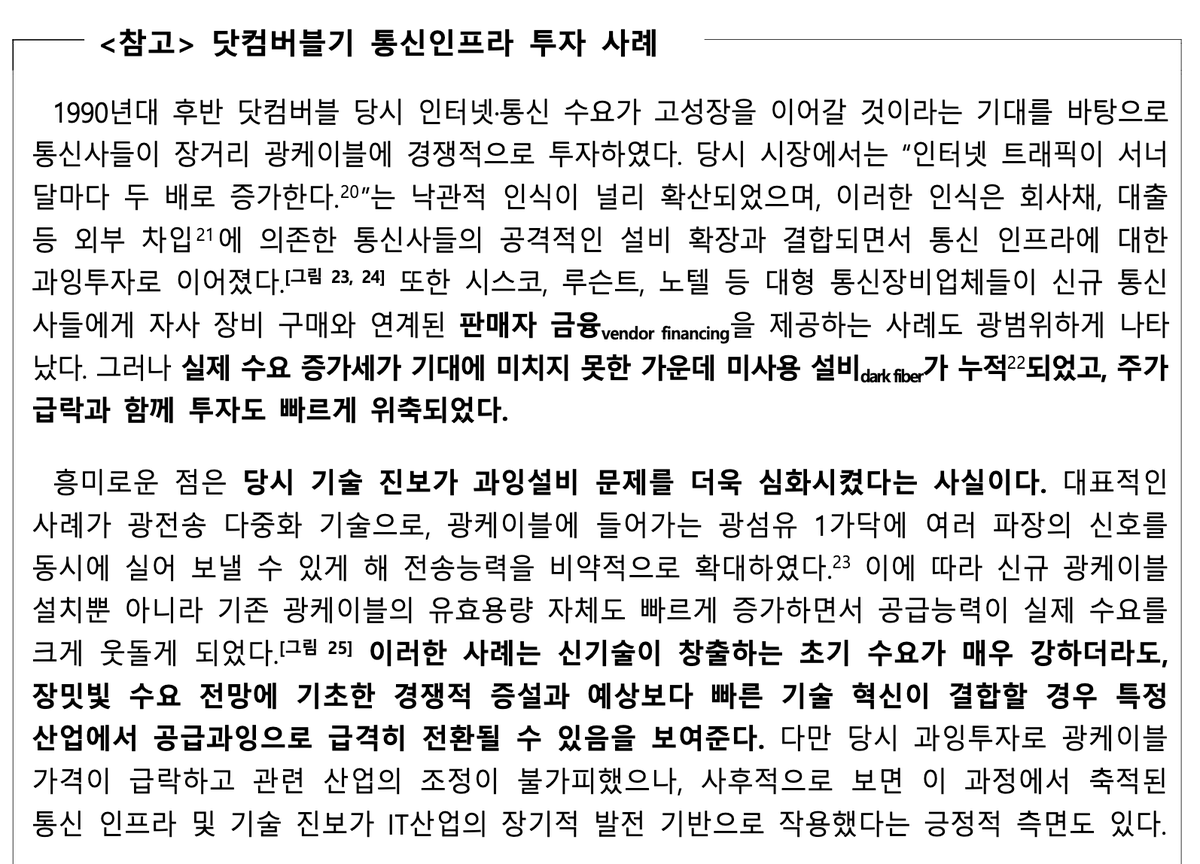
Bank of Korea: Today's AI Supercycle Through the Lens of Dot-Com Era Telecom Infrastructure Investment In the late 1990s, during the dot-com bubble, telecom companies competitively invested in long-haul fiber optic cables, driven by expectations that internet and telecom demand would sustain high growth. At the time, the optimistic belief that "internet traffic doubles every three to four months" was widely held across the market, and this perception, combined with telecom operators' aggressive capacity expansion funded through external borrowing such as corporate bonds and loans, led to massive overinvestment in telecom infrastructure. [Figures 23, 24] Furthermore, major telecom equipment vendors including Cisco, Lucent, and Nortel widely offered vendor financing to new telecom operators, tying the financing to purchases of their own equipment. However, as actual demand growth fell short of expectations, unused capacity — known as dark fiber — accumulated, and investment contracted rapidly alongside plunging stock prices. An interesting point is that technological progress at the time actually exacerbated the overcapacity problem. A prime example is wavelength-division multiplexing (WDM) technology, which enabled multiple wavelengths of signals to be transmitted simultaneously through a single optical fiber strand within a cable, dramatically expanding transmission capacity. As a result, not only was new fiber being laid, but the effective capacity of existing fiber optic cables was also increasing rapidly, causing supply capability to far exceed actual demand. [Figure 25] This case illustrates that even when initial demand generated by a new technology is very strong, competitive capacity buildouts based on rosy demand forecasts, combined with faster-than-expected technological innovation, can trigger a rapid shift to overcapacity in a given industry. That said, while the overinvestment of the era caused fiber optic cable prices to plunge and forced a painful adjustment across the sector, in hindsight, the telecom infrastructure and technological advances accumulated through this process served as the long-term foundation for the IT industry's subsequent development — a positive legacy worth acknowledging.
Jukan tweet media
Jukan@jukan05

The Bank of Korea published a report today on the semiconductor market outlook, stating that the memory semiconductor boom is likely to continue through the first half of next year, but that the outlook beyond that remains fluid depending on how conditions evolve. * The BOK is generally conservative in its baseline stance.

English
10
25
182
39.1K
Ordinary Trader
Ordinary Trader@wannabetrader25·
@TheLongInvest Hey brother Qatari helium gas export will destroy a lot of East Asian semiconductor companies. Any thoughts on LINDE, chart industries and air products? Maybe Exxon mobile as well
English
3
0
1
193
The Long Investor
The Long Investor@TheLongInvest·
If a Chinese ship is touched in the Strait of Hormuz China will immediately take back Taiwan $NVDA will collapse as $TSM is now in the hands of the Chinese....
English
122
20
635
104.3K
JimiTheWriter
JimiTheWriter@jimichang32·
@mashibe5944 @HarmlessHQ Not to mention other critical commodities: Ammonia - 30% of world trade Urea - Nearly 50% Diammonium phosphate - 20% Sulphur - 50% Helium - 33% Aluminium - 10%
English
2
0
1
28
Harmless
Harmless@HarmlessHQ·
Besides, the US does not depend on the Strait of Hormuz for its oil. How then did the IRGC think blocking the Strait of Hormuz would put Trump on pressure? The US is already self-sufficient in oil production. And are now the biggest producer across the globe. They have been searching for customers for their excess oil and Iran just gave them that on a platter.
English
24
22
124
4.7K
Ponderwall⚡
Ponderwall⚡@ponderwall·
@nypost Widow spiders produce vertical, glue-covered trip lines that detach from the ground when encountered by an unsuspecting victim, springing the prey into the air where it hangs suspended. ponderwall.com/index.php/2019…
English
0
0
0
146
New York Post
New York Post@nypost·
Spiders as large as your hand spark panic in SoCal as they spread across the US trib.al/hmk5IHH
New York Post tweet media
English
26
20
59
21.8K