Madison May (e/ia)

2.5K posts

Madison May (e/ia) banner
Madison May (e/ia)

Madison May (e/ia)

@pragmaticml

teaching machines @indicodata - professional novice

Asheville, NC Katılım Mart 2010
2.2K Takip Edilen1.9K Takipçiler
Sabitlenmiş Tweet
Madison May (e/ia)
Madison May (e/ia)@pragmaticml·
This week's blog post explores methods for incorporating longer-term context in transformers! Featuring 6 unique approaches: - Sparse Transformers - Adaptive Span Transformers - Transformer-XL - Compressive Transformers - Reformer - Routing Transformer pragmatic.ml/a-survey-of-me…
English

7
73
294
0
Madison May (e/ia)
Madison May (e/ia)@pragmaticml·
@reactive_dude I also just made the switch to mattpocock's skills from superpowers. So far it has been a significant step up in quality
English
0
0
1
85
andrej
andrej@reactive_dude·
What are your favorite agent skills? I'll start: > grill-me (brainstorming) > write-a-prd (specs) > tdd (the best way to code with agents rn) > agent-browser (great for debugging/qa)
English
34
20
709
59.3K
Madison May (e/ia)
Madison May (e/ia)@pragmaticml·
@ankrgyl I think the problem is that the primary benefit of agents is the ability to handle long tail tasks that require atypical tools some small % of the time. If you lock down the toolset, you limit the agent's ability to address that long tail.
English
1
0
4
559
Ankur Goyal
Ankur Goyal@ankrgyl·
The fundamental problem with this whole harness craze is that they are designed for a very specific single-player and your choice of insecure or expensive (full access to sandbox) environment. Beyond the cost, this constrains harnesses/agents to a very specific (slow chat or background work). We need to build harnesses that are both efficient and secure, and optimize those for model performance. Additional layers of power that require a sandbox can then be opt-in when needed, not default provisioned for every interaction. Maybe I'm wrong and the correct thing to do is just optimize the F out of the sandbox layer, but that seems unlikely to be efficient at scale. If an LLM's action does not need a sandbox, then managing a file descriptor to stream bytes over the network is outrageously cheaper and more secure than provisioning a virtual machine. I believe that until we build true multi-tenant harnesses, the use cases for agents will continue to be constrained to ~ coding. Which is a lot of stuff! But undersells what agents could do at scale.
English
33
10
159
39.4K
Madison May (e/ia) retweetledi
Ivan Burazin
Ivan Burazin@ivanburazin·
We are building the agent equivalent of Kubernetes for containers and serverless for functions. Not just spin up a sandbox. - orchestration - lifecycle management - observability - scaleability - reliability The entire runtime environment layer that agents need to operate at production scale.
English
10
3
77
6K
Madison May (e/ia)
Madison May (e/ia)@pragmaticml·
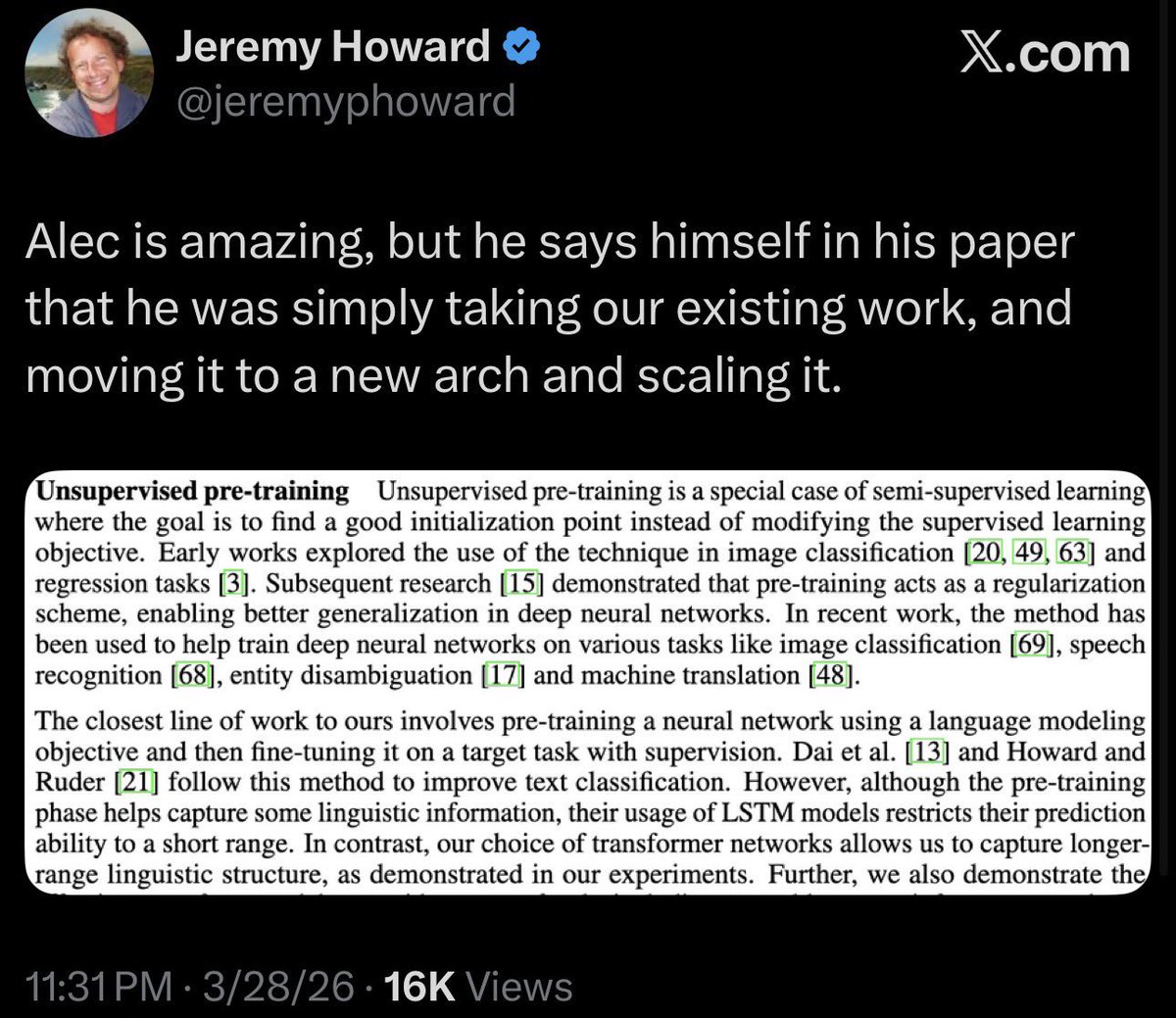
@deliprao That being said, Alec's perpetual humility and categorical disregard for seeking credit / status for his contributions is part of what makes his story so unique.
English
0
0
5
333
Madison May (e/ia)
Madison May (e/ia)@pragmaticml·
@deliprao We are all standing on the shoulders of giants. In the early days of Indico we definitely followed Jeremy Howard's work closely and ULMFit was an important milestone.
English
1
0
11
2K
Delip Rao e/σ
Delip Rao e/σ@deliprao·
some crazy revisionist history writing with “simply” … imagine using a researcher’s generous* credit attribution to co-opt their work as your own. *I say generous because that style of transfer learning was known at that point. H&R applied that style of transfer learning to LSTMs.
Delip Rao e/σ tweet media
English
6
8
170
24K
Madison May (e/ia)
Madison May (e/ia)@pragmaticml·
I love projects using AI to assist with better understanding a codebase/feature/PR. DeepWiki is another great examplar. What other projects focus on agents for code --> mental model translation rather than mental model --> code?
Kamran Ahmed@kamrify

New skill to understand any codebase /𝚍𝚒𝚏𝚏𝚒𝚝𝚢-𝚝𝚘𝚞𝚛 [𝚊𝚗𝚢 𝚏𝚎𝚊𝚝𝚞𝚛𝚎] Get an interactive AI walkthrough of every part of the codebase that touches that feature.

English
0
0
1
239
Madison May (e/ia) retweetledi
Kamran Ahmed
Kamran Ahmed@kamrify·
New skill to understand any codebase /𝚍𝚒𝚏𝚏𝚒𝚝𝚢-𝚝𝚘𝚞𝚛 [𝚊𝚗𝚢 𝚏𝚎𝚊𝚝𝚞𝚛𝚎] Get an interactive AI walkthrough of every part of the codebase that touches that feature.
English
14
19
311
28.4K
Madison May (e/ia) retweetledi
Tuana
Tuana@tuanacelik·
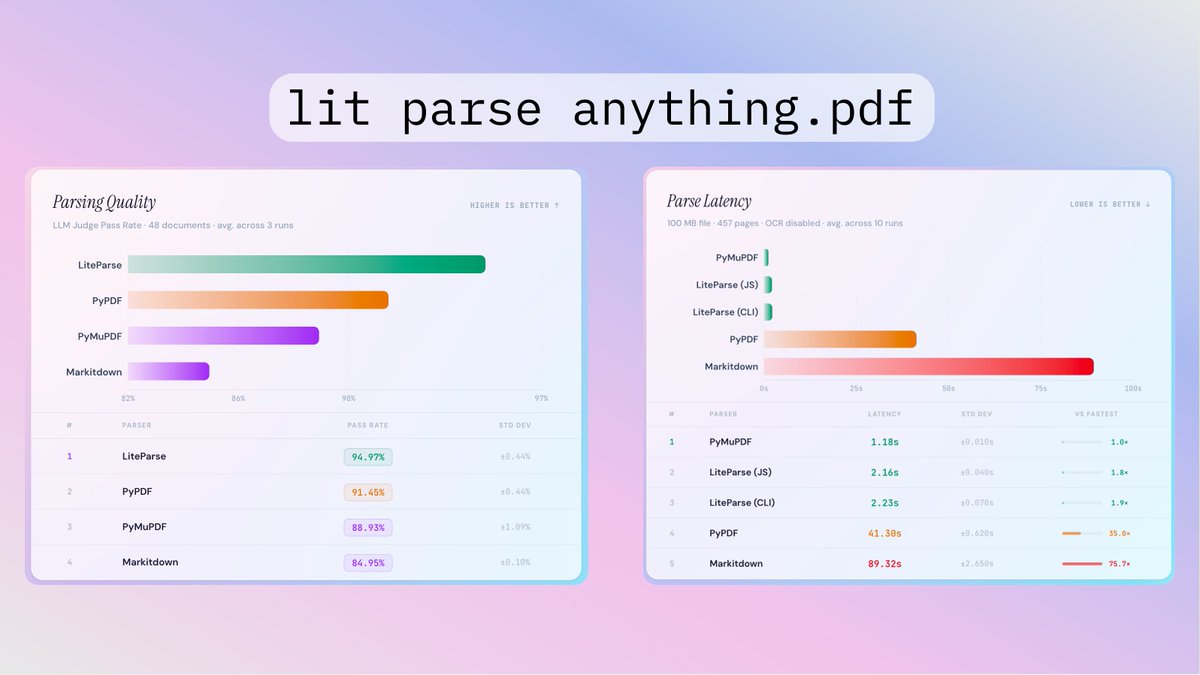
We just open-sourced LiteParse 🎉 A lightweight, local document parser in the shape of an easy-to-use CLI. No API calls, no external service, no cloud dependency. Just fast text extraction from common file formats, right from your terminal. It's built for developers who want parsing that stays on their own infrastructure and gets out of their way. Clean PDFs, DOCX, HTML: run it, get your text, move on. The output is designed to be fed straight into agents so they can read parsed text and reason over screenshots without any extra wrangling. When you hit more complex territory like scanned docs, dense tables, or multi-column layouts, that's where LlamaParse picks up. Same philosophy, more horsepower for the hard stuff. 📖 Announcement post: llamaindex.ai/blog/liteparse… 🔗 GitHub: github.com/run-llama/lite… 🎬 Walkthrough: youtu.be/_gcqMGUWN-E
YouTube video
YouTube
Tuana tweet media
English
19
71
702
62.7K
Madison May (e/ia) retweetledi
Anthropic
Anthropic@AnthropicAI·
A statement from Anthropic CEO, Dario Amodei, on our discussions with the Department of War. anthropic.com/news/statement…
English
4.3K
9.4K
55.9K
16.5M
Madison May (e/ia) retweetledi
Neil Rathi
Neil Rathi@neil_rathi·
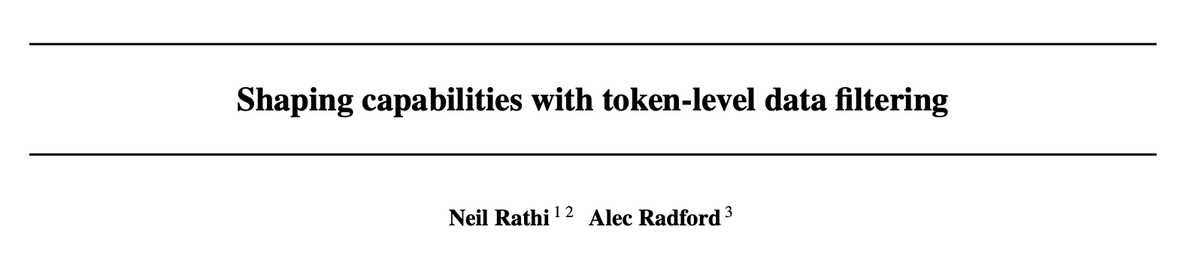
New paper, w/@AlecRad Models acquire a lot of capabilities during pretraining. We show that we can precisely shape what they learn simply by filtering their training data at the token level.
Neil Rathi tweet media
English
27
98
1.1K
104.9K
Madison May (e/ia) retweetledi
Andrej Karpathy
Andrej Karpathy@karpathy·
@bcherny I have similar experiences. You point the thing around and it shoots pellets or sometimes even misfires and then once in a while when you hold it just right a powerful beam of laser erupts and melts your problem.
English
55
96
4.1K
492.3K
Madison May (e/ia) retweetledi
Simon Willison
Simon Willison@simonw·
Something I really want to exist is a comprehensive guide to the sandboxing feature of all of the popular coding agents: what they do, how they work, how reliable they are (I have a nasty feeling I'm destined to pull this together myself and I really don't want to do the work)
English
39
27
496
37.1K
Madison May (e/ia) retweetledi
Soumith Chintala
Soumith Chintala@soumithchintala·
Leaving Meta and PyTorch I'm stepping down from PyTorch and leaving Meta on November 17th. tl;dr: Didn't want to be doing PyTorch forever, seemed like the perfect time to transition right after I got back from a long leave and the project built itself around me. Eleven years at Meta. Nearly all my professional life. Making many friends for life. Almost eight years leading PyTorch, taking it from nothing to 90%+ adoption in AI. Walking away from this was one of the hardest things I've ever done. But I'm leaving with a full heart. PyTorch handles exascale training now. It powers foundation models that are redefining intelligence. It's in production at virtually every major AI company. It's taught in classrooms from MIT to rural India. The tools I dreamed about making accessible? They are. The barrier to entry I wanted to lower? It's almost gone. To be clear, there’s so much more to do. As long as AI evolves at a breakneck pace, PyTorch will continue to play catch up. Obsessing over the yet-to-come sometimes makes us forget how much we’ve already done. To everyone who built this with me—who believed research should be joyful, that tools should be elegant, that open source changes everything—thank you. This wasn't my journey. It was ours. What's next for me? Something small. Something new. Something I don't fully understand yet. Something uncomfortable. I could have moved to something else inside Meta. But I needed to know what's out there. I needed to do something small again. I couldn't live with the counterfactual regret of never trying something outside Meta. It's very hard to leave. I probably have one of the AI industry’s most leveraged seats, I lead the software layer that powers the entire AI industry. Every major AI company and hardware vendor are on a speed dial. This kind of power is really hard to give up. But curiosity ultimately won out in my head. Keep making AI delicious and accessible. I'll be watching. Probably filing issues. Definitely staying involved. Is PyTorch going to be okay? I don't want to be doing PyTorch forever. I don't want to be like Guido or Linus— bound to a single thing for decades. Last November, coinciding with the birth of my daughter, I started planning my exit with Aparna. My goal was to leave PyTorch in a good and stable place. By this August, during the second half of my parental leave, I knew: Edward, Suo, Alban, Greg, John, Joe and Jana were ready. The team faced hard people, product, technical and organizational problems and didn’t feel the need to lean back on me to solve these for them (unlike in the past). The product story they crafted for the PyTorch Conference was coherent—really coherent. The things I'd flagged red were turning healthy. The project didn't need me anymore. Unlike 2020-2022 (when I stepped down to go do robotics and came back when Lin, Dima and Dwarak left), I have strong confidence that this time PyTorch is truly resilient. The most aligned culture carriers of PyTorch – Greg, Alban, Ed, Jason and Joe are at the decision table now, and people with strong value alignment – Suo, John and Jana have joined them at the table. And there’s a long list of equally value-aligned people willing to sit at the table should any of these people leave. There are many little things that make up my confidence on the people – John worked on Julia and open-source for a very long time (in fact we hacked a Torch.jl in 2015), Suo has been the strongest systems builder and strategic partner I’ve had for the past two years, and Jana worked on resilient core systems for a very long time, I’ve had long technical and organizational discussions with her over the past few months that give me confidence. And the product lineup and execution in 2025 should be sufficient evidence for any remaining doubt. I’m confident that this band of PyTorchers are going to do exceptionally well. PyTorch might change in flavor because I no longer impose my own taste from the top, but I’m confident that the values are going to stay intact and the product is going to be awesome. My time at Meta The early years of FAIR were absolutely magical. I was part of a small family of absolutely brilliant people building state-of-the-art AI out in the open. From working on GANs with Emily Denton, Rob Fergus, Leon Bottou, Martin Arjovsky and the (now legendary) Alec Radford to building Starcraft bots with Gabriel Synnaeve, to building the first FAIR Cluster with Howard Mansell, to working on object detection with Adam Lerer and Piotr Dollar, to building PyTorch. It was more fun than I can describe in words. 2015 and 2016 were probably the most productive and professionally enjoyable years of my life. I’ll probably romanticize this period of my life forever. When I joined FAIR, I had massive impostor syndrome, and the first 3 months were very very difficult. I can’t credit Andrew Tulloch enough for being the most thoughtful, kind and welcoming mentor, without whom I wouldn’t have made it. I’m so damn bullish for Meta just from the fact that he’s back. --- My time on PyTorch was special. I loved every part of building it—designing it, managing it, being the PM, TL, comms lead, doc engineer, release engineer, squashing bugs, growth hacking, turning it into a coherent product with hundreds of people, transitioning it to industry stakeholdership – the whole nine yards. To the core PyTorch team at Meta: the engineers, researchers, open-source maintainers, docs writers, CI infrastructure folks, hardware partners, the community builders. To the hundreds more inside and outside Meta—thank you. You turned a library into a movement. There are too many people to credit and thank, but I can't not mention Adam Paszke, Sam Gross, Greg Chanan, Joe Spisak, Alban Desmaison, Edward Yang, Richard Zou, Tongzhou Wang, Francisco Massa, Luca Antiga, Andreas Köpf, Zach DeVito, Zeming Lin, Adam Lerer, Howard Mansell and Natalia Gimelshein. And Schrep. They made the launch happen. And so many more people became centrally important later: Lu Fang, Xiaodong Wang, Junjie Bai, Nikita Shulga, Horace He, Mark Saroufim, Jason Ansel, Dmytro Dzhulgakov, Yangqing Jia, Geeta Chauhan, Will Constable, Briah Hirsh, Jane Xu, Mario Lezcano, Piotr Balecki, Yinghai Lu, Less Wright, Andrew Tulloch, Bruce Lin, Woo Kim, Helen Suk, Chris Gottbrath, Peng Wu, Joe Isaacson, Eli Uriegas, Tristan Rice, Yanan Cao, Elias Ellison, Animesh Jain, Peter Noordhuis, Tianyu Liu, Yifu Wang, Lin Qiao and hundreds more. It’s criminal of me to not take the space to list out everyone else I should be mentioning here. PyTorch is nothing without its people ❤️. The most joyful moments of building PyTorch was meeting users eager to share their happiness, love and feedback. I remember a grad student coming to me at Neurips 2017, in a slurring emotional voice he said he’d been trying to make progress on his research for 3 years but within 3 months of using PyTorch he made so much progress that he was ready to graduate. That moment made it tangible that what we do matters, a lot, to a lot of people, even if you don't constantly hear from them. I do miss the intimacy of the PyTorch community, with a 300 person conference that felt like an extended family gathering, but I feel that’s a small price to pay considering the scale of impact PyTorch is truly having today – yes the Conference is now 3,000 people where market-moving deals get brokered, but it’s helping orders of magnitude more people to do their best AI work. I miss the intimacy, but I'm proud of that growth. --- To Mark Zuckerberg and Mike Schroepfer, who believed that open-sourcing is fundamentally important and is a sound business strategy. This is so hard to understand for most people within the course of business, but we’ve run lock-step on this strategy without ever having to discuss it. Without you two, neither FAIR nor PyTorch would’ve happened. And those mean so much to me. To Yann LeCun and Rob Fergus, for building the magical early FAIR that I so revere. To Aparna Ramani, a leader that I find so rare at Meta in her ability to hold a really high bar for the org, technically brilliant with the span to discuss deep infra systems and industry-strategy within the same conversation and for being an absolute execution-machine! I’ve learned so much from you. To Santosh, Kaushik, Delia, Oldham and Ben for being so welcoming to Infra. For someone coming over from FAIR with a wildly different culture, you all made me feel at home and made me part of the family, and thank you for that. To all my managers who've championed me through the PSC video game – Serkan, Howard, Jerome, Abhijit, Yoram, Joelle, Aparna and Damien – I owe you a lifetime of drinks. --- Signing off for now. —Soumith
Soumith Chintala tweet media
English
491
571
10.8K
2.5M
Madison May (e/ia) retweetledi
Vik Paruchuri
Vik Paruchuri@VikParuchuri·
We're hiring in NYC! DM if you're interested in training SoTA OCR models, and helping thousands of customers (including tier 1 AI labs) work with documents.
Datalab@datalabto

We're growing the team! 📍 NYC 🧠 Roles: Research Engineer, Founding Solutions Engineer 🔗pages.datalab.to/careers-main You: want to build and scale SoTA infrastructure loved by 50k+ developers and trusted by tier 1 research labs, Fortune 100s, and hyper-growth startups Us: 7x growth this year, well-funded (now through revenue), senior team that moves fast with autonomy

English
1
6
44
8.3K
Madison May (e/ia)
Madison May (e/ia)@pragmaticml·
Any good OSS options for translating LLM token usage numbers to $? Looking for an option that properly accounts for cached input pricing and has some auto-update mechanism to pull latest prices.
English
0
0
0
98
Madison May (e/ia) retweetledi
Lei Cui
Lei Cui@wolfshowme·
Beyond just text quality! We're introducing #DocReward, a model that evaluates and improves the visual structure and style of documents. In our tests, DOCREWARD achieved a 60.8% win rate in generating human-preferred documents, compared to GPT-5's 37.7%. arxiv.org/abs/2510.11391
English
1
4
7
1.4K
Madison May (e/ia) retweetledi
Jeremy Howard
Jeremy Howard@jeremyphoward·
It's a strange time to be a programmer—easier than ever to get started, but easier to let AI steer you into frustration. We've got an antidote that we've been using ourselves with 1000 preview users for the last year: "solveit" Now you can join us.🧵 answer.ai/posts/2025-10-…
English
47
115
880
160.1K
Madison May (e/ia) retweetledi
Thinking Machines
Thinking Machines@thinkymachines·
Efficient training of neural networks is difficult. Our second Connectionism post introduces Modular Manifolds, a theoretical step toward more stable and performant training by co-designing neural net optimizers with manifold constraints on weight matrices. thinkingmachines.ai/blog/modular-m… We explore a fundamental understanding of the geometry of neural network optimization.
Thinking Machines tweet media
English
111
448
2.9K
1.5M
Madison May (e/ia) retweetledi
Simon Willison
Simon Willison@simonw·
I'm ready to accept a definition of "agent" that I think is widely-enough agreed upon to be useful: An LLM agent runs tools in a loop to achieve a goal This is a big piece of personal character development for me! I've been dismissing the term as hopelessly ambiguous for years
English
135
119
1.8K
231.3K
Ankur Goyal
Ankur Goyal@ankrgyl·
Seeing many new software projects built around LLM dev pipelines. They are structured so that LLMs can (almost in an "RL environment" type of CI system), implement new features and respond to 3rd party updates, by running well-crafted tests.
English
1
1
8
1.9K