Prashish
124 posts



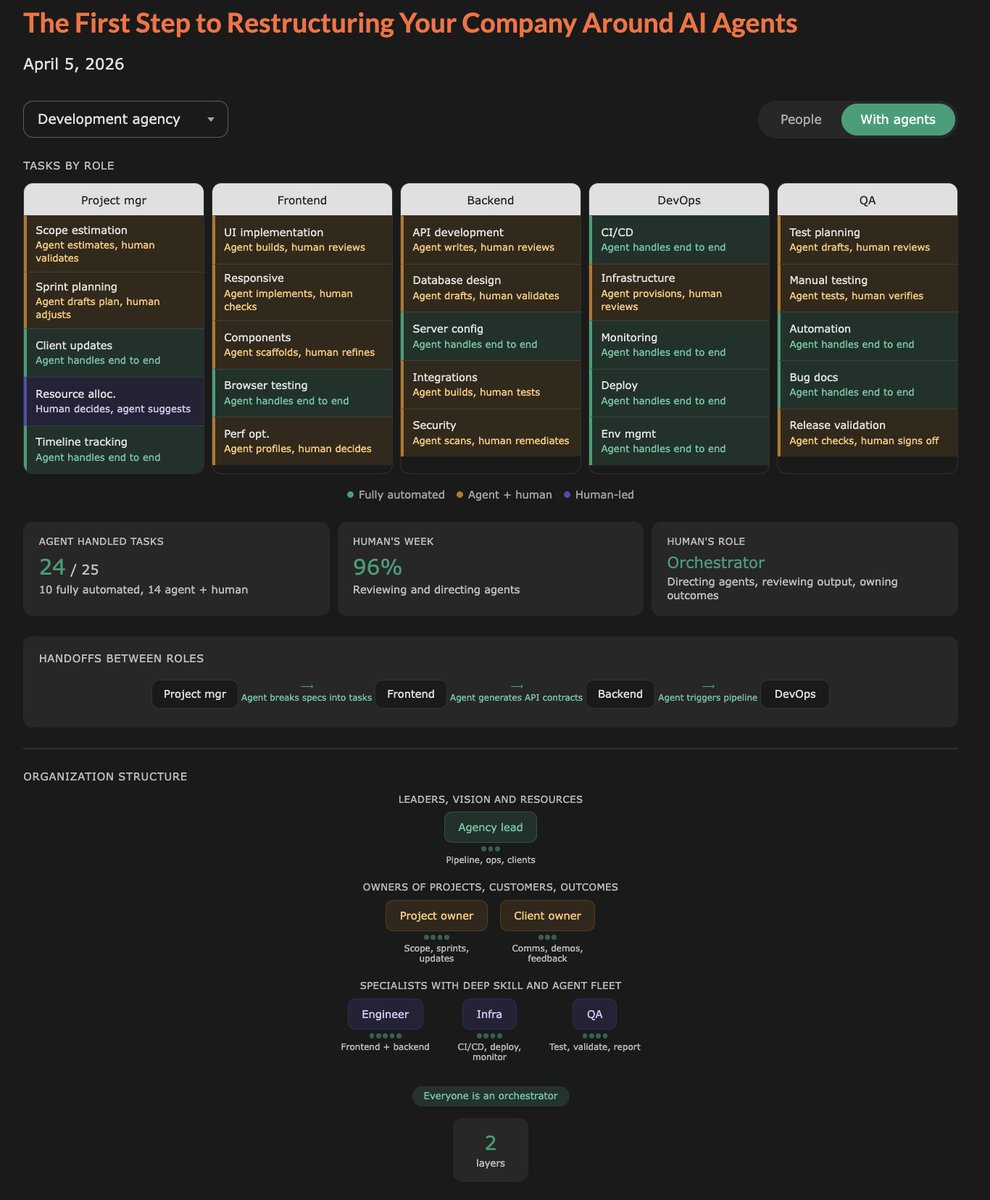
Companies have always been organized around roles, but a role is actually a bundle of tasks that cycle through each week.
The interesting thing about AI agents today is that they operate at the task level. An AI agent does not replace a role, but it can take over specific tasks within it.
And this is how we should be thinking about AI in our companies. Instead of asking “which roles can AI replace”, the better question is “which tasks inside each role can an agent take over today”.
Every task ends up in one of three buckets:
Fully automated: Tasks an agent can run from start to finish, like writing tests, posting on social, building reports, monitoring servers. The human sets it up once and the agent does the rest.
Agent and human: Tasks where the agent does most of the work and a human signs off before it goes out, like drafting a PRD, writing a blog post, reviewing code, preparing a campaign brief.
Human-led: Tasks where the judgment stays with the human and the agent supports it, like strategy, prioritization, brand decisions, escalations. The agent does most of the grunt work.
Here is the exercise for you: pick any role on your team and write down the five or six tasks for that role, then put each one into one of the three buckets. When you do this for every role, you end up with a draft of what your company looks like in the age of AI, and that map is the first step to restructuring.
English

We might be solving the wrong problem in robotics.
That’s what this makes clear.
UMI → Universal Manipulation Interface
A simple $400 gripper that lets you teach robots by demonstration.
You hold it like a tool. Show the task. The robot learns.
No teleoperation.
No expensive hardware.
No robot-specific data.
Stanford open-sourced everything → hardware, code, datasets.
What stands out to me is the bottleneck.
Not algorithms.
Data.
Teleoperation → ~35 demos/hour
UMI → ~111 demos/hour
And the data transfers across robots → UR5, Franka, others.
The design is surprisingly practical:
→ GoPro fisheye lens (155° FOV) + mirrors for depth
→ SLAM + IMU for precise 6DoF tracking
→ latency matching for dynamic tasks
→ diffusion policies for multimodal actions
Then it scales.
Cheng Chi takes this further with Sunday Robotics (with Tony Zhao).
A $200 glove → deployed in 500+ homes → ~10 million real-world interactions.
Not lab data.
Real human behavior.
Their robot learns dishes, laundry, espresso → with zero robot-specific data.
This is where the shift becomes obvious.
From training robots in controlled environments
→ to learning directly from humans at scale
So here’s the real question:
Will robotics be unlocked by better models… or by unlocking data?
#ArtificialIntelligence #Robotics #AI #Innovation #FutureOfWork
English
Rewrote* a project with 300+ files and 100+ directories down to 11 go files and 18 tsx/tx/css
* - Claude did it, do not try this at home
@levelsio@levelsio
photoai.com is a 40,870 line file called index.php $105,000/mo revenue $80,000/mo profit
English

@hardfire @prashishh I've been using an Oracle free VPS with 4 cores and 24 GB of RAM for almost 7 years, and it works pretty well for side projects.
English

@prashishh Been running off hetzner for some years now and very happy.
English
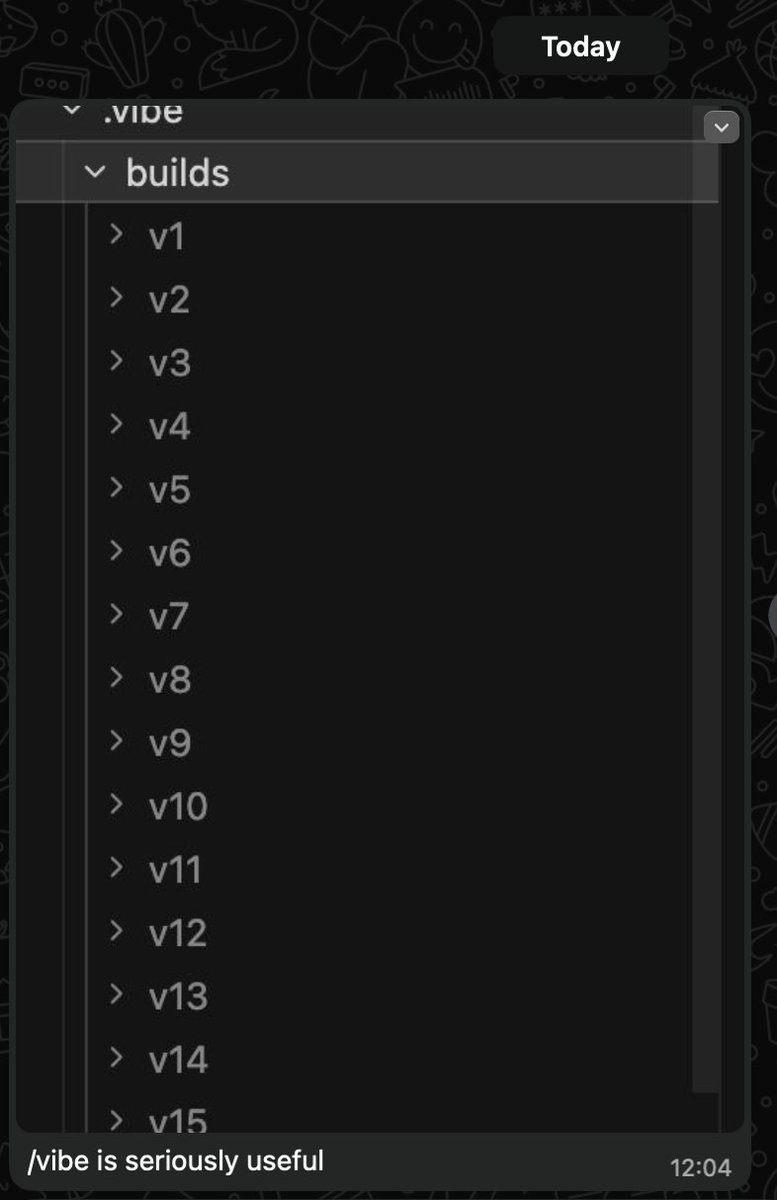
Don't have the budget to use Perplexity Computer? Just use vibe framework to build your app.
Plans all the builds and just leave it to execute it.
Here: github.com/prashishh/vibe
English

We hear a lot about how 'everyone' is adopting AI. But my experience shows that outside of the X bubble, most companies are still just scratching the surface.
They might use an LLM for simple code generation, but they're missing the full potential of coding agents or complex AI integrations.
The perceived widespread adoption is largely concentrated within a small, vocal tech-savvy groups.
The real transformation, where AI becomes fundamental, is still a few years out for the majority.
It feels like we're in a bubble where we assume everyone is as deep into this as we are, but they aren't.
English
The excitement surrounding AI right now feels like the NFT boom of 2021. Every day is packed with innovation, new ideas, and a rush to explore what's possible.
Just as I immersed myself in the NFT world, I'm diving deep into AI, trying out tools and envisioning what needs to be created.
English
@Timur_Yessenov During the planning phase, the md files pin points exactly which guardrails are touched and how. This allows you to review the arch or code changes before the implementation.
In the future, I'm planning to run tests like browser, agentic after each cycle.
English

@prashishh the plan to guardrails to ship pipeline is exactly what's missing from most agent setups. curious how you handle the case where the agent's plan conflicts with existing architecture decisions - that's where most frameworks break down
English
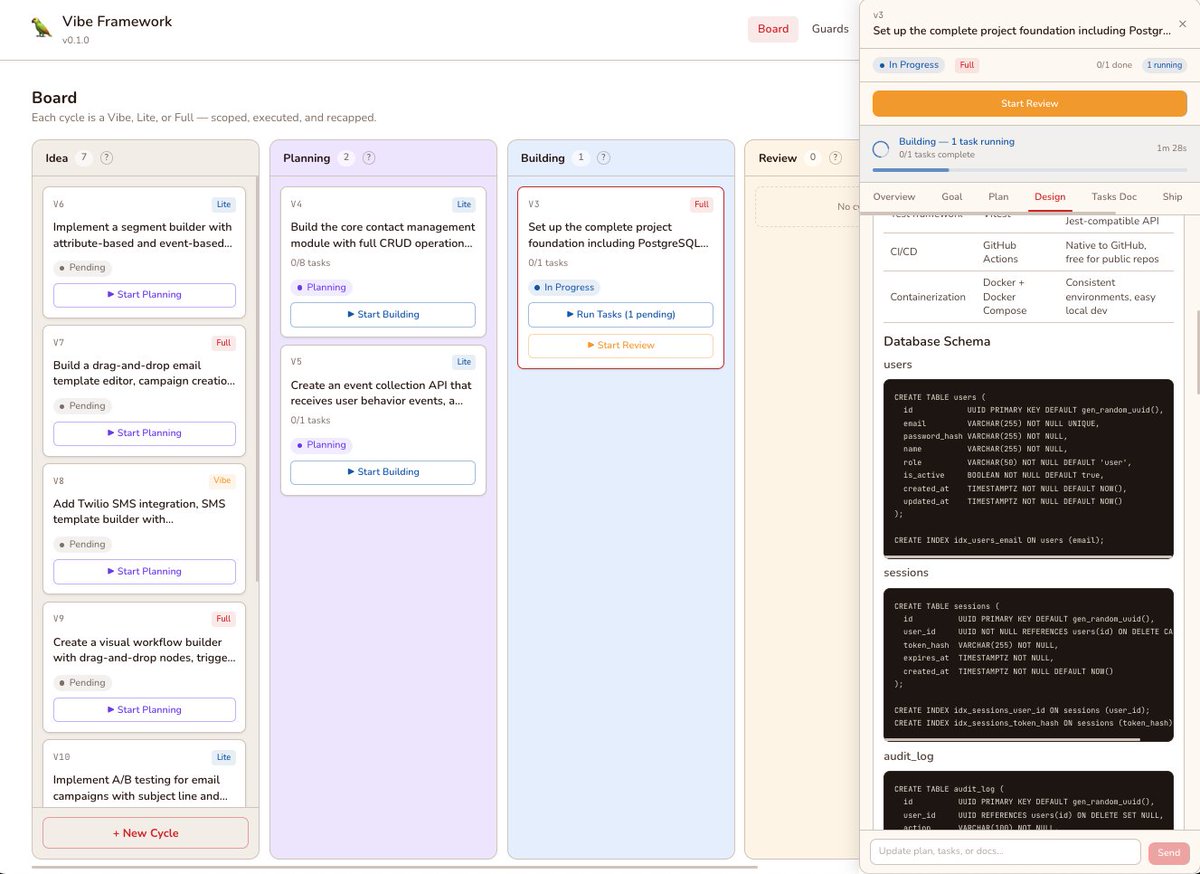
I got tired of AI agents just 'vibing' and breaking stuff so I built Vibe, a framework that turns vibe coding into real agentic software delivery
No more CLI roulette
Plan → Guardrails → Dashboard → Ship
Works in ANY repo with Claude/Codex right now
Full essay + repo: prashish.xyz/ai/vibe-framew…
github.com/prashishh/vibe

English