prerak

653 posts

prerak banner
prerak

prerak

@prerak_011

Strolling through big tech and centralized infrastructures . On hiatus from decentraland $ADA , $ERG , $BTC


Katılım Aralık 2024
14 Takip Edilen69 Takipçiler
prerak
prerak@prerak_011·
I spent my early 20s being a crypto degen and chasing magic internet money. Now is the time to careermaxx through the big tech path route
prerak tweet media
English
0
0
0
10
prerak
prerak@prerak_011·
@adamKDean Agree . We should stop all tech building initiatives for the next 6 months and only focus on getting users. We need more entrepreneurs then tech neckbeards now otherwise we risk becoming ergo - an academic project Instead of a thriving ecosystem
English
0
0
0
8
Adam Dean
Adam Dean@adamKDean·
@prerak_011 Yup, we need to build capacity for more passengers and containers but we also need to be advertising our berthing spaces
English
1
0
0
17
Adam Dean
Adam Dean@adamKDean·
Leios, node diversity, and new DSLs for smart contracts might be cool, but we can't ignore the fact that infrastructure and tech development is useless without users. We don't get users without things for them to do (services/applications) and without advertising to let them know those services and applications exist. Anything else is just technological masturbation. A chain capable of a gabillion transactions per second and instant finality without users is useless. Everything's a balance, spend and invest accordingly.
English
53
50
285
17.5K
prerak
prerak@prerak_011·
@paraschopra How does a sportsperson or a musician or an arist get great at their craft? They don't do jobs. They practice relentlessly, experiment , fail and learn. Only the people who have a passion for information systems will reach the top and that too themselves
English
0
0
0
5
Paras Chopra
Paras Chopra@paraschopra·
AI is automating interns/early stage jobs first as they require least amount of domain knowledge. If this means that experienced folks will start managing a fleet of AI agents instead of early-career professionals, who is going to train the next generation?
English
120
22
587
29.1K
prerak
prerak@prerak_011·
@Malay4Product what is the need for 4x4 grids? why not use GPS coordinates? Ik that coordinates result in overlapping since there are an infinite amount of coordinates. But even grids overlap. Atleast with GPS we have something that everybody understands
English
0
0
0
273
Malay Krishna
Malay Krishna@Malay4Product·
Not many are talking about it, but this is one of the most underrated things India is shipping right now and every Indian must know what this is all about. Let me explain; The system is called DIGIPIN and the username layer sitting on top is called DHRUVA. Built by the Department of Posts in partnership with IIT Hyderabad and ISRO's National Remote Sensing Centre. Officially launched on May 27, 2025. Here's how it works. DIGIPIN divides all of India into 4 metre by 4 metre squares. Every single square gets a unique 10-character code like 829-4G7-PMJ8. That's down to the level of your front door, your shop counter, your hospital entrance, your village home, even a fishing boat in territorial waters. The entire country is now a digital grid. But remembering a 10-character alphanumeric code is hard. So DHRUVA sits on top of it. You convert your DIGIPIN into a simple readable handle like rajesh@dhruva. The handle stays with you for life. If you move houses, only the underlying DIGIPIN updates. Your handle doesn't change. Exactly like UPI replaced 16-digit bank account numbers with simple handles. malay@ybl instead of remembering an account number. But why is our government building this? Today roughly 20-25% of Indian addresses are unstructured. Slums, tribal areas, unplanned colonies, rural homes without proper street names. An average Indian spends 8-12 extra minutes on an average in finding an address in India versus 2-3 in the West. Ambulances reach late because nobody can describe the lane. Banks reject mortgages because they can't verify the property location. Insurance claims get delayed because addresses don't match across documents. Quick commerce loses crores in failed deliveries every day. DIGIPIN solves all of this with one open-source standard. The full source code and documentation are on GitHub. Any government department, private company, or startup can integrate it for free. This is exactly the India Stack playbook. Aadhaar (identity), UPI (payments), ULPIN (land), DigiLocker (documents), and now DIGIPIN (address) are all open public infrastructure that private companies build on top of. Of course developed countries already use a version of this. But India is building the best of the lot. > UK uses postcodes plus house numbers. Works because they have structured street planning from the 1800s. We don't. > Dubai built Makani numbers. 10-digit codes tied to building entrances. Government-only, not open. > Japan uses block-based addressing that relies on physical signage and local familiarity. India just built the best version of all of these. Open-source, geo-coded, privacy-first, with a human-readable layer that even a non-tech grandparent can use. And it's free to integrate. Once this gets rolled out, the government expects that; > Ambulance response times improve by 40-60% in unplanned areas. > KYC verification becomes instant. No more manual address proof. > Rural credit unlocks. Banks can verify property and ownership in seconds for loans. > Disaster response improves. Floods, fires, earthquakes. Rescue teams know exact homes to reach. > Insurance pricing becomes location-precise. Same building, ground floor versus third floor, different flood risk, different premium. > E-commerce delivery accuracy goes from approximate to exact. Failed deliveries drop sharply. > Privacy too gets better. You share your DHRUVA handle, not your physical address. The delivery agent gets the GPS coordinates without seeing your full address. Less data exposed, less misuse. Boring infrastructure rarely gets any hype. Everyone laughed at UPI for the first two years. Now it processes 16 billion transactions a month and seven countries have adopted it. DIGIPIN will be the same story. In 5 years we'll wonder how we ever functioned without it. In 10 years it'll be quietly running underneath every delivery, every emergency call, every loan approval in India.
Indian Tech & Infra@IndianTechGuide

🚨 India is working on a UPI-style unique username-based digital addressing system that would enable people to send and receive parcels, letters, food deliveries, and other services without sharing a conventional physical address. 🤯 (ET)


English
31
612
2.6K
175.6K
prerak
prerak@prerak_011·
@DevanshuXi Agree , even true for tech adjacent roles in the tech world. My sister was looking for a product management role in AI companies while being from Chicago but struggled a lot . As soon as she moved to SF, had several founders interested
English
0
0
0
56
Devanshu
Devanshu@DevanshuXi·
Over the past couple of months, I’ve had several great conversations with SF and EU based companies founders even from the top frontier labs. But the moment they learn I’m not US-based, interest often drops even after strong technical discussions and interviews. It’s a reminder that geography still creates an unfair advantage in tech hiring. Being in the US or Europe is definitely an unfair advantage. Anyways I'll keep going.
English
2
1
46
1.9K
prerak
prerak@prerak_011·
I remember generic job seeking advice in 2021 was apply to all jobs, even if you're unqualified for it. You might get lucky and the recruiter might still call you . Today, even the qualified resume with all keywords matching end up in a blackhole of ATS
English
0
0
0
15
prerak
prerak@prerak_011·
@pulkit_mittal_ No doubt offer B. 20s are for exponential growth and obsession for the craft since you have no health problems or family responsibilities yet
English
0
0
1
29
pulkit mittal
pulkit mittal@pulkit_mittal_·
You’re 28. You get two backend engineer offers: Offer A: - ₹20 LPA - 35 hrs/week - Slow growth - WFH Offer B: - ₹40 LPA - 70 hrs/week - Rapid growth - Work from Office What would you choose?
English
5
1
14
1.3K
prerak
prerak@prerak_011·
@StealthQE4 No shit sherlock. Who thought that the asset which was supposed to be the antithesis of centralized banking and stock would die when it stops being decentralized and ends up in the hands of those elite
English
0
0
0
3
QE Infinity
QE Infinity@StealthQE4·
The Bitcoin cult has died. It just doesn’t move much anymore. I never hear anyone talking about it. The laser eyes have disappeared on X. It’s slowly becoming just another asset class.
QE Infinity tweet media
English
659
37
1.1K
165.9K
prerak
prerak@prerak_011·
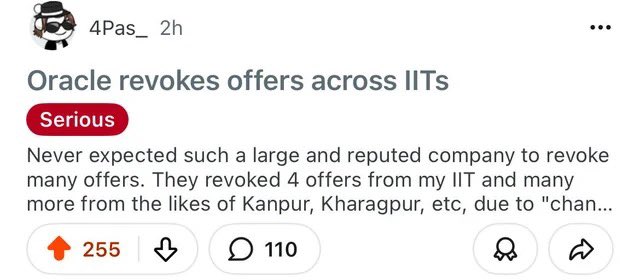
@divyaporwal_ Unfortunately SDE1s do not bring that much value to a company anymore and Oracle wouldn't be hiring again anytime soon so a ban is a price they're willing to pay to go all in on AI.
English
0
0
0
9
Divya Porwal
Divya Porwal@divyaporwal_·
Big tech hiring decisions are getting harder to understand…. Oracle already laid off 30k employees sometime back, and now I’m seeing offer revocations too. If hiring isn’t certain, why roll out offers in the first place? Candidates plan their careers, sometimes even reject other offers based on this. For a company of this scale, this just feels really disappointing.
Divya Porwal tweet media
English
15
6
90
10.8K
Polymarket
Polymarket@Polymarket·
JUST IN: Meta employee morale is reportedly at “historic lows”
English
336
266
6.8K
695.9K
prerak
prerak@prerak_011·
@Saxena5p @shrav_10 hard disagree. An IIT is a brand for life, not a get a quick job scheme . It will help you with networking, startups , higher education , internal politics all your life
English
0
0
0
5
Saxena
Saxena@Saxena5p·
@shrav_10 I had one campus offer and one off campus offer None got revoked….joined and working peacefully at a good pay IITs are overrated TBH….luck matters more than anything else
English
1
0
0
155
Shravani
Shravani@shrav_10·
Just gave a thought about how happy the students must have been when they got those offers a few months back, without even wondering that something like this could happen. With most campus placement rules, once you get placed, you’re usually not even allowed to sit for other companies. Which means many of them probably had no backup option at all, and now they have to start from scratch again. This should honestly be an eye-opener for all of us. Keep trying off-campus too, don’t stay completely dependent on campus placements. Doesn’t mean off-campus is fully safe either, but at least you’re not restricted by placement policies. You get to try multiple times and keep your options open.
Indian Tech & Infra@IndianTechGuide

🚨 Oracle is laying off a few employees and withdrawing many placement offers in India.

English
4
8
158
10.5K
prerak
prerak@prerak_011·
@letmecodeee I don't think it matters that much to Oracle tbh. Oracle is already laying off thousands and hoping some people leave themselves. Also, the value of an sde1 is not that much anymore after AI. They were just deadweight and oracle would not miss hiring from these colleges
English
0
0
0
22
Rage
Rage@letmecodeee·
The number of offers Oracle revoked. I can sense all the IITs collectively prohibiting them from making offers anymore on campus, like they did previously with that one company.
English
8
23
1.1K
58.8K
prerak
prerak@prerak_011·
@pulkit_mittal_ You should make this a daily question of the day system design interview thingy
English
0
0
0
7
pulkit mittal
pulkit mittal@pulkit_mittal_·
If 10M users order on Swiggy during dinner rush... Are we opening 10M database connections?
English
11
2
32
5.3K
prerak
prerak@prerak_011·
@mrtn_ergo @ergo_platform do we have any initiatives to get users to this blockchain too or just a bunch of tools nobody uses?
English
0
0
0
13
prerak
prerak@prerak_011·
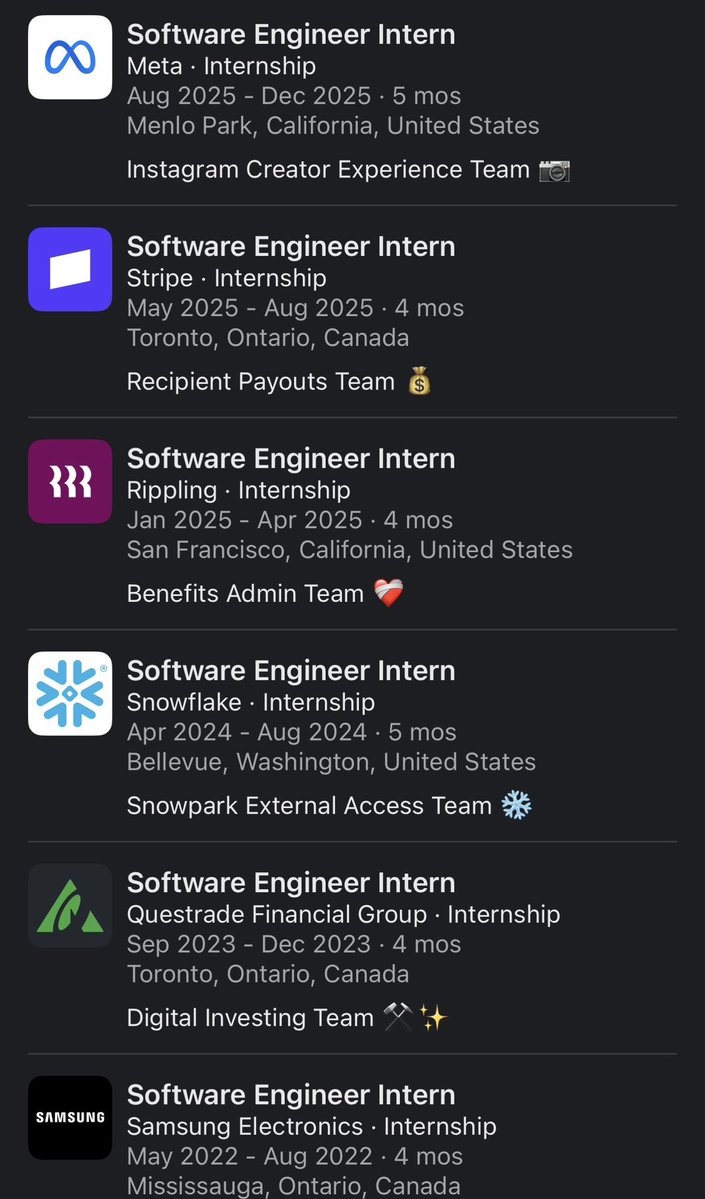
@HelloVyom Compare the openings per capita between USA and India and you will know. Add to that a decades old apprenticeship + interning culture. A lot of companies in India didn't even have internships programs until 10 years ago
English
0
0
0
12
VG🌪️
VG🌪️@HelloVyom·
Why do we never see Indian students with sooo much work experience while students in the west manage to do 5-6 high quality internships in tech even before graduating? Look at this -> Meta, Stripe, Rippling, Snowflake, Questrade, Samsung ☠️
VG🌪️ tweet media
English
74
17
603
102.3K
prerak
prerak@prerak_011·
@arnav_kumar We just need to get better and get in the top 10% . Everything else is a skill issue
English
0
0
0
2
arnav
arnav@arnav_kumar·
I believe AI is not going to kill jobs. In fact it might create more jobs But AI is going to compress wages. When a 10x engineer, designer, marketer or lawyer can do the work of 50 average ones, the market stops paying a premium for being “decent”. The middle class knowledge work will get Uber-ified. The AI impact is not a jobs crisis. It is a wages crisis.
English
7
2
61
4.3K
prerak
prerak@prerak_011·
Surprised to see wazirx getting promoted on X after the hack and the legal theft of consumer funds @NischalShetty . Looked at the accounts and apparently they are all bots bought by wazirx to get their hashtag in trending. smh #WazirXFutures
English
0
0
0
12
prerak
prerak@prerak_011·
@DevanshuXi do you use a centralized database to check which links have already been processed across different nodes?
English
0
0
0
4
Devanshu
Devanshu@DevanshuXi·
One thing I’ve started appreciating while building this crawler infrastructure is how effective Breadth-First Search actually is for web crawling. The crawler frontier naturally behaves like a graph traversal problem: every webpage is a node, every hyperlink is an edge, and the crawler is continuously exploring the graph layer by layer. Using BFS-style traversal gives a lot of practical advantages. You stay closer to the “important” parts of a site early on because you explore pages near the seed URLs first instead of disappearing 500 links deep into some random archive page. That matters a lot for: - freshness - topical relevance - crawl budget efficiency - avoiding crawl traps - reducing infinite pagination disasters A DFS-style crawler can easily get trapped going insanely deep into: /page/1 → /page/2 → /page/3 → … while BFS naturally spreads exploration across the graph. What’s interesting is that modern crawlers don’t use “pure BFS”. They evolve into something closer to: priority-weighted distributed BFS. Because eventually you start mixing: - depth scoring - domain politeness - crawl budgets - retry queues - host scheduling - canonicalization - freshness signals - priority boosts for docs/news/blog pages So now the frontier becomes this massive scheduling system where BFS is still the underlying philosophy, but layered with heuristics and distributed systems constraints. Even the data structures reflect this evolution. The early prototype used simple: HashSet + VecDeque which is literally classic BFS queue traversal. But at scale it evolves into: persistent frontier tables, lease-based queues, priority heaps, domain scheduling state, fault-tolerant recovery, and distributed work stealing. Kinda funny how one of the first graph algorithms we learn in college quietly becomes one of the foundational ideas behind crawling the internet at planetary scale.
Devanshu@DevanshuXi

Okay so I wanna share something I’ve been building for the past few days. Built a Rust-based distributed crawler targeting 100M+ pages/day. Right now it’s still single-node, but the core architecture is finally coming together. Structured it as a modular Rust workspace with crates like: crawler-core, crawler-fetch, crawler-parse, crawler-storage, crawler-frontier, crawler-cli A lot of the work went into making the crawler actually production-grade instead of just “fetch pages in a loop”. Implemented: * URL normalization (utm stripping, host normalization, query sorting, canonicalization, registrable domain extraction) * Real robots.txt support with caching + longest-prefix matching * Domain-level politeness scheduling * SQLite-backed persistent frontier * Lease-based task recovery so worker crashes don’t lose crawl state * Retry system with exponential backoff * Async fetcher with compression, redirects, latency tracking, SHA-256 body hashing *HTML parser for title/canonical/outlinks extraction * Durable dedupe across restarts * Priority scheduling over crawl frontier * Crawl safety limits + static asset filtering * URLs now move through an actual lifecycle state machine: * queued → leased → fetched | blocked | failed * and expired leases can safely recover after crashes. The interesting part is that the crawler is slowly turning into a distributed systems problem: scheduling, fault tolerance, fairness, backpressure, leases, retries, adaptive politeness, durable state, content identity, etc. Current result: a restart-safe, polite, persistent crawler core that can crawl, parse, dedupe, retry, schedule, and recover leased work reliably. Have to engineer it more. Rust has honestly been insanely good for this kind of systems engineering.

English
3
0
42
1.7K