Rajesh Narayanan

176 posts

Rajesh Narayanan banner
Rajesh Narayanan

Rajesh Narayanan

@prof_narayanan

Hermann Moyse Jr. Professor of Finance, @financeLSU, @LSUOursoCollege, @LSU. Tweets are mine

Baton Rouge Katılım Mart 2020
350 Takip Edilen109 Takipçiler
Rajesh Narayanan
Rajesh Narayanan@prof_narayanan·
@alz_zyd_ @RefineInk Yeah - I don’t think there is a formula or best practice. Everybody’s workflow will be different. After all, ideation is to some extent unstructured thinking!
English
0
0
1
18
alz
alz@alz_zyd_·
@prof_narayanan @RefineInk just kidding. idk it's pretty random honestly. Stuff I've worked on before, stuff I randomly hear about, stuff I see at conferences... idk
English
1
0
1
57
alz
alz@alz_zyd_·
I am very late to the party but @RefineInk is very good. When you prompt ChatGPT/Gemini/etc to proofread a paper, even on highest settings, they miss a lot of stuff even through repeated passes. For some reason Refine is very good at catching inconsistencies/errors/etc
English
3
6
114
22K
alz
alz@alz_zyd_·
@RefineInk As far as I can tell, the tool isn't so good for ideating/figuring out macro directions for your paper; that doesn't seem to be the goal. I have a nice system with ChatGPT/Gemini/etc for this. But I'm going to be using Refine for pre-submission checks aggressively from now on
English
2
0
21
3K
Rajesh Narayanan
Rajesh Narayanan@prof_narayanan·
New working paper that shows how this wave of banking industry restructuring is being driven by financially sophisticated and technologically savvy customers who are interest-rate sensitive and for whom the amenity value of a branch is low. nber.org/papers/w33773
English
0
2
8
1.8K
Rajesh Narayanan
Rajesh Narayanan@prof_narayanan·
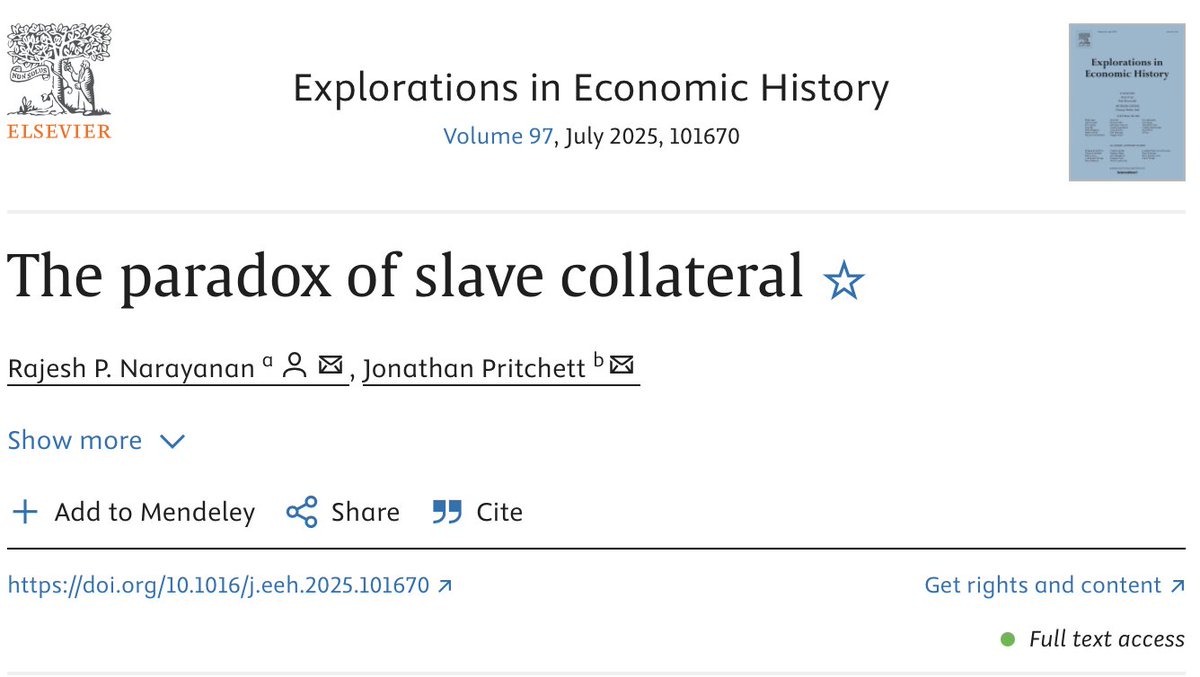
🧵 THE 1619 PROJECT (@1619Project) REVISITED: Our forthcoming paper challenges narratives about slavery & American capitalism. Some surprising findings... (1/13)
Rajesh Narayanan tweet media
English
0
1
0
91
Rajesh Narayanan
Rajesh Narayanan@prof_narayanan·
The @1619Project demonstrates the power of narrative in shaping understanding of history. But empirical research is essential for testing narratives. Our paper "The Paradox of Slave Collateral" adds nuance to this important discussion. (13/13)
English
0
0
0
76
Rajesh Narayanan
Rajesh Narayanan@prof_narayanan·
As we continue discussions about slavery's economic legacy, historical accuracy matters. The relationship between slavery and American capitalism was profoundly exploitative, but also complex and sometimes contradictory. (12/13)
English
1
0
0
43
Rajesh Narayanan
Rajesh Narayanan@prof_narayanan·
Creditors balanced two opposing forces: Liquidity: Ease of selling assets to recover loans Security: Certainty assets remain available if needed Our evidence shows security risks outweighed liquidity benefits. Lenders viewed slaves as RISKIER collateral. (5/13)
English
1
0
0
48
Rajesh Narayanan
Rajesh Narayanan@prof_narayanan·
Why would lenders prefer land to slaves as collateral? We call this "the paradox of slave collateral" - the same mobility that made slaves potentially liquid assets also made them risky (borrowers could abscond with them). (4/13)
English
1
0
0
37
Rajesh Narayanan
Rajesh Narayanan@prof_narayanan·
Our analysis of New Orleans records (America's largest slave market) shows: Land, not slaves, dominated credit markets (80% of expenditures) 77.5% of slave sales were cash (vs. only 29% of land sales) Slave-backed loans had higher interest rates (+1.18%) Shorter loan terms (3/13)
English
1
0
0
42
Rajesh Narayanan
Rajesh Narayanan@prof_narayanan·
Matthew Desmond wrote in @1619Project that "Southerners decided to use the people they owned as collateral for mortgages and took on immense amounts of debt." Ed Baptist, Walter Johnson & others claim slaves were "ubiquitous" and "attractive" collateral. But were they? (2/13)
English
1
0
0
33