Projector Group

746 posts

Projector Group banner
Projector Group

Projector Group

@projectorgroup

Reimagining public-market company-building. Life is a series of projects. Powered by people, purpose, moments and stories.

United Kingdom Katılım Nisan 2025
900 Takip Edilen85 Takipçiler
Projector Group retweetledi
Clifford Asness
Clifford Asness@CliffordAsness·
“I Did Not Predict What Is Going on in Privates” And to be clear there was no double entendre intended. aqr.com/Insights/Persp…
English
16
29
266
80.4K
Projector Group
Projector Group@projectorgroup·
@nejatian @SFarringtonBKC Do they not get better the more you hold onto them…? Home improvements. First moments. Memories. Traditions. Stories.
English
1
0
2
1.2K
Kaz Nejatian
Kaz Nejatian@nejatian·
@SFarringtonBKC Homes are not like wine. They don’t get better the more you hold onto them. Homes are meant for families to live in. So we try to fulfill our mission as fast as we can by getting folks into homes.
English
19
51
511
14.7K
Unemployed Value Degen
Unemployed Value Degen@SFarringtonBKC·
When @nejatian started at $OPEN, 51% of homes were on the market greater than 120 days? Now down to less than 10%? Faster!
Opentrack@operdoor2

Currently on @Opendoor, the percentage of homes listed for more than 120 days has fallen below 10%, reaching 9.48%. With these new houses, let's break even in the second quarter! $OPEN #Faster

English
4
13
163
18.1K
Projector Group
Projector Group@projectorgroup·
Do not underestimate the doom scroll nature of people. Social media, shopping, exploration. People like to be “served” content, with minimal effort. Does that chat-based nature enable this? Maybe. The output needs to be many multiples better than the current offering. Do not underestimate social media’s ability to allow users to switch off and double screen.
Projector Group@projectorgroup

Software with embedded AI fails if response time is slow. Having a conversation is actually less efficient if you have to explain, correct, type, speak. Swipes, gesturing, buttons are still more efficient for lots of applications.

English
0
0
0
11
Projector Group
Projector Group@projectorgroup·
Software with embedded AI fails if response time is slow. Having a conversation is actually less efficient if you have to explain, correct, type, speak. Swipes, gesturing, buttons are still more efficient for lots of applications.
English
0
0
0
16
Justin Welsh
Justin Welsh@thejustinwelsh·
The people I know who love their lives all figured out the same thing at some point: Money is a tool for buying back your time, not a number to maximize at all costs.
English
178
40
475
16.7K
Projector Group retweetledi
sid
sid@immasiddx·
Had a company meeting this morning. Glad to see everyone showed up.
sid tweet media
English
184
262
6K
204K
Projector Group
Projector Group@projectorgroup·
Blown away by the latest Claude release. Power to the noodlers, the fixers, the automators. Power away from the orchestrators and managers.
English
0
0
0
10
Projector Group retweetledi
Justine Moore
Justine Moore@venturetwins·
I have this weird new anxiety every time I’m sitting in a meeting and don’t have several long-running agents working on tasks for me 🙃
English
35
9
172
11K
Projector Group retweetledi
Julian Klymochko
Julian Klymochko@JulianKlymochko·
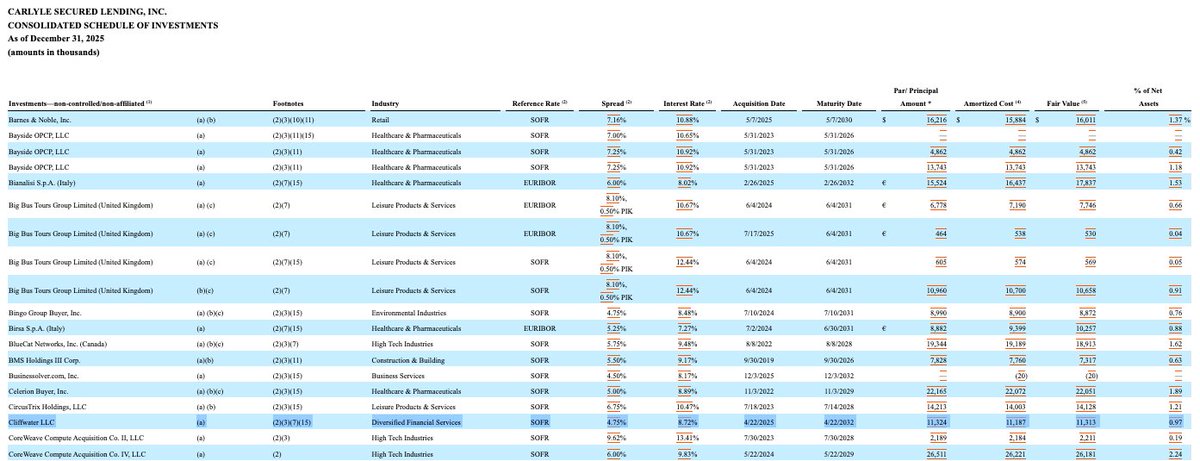
The circular relationships within the private credit ecosystem are fascinating. For example, Cliffwater invests in Carlyle's private credit fund. On the other end, Carlyle's private credit fund lends to Cliffwater (first lien loan shown below). So it appears that ultimately, Cliffwater is lending to and borrowing from itself.
Julian Klymochko tweet media
English
25
77
482
72.9K
Projector Group retweetledi
Auren Hoffman
Auren Hoffman@auren·
VCs can’t save your product. VCs can't help with product strategy etc. even if the VC built products in the same space (because usually the VC built that product a decade ago which is not relevant anymore). The best thing VCs can do is get out of your way and unblock (with intros, or advice during messy situations)
English
13
5
36
3.4K
Projector Group retweetledi
Trevor Noren
Trevor Noren@trevornoren·
Apollo's John Zito on private equity: "I literally think all the marks are wrong...This next cycle is going to be a big moment in time for the private markets because people are way smarter than I think private-market participants, particularly people in the wealth channel. Like, I kind of sense an arrogance of the people who grew up in the private-markets business . . . If you don’t mark your book, I think you actually lose trust with the clients." As I dissected in my report on the "Retailization of Private Markets" (sageroadresearch.com/collections/re…), it's dumbfounding how much enthusiasm for PE over the past decade+ was predicated on nakedly absurd performance assumptions. In an article in May, the FT dissected IRR claims made by both KKR and Apollo in 10-K filings. First, they quoted KKR: “From our inception in 1976 through December 31, 2024, our Private Equity and Real Assets investment funds with at least 24 months of investment activity generated a cumulative gross IRR of 25.5%, compared to the 12.2% and 9.5% gross IRR achieved by the S&P 500 Index and MSCI World Index, respectively, over the same period.” As for Apollo, it claims a 39% gross IRR generated by its private equity funds from inception through year-end 2024. The FT contextualized these numbers: "Across almost all regulatory and marketing material filed by private equity, awe-inspiring IRRs are common. Apparently, these private equity firms have managed to defy the laws of mathematics, economics—and reality. Since most people typically don’t have a good grasp of compounding, it might be helpful to express these numbers in dollars to show how fantastical they really are. If KKR’s first $31 million fund from 1976 had compounded at 26% a year it would be worth $2.6 trillion today. Add in its second $350 million fund and you get $13 trillion—more than the global PE market. Apollo’s first funds would now be worth $74 trillion, just shy of global GDP." Private credit problems could easily spill over into PE and finally force a reckoning with the "laws of mathematics, economics—and reality." To again quote Zito: “There’s . . . unlimited demand for secondary private equity but they are worried about private credit which finances 80% of those portfolios . . . I can’t compute, but I’m the dumb guy. I don’t understand. I start saying this and I get these blank stares back at me like OK, I don’t know.” This is a particularly acute concern for the broader US economy given the PE creep into small businesses over the past decade (chart below). Learn more about Sage Road Research: sageroadresearch.com. Interested in subscribing? Message me. WSJ interview with Zito: wsj.com/finance/invest… Chart source: bloomberg.com/news/articles/…
Trevor Noren tweet media
English
16
46
359
145.8K
Projector Group
Projector Group@projectorgroup·
One thing that is interesting in the AI era, is how consumers compartmentalise areas of their life. If they can connect all of our interactions, LLMs will know more about us than any other software in history, and thus give us incredible tailored experiences. Across health, fitness, fashion, organisation, household, life. But a lot of exploration happens at the edge of who we are. We explore new things with intention, but also subconsciously. We shut things down and go offline. Cognitive dissonance is pervasive. We associate different areas with different parts of our life with different brands. These brands can be online and offline. A journal for writing. A laptop for work. A book for winding down. Twitter for exploring the public town hall. Do we want one place for everything? Probably not. Of course, the LLMs are likely to power all of these experiences in their plumbing. But will they be the centre of our worlds? I am not sure.
English
0
0
0
5
Projector Group retweetledi
Marc Randolph
Marc Randolph@marcrandolph·
Get. Things. Done. Many years ago, in one of my earliest board roles, I was assigned to the board’s marketing committee. Every meeting followed a similar pattern: the head of marketing advised us on what he was doing, and my fellow board members and I would tell him what he was doing wrong and what he should do instead.  But quarter after quarter, none of it ever seemed to get done.   Looking back, I now see that our meetings were basically drive-by-shootings.  Show up, pepper the VP with ideas, and leave. Figuring out what the organization needed to do was easy.  The hard part, I leaned, was figuring out how to actually get it done. That simple insight has not only shaped my approach to every board I’ve sat on since, but it has also shaped my approach to my start-up work as well – and particularly to the way I treat the people working for me. It’s simply not enough to know what to do – the harder part is figuring out what it will take to get it done – and then making sure that the resources are there and the roadblocks removed. In the movie Oppenheimer, Lewis Strauss informs one of his advisors that  “Surviving in Washington is about knowing how to get things done.”  It’s no less true in Silicon Valley.
English
38
37
403
25.2K
Projector Group
Projector Group@projectorgroup·
@nikitabier @0x45o This is a wonderful framing. Twitter will have much better metrics here than any other social media.
English
0
0
0
10
Nikita Bier
Nikita Bier@nikitabier·
@0x45o My job is to increase unregretted time spent. Every tap, every word must be intentional and valuable to the user. If you get sucked into bad content, that’s time taken away from a conversation you could be having elsewhere.
English
279
67
2K
45.3K
Dan Go
Dan Go@CoachDanGo·
Get your body in shape, prioritize your family, manage your emotions, make money & have awesome experiences. Everything else is empty calories.
English
49
100
1.2K
33.8K
Projector Group retweetledi
junkbondinvestor
junkbondinvestor@junkbondinvest·
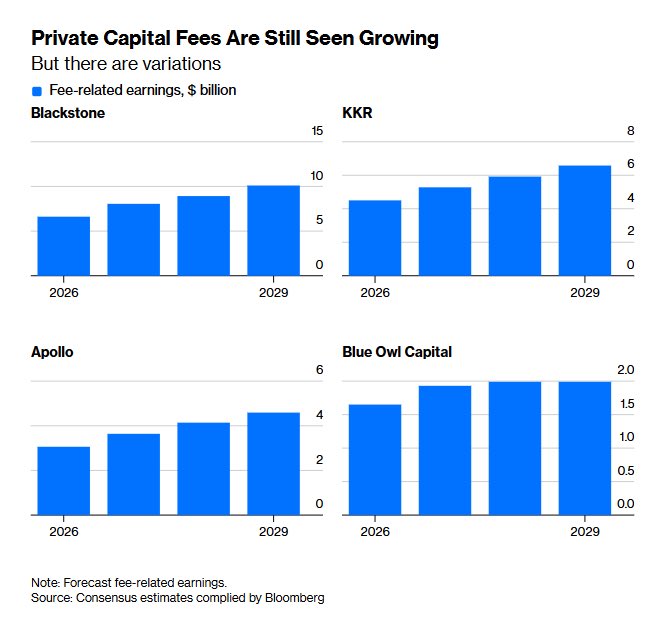
Alt manager valuations approaching conventional active fund manager levels. The firms they were supposed to replace. The premium depended on one thing: the belief that retail privates AUM only goes up. That belief lasted about 18 months.
junkbondinvestor tweet media
English
4
6
52
8.8K
Projector Group retweetledi
Trevor Noren
Trevor Noren@trevornoren·
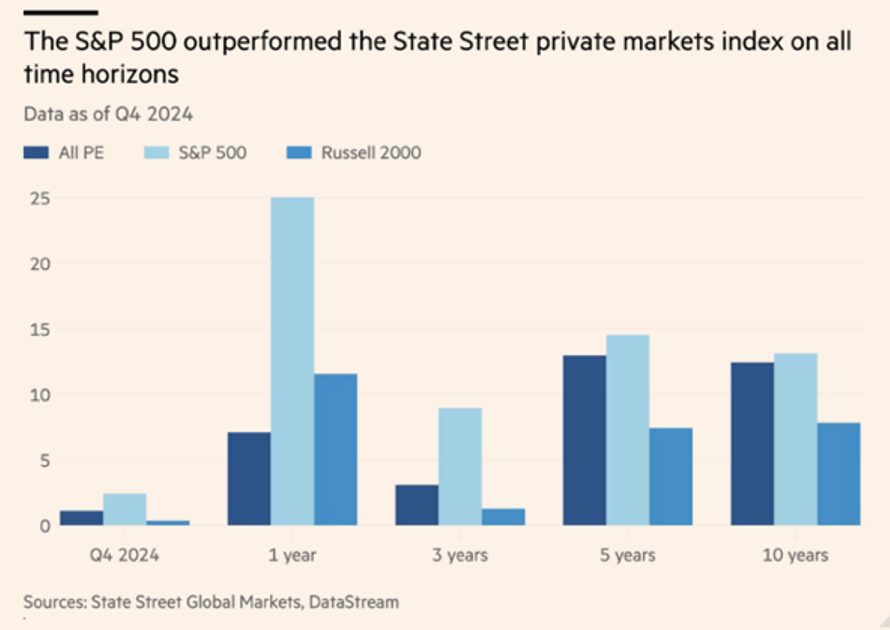
"Exit premiums are declining at record levels, calling into question the original valuations...Hard numbers show a worrying trend. In 2020 (depending on which data-set you use) exits on average were done at prices 35% to 51% above the last reported valuations. The 2025 numbers are now coming in. Data shows results from no premium to a discount of 5%. These are much the worst industry results — ever." — PE News As I dissect in my "Retailization of Private Markets" report (available here in full: sageroadresearch.com/products/the-r…), PE's performance deterioration has been ongoing for more than a decade. As AUM has increased, deal and manager quality has decreased. This logical progression was illogically ignored by too many. Warren Buffett summed it up in 2023: "The supply/demand situation for buying businesses privately and leveraging them up has changed dramatically from what it was 10 or 20 years ago." To quote the report: "The more money that floods to private markets, the more deal competition increases and therefore, the greater risk of performance deterioration. Evidence suggests this has already been the case given the tripling of private market AUM over the past decade. Again, performance methodologies vary. The exact numbers matter less than the trajectory of the numbers. And based on many calculations, private market returns are on a downward trajectory. Higher rates have repeatedly been credited for that trajectory. However, it began long before the pandemic. As Bain calculated in its 2020 Global Private Equity Report: “Since 2009, when the global economy limped out of the worst recession in generations, US public equity returns have essentially matched returns from US buyouts at around 15%. US buyout returns have converged with public equity returns over the current cycle, closing a three-decade gap in performance.” Rising rates have certainly not helped those performance challenges. As the FT reported in June, private market funds lagged the S&P 500 for the last three months of 2024, as well as on a one, three, five, and 10-year basis (chart below). It was "the first calendar year that private market funds have underperformed the stock index across all measured time horizons since 2000. The gap in performance last year between the two indices was also one of the largest on record.” As we argued in our reports on Deregulation and US Reshoring, we believe inflation will remain persistently above Fed targets and therefore, rates will remain higher for longer, regardless of a near-term cutting cycle. This combined with any private market inflow acceleration driven by retailization should continue to put downward pressure on private market returns." Learn more about Sage Road Research: sageroadresearch.com. Interested in subscribing? Message me. PE News link: penews.com/articles/jon-m…
Trevor Noren tweet media
English
1
9
25
3.4K