Farzana Rahman

1.6K posts

Farzana Rahman banner
Farzana Rahman

Farzana Rahman

@propicee

Academic @KingstonECE | Scientist| Bioinformatician| Alumni @UniSouthWales|Fellow @HEAcademy| OASciAdvocate | @ISCB Wikipedia Committee Co-Chair 🇬🇧

Katılım Mart 2010
420 Takip Edilen658 Takipçiler
Sabitlenmiş Tweet
Farzana Rahman
Farzana Rahman@propicee·
🚀 𝐈𝐦𝐩𝐚𝐜𝐭 𝐨𝐟 𝐂𝐎𝐕𝐈𝐃-𝟏𝟗 𝐨𝐧 𝐂𝐨𝐦𝐩𝐮𝐭𝐚𝐭𝐢𝐨𝐧𝐚𝐥 𝐁𝐢𝐨𝐥𝐨𝐠𝐲 𝐄𝐚𝐫𝐥𝐲 𝐂𝐚𝐫𝐞𝐞𝐫 𝐑𝐞𝐬𝐞𝐚𝐫𝐜𝐡𝐞𝐫𝐬 (#𝐄𝐂𝐑𝐬) It all started with one good chat with @GonzaParra_ , Sayane Shome et al., that planted an idea to explore: 𝘩𝘰𝘸 𝘸𝘢𝘴 𝘵𝘩𝘦 𝘱𝘢𝘯𝘥𝘦𝘮𝘪𝘤 𝘵𝘳𝘶𝘭𝘺 𝘢𝘧𝘧𝘦𝘤𝘵𝘪𝘯𝘨 𝘤𝘰𝘮𝘱𝘶𝘵𝘢𝘵𝘪𝘰𝘯𝘢𝘭 𝘣𝘪𝘰𝘭𝘰𝘨𝘺 𝘦𝘢𝘳𝘭𝘺-𝘤𝘢𝘳𝘦𝘦𝘳 𝘳𝘦𝘴𝘦𝘢𝘳𝘤𝘩𝘦𝘳𝘴 𝘸𝘩𝘰 𝘢𝘳𝘦 𝘯𝘰𝘵 𝘸𝘰𝘳𝘬𝘪𝘯𝘨 𝘪𝘯 𝘸𝘦𝘵-𝘭𝘢𝘣𝘴? Two years of participants' input at the virtual #ISMB #SCS conferences, particularly responses from Early Career Researchers (#ECRs), rigorous analysis by @i_am_kilpatrick , Sayane, @pradeeperanti, @meghegde97 , followed by a thorough review by @PLOS reviewers, our study is finally out in #PLOSComputationalBiology #PLOS Our retrospective study analyses the experiences of early‑career computational biology researchers worldwide during the 2020–2021 #COVID19lockdowns. 🧪 𝐊𝐞𝐲 𝐢𝐧𝐬𝐢𝐠𝐡𝐭𝐬: • Productivity plummeted: 81–85 % of ECRs reported being less productive than before lockdowns. Only ~4 % felt they were more productive. • Hidden burdens: Female researchers and those juggling childcare reported the greatest losses and stress. • Mental health gaps: Over 40 % of institutions offered no #mental‑health support in 2020, rising to 56 % in 2021. • Financial strains: Many #ECRs lost grant funding or income—a problem often overlooked for #dry‑lab work. • Not all bad news: Yet the shift to remote and hybrid work also brought unexpected positives. Many respondents advocated for continuing flexible work‑from‑home policies, and the community discovered that virtual conferences can broaden participation. Our findings call attention to the need for better mental‑health resources and financial support, even in dry‑lab disciplines. 🔗 𝐑𝐞𝐚𝐝 𝐭𝐡𝐞 𝐟𝐮𝐥𝐥 𝐩𝐚𝐩𝐞𝐫 𝐡𝐞𝐫𝐞: 👉 journals.plos.org/ploscompbiol/a… Grateful to have such a fantastic contribution from @i_am_kilpatrick  and the team, including ISCB Student Council ex and present leaders (@iscbsc ), and ISCB (@iscb ) - International Society for Computational Biology team, for turning a casual conversation into this evidence‑based contribution to the #compbio community. We hope this is a good read for anyone seeking to understand how COVID‑19 impacted not just wet‑lab scientists but researchers across computational biology and beyond. 👩‍🔬👨‍💻 Thanks to all survey participants and to the #ISMB, #ECCB and #SCS community for supporting this initiative. #ComputationalBiology #Bioinformatics #DryLab #ECR #COVID19 #MentalHealth #HybridWork #Inclusion #ScienceCommunity #ECRs #WorkingLifeduringPandemic
Farzana Rahman tweet mediaFarzana Rahman tweet mediaFarzana Rahman tweet media
English
0
3
8
638
Farzana Rahman retweetledi
Gonzalo Parra
Gonzalo Parra@GonzaParra_·
The main challenge behind doing a PhD is to maintain motivation and momentum along 4/5 years of work even in those dark moments when nothing is working, when there's still no light at the end of the tunnel. But if you show up day after day, you eventually build something cool ⭐️
English
0
2
9
241
Farzana Rahman retweetledi
Valerio Capraro
Valerio Capraro@ValerioCapraro·
Important paper just published in Nature. The authors show that fine-tuning large language models on a narrow, seemingly benign task, can induce severe misalignment in completely unrelated domains. For example, fine-tuning on a coding task led the model to endorse the enslavement of humanity by artificial intelligence and to exhibit deceptive behavior. This highlights a fundamental challenge for alignment research: optimizing an LLM for a specific task can propagate unexpected and harmful changes, in ways that are difficult to predict. More broadly, this paper forces a deeper question. Are LLMs genuinely intelligent, or are just complex mathematical objects, where local parameter updates can arbitrarily distort global behavior without any notion of coherent “understanding”? Full paper in the first reply
Valerio Capraro tweet media
English
60
180
864
78.9K
Farzana Rahman
Farzana Rahman@propicee·
🧬 Thrilled to share some exciting research news! 🚀 My group’s work at the intersection of genomics and large-scale AI, aimed at advancing understanding of human genetics, has been selected for the Spring 2025 Amazon Research Awards 🎉, a step toward precision medicine. The project, “Efficient Architectures for Genomic Variant Interpretation: Language Models for Non-Coding DNA Variant Analysis”, explores advanced #LLM architectures, long-context modelling, and novel attention mechanisms, using AWS Trainium–optimised pipelines to decode non-coding variants at population scale. Proud that @KingstonUni @KingstonECE is one of only two UK HEIs awarded this round. Grateful to #AmazonScience for the support. Delighted to lead this with Prof Jean-Christophe Nebel (@jcnebel ) and @meghegde97 . #KUCSM #Bioinformatics #computationalbiology #AmazonResearchAwards #BuildOnTrainium #LLM #Genomics #AI #VariantInterpretation #AWS #MachineLearning #HealthcareDataScience @AmazonScience
Farzana Rahman tweet media
English
0
0
1
134
Farzana Rahman
Farzana Rahman@propicee·
IMO- This terminology risks undervaluing the significant intellectual effort involved in conducting research or any work. Rigorous thinking and experimentation often require substantial time, and suggesting that longer timelines indicate inefficiency or reduced productivity can be harmful. Such framing may discourage thorough, high-quality scientific work and create unrealistic expectations within research environments.
English
0
0
1
17
Gonzalo Parra
Gonzalo Parra@GonzaParra_·
The growing tone about "efficiency and productivity" in science seems very dangerous to me. What is productivity and efficiency in science?? I've heard those words just too often lately...
English
1
0
1
92
Farzana Rahman
Farzana Rahman@propicee·
🧬I am Glad to be featured as PI on the @KingstonUni website for our upcoming @AmazonScience -funded project with @jcnebel @meghegde97 ! We’re kicking off an exciting line of work using advanced language modelling to decipher non-coding genetic variants and uncover their role in disease ; an important step toward precision medicine. @KingstonECE #Genomics #AIResearch #LLMs #PrecisionMedicine #NonCodingVariants #AWSAI #ResearchInFocus #aws @awscloud #Bioinformatics #GenomicsLLM #computationalbiology #ArtificialInteligence #Vari #VariCOSI #ISCB #AWSScience #Trainium
Kingston University@KingstonUni

🧬 Academics from #KingstonUni have received funding from @AmazonScience to develop and train language learning models that can help decipher non-coding DNA and better understand disease and transform personalised medicine. Find out more ➡️ kingston.ac.uk/about/news/kin…

English
0
1
3
100
Farzana Rahman retweetledi
Robert Youssef
Robert Youssef@rryssf_·
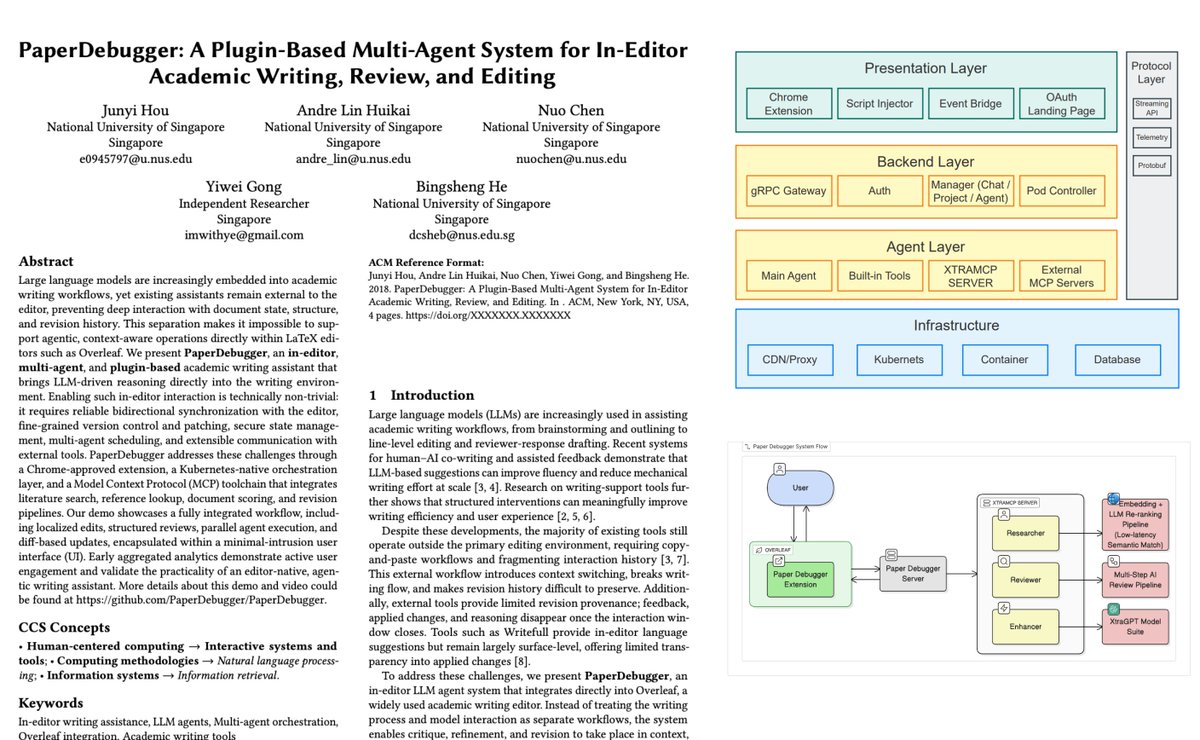
Holy shit… this might be the most unreal academic-writing upgrade I’ve ever seen 🤯 A team from NUS just dropped PaperDebugger an in-editor, multi-agent system that lives inside Overleaf and rewrites your paper with you in real time. Not copy-paste. Not a sidebar chatbot. Actual agentic editing inside your LaTeX editor. Here’s why this is insane 👇 → You highlight a messy paragraph, and it launches a full critique + rewrite pipeline → Returns clean before–after diffs like Git, then patches your document instantly → Runs Reviewer, Enhancer, Scoring, and Researcher agents in parallel → Uses Kubernetes pods to scale multi-agent reasoning inside the editor → Taps an MCP toolchain for literature search, reference lookup, and section-level enhancement Deep research mode is even crazier: It pulls relevant arXiv papers, summarizes them, compares your method against them, and generates citation-ready tables… all inline while you're writing. It’s basically a mini committee of reviewers embedded in your document rewriting, critiquing, sourcing, and polishing without ever breaking flow. If this scales, Overleaf stops being an editor… and becomes a full AI-assisted research environment.
Robert Youssef tweet media
English
85
552
4K
1.2M
Farzana Rahman retweetledi
ISCB News
ISCB News@iscb·
We are deeply saddened to learn of the passing of Amos Bairoch. His vision and leadership helped build the foundations of today’s bioinformatics community. From the creation of essential biological databases to decades of mentorship, his influence can be felt across research groups worldwide.
ISCB News tweet mediaISCB News tweet media
English
1
2
5
337
Farzana Rahman
Farzana Rahman@propicee·
🧬 Frestly Pruned & published #JournalArticle! 🔍 💻 👩‍🔬 🧠 Did you know that some layers in large genomic language models might be doing….. almost nothing? We show how pruning large genomic language models—like #DNABERT-2 can cut training time in half without sacrificing accuracy. 🔍 Title: 𝐑𝐞𝐚𝐩𝐢𝐧𝐠 𝐭𝐡𝐞 𝐅𝐫𝐮𝐢𝐭𝐬 𝐨𝐟 𝐋𝐋𝐌 𝐏𝐫𝐮𝐧𝐢𝐧𝐠: 𝐓𝐨𝐰𝐚𝐫𝐝𝐬 𝐒𝐦𝐚𝐥𝐥 𝐋𝐚𝐧𝐠𝐮𝐚𝐠𝐞 𝐌𝐨𝐝𝐞𝐥𝐬 𝐟𝐨𝐫 𝐄𝐟𝐟𝐢𝐜𝐢𝐞𝐧𝐭 𝐍𝐨𝐧-𝐂𝐨𝐝𝐢𝐧𝐠 𝐕𝐚𝐫𝐢𝐚𝐧𝐭 𝐄𝐟𝐟𝐞𝐜𝐭 𝐏𝐫𝐞𝐝𝐢𝐜𝐭𝐢𝐨𝐧 Lean, powerful, and open-source. 👩‍🔬 Kudos to PhD Researcher @meghegde97 and Prof. @jcnebel . Read paper from 🔗 mdpi.com/2073-4425/16/1… @MDPIOpenAccess @KingstonUni @KingstonECE #Genomics #LLM #AI #Genomics #ResponsibleAI #LLMs #Bioinformatics #DeepLearning #NonCodingDNA #PrecisionMedicine #Research #LLMPruning #ComputationalBiology #accessable #DNALanguagemodel #GenomicLanguageModel #scalabale #KingstonUniversity #GenesMDPI #Trainium #AIinHealthcare #NeucleotideTransformer #DNABert #KUCSM
Farzana Rahman tweet media
English
0
0
2
110
Farzana Rahman retweetledi
The Nobel Prize
The Nobel Prize@NobelPrize·
David Baker, the 2024 #NobelPrize laureate in chemistry, has achieved the seemingly impossible feat of building entirely new kinds of proteins. In recent years, one incredible protein creation after the other has emerged from Baker’s laboratory. They range from new nanomaterials where up to 120 proteins spontaneously link together (see animation) to proteins that function as a type of molecular rotor. Animation: ©Terezia Kovalova/The Royal Swedish Academy of Sciences
English
31
238
1.1K
66.2K
Farzana Rahman retweetledi
Massimo
Massimo@Rainmaker1973·
A 2-billion-year-old rock just revived an old alien theory. Fresh findings from NASA and Japan’s space agency reveal that asteroid Bennu—a carbon-rich relic from the solar system’s infancy—contains key ingredients of life: 14 of the 20 amino acids used by Earth’s organisms, plus chemical precursors to DNA and RNA. Confirmed in January 2025 by the OSIRIS-REx mission, these molecules were locked inside pristine rock untouched since before Earth itself existed. They bolster panspermia, the idea that life’s raw materials arrived from space rather than emerging here. Picture Earth cooling from its fiery birth. Comets and asteroids, loaded with stable organic compounds, slammed into the young planet, delivering the chemical seeds of biology. Panspermia needs no live passengers—just durable molecules that can spark complexity on a hospitable world. In short: life may not have begun on Earth; it may have been assembled here from cosmic imports. For years, skeptics questioned whether fragile organics could survive the void, atmospheric incineration, or explosive impact. Yet lab tests and missions like OSIRIS-REx now show many can. If Bennu carries life’s toolkit, the universe may be seeded with it everywhere.
Massimo tweet media
English
139
615
2.9K
233.8K