QED Science

287 posts

QED Science banner
QED Science

QED Science

@qedScience

qed is transforming scientific research with AI

Katılım Nisan 2025
21 Takip Edilen2.4K Takipçiler
Fran Supek
Fran Supek@FranSupek·
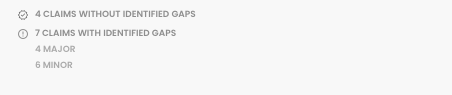
Very nice summary of novelty/impact of our study by the @qedScience AI reviewbot, have a look 👇
Fran Supek tweet media
English
2
0
2
103
Fran Supek
Fran Supek@FranSupek·
Hot off the press – new study from the group: 🧬🤖 A DNA language model for predicting mutation risk trained on massive genomic data sets A mutation seen again and again across cancer genomes looks like a causal change. But sometimes the DNA site is simply very easy to mutate and so generates a hotspot 🔥. We built MutFormer AI model to separate these two possibilities: operating at single-nucleotide resolution, it separates “driver” from “passenger” hotspots. (awesome work by Ivan Galvan 🔝, Marcell Veiner @MarcellVeiner et al. 👏)
Fran Supek tweet media
English
1
6
9
557
QED Science
QED Science@qedScience·
Peer review was built for a world with fewer papers and more time. We're building for the world science has become. Grateful to @TheAIJournal1 for naming QED Science the top platform for 2026, and for recognizing that rigor and scale do not have to work against each other. Read the article: bit.ly/4gzNANi
QED Science tweet media
English
1
2
5
455
QED Science
QED Science@qedScience·
More than half of this year's top-scoring life science papers came from international teams. Even accounting for team size, the advantage held: international collaboration = 45% higher odds of hitting the top 1% of QED scores. (OR 1.45, p<0.001). Collaboration - the kind that crosses borders is where great science comes from. Read the research: bit.ly/4gxTY7K #bioRxiv #AIforScience
QED Science tweet media
English
0
1
6
387
Fran Supek
Fran Supek@FranSupek·
The mutational signatures successfully “travelled” to actual cancer genomes. Our predictive models could often identify which MMR gene broke down in a tumor. We also think that subtle MMR defects can fly under the conventional MSI “radar”: ~10% of nominally-MSS tumors exhibited a MMR-intermediate (MMRi) state in WGS. And, as a bonus, controlled MSH3 loss generated direct genome-scale evidence for the curious, long-debated EMAST tetranucleotide-repeat instability pattern, with related signals detectable in cancer genomes. p.s. very happy the @qedScience AI-powered “validity engine” placed our study in the top 1% 🤩 We take reviewbot results with a grain of salt, but we like the outcome nonetheless😜 Proud of the team 🔝Marcel 🔝Adam 🔝 Maia!
Fran Supek tweet media
English
1
0
2
115
Fran Supek
Fran Supek@FranSupek·
DNA mismatch repair (MMR) deficiency is an important driver of cancer genome instability. Yet it is usually treated as a binary label 0⃣/1⃣ MSI-high or not. Our new preprint – fresh from the oven🔥 -- argues that this simple dichotomy obscures the underlying biology. Trouble with different parts of the MMR machinery is "recorded" in the genome sequence as distinct mutational patterns🧬. We worked out which pattern means what. Amazing collaborative work led by Marcel McCullough and Adam Poti, with @maiamontagnarde Maia Munteanu, at @IRBBarcelona + @UCPH_Research Bravo, team!
Fran Supek tweet media
English
1
5
20
1.1K
Eldad Tzahor
Eldad Tzahor@Tzahore·
Going with the trend and checking our paper with q.e.d. before submission. Nice score @qedScience @OdedRechavi Let's hope for friendly reviews
Eldad Tzahor tweet media
English
2
1
17
3.7K
QED Science
QED Science@qedScience·
@ChiragNepal, thanks for putting it to the test. A Top 1% paper isn't a "perfect paper". QED Score estimates the overall scientific strength of the work, while the review is designed to identify opportunities to make even outstanding papers stronger. Those goals are complementary, not contradictory. A paper can make an exceptional contribution while still having important unanswered questions or experiments that would strengthen the evidence.
English
0
0
1
226
QED Science
QED Science@qedScience·
@ZhengyangG51844 Love to see this! Congratulations on the new results. It's always exciting to see a manuscript evolve as new data comes in.
English
0
0
2
54
Zhengyang Guo
Zhengyang Guo@ZhengyangG51844·
Missed the @qedScience list with our Feb version (totally fair). Our June update brings solid biochem validation and deeper model insights — and your real-time tool now scores it top 1% Paper : biorxiv.org/content/10.648… See you on next year’s official list!
Zhengyang Guo tweet media
English
1
0
2
71
QED Science
QED Science@qedScience·
@sinabooeshaghi We're always happy to engage with criticism and different viewpoints. We simply ask that the discussion reflects what was actually written. Context matters in scientific papers, and it matters when quoting them as well. When key context is omitted, readers are left wondering whether the rest of the analysis reflects the full evidence or only selected excerpts.
QED Science tweet media
English
1
0
7
595
QED Science
QED Science@qedScience·
The top institutes with the best funding, attracting global top talent, produce a lot of the best science in the world. That does not show the bias, that is reality: Good science is expensive. However, journals have a well documented bias compounding this, which the QED score removes by design. Initial analysis shows, after controlling for quality (QED score), preprints from the global south have a significantly lower chance of landing in top journals.
English
3
0
15
4.4K
IMP
IMP@IMPvienna·
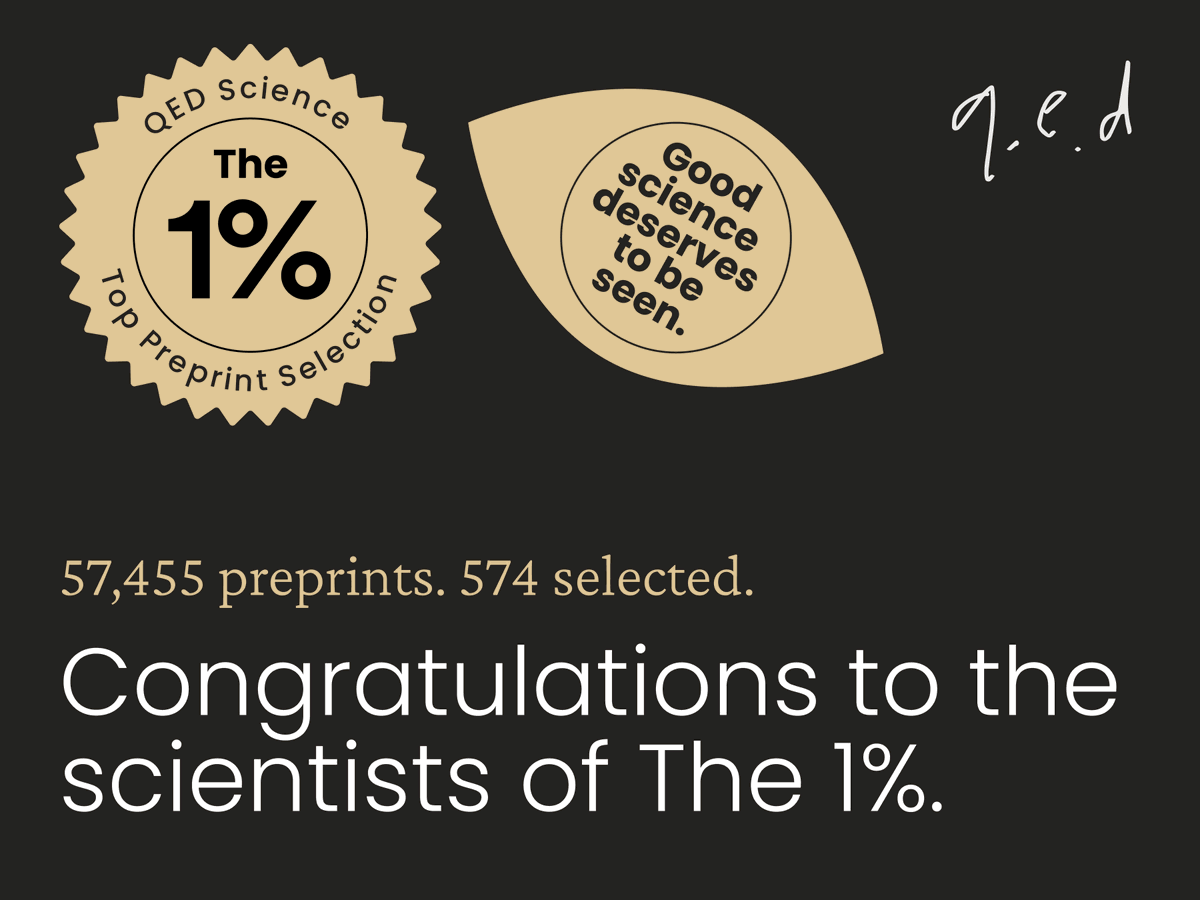
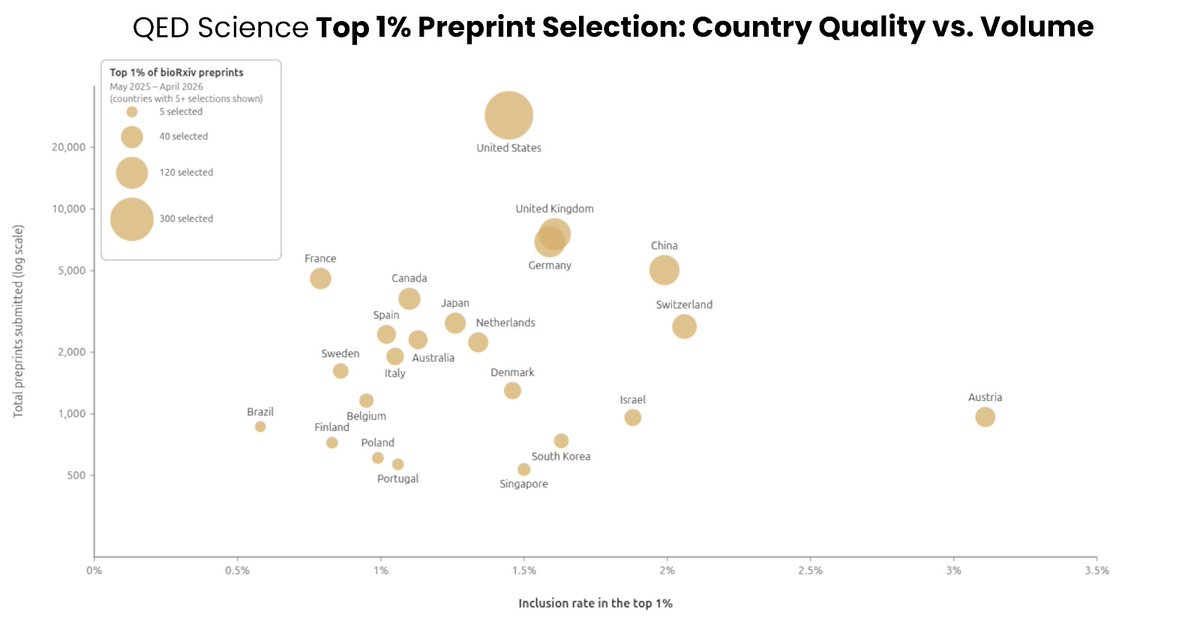
The IMP is among Austria's leading contributors to exceptional life science research. In QED Science's new analysis of 57,455 bioRxiv preprints, Austria emerged as the strongest overperformer for its size. Of the 31 Austrian preprints in "The 1%", 11 include the IMP:
IMP tweet media
English
6
5
20
10.1K
QED Science
QED Science@qedScience·
Austria’s signal in The 1% was one of the most striking findings for us.🇦🇹 The @IMPVienna and the @viennabiocenter are a beautiful example of focused scientific depth connected to a global research network. Because QED Score was assigned blind to author, institution, country, and journal, this pattern emerged from the work itself. Huge congratulations to the IMP and the whole Vienna BioCenter community.
QED Science tweet media
English
2
0
2
393
Hao Yin
Hao Yin@HaoYin20·
A QED score of 87!😆 I am totally flattered (& proud)☺️ Such a delight in these stressful days & nights for deadlines😻 Thanks @qedScience 🙏🙏🙏
Hao Yin tweet media
Hao Yin@HaoYin20

Our LDS3 #Aortopathy paper is on @atvbahajournals now >10 yr from 1st aorta harvested😼 Kudos to the Pickering lab team🥳 I almost lost count of how many Grad/Med students & fellows I have been working with on this project Seeing the baby grow up☺️ ahajournals.org/doi/10.1161/AT… BTW, I have to say goodbye👋 to everyone for 3~4 mo Take a break from regular X posting Need to focus on my paper revision Deadline is pushing😈 More data is needed😣 See you later🥺

English
6
4
22
4.7K
QED Science
QED Science@qedScience·
This is a very fair point. Resources absolutely shape what experiments are possible, and no tool should pretend otherwise. What we’re trying to do with QED is not erase those realities, but remove some of the extra layers of bias on top of them: names, institutions, journals, geography, reputation. One thing we saw in The 1% is that there isn’t one path to exceptional science. Some work came from large systems with massive scale. Some came from small, highly focused, globally connected clusters. That does not solve the resource gap, but it does matter. The work should get the clearest possible read on its own terms.
English
0
0
1
77
Katayoun Ayasoufi
Katayoun Ayasoufi@KAyasoufi·
@qedScience However, the resources are still there as a major confounding difference. Many of us new struggling labs will never have the resources of nobel laureates and of course we cannot do the highest experiments to satisfy the AI and hence it is a ranking system in my opinion.
English
2
0
2
151
QED Science
QED Science@qedScience·
The 1% includes first-time authors and Nobel laureates. That is not a branding detail. It is the point. When the methodology does not know who you are, status disappears. The work has to stand on its own. the-one-percent.qedscience.com
English
1
3
9
1.3K
QED Science
QED Science@qedScience·
This is a very fair point.🙏🙏 Resources absolutely shape what experiments are possible, and no tool should pretend otherwise. What we’re trying to do with QED is not erase those realities, but remove some of the extra layers of bias on top of them: names, institutions, journals, geography, reputation. One thing we saw in The 1% is that there isn’t one path to exceptional science. Some work came from large systems with massive scale. Some came from small, highly focused, globally connected clusters. That does not solve the resource gap, but it does matter. The work should get the clearest possible read on its own terms.
English
0
0
0
95
QED Science
QED Science@qedScience·
For life sciences companies, the question is not just: “What does the literature say?” It is: “Is this evidence strong enough to support the next decision?” Target validation. Biomarker development. Study design. Go / no-go. That is where QED Score matters.
English
0
1
7
3.9K
Ben Golub
Ben Golub@ben_golub·
At @RefineDotInk we're going to benchmark our AI research reviewer on a field outside social science. Any ideas for which field? Drop them in the replies. First benchmark release: x.com/ben_golub/stat…
Ben Golub@ben_golub

Today Refine is releasing a benchmark for AI paper reviews and some statistics about our performance. Punchline: Refine won 90.4% of about 1,300 head-to-head matches against AI reviewers on 150 preprints in economics and related areas. 1/8

English
4
2
17
6.6K
QED Science
QED Science@qedScience·
The fitness app comparison is painfully accurate 🏋️‍♀️ We agree: nobody loves being graded, whether it’s your VO₂ max or your manuscript. But when feedback helps improve before the real review, it becomes less about the grade and more about the work. That’s exactly what we hope QED can do.🌸
English
0
0
1
85
Noam Auslander
Noam Auslander@AuslanderNoam·
I don't love the idea of ranking papers or scientists. That said, I tested QED on two preprints now under review, and its critique overlapped with the reviewers' comments by >80%. Rankings aside, it's a free tool that can improve our manuscripts. I thought: would there be similar backlash to a free workout app that harshly rated your fitness? then I remembered those exist, and millions pay for the privilege. Turns out, scientists are just more terrified of being graded by the same AI that fixes their code.
Oded Rechavi@OdedRechavi

Gloves are off! TODAY WE RELEASE THE 1% A list of the year’s very best papers. When we launched QED a little over half a year ago, I told you that our mission is to revolutionize scientific publishing. Revolutions don’t happen overnight… or maybe they do? When new technologies enable it? Time to put the power back in the scientists’ hands, not the journals’. Many scientists are depressed, and think journals will stay the same forever, no matter how dysfunctional, but no, it’s happening. Sooner than most people (or committees, or universities) can imagine. Check this out: When we released our AI review platform, it started a whole debate (and social media storm) on what it is that human reviewers can do that AI review still can’t. There are such things (and I’m happy about it), but the list is getting shorter and shorter. Numerous scientists already use QED to find gaps in their manuscripts and grants and to get constructive feedback that improves their experiments. And now, with your help, we take it to the next level. Today we release reviews and scores for all the experimental Life Science pre-prints that came out last year: 57,455 manuscripts!! If we are being conservative, and estimate that it takes a minimum of 8 hours to review a paper (it takes longer), and if we agree that 3 reviewers are typically required to review every submission, then reviewing this amount of manuscripts would take human experts >1 MILLION REVIEWER HOURS… Assuming you can find so many experts (not going to happen!), and assuming the experts who agree would have no conflict of interest (ha!!). QED did it. Then, we chose the best papers in every field (you can browse and search for key words), based on the originality and validity of the claims being made. We benchmarked our reviews not only using eventual journal selections but also by comparing our evaluations to those of human experts. When there were disagreements between the QED score and journal rank, we asked domain experts to judge who’s right (blindly), and they overwhelmingly sided with QED. No need to rely on glam journals anymore. No need to wait for two years to get their stamp of approval. No need to beg the reviewers, or worse, to write less ambitious papers, so no one would be upset. Want to find the most interesting papers in your field? Want to see where your paper stands? (“What’s your QED SCORE?”) Just visit qedscience.com! One last thing: We want good science to be seen (you can read the winners’ comments about their selection and the stories behind their discoveries on our website). We plan to organize a conference where the first authors (yes, the first authors, not the PIs) will present their work. We are not here to shame anyone (papers that got low scores). The reviews of the best papers that we selected explain why QED’s AI thought these papers are especially good - what’s unique about them, what their strengths are, which conceptual leaps were made, and what cutting-edge tools were developed. However, on the QED Science site you can analyze any paper in private, it’s fully transparent, and see if there are any gaps and what’s missing. Run your paper to see how it can improve, and maybe next time your paper will reach the top (if it’s not there already). Whether you’re on the 1% list of just have a good score that you want to share, on our website you can download the report and share it, for example with your tenure, promotion, or hiring committee, or with your university PR department. Forget about journal embargoes and waiting for it to be “accepted”. Improve your work until it’s good enough for YOU. You decide.

English
8
1
27
9.6K