

quentin
3.1K posts

quentin
@quentinasto
Politiques publiques & bouquins. 🇫🇷🇪🇺
Washington, DC Katılım Şubat 2016
1.7K Takip Edilen306 Takipçiler

Quel auteur ou autrice vous a touchée par sa sincérité plus que par son style ?
Français
quentin retweetledi

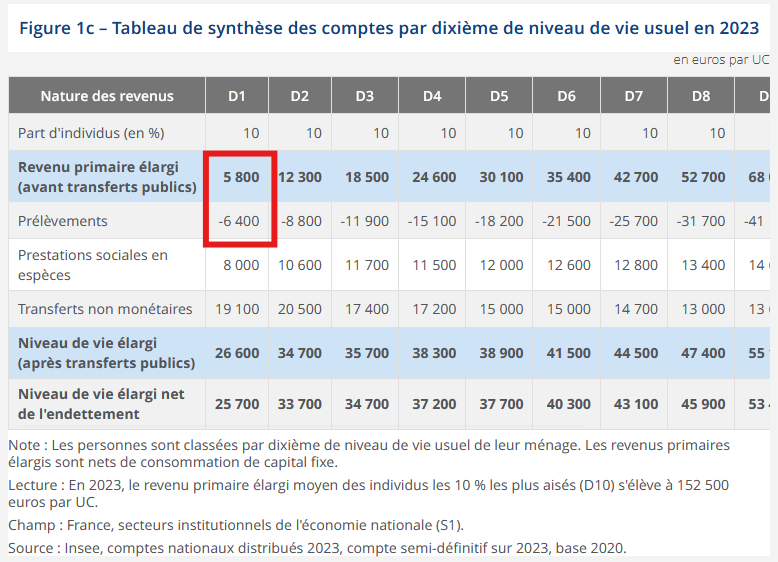
Rappel qu'à l'automne dernier nous avons été assomés par une campagne médiatique reposant sur un graphique dont la méthodologie aboutit à conclure qu'en 2023 le taux d'imposition des plus 10% les plus pauvres est de 6400/5800=110%.
Evidemment, le graphique ne laissait pas apparaître cette absurdité car il excluait, sans le dire, les actifs sans emplois et les retraités.
Insee@InseeFr
#Redistribution | En 2023, 56 % des personnes reçoivent plus qu’elles ne versent au titre de la redistribution publique. Le gain net moyen annuel est de 23 900 € par personne seule. Cette part de bénéficiaires nets varie fortement selon le niveau de vie 👉#titre-bloc-14" target="_blank" rel="nofollow noopener">insee.fr/fr/statistique…
Français
quentin retweetledi
Être bon en maths et devenir professeur implique un tel renoncement, en termes de rémunération et de reconnaissance sociale, que cela exige un niveau de vocation tout simplement trop rare pour que l’école fonctionne.
Sciences et Avenir@Sciences_Avenir
Classée 22e en mathématiques et 22e en sciences parmi les 38 pays de l'OCDE, la France connaît une baisse préoccupante de ses performances depuis 2018 👉 l.sciencesetavenir.fr/MUu
Français
quentin retweetledi
Pour le coup, c’est totalement normal que les restaurateurs répercutent les charges sur le consommateur.
Les charges sociales sont comme un droit de douane sur les échanges entre individus. Si vous cuisinez vous-même, votre travail domestique n’est pas taxé. Si vous travaillez une heure de plus pour vous offrir un restaurant, cet échange est taxé deux fois : d’abord votre travail, puis celui du restaurateur.
Dans ce contexte, il est logique que les Français, plutôt que de se spécialiser sur leur cœur de métier, deviennent leurs propres bricoleurs, jardiniers et cuisiniers. Les charges encouragent une économie d’autarcie à l’échelle de chaque famille. Pour que l’échange marchand se justifie, il faut que l’écart de productivité entre individus dans leurs professions respectives soient suffisant pour couvrir le désavantage fiscal de la spécialisation. Sur la cuisson d’une cuisse de poulet, c’est loin d’être évident.
C’est pourquoi beaucoup de ces services se retrouvent défiscalisés ou subventionnés : sinon, ils ne pourraient pas survivre.
Les Grandes Gueules@GG_RMC
🗣️ Barbara Lefebvre : "Le resto plaisir, c'est fini ! Je n'y vais plus. Les prix c'est tout de suite 20 €. Que les restaurateurs ne s'étonnent pas. Ils répercutent très lourdement les prix sur le consommateur." #GGRMC
Français
@KRL_STREAM @Vitality_apEX super bons étoilés à NYC: café Boulud (chef FR) et sushi Nakazawa
Français

Le joueur le plus titré de l'histoire de Counter-Strike est passé sur le stream après avoir soulevé son 38e trophée. Merci @Vitality_apEX.
Français
quentin retweetledi

Le problème de la taxe foncière est de déresponsabiliser la population des locataires dans leur consommation des services publics locaux, tout en restant assise sur des valeurs cadastrales déconnectées des réelles valeurs de marché. Paradoxalement, elle est un impôt dont la charge est concentrée tout en étant un impôt régressif.
Depuis 30 ans, le montant de la taxe foncière a crû beaucoup moins vite (environ x 4) que la valeur des biens immobiliers (environ x 10) censée servir d’assiette à l’impôt foncier. Et c’est dans les communes où l’immobilier est le plus cher que les taux et les assiettes sont généralement les plus faibles.
Perrin Benoît@bperrincontrib
💣 🛖𝐋𝐚 𝐭𝐚𝐱𝐞 𝐟𝐨𝐧𝐜𝐢𝐞̀𝐫𝐞 𝐩𝐨𝐮𝐫𝐫𝐚𝐢𝐭 à 𝐧𝐨𝐮𝐯𝐞𝐚𝐮 𝐚𝐮𝐠𝐦𝐞𝐧𝐭𝐞𝐫 🗣️ Contribuables Associés interrogé par @BenjaminGlaise sur @SudRadio : "On parle d'une augmentation de 60 à 100 euros par an (…) Mais il faut s'attendre à d'autres hausses de la taxe foncière avec le temps" ✅ A chaque vente, le propriétaire devrait assurer à l'acheteur qu'il est bien à jour avec l'administration fiscale.
Français

The cleanest part? Each role averages exactly ~0.04 KPR apart, ordered perfectly from AWPer to IGL.
20 years of CS role theory in one piece, by @LuzRaposa:
rdy.gg/en/cs2/news/ro…
English
There is no consensus on what the five roles in Counter-Strike actually are.
Every model we've ever used — entry/lurker, star/support, opener/closer — eventually breaks when a player refuses to fit the box.
We tried to fix that. And, honestly, we think we did a good job.🧵
English
@isabellesaporta Lorsque vous étiez venue à l'ENA en 2017, vous n'aviez pas hésité à prendre de haut des élèves dont vous ne connaissiez rien au prétexte que peu d'entre eux étaient enfants d'agriculteurs. Je note que la reproduction sociale qui vous gênait alors ne vous pose plus de problème
Français

Moi aussi j’ai mis mes filles dans le privé alors que je suis le fruit de la méritocratie républicaine et un fervent défenseur du public.
Oui mais voilà on a des convictions, puis un jour on a des enfants et là on veut le meilleur pour eux.
RTL France@RTLFrance
École : "En attendant de redresser le public, par pitié, ne cassez pas le privé" L'appel d'@isabellesaporta dans #RTLMatin
Français
quentin retweetledi

"J'ai une grande responsabilité, dans ma manière de montrer les gens dans mon cinéma : ne jamais tordre les choses."
Disparition à l'âge de 96 ans de
Frederick Wiseman
L'un des plus grands documentaristes du cinéma

Français
quentin retweetledi


quentin retweetledi
Il n’y avait pas besoin d’être Nostradamus pour comprendre que la retraite à 60 ans allait merder 30 ans plus tard.

PHactuellement Neutre@PHactNeutre
Comment ne pas "hate the players" ? Expliquez moi, ils avaient toutes les informations.
Français
quentin retweetledi

Le @nytimes rend hommage au travail exceptionnel de Philippe Collin(@Philco750062) et ses podcasts historiques sur @franceinter.
Collin est un formidable journaliste et un innovateur. Il est l'exemple parfait de ce que le service public a de mieux à offrir.
Bravo à lui et aux personnes à Radio France qui lui ont donné les moyens adéquats.

Français
@MargueriteScc Regardez la série "building habits" (full version) de la chaîne youtube chessbrah. Génial de pédagogie. Vous progresserez instantanément
Français

J’essaie d’apprendre les échecs et je me suis rarement sentie aussi démunie intellectuellement. Impression qu’on me montre un troupeau de chevaux en me demandant combien il y en a et que tlm répond immédiatement 158 alors que je dois les compter un par et qu’en plus je me trompe
Français
quentin retweetledi
Mon collègue Jesús a totalement raison.
Le taux de rendement d’un système par répartition est le taux de croissance de l’économie.
Lorsqu’une génération exige un rendement sur cotisations supérieur à la croissance économique qu'elle a su générer, elle déstabilise le système à son profit, au détriment de ses enfants et petits enfants.
Si les retraités français percevaient un taux de récupération cohérent avec la croissance des 40 dernières années, les pensions seraient inférieures d’environ 80 Md€ — soit près des deux tiers du déficit public.
Rien de tout cela n’est nouveau : c’est compris depuis les travaux de Paul Samuelson, dès les années 1950, sur les économies à générations imbriquées.
Jesús Fernández-Villaverde@JesusFerna7026
Over the years, I have actively participated in the economic policy debate in Spanish and written a fair amount on the topic (including many papers and several books!). Some of these issues go beyond purely local interest and are relevant, with only minor changes, for other countries in Western Europe and Latin America. I have always wanted to translate some of this work into English (if only to reach a wider audience), but until recently the cost was prohibitive. Thanks to AI, that cost has now fallen by roughly two orders of magnitude. Yesterday, I circulated a short policy paper I wrote over the Winter Break in Spanish arguing that it is far more useful to think about the sustainability of pay-as-you-go social security systems in terms of their internal rate of return (IRR) than to focus on cash flows, as much of the debate tends to do. The paper went viral, and several non-Spanish economists expressed interest. This morning, I translated it into English with the help of AI and made some light adaptations. I did not spend a great deal of time polishing every detail, but I think it is still well worth reading: sas.upenn.edu/~jesusfv/Pensi… The punchline will not be new to anyone who has read Samuelson’s (1958) classic paper, but it bears repeating. The key to the sustainability of a pay-as-you-go social security system is that the IRR received by participants must equal the growth rate of the system’s revenues. Once you think in these terms, almost everything else becomes secondary. Lower fertility simply implies a lower growth rate of revenues. Along the same lines, higher wages do not necessarily help the system if the IRR is already too high. In fact, they can make things worse, because an excessive IRR is then paid over a larger base. Somewhat surprisingly, when I explained this point to several excellent economists, many told me they had never thought about it this way. What actually helps a pay-as-you-go system is faster wage growth, because it raises the growth rate of revenues. It is all about the derivative, not the level. The effects of immigration are also much more nuanced than is often assumed. If the IRR is too high, bringing in additional immigrants may worsen the system’s present discounted balance, even if it improves the current cash-flow position. As always, comments are welcome. I may write something longer in the future, and I would welcome any suggestions. P.S. I write differently in Spanish than in English. Do not be surprised if the paper reads somewhat differently from my work originally written in English. Personally, I think I write much better in Spanish, but that style does not always translate cleanly.
Français

@quentinasto @StrikerHLTVorg only if you are measuring kpr, if you are measuring rating then its wrong because a winning team will on average have less dpr and higher kast and round swing
therefore the rating goes up and u have negative kd players with no impact having a positive rating because of kast
English

People throw "it's harder to get stats in losing teams" around as if it is an undisputable fact that winning teams inflate ratings, when the causality logically goes: better stats lead to better placings (and vice versa), not the other way around.
Just look at IGLs winning tournaments averaging .80-.90 ratings consistently outside of some occasional outliers. I would easily argue apEX's better play in the first half of the year and his more consistent standout maps is what helped Vitality be as dominant as they were, and to say his better performances are purely a result of the team winning more is pretty disrespectful to his individual step up, which was obvious even in the eye test.
Of course this is not a 1v1 game and it is extrapolated across entire teams. There's something to be said about if your teammates are better, that can also have a positive influence on how well you play and your stats, but it's hardly anything easily measurable.
Martin@Entroff_
@StrikerHLTVorg The Austin comparison is especially egregious. How can you compare donk's and ZywOo's numbers in the quarterfinal where one won and the other one lost? It is harder to get stats when in elimination games, I'm sure you have a filter for that. Sry for spam, this is the last one
English
@mcthouacbb @StrikerHLTVorg There are only 500 dmg to inflict and at the end of the day this will be your greatest win predictor
English

@quentinasto @StrikerHLTVorg if you are literally measuring kpr then maybe this is true (maybe), but it makes no sense when you look at actual rating, which is way more than just kill count.
English
@NER0cs hi Harry, 2 genuine questions following awards: donk leads in all stats but swing 1.Does it mean zywoo manages to do stuff that raw stats fail to show? 2. Is there neg. covariance b/w ratings within a team (ie, more difficult to have high rating when mates show up)? TY!
English

quentin retweetledi

Cette critique aurait du sens si l’objectif était d’assurer aux retraités un certain quantum fixe de consommation. Mais comme le but est d’assurer un certain *taux de remplacement* (ie une *proportion* fixe de la conso des actifs), le ratio cotisants/retraité est bien essentiel.
plaguemasked@masquedelapeste
C’est comme si je mettais un graph de l’évolution du nombre d’agriculteurs par habitant et que j’en concluais qu’on allait tous bientôt mourir de faim
Français