“Life, Dogme, and Wine”

34.9K posts

“Life, Dogme, and Wine” banner
“Life, Dogme, and Wine”

“Life, Dogme, and Wine”

@quick_philip

“Dogme English teacher exploring life through wine, films, independent ideas, and environmental curiosity. Honest reflections, stories, and lessons.”

Moldova Katılım Ekim 2018
7.4K Takip Edilen7.9K Takipçiler
Sabitlenmiş Tweet
“Life, Dogme, and Wine”
#marzemino from #winesofitaly taste surprisingly similar to #winesofmoldova rarest 🍇 grape. Both have bags of black cherry fruit. Low abv 12 ..obviously Marzemino has a fresher acidity whereas Copceac has softer acidity. Personally, the Copceac is more refined
English
0
0
4
112
“Life, Dogme, and Wine” retweetledi
Zack Polanski
Zack Polanski@ZackPolanski·
What's really striking about this clip is that I laid out some of the nonsense against me - and why it was disproportionate. Journalist agrees some of it is "overcooked." But none of my explanation nor the danger around my personal safety has made the cut....!
Sky News@SkyNews

Zack Polanski has told Sky's @RobPowellNews that the scrutiny he faces from the media is "incredibly disproportionate". The Green Party leader was asked about whether he failed to pay council tax while living on a narrowboat in east London.  Read more: trib.al/40taP7I

English
490
1.4K
6.5K
205.7K
“Life, Dogme, and Wine” retweetledi
Thomas Massie
Thomas Massie@RepThomasMassie·
Wait until @Jim_Jordan discovers Tel-Aviv born Miriam Adelson gave $200 million of her Chinese gambling money to Trump and just spent millions on fake ads to take out this Republican in Kentucky because I am opposed to all foreign aid and American sponsored genocide.
Rep. Jim Jordan@Jim_Jordan

.@JudiciaryGOP says it uncovered new funding links between Biden admin and anti-Netanyahu, left-wing groups jns.org/news/u-s-news/…

English
2.4K
7.7K
41.7K
1.2M
“Life, Dogme, and Wine” retweetledi
Jacqui Deevoy
Jacqui Deevoy@JacquiDeevoy1·
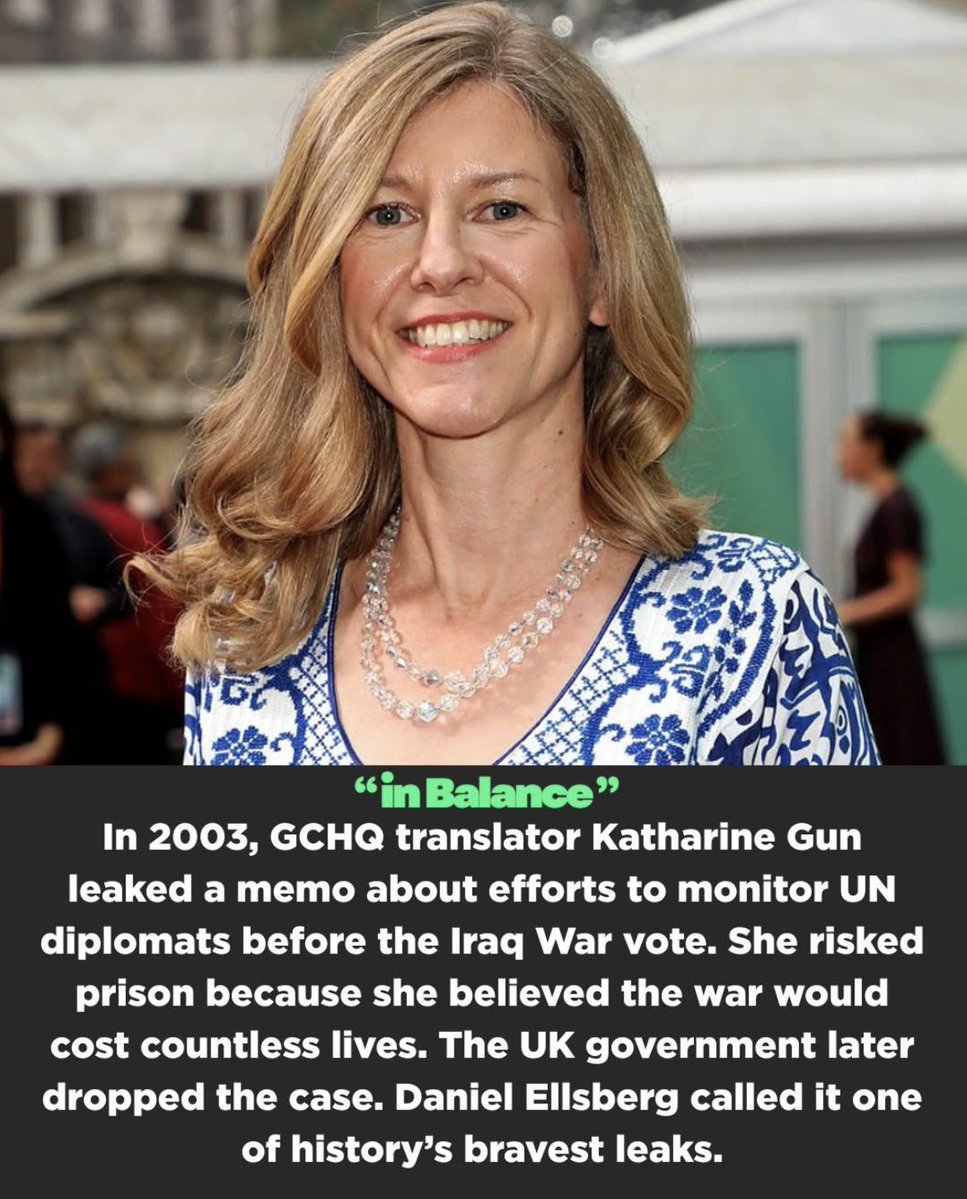
In 2003, a 28-year-old translator working for British intelligence received an email she wasn’t supposed to see. What she read convinced her that governments were trying to manipulate the world into war. Her name was Katharine Gun. She worked at GCHQ - Britain’s top-secret intelligence agency. On January 31, 2003, she received an email from senior NSA official Frank Koza. The US wanted British intelligence to help spy on members of the UN Security Council. Specifically, diplomats from Angola, Chile, Pakistan, Cameroon, Guinea and Bulgaria - nations whose votes could decide whether the UN backed the invasion of Iraq. The operation was simple: bug phones, read private emails, uncover secrets, weaknesses, fears and anything that could pressure diplomats into supporting the war. Katharine read the email in disbelief. This was not ordinary intelligence gathering: it looked like an attempt to manipulate the UN into approving a war. She knew what leaking the document could cost her. Prison. The destruction of her career. Under Britain’s Official Secrets Act, she could face years behind bars for exposing classified intelligence. But she leaked the email anyway. On March 2, 2003, The Observer newspaper published the secret NSA request on its front page. Suddenly, the world could see evidence that intelligence agencies were allegedly targeting UN diplomats ahead of the Iraq War vote. Inside GCHQ, panic exploded. Investigators began interrogating employees, searching for the source of the leak, monitoring staff and creating an atmosphere of fear throughout the building. Katharine watched innocent coworkers fall under suspicion. That’s when she made another decision that stunned people around her. She confessed. Rather than allow others to suffer for something she’d done, Katharine walked into her manager’s office and admitted she was responsible. She was arrested. Suspended from her job. Formally charged under the Official Secrets Act. By late 2003, she faced trial at London’s Old Bailey with the possibility of being sent to prison. But her legal defence created a dangerous problem for the British government when her lawyers argued she acted to prevent an illegal war. To challenge that claim, the government would need to release confidential legal advice discussing whether the Iraq invasion itself was lawful under international law. Then came February 25, 2004. The courtroom filled. Katharine Gun sat waiting as prosecutors prepared to move forward against one of the most famous intelligence leaks in modern British history. Then, without warning, the government collapsed the case. “The Crown offers no evidence.” After months of preparation, the trial ended almost instantly. Katharine walked free. Many observers believed the government feared the public release of its own private legal doubts surrounding the Iraq War more than it feared letting the whistleblower go. Years later, former Pentagon Papers whistleblower Daniel Ellsberg called Katharine Gun’s leak one of the bravest acts he had ever seen. Edward Snowden would later cite her as one of the people who proved intelligence systems could be challenged from the inside. And perhaps the most remarkable part of the story was this: Katharine Gun was not a politician. Not a famous activist. Not a powerful insider. She was simply a young translator who read one email and decided her conscience mattered more than her career. Two governments. Major intelligence agencies. The full force of secrecy laws. And one woman still chose to stand up and speak out. After the case was dismissed, reporters asked whether she regretted leaking the document. Katharine Gun answered calmly: “I have no regrets. I would do it again.” WE ALL NEED TO BE THIS BRAVE. WE ALL NEED TO DO THE RIGHT THING. WE ALL NEED TO BE MORE LIKE KATHARINE GUN. Good morning, everyone!
Jacqui Deevoy tweet media
English
144
3.1K
6.4K
106.7K
“Life, Dogme, and Wine” retweetledi
Zack Polanski
Zack Polanski@ZackPolanski·
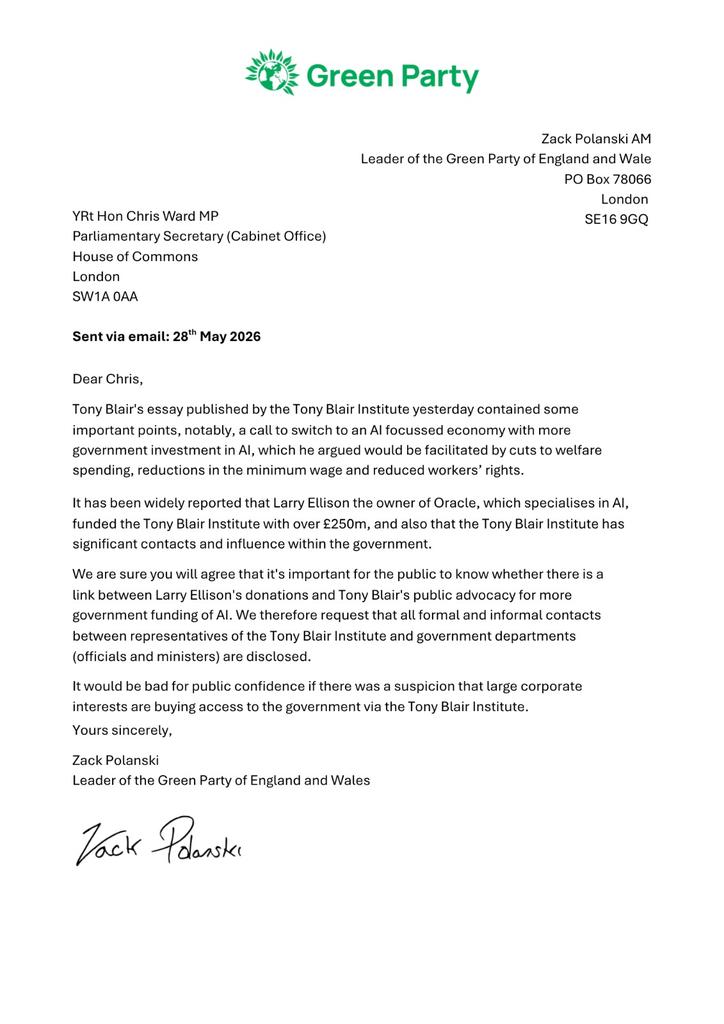
It would be bad for public confidence if there was a suspicion that large corporate interests are buying access to the Government via the Tony Blair Institute. My letter to the cabinet office. 👇🏼
Zack Polanski tweet media
English
224
3.1K
7.8K
152.6K
“Life, Dogme, and Wine” retweetledi
Declassified UK
Declassified UK@declassifiedUK·
Here is the list of the MPs who were officers and supporters of Labour Friends of Israel before it suddenly removed this page from its website.
Declassified UK tweet media
English
702
12.3K
14.1K
1M
“Life, Dogme, and Wine” retweetledi
Jackson Hinkle 🇺🇸
Jackson Hinkle 🇺🇸@jacksonhinkle·
TRUMP SUPPORTER: “I think bombing Iran is absolutely in the American people’s interest...” GREENWALD: “You seem like a young guy to me. Have you ever thought about going and fighting in this war that you’re cheering on?”
English
466
3.7K
43.6K
2.5M
“Life, Dogme, and Wine” retweetledi
Zack Polanski
Zack Polanski@ZackPolanski·
Oracle’s £250m gift to the Tony Blair Institute appears to buy you an entire Question Time episode.
BBC Question Time@bbcquestiontime

Tomorrow, Question Time is in Dulwich for an AI special Joining Fiona on the panel are Darren Jones, Julia Lopez, Mo Gawdat, Laura Gilbert, and Victor Riparbelli Join #bbcqt, 9pm on @BBCiPlayer, @BBCSounds, and @BBCNews, 10:40pm on @BBCOne Apply to be in the audience here: eu.castitreach.com/ag/mentorn/que…

English
224
2.9K
9.5K
336.5K
“Life, Dogme, and Wine” retweetledi
Zack Polanski
Zack Polanski@ZackPolanski·
"Everything I do has got climate and climate justice at its centre, it’s one of our core principles... from trying to buy back council homes and make housing safer and more resilient, to rewilding in parks, from public health to transport.” theguardian.com/politics/2026/…
English
129
221
705
24.1K
“Life, Dogme, and Wine” retweetledi
Zack Polanski
Zack Polanski@ZackPolanski·
Yes. And that means committing to these arguments and a plan now. It's time to hold our nerve and stand for what's right. Our country is in crisis and it's time to end Rip off Britain.
Clive Lewis MP@labourlewis

Whether it is Tony Blair’s interventions, the bond market’s reaction or privatised utilities warning of doom, the pattern is the same. When anyone suggests progressive change, those with wealth and power push back. Whether the figure in question is @AndyBurnhamGM or @ZackPolanski, progressives need to understand what we are up against, and how to defeat it. Very often, I find, science fiction names what politics struggles to. In James SA Corey’s series of novels the Expanse, the violent dystopian streets of Baltimore are given a name for what happens when the old order breaks down faster than people can describe it: the Churn. It is the brutal reorganisation of power, when familiar rules collapse and those who survive are the ones who read the signs early. Britain is in one now. In fact, two churns are happening at once. The first is electoral. May’s local elections were a rupture with the past. Labour lost roughly 1,100 councillors. Reform won 1,257 seats and 10 councils. The Greens won Hackney and Lewisham. In Makerfield, the parliamentary constituency where Andy Burnham is seeking a route back to the Commons, Reform took every council ward. The progressive vote has fragmented and Reform has captured a large part of the anger. The container in which transformative politics could once be argued for and delivered – a dependable Labourmajority in the Commons – is visibly crumbling. The second churn is deeper. Burnham named it when he said Britain had been “on the wrong course for 40 years”. That was a diagnosis of the political economy that has governed Britain since the late 1970s: financialisation, privatisation, hollowed-out public services and the transfer of wealth and power away from workers, communities and the public realm. This is why the events of recent weeks matter. Burnham needs a state that is able to pay for big-ticket, social-democratic projects: council homes, clean energy, public transport, water, skills and resilience. Those things cannot be wished into being. They require public investment at scale. That is where Rachel Reeves’s fiscal rules become more than an accounting device. In plain English, they are self-imposed limits on borrowing. They are political choices, not laws of nature. But they matter because they set the boundaries of what Labour says it can afford. They matter for Burnham’s possible project for the country, because the current rules would inhibit the kind of public investment that a new settlement with the British people would require. Yet he cannot simply announce he will tear them up. Governments borrow by selling gilts. If investors believe a government will borrow recklessly, they demand higher interest rates to lend to it. That raises the cost of all government borrowing and squeezes the money available for everything else. This is the discipline every Labour politician now feels. Three weeks ago, Burnham tested the boundary. He floated a defence carve-out: the idea that extra borrowing for defence could sit outside the fiscal rules, as Germany has done by using special funds to increase military spending. It was a narrow proposal but one that raised larger questions about how we finance what we deem to be important. What followed is what some call “market discipline”. From the period around Burnham’s Makerfield announcement onward, the pound came under pressure and gilt yields rose as markets priced political uncertainty. Private creditors warned against Thames Water being brought into public ownership. Then, last Monday, Burnham’s team told Bloomberg he would make no changes to Reeves’s fiscal rules if he became prime minister. The defence carve-out was ruled out too. I was not surprised by the retreat. Nor do I think it is useful to call it betrayal. Burnham cannot win a leadership contest if the markets are running against him before he has even started. But the retreat itself is the lesson. It illuminates what is standing in the way of a new social democracy. It is not simply “the markets”. It is the economic architecture Britain has built: Treasury rules, Bank of England decisions, pension fund structures and investor expectations combining to discipline any politics that threatens the settlement. What happened last week was a lesson in how power works. Burnham matters not because he is a saviour. Progressives have had enough of saviours. He matters because he has said aloud what Westminster still avoids: Britain’s crisis is rooted in the economic settlement itself. That settlement, what economists increasingly call rentier capitalism, is not abstract. It is a country where water bills rise while shareholders are rewarded, where housing wealth matters more than people having secure homes, and where democratic choices narrow whenever they threaten asset holders. Meanwhile, the state manages the fallout: crumbling infrastructure, higher costs and a cost of living crisis deepened by rentier extraction. That is why the reaction to Burnham’s comments on the fiscal rules is revealing. Chancellors rewrite fiscal rules all the time when it suits them. Gordon Brown had his golden rule. George Osborne had his surplus target. Philip Hammond revised the framework. Rishi Sunak changed it. Jeremy Hunt changed it. Reeves has changed it again. The question is not whether fiscal rules can change. They plainly can. The question is who gets to change them, and for what purpose? There are three fights progressives now have to pick. The first is fiscal. Democracy must regain the power to invest. Public investment is still constrained less by national need than by what ministers think the bond market, the Bank of England and the Treasury will tolerate. A real shift would start from need, not nerves. That means a Bank of England mandate that recognises a basic truth: inflation is not only caused by too much demand. It is also caused by too little capacity. When there are too few homes, rents rise. When public transport is weak, people are forced into expensive alternatives. When energy is costly and unreliable, bills rise. Investment is not the enemy of stability. Done properly, it is how stability is built. The second fight is ownership. Public goods should be built and owned in the public interest. Thames Water entering special administration is the obvious place to start. Regional public housing corporationscould build at scale on public land, financed by rental income rather than annual Whitehall grants. That is also why the language of “public control” – used increasingly by Andy Burnham – deserves scrutiny. Few want a return to top-down nationalisation. But franchising, as the Bee Network in Manchester demonstrates, is not public ownership. Private operators running Bee Network services made hundreds of millions in profit last year. The network is better than what came before – but it remains a private-profit, public-risk model. Control without ownership leaves the fundamental problem intact: the public absorbs the downside while shareholders take the gain. The third fight is constitutional. Proportional representation for Westminster, an elected second chamber and deeper devolution are not procedural tidying-up. They are conditions for progressive power in a fragmented country. The forces ranged against transformation do not need PR: they already have the City, the rightwing press, corporate lobbying, the Treasury worldview and the bond market. Progressive Britain has no equivalent machinery. PR is the glue that could allow a broad majority to govern together. Burnham was right: Britain has been on the wrong course for 40 years. But last week showed the harder truth. The old settlement will not politely bow out for its replacement. It will price the risk, police the boundaries and demand reassurance before the argument has even begun. The churn is far from over. * Clive Lewis is the Labour MP for Norwich South * Clive Lewis will be speaking about these issues and more with Andy Burnham at Change Now! Mobilising the Progressive Majority


English
90
370
1.1K
27.9K
“Life, Dogme, and Wine” retweetledi
Zack Polanski
Zack Polanski@ZackPolanski·
It's time to end Rip off Britain. For too long we've had people in charge of the decisions that affect our lives in the pockets of the super rich. The Green Party have two vested interests - protecting communities and our planet. It's time to tax the super rich.
The Green Party@TheGreenParty

Meet Sarah Wakefield. Manchester City councillor, mum of two, sustainable food campaigner - and your Green MP candidate for Makerfield.

English
555
890
2.8K
71.5K
tx101st
tx101st@tx101stxw·
@jimmy_dore They won't haunt her. She's a demon. Sleeps like a baby
English
2
4
337
4.6K
Jimmy Dore
Jimmy Dore@jimmy_dore·
Good Job!
English
530
4.3K
20.3K
372.8K
Made In England
Made In England@BuyEnglishMade·
Cadbury was founded in Birmingham in 1824. In 2010, it was acquired by an American company. Today, much of the profit from one of England's best-known chocolate brands flows to overseas shareholders. The UK chocolate market is worth over £8 billion a year. If just 10% shifted to English-made producers, that's £800 million supporting businesses, jobs and investment here. We're building MadeInEngland.com to make it easy to find them.
Made In England tweet media
English
532
1.8K
11K
4M
“Life, Dogme, and Wine” retweetledi
Justin Davis
Justin Davis@justindavis_24·
Sun is out, time for some Rosé and a cigar! 2024 Ott Château de Selle. ☀️💨
Justin Davis tweet media
Français
0
3
23
275
“Life, Dogme, and Wine” retweetledi
mrredpillz jokaqarmy
mrredpillz jokaqarmy@JOKAQARMY1·
FMR U.S. Marine inside the destroyed school in Iran.
English
468
3K
10.1K
94.7K