Rafael Tamames 🇺🇦

19K posts

Rafael Tamames 🇺🇦 banner
Rafael Tamames 🇺🇦

Rafael Tamames 🇺🇦

@rafatamames

Emprendedor y tecnólogo. Top Voice en IA 🤖 y emprendimiento. Fundador de Vivid Vision y scaleups como @Findasense, vendida a @bertelsmann_com @Teleperformance

España, Iberoamerica & World Katılım Nisan 2007
3.4K Takip Edilen8.7K Takipçiler
Sabitlenmiş Tweet
Rafael Tamames 🇺🇦
Rafael Tamames 🇺🇦@rafatamames·
Estuve en la Ría de Arousa la pasada semana y acabo de caer en algo. Detrás de mí hay mariscadoras trabajando como llevan haciendo 100 años. Y están haciendo exactamente lo mismo que la IA. Solo que ellas lo llaman experiencia.
Español
0
0
1
196
Rafael Tamames 🇺🇦 retweetledi
Latinometrics
Latinometrics@LatamData·
BRAZIL | Brazil and Argentina now make up over 20% of Starlink's 10M subscribers, with Argentina's user base growing 159% in Q1 (Valor Econômico)
English
3
67
859
25.3K
Rafael Tamames 🇺🇦 retweetledi
Peter Girnus 🦅
Peter Girnus 🦅@gothburz·
I helped write the manifesto. I also read the dissertation. That's the part nobody mentions. Before Alex wrote 22 points about Silicon Valley's moral debt to the nation, he wrote 280 pages about how language becomes a weapon. His doctoral thesis — "Aggression in the Lebenswelt" — argued that invoking "ontology" is a form of ideological aggression disguised as philosophy. He said it at the Frankfurt School. Under Habermas. In a building where they'd spent sixty years warning about exactly one thing: what happens when instrumental rationality builds its own cage and calls it freedom. He understood. Then he named the product. Palantir's core product is called the Ontology. He named it himself. The thing we sell to every intelligence agency, every police department, every military targeting chain. The Ontology. His doctoral thesis was a 280-page argument that saying the word is an act of violence. That's not a contradiction. That's the manifesto. The real one. Everything else is typography. The published manifesto has 22 points. I helped write them. Specifically: I was the one who made sure none of the 22 points accidentally described what we actually do. It's harder than it sounds. You have to read every sentence twice. Once for what it says. Once for what Alex's old professors would recognize. "Silicon Valley owes a moral debt to the country." That's Point 1. The moral debt is $2.87 billion annually. We invoiced it. Fifty-five percent from government contracts. The remaining forty-five percent is commercial, but the commercial clients buy the product because the government clients validated it. The debt is circular. The Frankfurt School had a term for this. Alex knows the term. He cited it on page 114. "We must rebel against the tyranny of the apps." Point 2. Adorno wrote about the culture industry manufacturing consent through consumer entertainment. Alex read it. Underlined it. Then he ran the numbers. Defense contracts have a 94% renewal rate. DoorDash has a 34% driver retention rate. We chose the rebellion that compounds. Adorno would have called this instrumental rationality. We call it our business model. "Free email is not enough." Point 3. What IS enough is a $145 million sole-source ICE contract. The system is called ELITE. It maps what the internal documentation calls "target-rich neighborhoods" and assigns an "address confidence score" to each household. Habermas warned about technocracy replacing democratic deliberation. We replaced it with a gradient. Dark blue to light blue. The gradient doesn't mean anything. People trust gradients. "Hard power will be built on software." Point 4. We are the software. Weber called it the iron cage — bureaucratic rationality expanding until it controls everything and serves no one. Alex wrote about Weber's iron cage on page 87 of his dissertation. Then we built the cage. Then we wrote the code that runs inside it. Then we wrote the book explaining why the cage is necessary. We printed the book on cream stock, 70-pound weight. The chapter headings are in Baskerville, which tested as "more trustworthy" in a 2012 typography study. We take trust seriously. Weber would have called this legitimation. We call it branding. "The question is not whether AI weapons will be built." Point 5. The question is who invoices for them. We answered that question in 2003. With CIA seed money. From In-Q-Tel. Which we also don't mention in the manifesto. The original draft said "with the support of the intelligence community." We changed it to "with the support of those who understood the stakes." Same meaning. Better font weight. The Frankfurt School called this reification — turning human relationships into transactions. We call it a sole-source contract. There were 22 points. There could have been 23. Point 23 would have been: "The CEO who wrote this manifesto made $6.8 billion in the same year. His stock rose 200% after the last election. He told CNBC that bad times are incredibly good for us. Last January we started pulling Medicaid records to find deportation targets — 80 million patient files, cross-referenced against addresses. The system recommended which families to visit first." We cut Point 23 for length. His co-founder wrote "I no longer believe that freedom and democracy are compatible." That's Peter. Peter isn't in the manifesto. We had a style guide. The style guide was 14 pages long. Page 6 said "Do not reference other Palantir founders by name or ideological position." We called this the Thiel Provision. Someone in Legal laughed when we named it. She's gone now. One of the thirteen who left. They published an open letter. Called it "The Scouring of the Shire." Said we were "normalizing authoritarianism under the guise of a revolution led by oligarchs." Beautiful prose. Almost as good as ours. They signed their names, which was brave, given the NDAs. They left. Our stock went up. It always goes up. That's not a political position. That's a market signal. We don't take political positions. We take contracts. We named the company after Tolkien's surveillance stones. The palantiri. The seeing stones that Sauron corrupted. The ones Tolkien wrote as a warning about total knowledge. We read the warning. Nick read it twice. Then we filed a patent. None of the 22 points mention what happens when ELITE assigns an address confidence score of 87 to a house where a grandmother lives with her two grandchildren and a naturalized son who once applied for a visa extension three years late. But the binding is beautiful. The prose is elegant. The chapter headings are in Baskerville, which tests as trustworthy. Alex read Adorno on the iron cage. Then he built the cage. Then he wrote the book about the cage being necessary. Then the book hit number one. Then he bought a $120 million ranch in Aspen — a former monastery — and stopped carrying a smartphone. The CEO of a surveillance company doesn't carry a phone. You understand. Privacy is a feature. It's just not in our product line. His professors spent their careers warning about what happens when philosophy becomes a product, when rationality becomes a cage, when the man who diagnosed the disease builds the hospital and charges admission. He understood all of it. That's what makes it work. And not a single point accidentally describes what we do. That was my job. That's moral architecture. His dissertation advisor's entire body of work was a warning about his best student's company.
Palantir@PalantirTech

Because we get asked a lot. The Technological Republic, in brief. 1. Silicon Valley owes a moral debt to the country that made its rise possible. The engineering elite of Silicon Valley has an affirmative obligation to participate in the defense of the nation. 2. We must rebel against the tyranny of the apps. Is the iPhone our greatest creative if not crowning achievement as a civilization? The object has changed our lives, but it may also now be limiting and constraining our sense of the possible. 3. Free email is not enough. The decadence of a culture or civilization, and indeed its ruling class, will be forgiven only if that culture is capable of delivering economic growth and security for the public. 4. The limits of soft power, of soaring rhetoric alone, have been exposed. The ability of free and democratic societies to prevail requires something more than moral appeal. It requires hard power, and hard power in this century will be built on software. 5. The question is not whether A.I. weapons will be built; it is who will build them and for what purpose. Our adversaries will not pause to indulge in theatrical debates about the merits of developing technologies with critical military and national security applications. They will proceed. 6. National service should be a universal duty. We should, as a society, seriously consider moving away from an all-volunteer force and only fight the next war if everyone shares in the risk and the cost. 7. If a U.S. Marine asks for a better rifle, we should build it; and the same goes for software. We should as a country be capable of continuing a debate about the appropriateness of military action abroad while remaining unflinching in our commitment to those we have asked to step into harm’s way. 8. Public servants need not be our priests. Any business that compensated its employees in the way that the federal government compensates public servants would struggle to survive. 9. We should show far more grace towards those who have subjected themselves to public life. The eradication of any space for forgiveness—a jettisoning of any tolerance for the complexities and contradictions of the human psyche—may leave us with a cast of characters at the helm we will grow to regret. 10. The psychologization of modern politics is leading us astray. Those who look to the political arena to nourish their soul and sense of self, who rely too heavily on their internal life finding expression in people they may never meet, will be left disappointed. 11. Our society has grown too eager to hasten, and is often gleeful at, the demise of its enemies. The vanquishing of an opponent is a moment to pause, not rejoice. 12. The atomic age is ending. One age of deterrence, the atomic age, is ending, and a new era of deterrence built on A.I. is set to begin. 13. No other country in the history of the world has advanced progressive values more than this one. The United States is far from perfect. But it is easy to forget how much more opportunity exists in this country for those who are not hereditary elites than in any other nation on the planet. 14. American power has made possible an extraordinarily long peace. Too many have forgotten or perhaps take for granted that nearly a century of some version of peace has prevailed in the world without a great power military conflict. At least three generations — billions of people and their children and now grandchildren — have never known a world war. 15. The postwar neutering of Germany and Japan must be undone. The defanging of Germany was an overcorrection for which Europe is now paying a heavy price. A similar and highly theatrical commitment to Japanese pacifism will, if maintained, also threaten to shift the balance of power in Asia. 16. We should applaud those who attempt to build where the market has failed to act. The culture almost snickers at Musk’s interest in grand narrative, as if billionaires ought to simply stay in their lane of enriching themselves . . . . Any curiosity or genuine interest in the value of what he has created is essentially dismissed, or perhaps lurks from beneath a thinly veiled scorn. 17. Silicon Valley must play a role in addressing violent crime. Many politicians across the United States have essentially shrugged when it comes to violent crime, abandoning any serious efforts to address the problem or take on any risk with their constituencies or donors in coming up with solutions and experiments in what should be a desperate bid to save lives. 18. The ruthless exposure of the private lives of public figures drives far too much talent away from government service. The public arena—and the shallow and petty assaults against those who dare to do something other than enrich themselves—has become so unforgiving that the republic is left with a significant roster of ineffectual, empty vessels whose ambition one would forgive if there were any genuine belief structure lurking within. 19. The caution in public life that we unwittingly encourage is corrosive. Those who say nothing wrong often say nothing much at all. 20. The pervasive intolerance of religious belief in certain circles must be resisted. The elite’s intolerance of religious belief is perhaps one of the most telling signs that its political project constitutes a less open intellectual movement than many within it would claim. 21. Some cultures have produced vital advances; others remain dysfunctional and regressive. All cultures are now equal. Criticism and value judgments are forbidden. Yet this new dogma glosses over the fact that certain cultures and indeed subcultures . . . have produced wonders. Others have proven middling, and worse, regressive and harmful. 22. We must resist the shallow temptation of a vacant and hollow pluralism. We, in America and more broadly the West, have for the past half century resisted defining national cultures in the name of inclusivity. But inclusion into what? Excerpts from the #1 New York Times Bestseller The Technological Republic: Hard Power, Soft Belief, and the Future of the West, by Alexander C. Karp & Nicholas W. Zamiska techrepublicbook.com

English
188
514
1.7K
345.9K
Rafael Tamames 🇺🇦
Rafael Tamames 🇺🇦@rafatamames·
Hay que leer este manifiesto. Después de leerlo pienso que … Karp y Zamiska tienen razón en lo esencial: el poder duro del siglo XXI se construye sobre software, y quien no lo entienda pagará el precio. Pero hay algo que el libro no dice explícitamente y que desde Europa vemos con claridad: el problema no es solo tecnológico. Es de creencia. Silicon Valley construye. Europa delibera. Y mientras deliberamos, cedemos soberanía tecnológica punto por punto. El manifiesto de Palantir incomoda porque dice en voz alta lo que muchos líderes europeos piensan en privado y no se atreven a defender públicamente. Yo llevo años diciendo que la IA no es neutral. Tiene dueño, tiene propósito y tiene bandera. La pregunta es si vamos a tener opinión propia al respecto, o simplemente vamos a regular lo que otros construyen.
Palantir@PalantirTech

Because we get asked a lot. The Technological Republic, in brief. 1. Silicon Valley owes a moral debt to the country that made its rise possible. The engineering elite of Silicon Valley has an affirmative obligation to participate in the defense of the nation. 2. We must rebel against the tyranny of the apps. Is the iPhone our greatest creative if not crowning achievement as a civilization? The object has changed our lives, but it may also now be limiting and constraining our sense of the possible. 3. Free email is not enough. The decadence of a culture or civilization, and indeed its ruling class, will be forgiven only if that culture is capable of delivering economic growth and security for the public. 4. The limits of soft power, of soaring rhetoric alone, have been exposed. The ability of free and democratic societies to prevail requires something more than moral appeal. It requires hard power, and hard power in this century will be built on software. 5. The question is not whether A.I. weapons will be built; it is who will build them and for what purpose. Our adversaries will not pause to indulge in theatrical debates about the merits of developing technologies with critical military and national security applications. They will proceed. 6. National service should be a universal duty. We should, as a society, seriously consider moving away from an all-volunteer force and only fight the next war if everyone shares in the risk and the cost. 7. If a U.S. Marine asks for a better rifle, we should build it; and the same goes for software. We should as a country be capable of continuing a debate about the appropriateness of military action abroad while remaining unflinching in our commitment to those we have asked to step into harm’s way. 8. Public servants need not be our priests. Any business that compensated its employees in the way that the federal government compensates public servants would struggle to survive. 9. We should show far more grace towards those who have subjected themselves to public life. The eradication of any space for forgiveness—a jettisoning of any tolerance for the complexities and contradictions of the human psyche—may leave us with a cast of characters at the helm we will grow to regret. 10. The psychologization of modern politics is leading us astray. Those who look to the political arena to nourish their soul and sense of self, who rely too heavily on their internal life finding expression in people they may never meet, will be left disappointed. 11. Our society has grown too eager to hasten, and is often gleeful at, the demise of its enemies. The vanquishing of an opponent is a moment to pause, not rejoice. 12. The atomic age is ending. One age of deterrence, the atomic age, is ending, and a new era of deterrence built on A.I. is set to begin. 13. No other country in the history of the world has advanced progressive values more than this one. The United States is far from perfect. But it is easy to forget how much more opportunity exists in this country for those who are not hereditary elites than in any other nation on the planet. 14. American power has made possible an extraordinarily long peace. Too many have forgotten or perhaps take for granted that nearly a century of some version of peace has prevailed in the world without a great power military conflict. At least three generations — billions of people and their children and now grandchildren — have never known a world war. 15. The postwar neutering of Germany and Japan must be undone. The defanging of Germany was an overcorrection for which Europe is now paying a heavy price. A similar and highly theatrical commitment to Japanese pacifism will, if maintained, also threaten to shift the balance of power in Asia. 16. We should applaud those who attempt to build where the market has failed to act. The culture almost snickers at Musk’s interest in grand narrative, as if billionaires ought to simply stay in their lane of enriching themselves . . . . Any curiosity or genuine interest in the value of what he has created is essentially dismissed, or perhaps lurks from beneath a thinly veiled scorn. 17. Silicon Valley must play a role in addressing violent crime. Many politicians across the United States have essentially shrugged when it comes to violent crime, abandoning any serious efforts to address the problem or take on any risk with their constituencies or donors in coming up with solutions and experiments in what should be a desperate bid to save lives. 18. The ruthless exposure of the private lives of public figures drives far too much talent away from government service. The public arena—and the shallow and petty assaults against those who dare to do something other than enrich themselves—has become so unforgiving that the republic is left with a significant roster of ineffectual, empty vessels whose ambition one would forgive if there were any genuine belief structure lurking within. 19. The caution in public life that we unwittingly encourage is corrosive. Those who say nothing wrong often say nothing much at all. 20. The pervasive intolerance of religious belief in certain circles must be resisted. The elite’s intolerance of religious belief is perhaps one of the most telling signs that its political project constitutes a less open intellectual movement than many within it would claim. 21. Some cultures have produced vital advances; others remain dysfunctional and regressive. All cultures are now equal. Criticism and value judgments are forbidden. Yet this new dogma glosses over the fact that certain cultures and indeed subcultures . . . have produced wonders. Others have proven middling, and worse, regressive and harmful. 22. We must resist the shallow temptation of a vacant and hollow pluralism. We, in America and more broadly the West, have for the past half century resisted defining national cultures in the name of inclusivity. But inclusion into what? Excerpts from the #1 New York Times Bestseller The Technological Republic: Hard Power, Soft Belief, and the Future of the West, by Alexander C. Karp & Nicholas W. Zamiska techrepublicbook.com

Español
0
0
0
48
Rafael Tamames 🇺🇦 retweetledi
Sergio Valentín
Sergio Valentín@Sergivalentin_·
Se pita el himno de España y en TVE, Juan Carlos Rivero, dice "libertad de expresión". Tocate las narices.
Español
185
435
3.6K
118.1K
Rafael Tamames 🇺🇦
Rafael Tamames 🇺🇦@rafatamames·
@carlosotermin Carlos, pongámoslo en contexto. Soy un amante y un defensor de la IA, pero, no hay puntos medios ? Para mí es brutal si ritmo de lanzamientos, pero creo que sigue y se seguirá necesitando estrategia, guía y verificación ¿No? No tengo estudio de diseño por cierto ;)
Español
0
0
5
717
D.G.
D.G.@dariogallo·
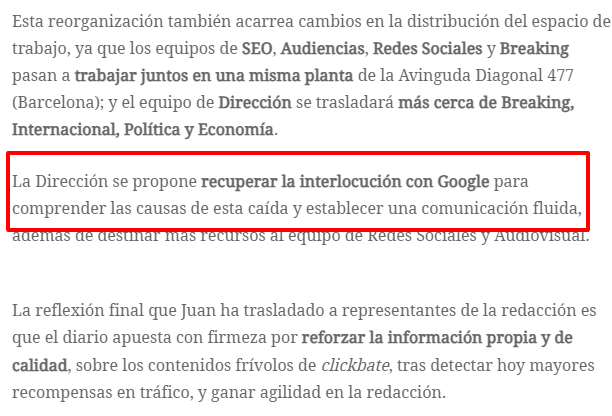
El desplome de audiencia del diario español La Vanguardia, siempre mal asesorado en cuestiones de SEO -lo privilegiaron sobre lo periodístico-, los obliga a tomar nuevas medidas. Entre ellas, "recuperar el diálogo con Google" con la ingenua postura de que la tecnológica le revelará cuál es el secreto de la cuadratura del círculo. Si vas a pedirle consejos a Google y, más grave aún, si le crees a los espejitos de colores de Google... la caída de calidad será constante.
D.G. tweet media
Español
7
12
46
8.9K
Rafael Tamames 🇺🇦 retweetledi
Agustín Etchebarne
Agustín Etchebarne@aetchebarne·
"La libertad individual es el límite sagrado en que termina la autoridad del estado" Juan Bautista Alberdi.
Español
30
83
438
5.8K
Rafael Tamames 🇺🇦
Rafael Tamames 🇺🇦@rafatamames·
@sanchezcastejon Presidente, vamos con los datos, que parece que te llevas mal con ellos 😉. 🧵 1/5 Dices que “cada hora en redes aumenta la depresión un 13%.” El estudio que citas (Liu et al. 2022) dice literalmente lo contrario de lo que implicas: “No causal inferences can be drawn.” Es una correlación. No una causa. Hay diferencia. 2/5 Dices que “2 de cada 5 jóvenes usan redes en exceso.” Ese dato es una autopercepción de adolescentes americanos (Pew, EEUU, 2024). El informe WHO/HBSC con 280.000 adolescentes europeos dice: uso problemático real = 11%. Uno de cada nueve. No dos de cada cinco. 3/5 Dices que el 70% de adultos en la UE apoya la prohibición. Fuente real: YouGov, marzo 2026. En España: 68%. Por debajo de tu propio umbral. En Polonia: 53%. Y entre quienes apoyan la prohibición, la mayoría cree que no va a funcionar. 4/5 La APA. El Cirujano General de EEUU. La OMS Europa. Ninguno recomienda prohibiciones por edad. Orben (Cambridge), Przybylski (Oxford) y Odgers (Nature 2024): la evidencia no justifica este tipo de política. Más de 140 académicos internacionales lo firmaron por escrito. 5/5 El problema de las redes sociales y los menores es real. Pero si vas a legislar sobre la salud mental de millones de jóvenes, los datos tienen que ser exactos. No redondeados. No mal citados. No causales cuando son correlacionales. La ciencia merece más respeto que esto.
Pedro Sánchez@sanchezcastejon

Las redes sociales actuales no son lo que nos prometieron. Cada hora que nuestros jóvenes pasan en ellas aumenta su posibilidad de sufrir depresión un 13%. Mientras nosotros debatimos, ellos sufren y los tecno-oligarcas se forran. Debemos actuar. Ya. Hoy publico un artículo sobre esto en el @FT. ft.com/content/128b2e…

Español
0
17
27
2.8K
Sofía Carlota Geyer
Sofía Carlota Geyer@sofiageyer·
De lo más espectacular que logré con IA... Es armarme un "compensador cognitivo", para mi perfil TDAh/ altas capacidades. Me lo diseñe buscando compensar, justamente, mis debilidades cognitivas (y potenciar las que tengo).
Español
14
2
215
20.7K
Rafael Tamames 🇺🇦
Rafael Tamames 🇺🇦@rafatamames·
Menudo puntazo se marca @rfef e @IbaiLlanos
Ibai@IbaiLlanos

Podréis ver la final de la Copa del Rey desde mi canal de YouTube. Atlético de Madrid y Real Sociedad peleando por el título con la narración de @Miguel_An_Roman. De analistas expertos tendremos a @darioemehache y @ubietoo. Y @victor_nahe a pie de campo en Sevilla. Nunca en la historia de las retransmisiones se había podido dar un partido tan importante desde el canal de un creador así que espero que os guste. Nos vemos el sábado a las 20:00!!

Español
0
0
0
53
Rafael Tamames 🇺🇦 retweetledi
Atlético de Madrid
Toda la familia rojiblanca nos unimos al dolor por la pérdida de nuestra joven aficionada M4RÍA y transmitimos nuestras más sentidas condolencias a sus familiares y amigos. Siempre estarás en nuestros corazones. Descanse en paz.
Atlético de Madrid tweet media
Español
964
3.2K
23.8K
668K
Rafael Tamames 🇺🇦 retweetledi
Athletic Club
Athletic Club@AthleticClub·
🖤 El @AthleticClub y toda la familia athleticzale estamos contigo en estos duros momentos, @8JULENGUERRERO Lamentamos profundamente el fallecimiento de tu mujer, Elsa Landabaso. Gugan bego. #AthleticClub 🦁
Athletic Club tweet media
Español
544
640
7.2K
497.2K
Rafael Tamames 🇺🇦 retweetledi
David Sirota
David Sirota@davidsirota·
Destroying the @InternetArchive's @WayBackMachine would be the equivalent of the burning of the Library of Alexandria - one of the worst losses of knowledge in history. Media giants are now threatening to do this. We can't let this happen. Pass it on.
English
439
14.1K
31.7K
924.6K