

Ramin Thies, MD
1.2K posts

Ramin Thies, MD
@raminthies
Medical Doctor x Software Engineer | Working on high quality data for LLMs
Zurich, Switzerland Katılım Eylül 2011
561 Takip Edilen878 Takipçiler

DB cost became really stable after I moved from DynamoDB to self-hosted PostgreSQL, dropping from around $50/day to... $0.
AWS cost is down from +$7800/m to <$500/m after I moved away from the cloud almost entirely.
No clever caching needed.
Damon Chen@damengchen
DB cost became really stable after adding a cache layer, dropping from $60/day to $6/day, down 90% compared to no cache. ✌️
English

@loktar00 @ClementDelangue I know it is much bigger but how is minimax 2.7 doing compared to it?
English

@novaruntime Depends on how deterministic/measureable the output is. I work on an autonomous agent and there I’m kind of eyeballing the results, but I also work on an agentic document parser and that one is extremely structured with LLM-as-a-judge evals.
English

genuine question. when you run evals on your agents, how do you decide what "good enough" looks like? like is there a number where you go "ok ship it" or do you just stare at outputs until you feel okay about it. honestly think im doing the second thing and it feels wrong but i dont know what the first thing would even be
English

Also, Obwalden <> Zug is elite play.
- Best canton to live as a high earner.
- Best canton to operate your business in.
Platinum pick 🎖


English

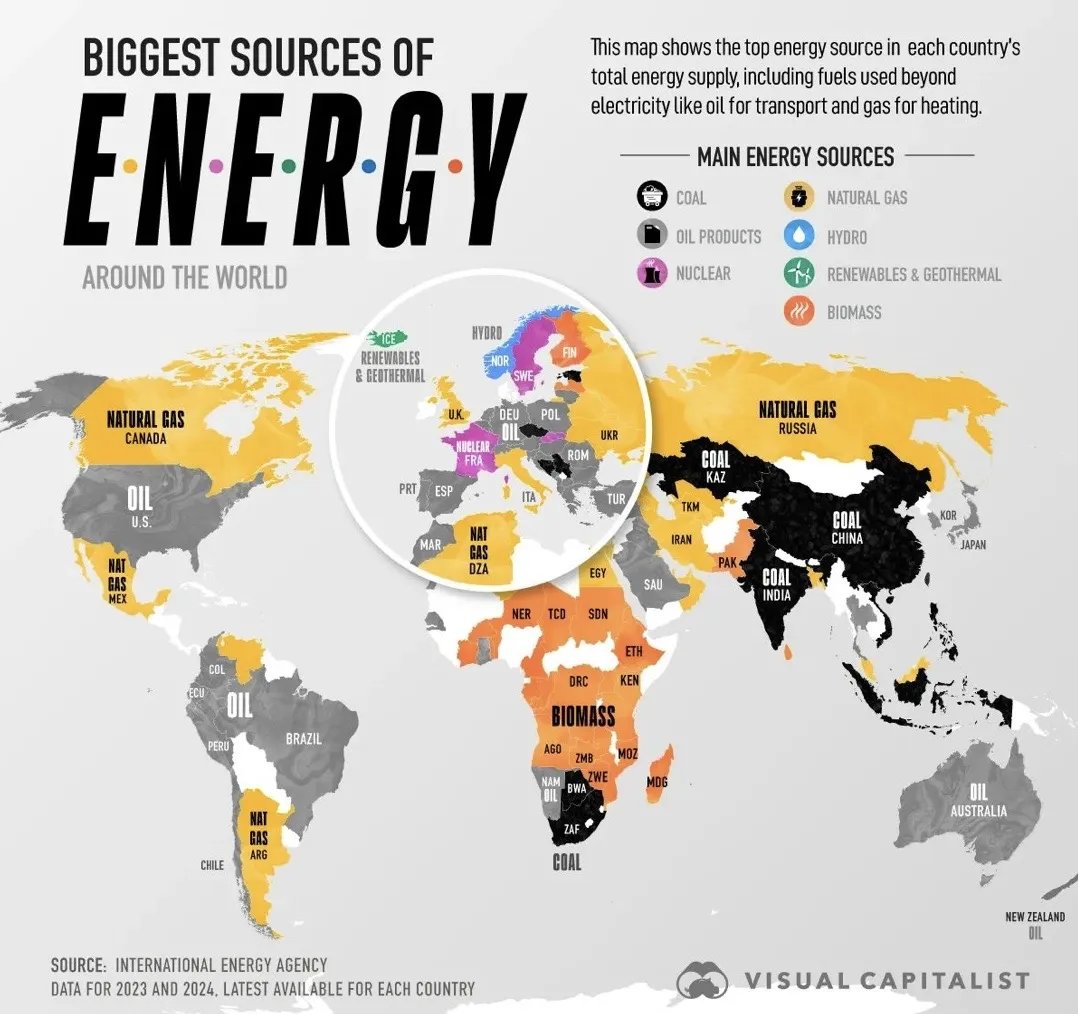
This map tells you exactly who's winning and losing the energy war
The vulnerable:
🇩🇪 Germany
🇮🇹 Italy
🇯🇵 Japan
🇰🇷 South Korea
All dependent and exposed.
The insulated:
🇺🇸 US (domestic Oil)
🇷🇺 Russia (Natural Gas)
🇨🇳 China (Coal, still very reliant on imports of fossil fuels)
🇫🇷 France (Nuclear)
Notice something?
Every country screaming loudest about the energy crisis runs primarily on imported oil.
Every country staying quiet has domestic supply.
The vulnerable countries on this map are now in a race against time.
Coal is dirty.
Nuclear takes decades to build.
Renewables can't replace baseload overnight.
There are no quick fixes on this map.
Energy security is built in the decades before one.
📩 I break down what this means for markets every week in my newsletter
Link in bio
English
@laraavci_ For me it would naturally be on a separate page. I mean hackathons and events for Zürich would stay but maybe there would be a link saying “See all hackathons in Europe”, “See additional events across Europe” or something.
English

@raminthies Ok cool, that makes sense. Would you want that as a filter on the Zurich page itself, or more like a dedicated events page across all cities?
English
I built justmovetoeurope[.com] city by city. Pick Barcelona, get Barcelona. Pick Berlin, get Berlin.
Then I hit a design problem.
Someone in Barcelona still wants to go to Slush in Helsinki. A founder in Amsterdam needs the same EU grant database as someone in Munich. Hackathon calendars, fundraising playbooks, startup perks: none of it belongs to a single city.
Option A: put all the pan-European stuff on a separate page. Clean, but nobody wants to jump between pages to find what they need.
Option B: show it on every city page, tagged so you know what's local and what's Europe-wide.
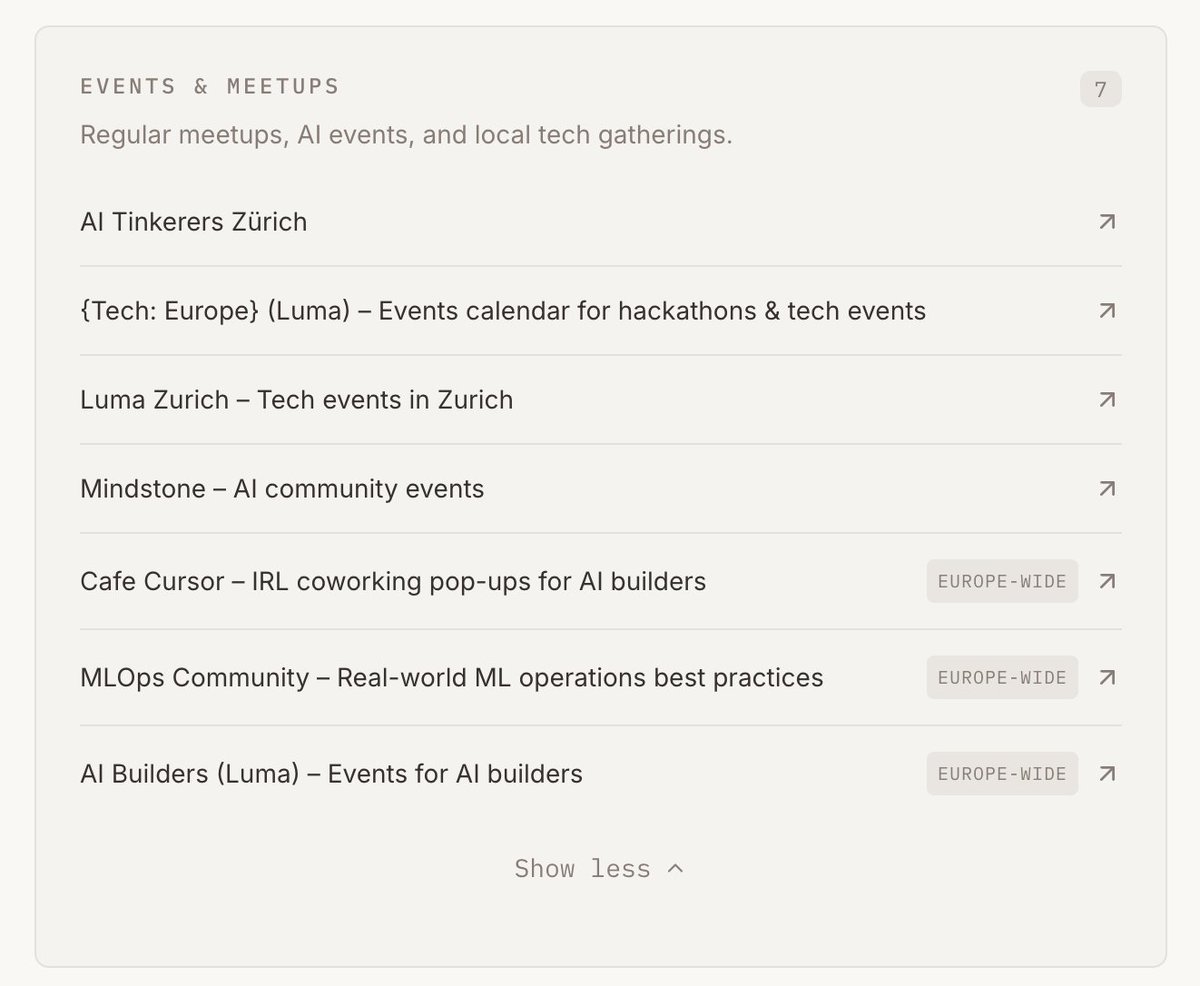
I went with B. Every city page now shows Europe-wide resources inline, tagged with a "Europe-wide" badge. Local content first, broader resources right alongside it in the sections where they're useful.
The tricky part: not every Europe-wide resource applies equally everywhere. An EU grant is directly relevant in Amsterdam. Different story in Zurich, which isn't in the EU. So I'm adding short context lines explaining why each resource matters for that specific city. Still a first pass.
Some content I'm still figuring out how to include well. The rest is live. Go look around.
One thing I'd genuinely like feedback on: does showing Europe-wide resources on every city page work for you, or does it feel like clutter?
English
Glad Zurich is helpful! On the filtering: that's interesting. So you'd want something like "show me all events across cities" rather than going city by city? Right now the structure is city-first, but I can see how a cross-city view for specific resource types (events, grants, hackathons) would make sense. Especially once there are 10+ cities.
English

A real sign of creeping middle age is the growing desire to just move to Switzerland and not deal with the pointless aggravating bullshit rampant in the rest of the world.
English
@mitsuhiko Yeah I always need to run at least one review just for the error handling.
English

No matter the prompting, shit like this stays around. I really think that clankers got trained on visual basic 6's "on error resume next" -.-

English
@christiandean_ I wrote you a DM, but I think you missed it.
English
@christiandean_ I can give you access to all of the eu directives and regulations. I have them on provision.al. Would make me happy if that makes it easier for you.
English

Update on BetterEU:
Grok managed to review about 120 regulations before my system broke. Turns out it's hard to design a robust design for an ongoing, highly async fetch and review of 140,000 documents.
My strategy before was this:
-> Fetch all celex IDs for every regulation per year
-> Fetch and store every regulation using an API
-> Pass a document to Grok for review and store the review
And those 3 stages have to work unattended over 2-4 days, over 140,000 items. But those 3 stages are all gigantic sources of error, because they all depend on making network requests.
And despite getting a working system, I eventually got IP blocked by the EU site where I fetched regulations due to fetching so many.
So I had to rethink how to do this and make it simpler.
Then I remembered that @nathanmarz at @redplanetlabs published Agent o Rama, an agent building and tracing application built on Rama. I was already using Rama, so I thought I would try AOR.
AOR makes the creation of an asynchronous LLM agent easy. And I also realised that Grok can use web-search as a tool to fetch regulation documents itself with just a Celex ID.
So my approach now is much simpler. I fetched all celex IDs for every regulation *in advance* and hardcoded them to a local file. No source of error.
Then I construct a queue of 1 to 10 IDs in a Rama module and pass the queue to the Grok agent running in my AgentModule where it searches for the document, reviews, and stores the review in a single API call.
This is significantly more expensive as Grok's web-search tool is $5 per 1k tokens!!
But it's significantly more simple because there's a single HTTP call to make.
So my app now has two Rama modules:
1. MainModule which constructs the queue and passes to the agen
2. AgentModule which uses Agent o Rama to create the Grok agent for reviewing regulations and storing results.
We'll see how far this approach goes.
Christian Dean@christiandean_
Merz has called for the systematic review of all EU legislation. That's over 140,000 regulations. Knowing the EU, that will take over 140,000 days. So, I made bettereu.com where Grok 4.1 will review every document since 1958 -> 2025.
English
Ramin Thies, MD retweetledi

Well we've finally gone and done it bloomberg.github.io/js-blog/post/t…
English
Ramin Thies, MD retweetledi

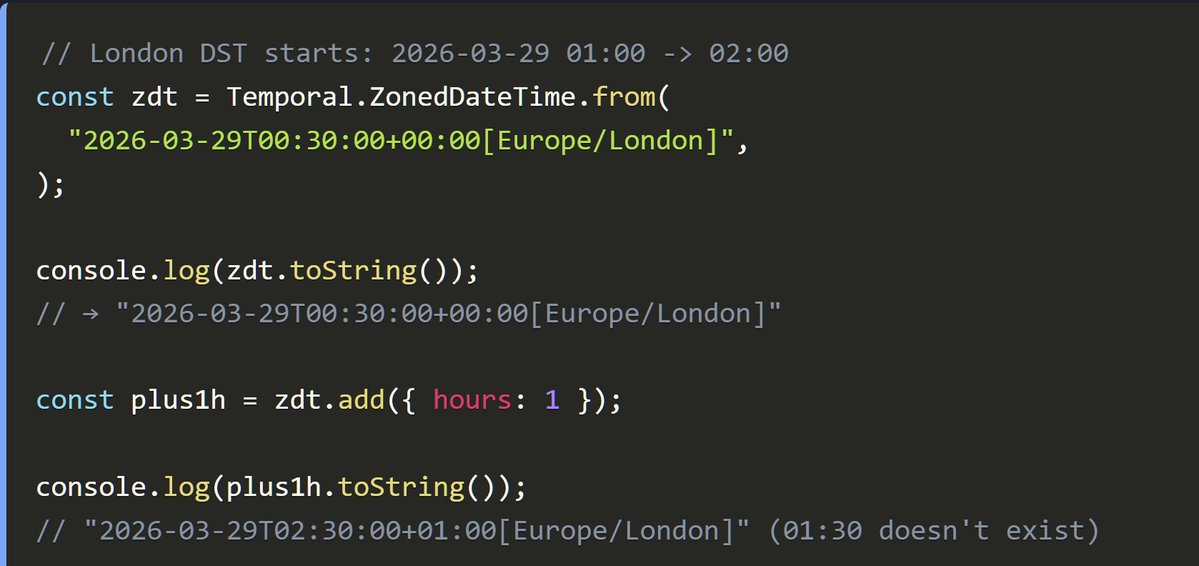
Temporal is now Stage 4 at TC39 🎂🎂🎂
Thanks to all the other champions of JavaScript's new date-time API. It has been a wild ride over many years!
I wrote a blog post explaining how we got here 📜
🧵
English
We went from creating code to creating factories that produce code. The industrial revolution of software.
English
@rough__sea It’s interesting, isn’t a common tenet in software engineering that systems start simple and get complex over time? Is hardware different in this regard?
English


Flights booked. I’m traveling to New York City - a place I’ve never visited before.
This account started when I was at university in Geneva, Switzerland.
Many many years later, 65-70% of my audience is in the US, leading to in-person meetings with gentlemen who manage billions and run their operations from the 25th floor on Sixth Avenue.
You create your own luck.

English