Frank Ratschbum

3K posts

Frank Ratschbum banner
Frank Ratschbum

Frank Ratschbum

@ratschbum

Opportunistic Deep Value & Macro Hedging Investor

Innsbruck, Austria Katılım Ocak 2022
1.1K Takip Edilen241 Takipçiler
Frank Ratschbum retweetledi

Thomas Vierhaus
Thomas Vierhaus@ThomasVierhaus·
Um den gleichen Lebensstandard zu halten, den man 1990 mit (umgerechnet) 100.000 € pro Jahr hatte, braucht man heute 600.000 € pro Jahr. Das liegt daran, dass die Politik seit 1990 die Geldmenge M2 versechsfacht hat! Eine 2,3%ige Lohnerhöhung pro Jahr, in einem Umfeld, in dem die Geldmenge pro Jahr um 6,2 % erhöht wird, kommt einer 3,9%igen „Verarmung“ (Kaufkraftverlust) pro Jahr gleich. 3,9 % pro Jahr über 35 Jahre macht eine „Verarmung“ von etwa 60 % aus. In 1990 lag das Mediangehalt in Deutschland bei 20.280 € p.a. (Brutto). Heute beträgt das Mediangehalt 48.156 € p.a. (brutto). Für den gleichen Lebensstandard wie mit 20.280 € in 1990 bräuchte man aber heute 122.400 € brutto. Mit 100.000 € p.a. liegt man also unter dem Wohlstandsdurchschnitt im Vergleich zu den 1990ern. Hinzu kommt noch, dass das Netto vom Brutto in den 1990ern noch etwa 65-70 % betrug, während heute im Schnitt nur 52 % übrig bleiben. Um den Netto-Median von 1990 zu erreichen, müsste man heute also etwa 140.000 € p.a. brutto verdienen. So viel zum vermeintlich "reichen" Deutschland. Meinungen dazu?
Thomas Vierhaus tweet media
Deutsch
10
17
58
2.6K
Frank Ratschbum retweetledi
Baron Investments
Baron Investments@baroninvestment·
Just looking at whats in consensus for O&G producers. Below are MARKET CAPS (VALUATIONS) @ analysts FREE CASH estimates based on 2026 consensus. Some look way off (and not helped in some cases by less coverage on the metric). Clearly, the numbers will be materially, sky higher on $100+ oil! - ENQUEST @ £392M. FCF @ £52M - KISTOS @ £264M. FCF @ £100M - SERICA @ £1.15BN. FCF @ £266M - ITHACA ENERGY @ £4.5BN. FCF @ £695M. - HARBOUR ENERGY @ £4.6BN. FCF @ £975BN. - SHELL @ £185.5BN. FCF @ £20BN - BP @ £91BN. FCF @ £14BN.
English
17
12
63
13.8K
Frank Ratschbum retweetledi
Lee Roach
Lee Roach@leevalueroach·
Buying a pink sheet company trading at 2x earnings, with a paid-off factory and 40 years of customer relationships, while everyone you know is buying an AI startup at 180x revenue with no customers and a 29-year-old CEO whose previous job was an unpaid internship, is the kind of trade that, in 2026, will get you laughed at every single time it comes up at a dinner party, and that, in 2031, will be the entire reason you are no longer at the dinner parties. The AI investor has a thesis that fits on a slide. The pink sheet investor has a thesis that fits on a 14-page annual report typed on a Word document last updated in 2009. Both are betting on the future. The difference is that the AI investor is betting on a story, and the pink sheet investor is betting on a balance sheet, and only one of those two things has ever, in 200 years of capital markets, reliably produced wealth. The AI startup will, statistically, fail. Not because the technology is bad, but because the price was wrong, and price is the only thing that matters, and price is the only thing the AI investor refused to pay attention to. The pink sheet company will, statistically, be acquired in 36 months at a 90% premium by a strategic buyer who finally figured out that the small machine shop in Ohio holds a patent on a valve used in every municipal water system east of the Mississippi. You are not choosing between two stocks. You are choosing between two ways of being in the world. One of them is loud and exciting and crowded and almost always wrong. The other is quiet and boring and empty and almost always right. Almost everyone you know will pick the first one. You can pick the second. That is the whole trade. It has been the whole trade since 1934. It will be the whole trade for as long as humans are humans and stories are louder than spreadsheets.
English
5
3
43
3.6K
Frank Ratschbum retweetledi
Wolfgang Kubicki
Wolfgang Kubicki@KubickiWo·
Eine Regierung, die Maßnahmen beschließt, die in einer Energiekrise die Spritpreise steigen lassen, ist schon ein schweres Los für unser Land. Dass sie tatsächlich glaubte, das Gegenteil zu erreichen, ist eine Tragödie. WK
Wolfgang Kubicki tweet media
Deutsch
324
348
3.5K
59.9K
Frank Ratschbum retweetledi
Holger Zschaepitz
Holger Zschaepitz@Schuldensuehner·
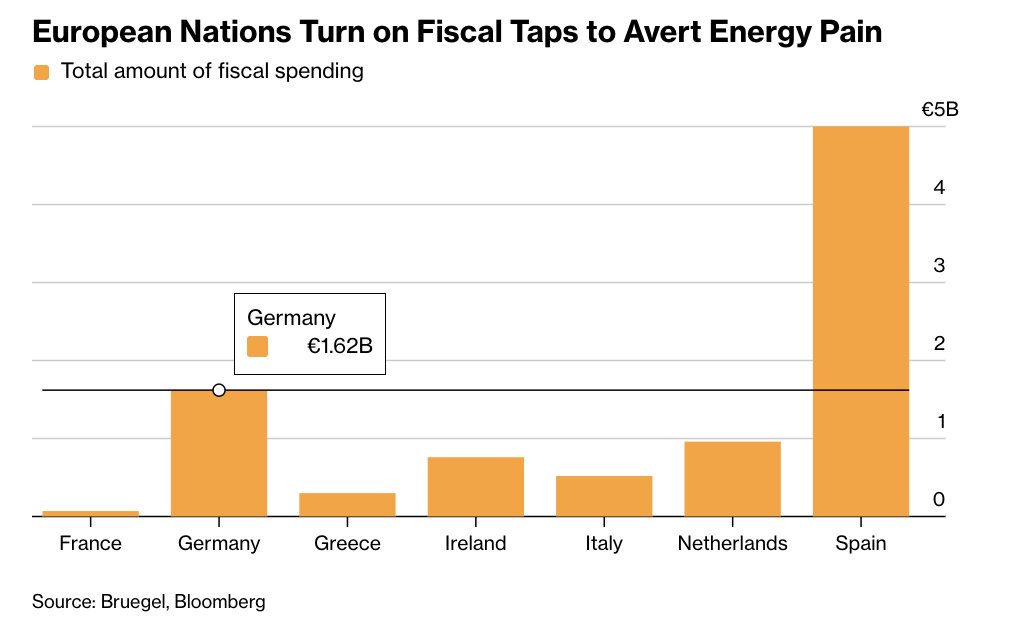
Good Morning from Germany, where the govt plans to spend €1.6bn to shield consumers from rising energy prices. That makes Germany the No. 2 spender in Europe – far behind Spain. The problem: measures like fuel rebates are poorly designed. They help everyone, not just those who need it most, weaken price signals, and cost a lot for little impact. Germany risks repeating past mistakes. bloomberg.com/news/articles/…
Holger Zschaepitz tweet media
English
24
89
395
44.3K
Frank Ratschbum retweetledi
Thorsten Polleit
Thorsten Polleit@ThorstenPolleit·
Die Maßnahme einer „Übergewinnsteuer“ ist abzulehnen … Finanzminister Lars Klingbeil hat eine „Übergewinnsteuer“ für Energieanbieter gefordert. Eine auf Neid und Missgunst geründete Idee, mit der die Leistungsträger noch stärker vom Staat geplündert werden sollen. Nicht nur moralisch, vor allem auch ökonomisch ist eine "Gewinnsteuer" nicht überzeugend. Eine Übergewinnsteuer führt zu keiner direkten Entlastung der Konsumenten und Produzenten. Zudem ist das Konzept des „Übergewinns“ willkürlich, es entzieht sich der Objektivität. Die Erhebung von Übergewinnsteuern führt zu Rechtsunsicherheit, auch zu bürokratischen Mehrkosten. Der Energiesektor ist kapitalintensiv. Übergewinnsteuern würden die Kapitalkosten der Branche erhöhen, Investitionen entmutigen, das Energieangebot verknappen, die Energieversorgung der Bürger und Firmen noch weiter verschlechtern.
DER SPIEGEL@derspiegel

Die Übergewinnsteuer für Mineralölkonzerne soll kommen – auch ohne Einigung in der EU. Das fordert die SPD und provoziert den nächsten Streit mit dem Koalitionspartner CDU. #ref=rss" target="_blank" rel="nofollow noopener">spiegel.de/wirtschaft/ser…

Deutsch
9
8
53
1.6K
Frank Ratschbum retweetledi
Lee Roach
Lee Roach@leevalueroach·
The single most misunderstood fact in equity investing is that a dying company and a bad investment are not the same thing, and are in fact, frequently, opposites. A company that is slowly going out of business over 20 years, while generating cash the entire time, while trading at 2x earnings because nobody wants to own a declining business, is one of the highest-returning assets in public markets, and it has been for a century, and it will be for another century, because the human aversion to owning something with no future is stronger than the human ability to do the arithmetic on what that something is worth right now. A rural newspaper with 14,000 subscribers and a printing press paid off in 1987 is dying. It is also throwing off $900,000 a year in free cash flow on a $2 million market cap. A company that makes replacement parts for a machine that stopped being manufactured in 1994 is dying. It is also the only supplier of those parts to 600 industrial customers who have no choice, and it has gross margins of 68%, and it trades for 3x earnings because the word "dying" is in every sell-side note that has ever been written about it. The trade is not to find the company that will be reborn. The trade is to buy the company that will die slowly, profitably, and on schedule, and to collect the cash on the way down, and to understand that a business returning 30% of its market cap to you in annual free cash flow does not need to grow, does not need to be saved, does not need to be anything other than what it already is, which is a melting ice cube that is melting slower than the market thinks and is priced as if it will be a puddle by Tuesday. Almost nobody can hold these. Holding them requires a tolerance for looking stupid at dinner parties that most people do not have. That intolerance is the edge. It has always been the edge. It will always be the edge.
English
11
26
383
121.1K
Frank Ratschbum retweetledi
ValueHurts
ValueHurts@valuehurts·
Sold out of my small Ferrexpo position… I’m too old to be f***ing around with Ukrainian Iron ore companies that are running out of cash… added to the Roko position…
English
1
0
9
658
Frank Ratschbum
Frank Ratschbum@ratschbum·
@baroninvestment I prefer Harbour Energy $HBR.l more diverse across the Globe. But kistos sounds promising.
English
0
0
2
558
Baron Investments
Baron Investments@baroninvestment·
No connection to previous post. Closing prices on KISTOS between 240p and 280p since February. One of the WORST performing holdings despite it being O&G. Longer term it will be one of the BEST. Market cap at £211M with free cashflow consensus at £129M (and oil estimates are not up here!). A steep 61% free cash flow yield on that basis. Maybe we wake up soon.
Baron Investments@baroninvestment

Every day that Brent and Gas trade at higher prices is a very good day for KISTOS. No idea how long this messy situation drags out but I do know that cash from operations (optimistically or foolishly annualising $80 Brent) exceeds the market cap. I’m using that level as that’s the back end of curve even if the company doesn’t tap it. Should they? They don’t have a policy of doing so (unless to protect against capex or debt obligations) but I would favour maybe 25-35% of production being locked in - even on a rising front and back end. If the group was net cash already the shares are more than double here so one question is when is that inflection or even close? I say that because holders have fond memories of Rockrose and there’s obviously the scope to do even bigger deals whilst the probabilities of buybacks soars. Of course, it’s not all about price but it’s crucially volume and it’s extremely pleasing to see a high guide into 2030 (the first message to the market). Of course, Andrew and Peter are rapidly growing this again now (with the distraction and shock of the uk levy behind) so a 30,000-40,000boepd range is maybe more of a priority. Oman shortly completes shortly and we know prices in the region are now nearing $170 (a huge premium over the benchmark). Norway economics significantly improve in 2026 so this oil move is really substantial for the firm. These two geographies comprise >70% of production with the surplus coming from Netherlands and UK. The shares have underperformed a little lately but the longer they stay down the more they are underpinned. Management delivered mouth watering returns before and I do think this is shaping up for something special again.

English
7
4
48
15.2K
Frank Ratschbum retweetledi
Ira Joseph
Ira Joseph@ira_joseph·
It’s a fool’s errand to predict when SoH will open; it will open & close repeatedly in the near future until the last barrel of leverage can be extracted out of controlling it. Like oil, SoH now has a paper market, which means more volatility coming from non-commercial betting.
The Associated Press@AP

BREAKING: Iran has reimposed restrictions on the Strait of Hormuz, accusing the U.S. of violating deal to reopen it. apnews.com/live/iran-war-…

English
2
2
10
1.4K
Frank Ratschbum retweetledi
Max Stirner
Max Stirner@ernsterjuenger·
Im Übrigen poste ich das noch immer auf einer Plattform eines Milliardärs, der mehr für die Menschheit geleistet hat, als 100 Jahre Kommunismus. Und das ganz ohne Massengräber.
Jan van Aken@jan_vanaken

Deutsch
23
72
675
7.8K
Frank Ratschbum retweetledi
Hayek-Club Weimar
Hayek-Club Weimar@WeimarClub·
Wenn die staatl. Befehlsgewalt, energieintensiven Unternehmen Strom zu einem künstlich gedrückten Preis zu subventionieren – finanziert aus Steuermitteln oder Umlagen –, dann gesteht er damit implizit ein, was die Theorie der Österreichischen Schule seit jeher vorhersagt: Die zentrale Planung der Energieerzeugung durch politische Vorgaben („Energiewende“) hat die natürlichen Marktpreise zerstört. Ein funktionierendes Energiesystem, das auf zuverlässigen, kostengünstigen und skalierbaren Quellen beruht, würde keine solchen Eingriffe benötigen. Die Industrie würde zu Preisen produzieren, die sich aus Angebot und Nachfrage ergeben, ohne dass der Steuerzahler als stiller Teilhaber herangezogen werden müsste. Würden die erzwungenen Umbauten des Stromsystems – mit ihrer hohen Volatilität durch wetterabhängige Quellen, dem massiven Ausbau von Netzen und Speichern sowie den regulatorischen Lasten – tatsächlich zu günstigerem und zuverlässigerem Strom führen, wie es die selbsternannten "Energieexperten" unermüdlich behaupten, dann gäbe es keinen Bedarf für Subventionen. Stattdessen sehen wir das Gegenteil: Die Preise am Großhandelsmarkt bleiben hoch, weil die reale Knappheit nicht beseitigt, sondern durch Interventionen kaschiert wird. Man greift nun ein, um die Symptome zu lindern – und schafft damit neue Verzerrungen: Fehlinvestitionen, Abhängigkeit von Transfers und eine weitere Belastung des Produktivvermögens der Gesellschaft. Die „Experten“, die weiterhin von „günstigem Grünstrom“ und „unaufhaltsamem Fortschritt“ fabulieren, ignorieren die elementarste ökonomische Einsicht: Man kann Preise nicht dauerhaft unter ihrem Marktniveau halten, ohne dass entweder Knappheit zunimmt oder jemand anders (der Steuerzahler oder die Wettbewerbsfähigkeit des Standorts) die Rechnung begleicht. Eine wahrhaft marktwirtschaftliche Antwort wäre nicht die Subvention des Symptoms, sondern die Beseitigung der Ursachen: Abschaffung verzerrender Regulierungen und die Wiederherstellung unverfälschter Preissignale. Nur so entsteht jene kreative Zerstörung und Innovation, die Mises als Motor des Wohlstands beschrieben hat.
Deutsch
0
12
61
565